In the beautiful state of Hawaii, planning for the future often involves considering how to best manage your property after you’re gone. One tool that can simplify this process is the Transfer-on-Death Deed form. This unique legal document allows property owners to designate a beneficiary who will automatically receive their real estate upon their passing, avoiding the often lengthy and costly probate process. By using this form, individuals can maintain control over their property during their lifetime while ensuring a smooth transition to their chosen heir. It’s important to note that the Transfer-on-Death Deed can be revoked or modified at any time, offering flexibility and peace of mind. Additionally, this deed is not just for wealthy individuals; it can be an accessible option for anyone looking to secure their property for loved ones. Understanding the nuances of this form can empower property owners to make informed decisions about their estate planning, ensuring their wishes are honored and their family is taken care of in the future.
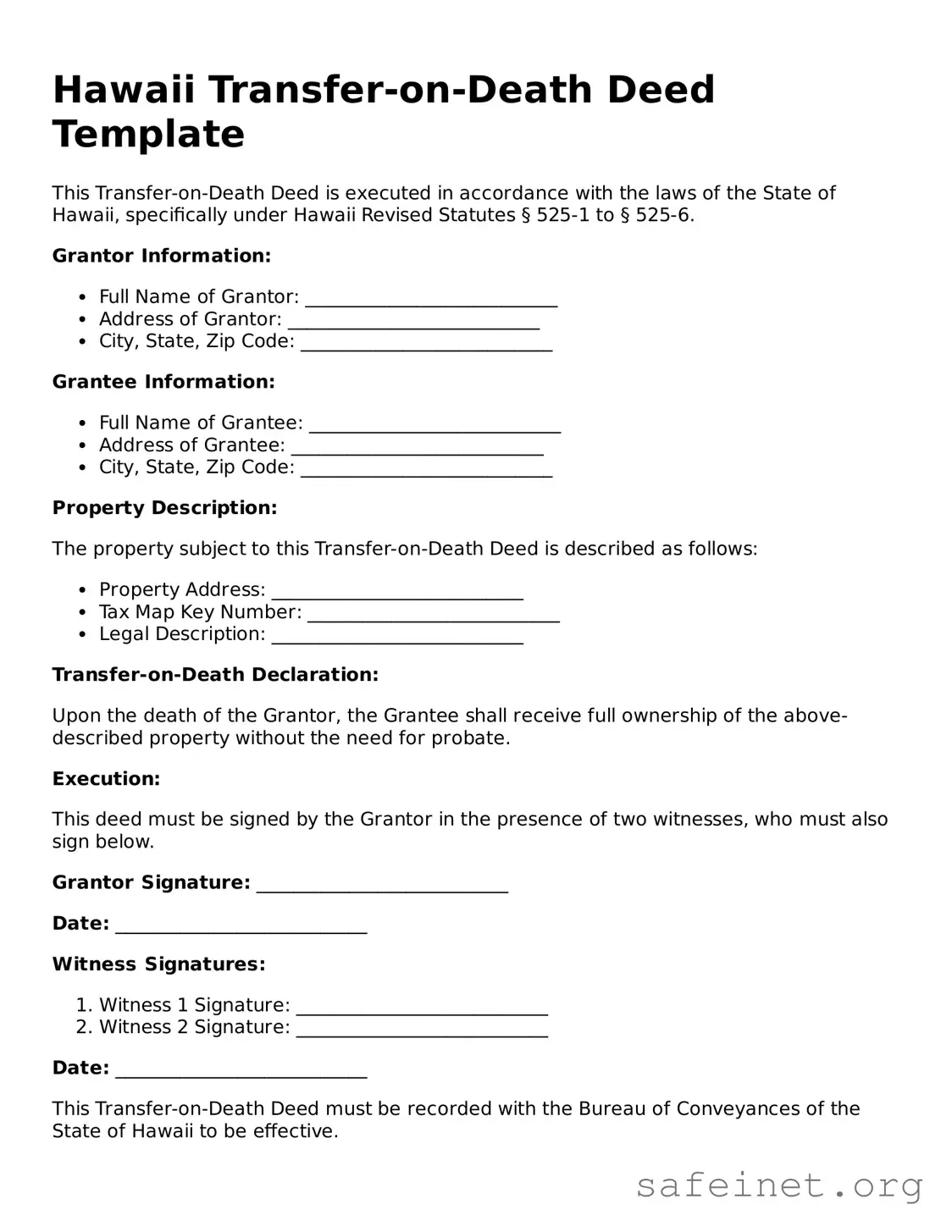
Hawaii Transfer-on-Death Deed Template
This Transfer-on-Death Deed is executed in accordance with the laws of the State of Hawaii, specifically under Hawaii Revised Statutes § 525-1 to § 525-6.
Grantor Information:
Grantee Information:
Property Description:
The property subject to this Transfer-on-Death Deed is described as follows:
Transfer-on-Death Declaration:
Upon the death of the Grantor, the Grantee shall receive full ownership of the above-described property without the need for probate.
Execution:
This deed must be signed by the Grantor in the presence of two witnesses, who must also sign below.
Grantor Signature: ___________________________
Date: ___________________________
Witness Signatures:
Date: ___________________________
This Transfer-on-Death Deed must be recorded with the Bureau of Conveyances of the State of Hawaii to be effective.
| Fact Name | Details |
|---|---|
| Definition | A Transfer-on-Death Deed allows property owners in Hawaii to transfer real estate to beneficiaries upon their death without going through probate. |
| Governing Law | The use of Transfer-on-Death Deeds in Hawaii is governed by Hawaii Revised Statutes § 527-1 to § 527-6. |
| Eligibility | Any individual who owns real property in Hawaii can create a Transfer-on-Death Deed. |
| Beneficiaries | Multiple beneficiaries can be named in the deed, and they can be individuals or entities. |
| Revocation | The Transfer-on-Death Deed can be revoked at any time by the property owner, provided the revocation is executed in writing. |
| Filing Requirements | To be effective, the deed must be recorded with the appropriate county office in Hawaii prior to the owner's death. |
| Effect on Creditors | Property transferred via a Transfer-on-Death Deed may still be subject to claims from creditors of the deceased. |
| Tax Implications | There may be tax implications for both the property owner and the beneficiaries, and consulting a tax advisor is recommended. |
| Limitations | Transfer-on-Death Deeds cannot be used for all types of property, such as timeshares or property held in a trust. |
| Legal Assistance | While not required, seeking legal assistance when drafting a Transfer-on-Death Deed can help ensure it meets all legal requirements. |
After obtaining the Hawaii Transfer-on-Death Deed form, you will need to complete it accurately. This process involves filling in specific details about the property and the beneficiaries. Once completed, the form must be signed and recorded with the appropriate county office.
What is a Transfer-on-Death Deed in Hawaii?
A Transfer-on-Death Deed (TODD) is a legal document that allows a property owner to designate one or more beneficiaries to receive their real estate upon their death. This deed enables the transfer of ownership without the need for probate, simplifying the process for heirs and ensuring that the property passes directly to them according to the owner’s wishes.
Who can create a Transfer-on-Death Deed?
Any individual who owns real property in Hawaii can create a Transfer-on-Death Deed. The property owner must be at least 18 years old and mentally competent to execute the deed. It is important to ensure that the deed is properly executed and recorded to be valid.
How do I fill out a Transfer-on-Death Deed?
To fill out a Transfer-on-Death Deed, you will need to provide specific information, including the name and address of the property owner, a legal description of the property, and the names of the beneficiaries. It’s crucial to ensure that all information is accurate and complete to avoid any issues in the future.
Is there a fee to file a Transfer-on-Death Deed in Hawaii?
Yes, there is typically a recording fee associated with filing a Transfer-on-Death Deed in Hawaii. The fee may vary by county, so it is advisable to check with the local county recorder's office for the exact amount. This fee is generally a one-time payment made at the time of recording.
Can I revoke a Transfer-on-Death Deed?
Yes, a Transfer-on-Death Deed can be revoked. The property owner can revoke the deed by creating a new deed that explicitly states the revocation or by executing a formal revocation document. It is essential to record the revocation with the county to ensure that it is legally recognized.
Do I need an attorney to create a Transfer-on-Death Deed?
While it is not legally required to have an attorney to create a Transfer-on-Death Deed, consulting with one can be beneficial. An attorney can provide guidance, help ensure that the deed complies with state laws, and address any specific concerns you may have about your property and beneficiaries.
What happens if the beneficiary predeceases the property owner?
If a beneficiary named in a Transfer-on-Death Deed passes away before the property owner, the deed typically does not transfer the property to that beneficiary’s heirs. Instead, the property would remain with the owner unless a contingent beneficiary is named in the deed. It’s wise to consider naming alternate beneficiaries to avoid complications.
Can I use a Transfer-on-Death Deed for all types of property?
A Transfer-on-Death Deed can only be used for real property, such as land and buildings. It does not apply to personal property, bank accounts, or other assets. For those types of assets, different estate planning tools may be more appropriate.
How does a Transfer-on-Death Deed affect taxes?
Generally, a Transfer-on-Death Deed does not trigger immediate tax implications for the property owner. However, beneficiaries may be subject to property taxes or capital gains taxes upon inheriting the property. It is advisable to consult with a tax professional to understand the potential tax consequences associated with inheriting real estate.
When does the Transfer-on-Death Deed take effect?
The Transfer-on-Death Deed takes effect only upon the death of the property owner. Until that time, the property owner retains full control over the property, including the right to sell, mortgage, or change the beneficiaries at any point during their lifetime.
Incomplete Information: Failing to provide all required details can lead to delays or rejection. Make sure to fill in every section completely.
Incorrect Property Description: Misdescribing the property can create confusion. It’s essential to accurately identify the property, including its address and legal description.
Not Signing the Deed: A signature is necessary for the deed to be valid. Without it, the document cannot be processed.
Failure to Notarize: The deed must be notarized to be legally binding. Neglecting this step can invalidate the transfer.
Improper Witness Requirements: Depending on the situation, witnesses may be needed. Ensure you meet any witness requirements outlined in the instructions.
Not Recording the Deed: After completing the deed, it must be recorded with the appropriate county office. Skipping this step means the transfer won’t be recognized.
The Hawaii Transfer-on-Death Deed form is a useful tool for property owners who want to ensure their real estate is transferred directly to their beneficiaries upon their passing. Along with this form, several other documents may be necessary to facilitate the transfer process and ensure everything is in order. Below is a list of related documents that are often used in conjunction with the Transfer-on-Death Deed.
Using these documents in conjunction with the Hawaii Transfer-on-Death Deed can help ensure a smooth transfer process and provide clarity to all parties involved. It's important to keep these documents organized and accessible to avoid any complications in the future.
The Transfer-on-Death Deed (TOD) is similar to a Last Will and Testament. Both documents allow individuals to specify how their property will be distributed after their death. A will goes into effect only after the individual passes away and usually requires probate, while a TOD allows for direct transfer of property to beneficiaries without the need for probate, simplifying the process for heirs.
An Affidavit of Heirship serves a similar purpose in that it identifies heirs of a deceased person and helps in transferring property. However, unlike the TOD, the affidavit is often used when a person dies without a will. It provides a legal declaration of who inherits the property, but it may require additional steps to establish the heirs’ rights, especially if disputes arise.
When filling out the Hawaii Transfer-on-Death Deed form, it's important to keep certain things in mind. Here’s a list of what you should and shouldn’t do:
By following these tips, you can help ensure that the transfer process goes smoothly for your loved ones.
Many people have misunderstandings about the Hawaii Transfer-on-Death Deed form. Here are five common misconceptions:
When considering the Hawaii Transfer-on-Death Deed form, it is essential to understand several important aspects. This deed allows property owners to designate beneficiaries who will inherit their property upon their passing, without the need for probate. Here are key takeaways to keep in mind:
Understanding these key points can help ensure that your wishes are honored and that the process is as smooth as possible for your loved ones.