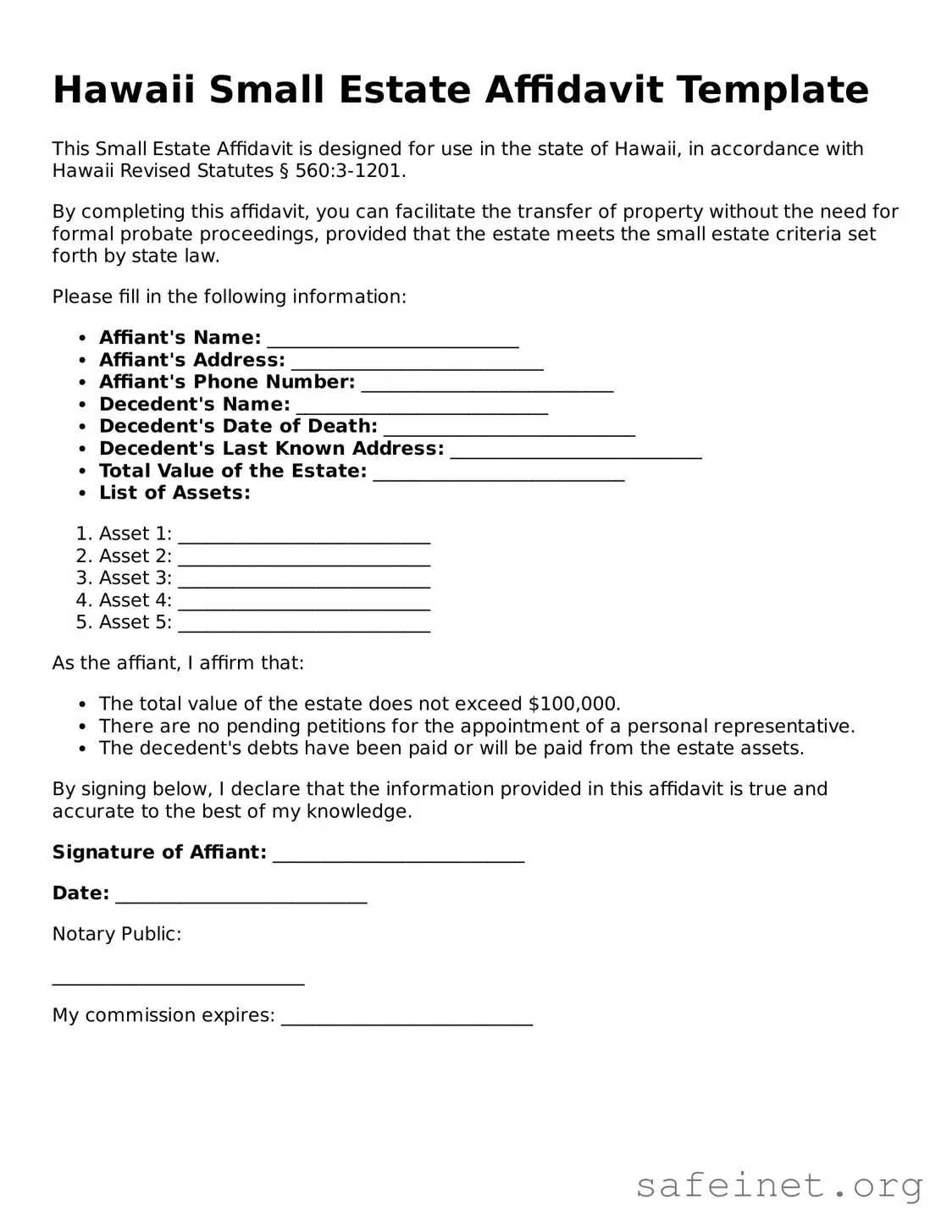
The Hawaii Small Estate Affidavit is a vital tool for individuals navigating the complexities of estate administration in the state. Designed to simplify the process for estates with a total value of $100,000 or less, this form allows heirs or beneficiaries to claim the decedent's assets without the need for formal probate proceedings. By utilizing the Small Estate Affidavit, individuals can expedite the transfer of property, including bank accounts, real estate, and personal belongings, directly to the rightful heirs. This form requires specific information, including the decedent's details, a list of assets, and the signatures of all beneficiaries, ensuring that the process remains transparent and equitable. Additionally, the affidavit must be notarized, which adds a layer of authenticity and legal standing. Understanding the requirements and implications of the Hawaii Small Estate Affidavit can significantly ease the burden on families during a challenging time, allowing them to focus on honoring their loved one's memory rather than becoming entangled in lengthy legal processes.
Hawaii Small Estate Affidavit Template
This Small Estate Affidavit is designed for use in the state of Hawaii, in accordance with Hawaii Revised Statutes § 560:3-1201.
By completing this affidavit, you can facilitate the transfer of property without the need for formal probate proceedings, provided that the estate meets the small estate criteria set forth by state law.
Please fill in the following information:
As the affiant, I affirm that:
By signing below, I declare that the information provided in this affidavit is true and accurate to the best of my knowledge.
Signature of Affiant: ___________________________
Date: ___________________________
Notary Public:
___________________________
My commission expires: ___________________________
| Fact Name | Description |
|---|---|
| Purpose | The Hawaii Small Estate Affidavit allows heirs to claim a deceased person's property without going through probate if the estate's value is below a certain limit. |
| Governing Law | This form is governed by Hawaii Revised Statutes § 560:3-1201. |
| Eligibility | To use this affidavit, the total value of the estate must be less than $100,000, excluding real property. |
| Filing Requirements | The affidavit must be signed by all heirs and submitted to the appropriate financial institutions or property holders. |
| Timeframe | The affidavit can be filed immediately after the person's death, but it is advisable to wait until the death certificate is available. |
| Limitations | This process cannot be used for estates that include real property valued over the threshold or for those that have been formally probated. |
After gathering the necessary information, you can proceed to fill out the Hawaii Small Estate Affidavit form. This form helps to transfer property without going through the probate process. Follow these steps to ensure accuracy and completeness.
What is the Hawaii Small Estate Affidavit?
The Hawaii Small Estate Affidavit is a legal document that allows heirs to claim property of a deceased person without going through the formal probate process. This form simplifies the transfer of assets, making it easier for those who are entitled to inherit. It is typically used when the value of the estate is below a certain threshold, which is currently set at $100,000 for personal property.
Who can use the Small Estate Affidavit?
The Small Estate Affidavit can be used by heirs or beneficiaries who are entitled to receive property from the deceased. This includes spouses, children, and other relatives. However, it is important to ensure that the estate qualifies under the small estate threshold and that all necessary conditions are met.
What assets are eligible for transfer using the Small Estate Affidavit?
Generally, personal property such as bank accounts, vehicles, and personal belongings can be transferred using the Small Estate Affidavit. Real estate, however, is not eligible for this process and must go through probate. Make sure to assess the total value of the estate to confirm it falls under the allowable limit.
How do I complete the Small Estate Affidavit?
To complete the Small Estate Affidavit, you must provide specific information about the deceased, including their name, date of death, and details about the assets being claimed. You will also need to sign the affidavit in the presence of a notary public. Ensure all information is accurate to avoid delays in the process.
Do I need to file the Small Estate Affidavit with the court?
No, the Small Estate Affidavit does not need to be filed with the court. Instead, you will present it to the institutions or entities that hold the deceased's assets, such as banks or car dealerships. They will use the affidavit to release the assets to you.
Is there a deadline for using the Small Estate Affidavit?
While there is no strict deadline for filing a Small Estate Affidavit, it is advisable to act promptly. Delaying the process can complicate matters, especially if there are other potential heirs or claims against the estate. Taking action sooner can help ensure a smoother transfer of assets.
What happens if the estate exceeds the small estate limit?
If the estate exceeds the small estate limit of $100,000, you will need to go through the formal probate process. This involves filing a petition with the court and may require more extensive documentation and legal assistance. It is crucial to assess the total value of the estate accurately to determine the appropriate course of action.
Incorrect Value of the Estate: One common mistake is miscalculating the total value of the estate. The estate must be valued accurately to qualify for the small estate process. If the value exceeds the limit set by Hawaii law, the affidavit cannot be used.
Missing Signatures: Failing to obtain the necessary signatures can lead to delays. All required parties, including the affiant and witnesses, must sign the form. Missing a signature can invalidate the affidavit.
Not Including All Assets: Some people forget to list all assets owned by the deceased. It’s important to include all real estate, bank accounts, and personal property. Omitting any assets can complicate the process.
Incorrectly Identifying Heirs: Errors in identifying the rightful heirs can cause issues. Make sure to provide accurate names and relationships of all heirs. This helps ensure that the estate is distributed correctly.
When navigating the process of settling a small estate in Hawaii, several additional forms and documents may be required to ensure a smooth transition of assets. Each of these documents serves a specific purpose and helps to clarify the intentions of the deceased, as well as the rights of the heirs or beneficiaries. Below is a list of common forms and documents that are often used alongside the Hawaii Small Estate Affidavit form.
Each of these documents plays a vital role in the efficient and legal settlement of a small estate in Hawaii. Gathering and preparing these forms can help ensure that the wishes of the deceased are honored and that the rights of the heirs are protected. Proper documentation not only facilitates the process but also minimizes potential disputes among family members.
The Hawaii Small Estate Affidavit form is similar to a Last Will and Testament. Both documents serve as important tools for estate planning. A Last Will and Testament outlines how a person wishes their assets to be distributed after death. In contrast, the Small Estate Affidavit allows heirs to claim the deceased's assets without going through a lengthy probate process, provided the estate meets certain criteria. Both documents are essential in ensuring that a person's wishes regarding their assets are honored.
Another document that shares similarities with the Small Estate Affidavit is the Letter of Testamentary. This letter is issued by a probate court and grants an executor the authority to manage the deceased's estate. While the Small Estate Affidavit allows for a more streamlined process for smaller estates, the Letter of Testamentary is typically required for larger estates that must go through probate. Both documents aim to provide a legal framework for asset distribution but differ in their application based on estate size.
The Small Estate Affidavit also resembles a Trust. A Trust is a legal arrangement where a trustee holds assets on behalf of beneficiaries. Like the Small Estate Affidavit, a Trust can facilitate the transfer of assets outside of probate. However, Trusts are generally more complex and require ongoing management. Both documents aim to simplify the transfer of assets but differ in their structure and intended use.
Additionally, the Small Estate Affidavit is akin to a Power of Attorney. A Power of Attorney allows an individual to appoint someone to manage their financial and legal affairs while they are alive. The Small Estate Affidavit, however, is utilized posthumously to settle an estate. Both documents empower individuals to designate authority, but they operate at different stages of life and for different purposes.
The Affidavit is also similar to a Beneficiary Designation form. This form allows individuals to designate who will receive certain assets, such as life insurance or retirement accounts, upon their death. Both documents facilitate the transfer of assets without going through probate. However, the Small Estate Affidavit applies to a broader range of assets and is used when the estate is below a certain value threshold.
A further comparable document is the Declaration of Informal Probate. This declaration is filed with the court to initiate a simplified probate process for small estates. Similar to the Small Estate Affidavit, it aims to expedite the distribution of assets. However, the Declaration of Informal Probate requires court approval, while the Small Estate Affidavit can be executed without court intervention if specific conditions are met.
The Small Estate Affidavit shares characteristics with a Family Settlement Agreement. This agreement is a legally binding contract among heirs that outlines how an estate will be divided. Both documents provide a mechanism for resolving estate matters without lengthy litigation. However, the Family Settlement Agreement typically requires negotiation among heirs, while the Small Estate Affidavit can be executed unilaterally by heirs who meet the requirements.
Finally, the Small Estate Affidavit is similar to an Executor’s Deed. This document is used to transfer real property from the estate to the beneficiaries after the probate process is complete. Both documents facilitate the transfer of property ownership, but the Executor’s Deed is used in the context of a formal probate proceeding, while the Small Estate Affidavit bypasses this process for smaller estates.
When filling out the Hawaii Small Estate Affidavit form, it's important to follow certain guidelines to ensure the process goes smoothly. Here are some dos and don'ts to keep in mind:
Following these guidelines can help ensure that your Small Estate Affidavit is processed without unnecessary delays or complications.
Understanding the Hawaii Small Estate Affidavit form is essential for those dealing with the estates of loved ones. However, several misconceptions can lead to confusion. Here are seven common misunderstandings:
This is not true. The Small Estate Affidavit is designed for estates that meet specific value limits, which can be beneficial for many families, regardless of wealth.
In reality, the Small Estate Affidavit can be utilized for personal property, bank accounts, and other assets, not just real estate.
While it is ideal for heirs to agree, it is not a strict requirement. The affidavit can still be filed even if not all parties are in consensus.
This is a misconception. The Small Estate Affidavit is a simplified process that avoids the lengthy probate procedures, making it quicker and less costly.
Although having legal assistance can be helpful, it is not mandatory. Many individuals successfully complete the process on their own.
This is incorrect. Multiple affidavits can be filed for different assets as long as they fall within the allowable limits.
This is misleading. The affidavit is primarily for transferring ownership of assets and does not address the payment of debts or liabilities of the deceased.
By clarifying these misconceptions, individuals can better navigate the process of handling small estates in Hawaii.
Filling out and using the Hawaii Small Estate Affidavit form can be a straightforward process if you understand the key points. Here are several important takeaways to keep in mind:
By keeping these points in mind, you can navigate the process more confidently and ensure that the estate is settled efficiently.