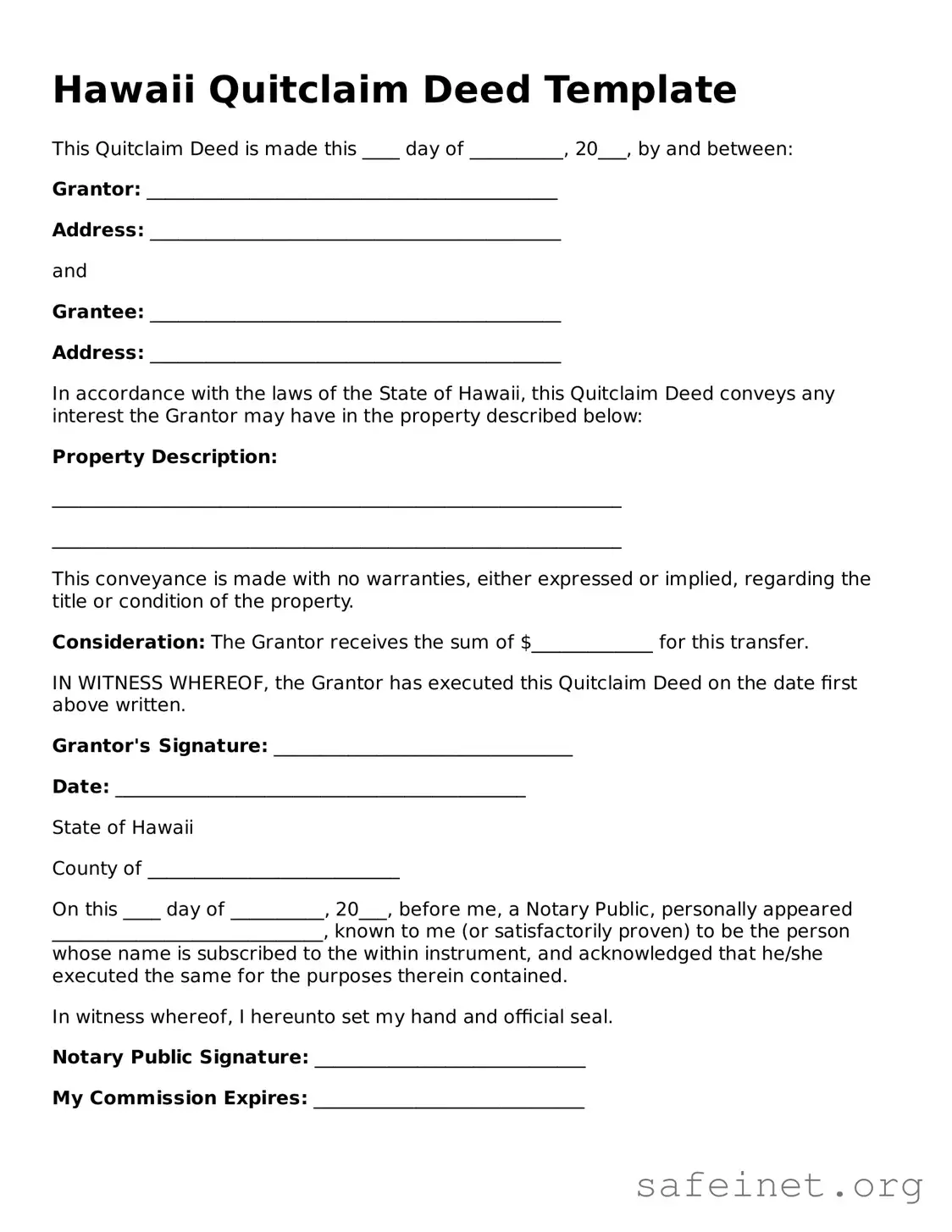
The Hawaii Quitclaim Deed form serves as an essential legal tool for property owners looking to transfer their interests in real estate without the complexities often associated with traditional sales. This document allows one party, known as the grantor, to convey their rights to another party, referred to as the grantee, effectively relinquishing any claim to the property. Unlike warranty deeds, which provide guarantees about the title, a quitclaim deed offers no such assurances, making it crucial for both parties to understand the implications of the transfer. The form typically requires essential information, including the names of the involved parties, a description of the property, and the date of execution. Additionally, it must be signed by the grantor and may require notarization to ensure its validity. Understanding the nuances of this form can help individuals navigate property transfers smoothly, whether for estate planning, divorce settlements, or other personal reasons.
Hawaii Quitclaim Deed Template
This Quitclaim Deed is made this ____ day of __________, 20___, by and between:
Grantor: ____________________________________________
Address: ____________________________________________
and
Grantee: ____________________________________________
Address: ____________________________________________
In accordance with the laws of the State of Hawaii, this Quitclaim Deed conveys any interest the Grantor may have in the property described below:
Property Description:
_____________________________________________________________
_____________________________________________________________
This conveyance is made with no warranties, either expressed or implied, regarding the title or condition of the property.
Consideration: The Grantor receives the sum of $_____________ for this transfer.
IN WITNESS WHEREOF, the Grantor has executed this Quitclaim Deed on the date first above written.
Grantor's Signature: ________________________________
Date: ____________________________________________
State of Hawaii
County of ___________________________
On this ____ day of __________, 20___, before me, a Notary Public, personally appeared _____________________________, known to me (or satisfactorily proven) to be the person whose name is subscribed to the within instrument, and acknowledged that he/she executed the same for the purposes therein contained.
In witness whereof, I hereunto set my hand and official seal.
Notary Public Signature: _____________________________
My Commission Expires: _____________________________
| Fact Name | Description |
|---|---|
| Definition | A Hawaii Quitclaim Deed is a legal document used to transfer ownership of real property from one party to another without guaranteeing the title. |
| Governing Law | The use and execution of quitclaim deeds in Hawaii are governed by Hawaii Revised Statutes, Chapter 501. |
| Purpose | This form is often used to clear up title issues or to transfer property between family members. |
| Consideration | While not always required, some form of consideration (payment) is typically included to validate the deed. |
| Notarization | A quitclaim deed in Hawaii must be notarized to be legally effective and enforceable. |
| Recording | It is advisable to record the quitclaim deed with the Bureau of Conveyances in Hawaii to provide public notice of the ownership transfer. |
After obtaining the Hawaii Quitclaim Deed form, the next step involves carefully filling it out with accurate information. This form is essential for transferring property ownership and must be completed correctly to ensure a smooth process.
What is a Hawaii Quitclaim Deed?
A Hawaii Quitclaim Deed is a legal document that transfers ownership of real estate from one party to another without guaranteeing that the title is clear. It is often used in situations where the grantor does not want to make any warranties about the property, such as in family transfers or when the property is being transferred as a gift. The deed simply conveys whatever interest the grantor has in the property, if any.
How do I complete a Quitclaim Deed in Hawaii?
To complete a Quitclaim Deed in Hawaii, you need to gather the necessary information, including the names of the grantor and grantee, a legal description of the property, and the date of the transfer. You can find templates online or consult with a legal professional for assistance. After filling out the form, both parties must sign it in the presence of a notary public. Once notarized, the deed must be recorded at the Bureau of Conveyances in Hawaii to make the transfer official.
What are the benefits of using a Quitclaim Deed?
Using a Quitclaim Deed can be beneficial for several reasons. It is a straightforward way to transfer property without the need for a lengthy title search or the involvement of a title company. This can save time and money. Additionally, it is often used in family transactions where trust exists between the parties, making it a practical choice for transferring property among relatives or friends.
Are there any risks associated with a Quitclaim Deed?
Yes, there are risks involved with using a Quitclaim Deed. Since it does not guarantee a clear title, the grantee may inherit any liens or claims against the property. If the grantor does not actually own the property or if there are undisclosed issues, the grantee may face legal challenges. It is crucial to understand these risks and consider conducting a title search or obtaining title insurance before proceeding with the transfer.
Do I need an attorney to prepare a Quitclaim Deed in Hawaii?
While it is not legally required to have an attorney prepare a Quitclaim Deed in Hawaii, consulting one is advisable. An attorney can ensure that the deed is properly completed and meets all legal requirements. They can also help you understand the implications of the transfer and address any potential issues, providing peace of mind throughout the process.
Not including the full legal names of all parties involved. It is crucial to ensure that the names on the deed match the names on official identification documents.
Failing to provide a complete and accurate property description. This description should include the lot number, parcel number, and any other identifying details to avoid confusion.
Neglecting to sign the document in the presence of a notary public. A signature without notarization can render the deed invalid.
Not dating the document. The date of signing is important for record-keeping and to establish the timeline of the property transfer.
Overlooking the need for witnesses. Some jurisdictions require witnesses to be present during the signing of the deed.
Using outdated or incorrect forms. Always ensure that the most current version of the Quitclaim Deed form is being used to avoid legal issues.
Forgetting to include the consideration amount. Even if no money is exchanged, it is important to state the consideration to complete the deed properly.
Not checking for errors before submission. Typos or incorrect information can lead to complications in the property transfer process.
Failing to record the deed with the appropriate county office. Recording the deed is essential for public notice and legal protection of ownership.
Ignoring local laws and regulations. Each county may have specific requirements for filing a Quitclaim Deed, and it is important to be aware of these.
When executing a property transfer in Hawaii, the Quitclaim Deed is often accompanied by several other important documents. Each of these forms serves a specific purpose in ensuring that the transaction is legally sound and properly recorded. Below is a list of commonly used forms alongside the Quitclaim Deed.
Utilizing these documents in conjunction with the Hawaii Quitclaim Deed can facilitate a smoother property transfer process. Each form plays a crucial role in protecting the interests of all parties involved, ensuring compliance with state regulations and providing clarity throughout the transaction.
The Warranty Deed is similar to the Quitclaim Deed in that both are used to transfer property ownership. However, the key difference lies in the guarantees provided. A Warranty Deed offers a guarantee that the seller holds clear title to the property and has the right to sell it. In contrast, a Quitclaim Deed does not provide any such guarantees. It simply transfers whatever interest the seller has in the property, if any. This means that buyers should exercise caution when accepting a Quitclaim Deed, as they may not receive full ownership rights.
The Grant Deed also shares similarities with the Quitclaim Deed. Both documents facilitate the transfer of property. However, a Grant Deed typically includes certain assurances from the seller. These assurances often state that the property has not been sold to anyone else and that there are no undisclosed liens against it. Unlike the Quitclaim Deed, which makes no guarantees, the Grant Deed provides some level of protection for the buyer, making it a more secure option for property transfers.
The Bargain and Sale Deed is another document that resembles the Quitclaim Deed. This type of deed implies that the seller has title to the property and the right to sell it, but it does not guarantee that the title is free of defects. While a Quitclaim Deed simply transfers whatever interest the seller has, the Bargain and Sale Deed suggests that the seller has some ownership rights. This can offer buyers slightly more assurance than a Quitclaim Deed, but it still carries risks regarding potential title issues.
Lastly, the Special Purpose Deed is similar to the Quitclaim Deed in that it is often used for specific situations, such as transferring property between family members or in divorce settlements. Like a Quitclaim Deed, a Special Purpose Deed typically does not provide warranties about the property title. Instead, it serves to facilitate a transfer in particular circumstances. This type of deed is straightforward and can simplify the process of transferring property under unique conditions, much like the Quitclaim Deed does.
When filling out the Hawaii Quitclaim Deed form, it's essential to follow specific guidelines to ensure accuracy and compliance. Here are nine things you should and shouldn't do:
When discussing the Hawaii Quitclaim Deed form, several misconceptions often arise. Understanding these can help individuals navigate property transfers more effectively. Here are six common misunderstandings:
By dispelling these misconceptions, individuals can make more informed decisions regarding property transfers in Hawaii and understand the implications of using a quitclaim deed.
When dealing with property transfers in Hawaii, understanding the Quitclaim Deed form is crucial. Here are some key takeaways to keep in mind:
By keeping these key points in mind, you can navigate the Quitclaim Deed process in Hawaii with greater confidence and clarity.