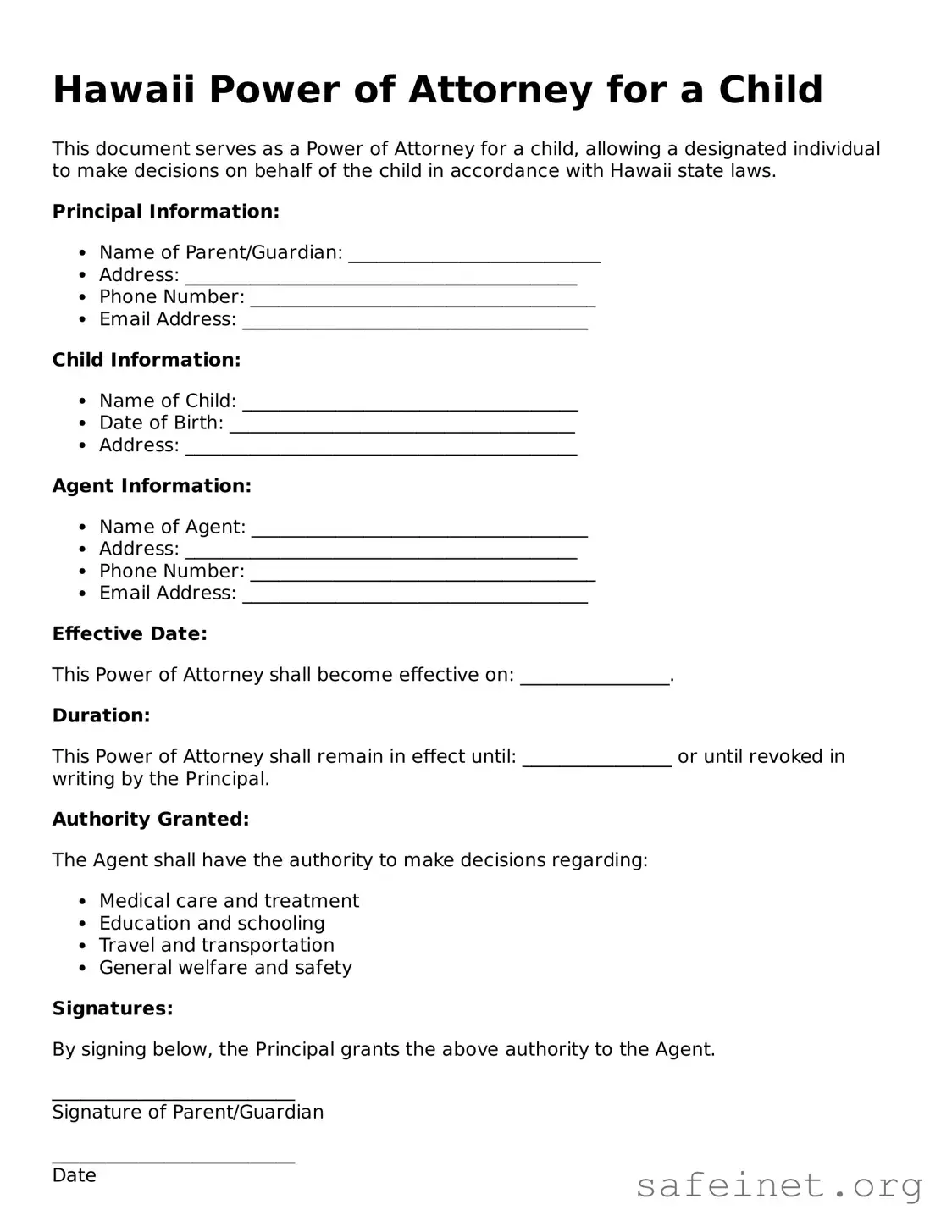
When it comes to ensuring the well-being of your child while you’re unable to be present, the Hawaii Power of Attorney for a Child form serves as an invaluable tool. This legal document allows a parent or guardian to designate another trusted adult to make important decisions on behalf of their child. It encompasses a variety of responsibilities, from medical care to educational needs, ensuring that your child's best interests are prioritized. Not only does this form provide peace of mind for parents, but it also empowers the appointed individual to act swiftly in times of need. Understanding the nuances of this form can help you navigate the process more smoothly, allowing you to focus on what truly matters—your child’s safety and happiness. Whether you're planning a trip, facing a temporary relocation, or simply want to prepare for unforeseen circumstances, knowing how to properly utilize this power of attorney can make all the difference.
Hawaii Power of Attorney for a Child
This document serves as a Power of Attorney for a child, allowing a designated individual to make decisions on behalf of the child in accordance with Hawaii state laws.
Principal Information:
Child Information:
Agent Information:
Effective Date:
This Power of Attorney shall become effective on: ________________.
Duration:
This Power of Attorney shall remain in effect until: ________________ or until revoked in writing by the Principal.
Authority Granted:
The Agent shall have the authority to make decisions regarding:
Signatures:
By signing below, the Principal grants the above authority to the Agent.
__________________________
Signature of Parent/Guardian
__________________________
Date
__________________________
Witness Signature
__________________________
Date
__________________________
Notary Public Signature
__________________________
Date
| Fact Name | Description |
|---|---|
| Purpose | The Hawaii Power of Attorney for a Child form allows a parent or legal guardian to designate another individual to make decisions on behalf of their child. |
| Governing Law | This form is governed by Hawaii Revised Statutes § 577-4, which outlines the legal framework for powers of attorney in the state. |
| Duration | The authority granted through this form can be limited to a specific period or remain in effect until revoked by the parent or guardian. |
| Eligibility | Any parent or legal guardian of a child under the age of 18 can complete this form to appoint an agent. |
| Agent's Responsibilities | The appointed agent can make decisions regarding the child's education, health care, and general welfare, depending on the powers specified in the form. |
| Revocation | The parent or guardian may revoke the power of attorney at any time, provided they do so in writing. |
| Notarization | While notarization is not strictly required, it is strongly recommended to ensure the document's validity and to prevent disputes. |
After obtaining the Hawaii Power of Attorney for a Child form, you will need to fill it out carefully. Make sure to have all necessary information ready before you start. This will help ensure the form is completed accurately and efficiently.
What is a Power of Attorney for a Child in Hawaii?
A Power of Attorney for a Child in Hawaii is a legal document that allows a parent or guardian to designate another individual to make decisions on behalf of their child. This document grants specific authority to the appointed person, often referred to as the agent, to handle matters such as education, healthcare, and general welfare while the parent or guardian is unavailable.
Who can be appointed as an agent under this form?
In Hawaii, any responsible adult can be appointed as an agent in the Power of Attorney for a Child form. This may include relatives, family friends, or trusted individuals. It is important that the person chosen is someone the parent or guardian trusts to act in the best interest of the child.
What decisions can the agent make on behalf of the child?
The agent can make various decisions regarding the child's care and welfare. This includes decisions related to education, medical treatment, and other day-to-day needs. However, the powers granted can be limited or specified in the document, allowing the parent or guardian to maintain control over certain aspects of the child's life.
How long does the Power of Attorney for a Child remain in effect?
The Power of Attorney for a Child typically remains in effect until a specified date or until the parent or guardian revokes it. It is advisable to clearly state the duration in the document. If no end date is specified, the authority may continue until the child reaches the age of majority, which is 18 years old in Hawaii.
Do I need to have the Power of Attorney for a Child form notarized?
Yes, in Hawaii, the Power of Attorney for a Child form must be notarized to be considered valid. This requirement helps to ensure that the document is executed properly and that the identities of the parties involved are verified. It is advisable to consult with a notary public to complete this process.
Can the Power of Attorney for a Child be revoked?
Yes, the Power of Attorney for a Child can be revoked at any time by the parent or guardian. This can be done through a written notice that should be provided to the agent and any relevant institutions or parties. It is important to formally document the revocation to avoid any confusion regarding the authority of the agent.
Not Specifying the Duration: One common mistake is failing to clearly state how long the power of attorney will be in effect. Without this information, it can lead to confusion or potential legal issues later on.
Inadequate Identification: People often overlook the importance of providing complete identification details for both the child and the agent. This includes full names, dates of birth, and addresses. Missing any of these details can render the document ineffective.
Ignoring State Requirements: Each state has specific requirements for a power of attorney. Some individuals forget to check Hawaii's unique rules, which can lead to invalidation of the document.
Not Including Emergency Contacts: Failing to list emergency contacts can be a significant oversight. This information is crucial for anyone who may need to reach out to family members or guardians in urgent situations.
Improper Signatures: A common error is not having the required signatures. Both the parent or guardian and the agent must sign the document. Additionally, some may forget to have the signatures notarized, which is often necessary.
Overlooking Revocation Procedures: Many people do not include how to revoke the power of attorney if needed. It’s important to outline the process to ensure that the authority can be terminated when circumstances change.
When preparing a Power of Attorney for a Child in Hawaii, it's essential to consider additional documents that may support the authority granted. These documents can help clarify responsibilities and ensure that the child's needs are met effectively. Below are four commonly used forms and documents that complement the Power of Attorney for a Child.
These additional forms and documents are vital in ensuring that the Power of Attorney for a Child is effective and comprehensive. They help protect the child's welfare and ensure that the designated agent can act in the child's best interests in various situations.
The Hawaii Power of Attorney for a Child form shares similarities with the General Power of Attorney. Both documents allow an individual to appoint someone else to make decisions on their behalf. However, the General Power of Attorney can cover a wide range of matters, including financial and legal decisions, while the Power of Attorney for a Child specifically focuses on decisions related to the care and welfare of a minor. This targeted approach makes it a vital tool for parents or guardians who need to ensure their child’s needs are met in their absence.
Another document that resembles the Hawaii Power of Attorney for a Child is the Medical Power of Attorney. This form grants an individual the authority to make medical decisions for another person if they are unable to do so. Similar to the Power of Attorney for a Child, it is essential for parents to designate someone to make healthcare choices for their child when they are unavailable. This ensures that the child receives appropriate medical care and that their health interests are prioritized.
The Child Custody Agreement also bears similarities to the Power of Attorney for a Child. While the latter allows for temporary decision-making authority, a Child Custody Agreement outlines the permanent arrangements regarding where a child will live and who will make important decisions about their upbringing. Both documents prioritize the child’s best interests and provide clarity about parental responsibilities, ensuring that the child’s welfare is always at the forefront.
Lastly, the Guardianship Agreement is comparable to the Power of Attorney for a Child. This legal document establishes a guardian for a minor, granting them the authority to make decisions regarding the child's upbringing. Unlike the temporary nature of a Power of Attorney, a Guardianship Agreement typically involves a more permanent arrangement. However, both documents aim to protect the child’s well-being and ensure that a responsible adult is available to make decisions when the biological parents are unable to do so.
When filling out the Hawaii Power of Attorney for a Child form, it's important to get it right. Here are some things to keep in mind:
The Hawaii Power of Attorney for a Child form is a valuable tool for parents and guardians. However, several misconceptions surround its use. Here are nine common misunderstandings:
Many believe that only biological parents can create this document. In reality, legal guardians and other caregivers can also utilize it to ensure a child's well-being.
Some think that once a Power of Attorney is established, it cannot be revoked. In fact, parents can revoke it at any time, as long as they follow the proper procedures.
While legal advice can be beneficial, it is not mandatory. The form can be filled out by parents or guardians without legal representation.
Many fear that signing this document means they lose custody of their child. However, the Power of Attorney only grants temporary authority for specific decisions, not full custody rights.
Some think this form is only necessary in urgent situations. However, it can also be used for planned events, such as travel or extended care arrangements.
This form is limited in scope. It typically covers health care and educational decisions but does not extend to financial matters unless specifically stated.
Although it is recognized in Hawaii, this document may not hold the same weight in other states. Always check local laws if traveling or relocating.
While notarization can add an extra layer of validity, it is not always a requirement for the Power of Attorney for a Child form in Hawaii.
People often think that the document is set in stone. However, parents can modify the Power of Attorney as their circumstances change.
Understanding these misconceptions can help ensure that the Power of Attorney for a Child form is used effectively and appropriately.
When considering the Hawaii Power of Attorney for a Child form, it's essential to understand its purpose and implications. Here are some key takeaways to keep in mind: