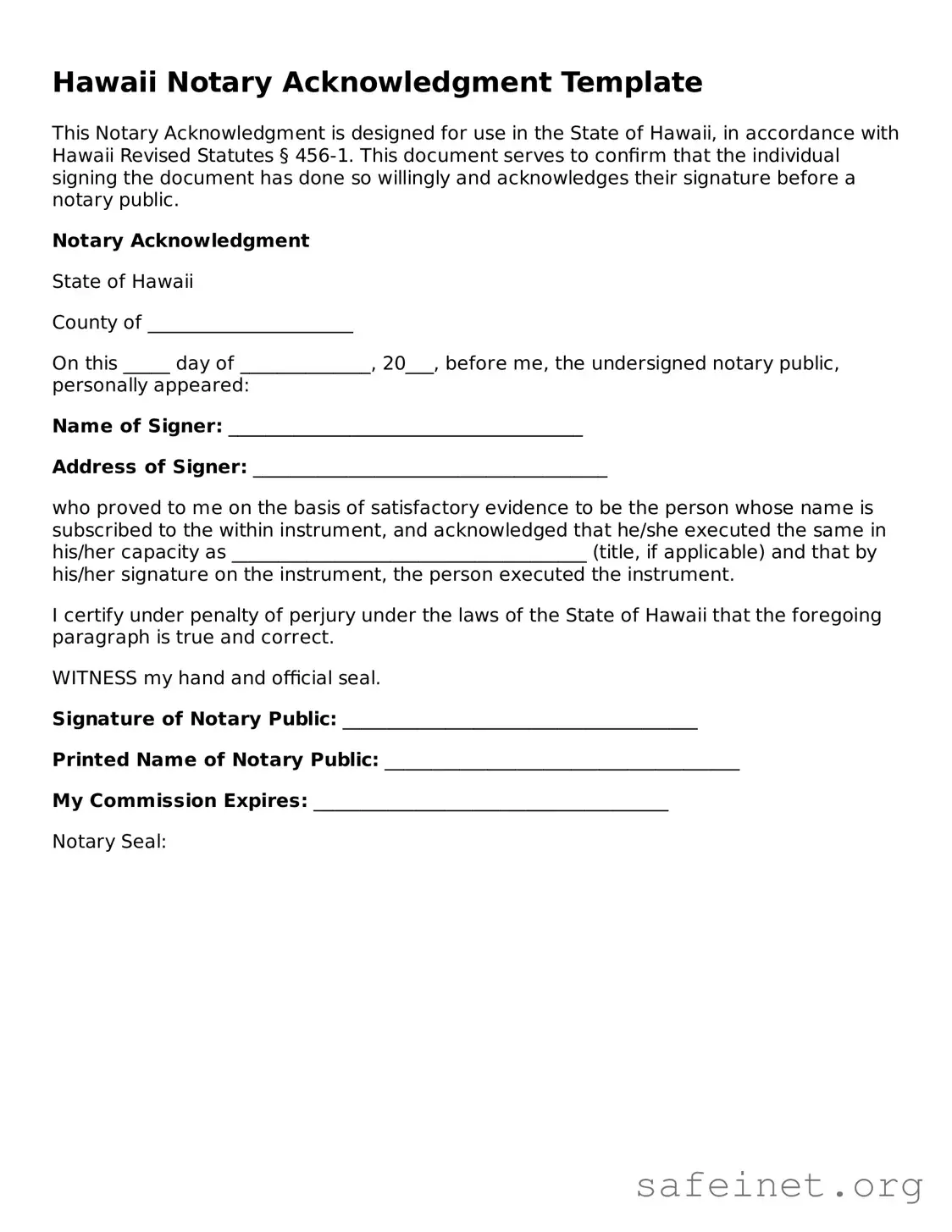
The Hawaii Notary Acknowledgement form plays a crucial role in various legal and financial transactions, ensuring that documents are properly verified and authenticated. This form is designed to confirm the identity of the signer and their willingness to sign the document voluntarily. It includes essential details such as the date of the acknowledgment, the name of the signer, and the notary's information. The notary public, a trusted official, must witness the signing of the document and then affix their signature and seal to validate the transaction. This process not only enhances the credibility of the document but also protects all parties involved by preventing fraud. Understanding the key components and proper usage of the Hawaii Notary Acknowledgement form is vital for anyone engaged in legal dealings in the state.
Hawaii Notary Acknowledgment Template
This Notary Acknowledgment is designed for use in the State of Hawaii, in accordance with Hawaii Revised Statutes § 456-1. This document serves to confirm that the individual signing the document has done so willingly and acknowledges their signature before a notary public.
Notary Acknowledgment
State of Hawaii
County of ______________________
On this _____ day of ______________, 20___, before me, the undersigned notary public, personally appeared:
Name of Signer: ______________________________________
Address of Signer: ______________________________________
who proved to me on the basis of satisfactory evidence to be the person whose name is subscribed to the within instrument, and acknowledged that he/she executed the same in his/her capacity as ______________________________________ (title, if applicable) and that by his/her signature on the instrument, the person executed the instrument.
I certify under penalty of perjury under the laws of the State of Hawaii that the foregoing paragraph is true and correct.
WITNESS my hand and official seal.
Signature of Notary Public: ______________________________________
Printed Name of Notary Public: ______________________________________
My Commission Expires: ______________________________________
Notary Seal:
| Fact Name | Description |
|---|---|
| Purpose | The Hawaii Notary Acknowledgement form is used to verify the identity of the signer and confirm that they willingly signed a document. |
| Governing Law | This form is governed by Hawaii Revised Statutes, Section 456-1, which outlines notarial acts and their requirements. |
| Signature Requirement | The signer must be present before the notary public at the time of signing the document to ensure authenticity. |
| Notary Seal | A notary public must affix their official seal to the form, which serves as a mark of legitimacy and authority. |
| Record Keeping | Notaries in Hawaii are required to maintain a journal of notarial acts, including the details of the acknowledgment performed. |
After obtaining the Hawaii Notary Acknowledgment form, the next step involves accurately filling it out to ensure compliance with the requirements for notarization. This form is essential for verifying the identity of the signer and the authenticity of the document being notarized. Follow the steps below to complete the form correctly.
What is a Hawaii Notary Acknowledgement form?
The Hawaii Notary Acknowledgement form is a legal document used to confirm that a specific individual has willingly signed a document in the presence of a notary public. This form serves as evidence that the signer is who they claim to be and that they understood the contents of the document. It is an essential part of the notarization process, ensuring the authenticity of signatures and the integrity of the documents involved.
Why is a Notary Acknowledgement necessary?
A Notary Acknowledgement is necessary to prevent fraud and to provide assurance that the signing party is acting voluntarily and with full understanding of the document's implications. In many cases, legal documents such as deeds, contracts, and affidavits require notarization to be considered valid. Without this form, the risk of disputes over the legitimacy of signatures increases significantly.
Who can serve as a notary public in Hawaii?
In Hawaii, a notary public must be a resident of the state, at least 18 years old, and have no felony convictions. They are appointed by the governor and must complete a training course before they can begin their duties. Notaries are responsible for verifying identities, witnessing signatures, and ensuring that all parties understand the documents being signed.
How do I complete a Notary Acknowledgement form?
To complete a Notary Acknowledgement form, the signer must first appear before the notary public. The notary will ask the signer to provide valid identification to confirm their identity. Once verified, the signer will then sign the document in the presence of the notary. The notary will fill out the acknowledgment section, which includes their signature, seal, and the date of notarization. It is crucial that all information is accurate to avoid complications later.
Is there a fee for notarization in Hawaii?
Yes, there is typically a fee associated with notarization services in Hawaii. While the maximum fee can vary, it is generally set by state law. Notaries are allowed to charge a reasonable fee for their services, and it is advisable to inquire about the cost beforehand. Some notaries may offer services for free or at a reduced rate, especially for charitable organizations or community services.
What should I do if my Notary Acknowledgement form is rejected?
If your Notary Acknowledgement form is rejected, it is essential to determine the reason for the rejection. Common issues include incomplete information, missing signatures, or failure to meet identification requirements. To resolve the issue, you may need to re-sign the document in the presence of a notary or provide additional identification. Always communicate with the party requesting the notarization to understand their specific requirements and rectify the situation promptly.
Not providing the correct date. Ensure that the date of the acknowledgment is clearly written. This is crucial for the document's validity.
Failing to include the name of the signer. The full name of the individual signing the document must be clearly stated to avoid any confusion.
Using an incorrect notary seal. The seal must be clear and legible. An unclear seal can render the acknowledgment invalid.
Not having the signer present during the acknowledgment. The notary must witness the signing of the document to properly complete the acknowledgment.
Omitting the notary's signature. The notary must sign the acknowledgment form. Without this signature, the document cannot be considered notarized.
Neglecting to fill in the notary's commission expiration date. This information is necessary to ensure that the notary was authorized at the time of the acknowledgment.
When dealing with legal documents in Hawaii, the Notary Acknowledgment form is often accompanied by several other important forms. Each of these documents serves a specific purpose and helps ensure that transactions are legally binding and properly recorded. Below is a list of commonly used forms alongside the Hawaii Notary Acknowledgment form.
Understanding these forms can streamline your legal processes and ensure that your transactions in Hawaii are secure and recognized. Always consider consulting with a legal professional to ensure that you have the correct documents and that they are properly executed.
The Affidavit is a sworn statement made under oath. Similar to the Hawaii Notary Acknowledgement form, it requires the presence of a notary public who verifies the identity of the person making the statement. Both documents serve to confirm the authenticity of the signatures and the truthfulness of the information provided. An affidavit can be used in various legal proceedings, making it essential that it is executed properly to ensure its validity.
The Power of Attorney (POA) document grants one person the authority to act on behalf of another in legal or financial matters. Like the Hawaii Notary Acknowledgement form, a POA must be notarized to be legally binding. The notary's role is to confirm the identity of the person granting the power and to ensure that they are doing so willingly. This added layer of verification protects against fraud and misrepresentation.
The Deed is a legal document that transfers ownership of property from one party to another. Similar to the Hawaii Notary Acknowledgement form, a deed must also be notarized to be effective. The notary public verifies the identities of the parties involved and ensures that the deed is signed voluntarily. This process is crucial for protecting the interests of both the buyer and the seller in real estate transactions.
The Last Will and Testament is a legal document that outlines a person's wishes regarding the distribution of their estate after death. While not always required to be notarized, having a notary acknowledge the signature can add an extra layer of authenticity. Similar to the Hawaii Notary Acknowledgement form, the notary's role is to confirm the identity of the testator and ensure that the will is executed voluntarily and without coercion.
When filling out the Hawaii Notary Acknowledgment form, it's crucial to approach the task with care and attention to detail. Below is a helpful list of what you should and shouldn't do to ensure the process goes smoothly.
Things You Should Do:
Things You Shouldn't Do:
When it comes to the Hawaii Notary Acknowledgment form, several misconceptions can lead to confusion. Understanding the truth behind these myths is essential for anyone needing notary services in Hawaii. Here are five common misconceptions:
By clarifying these misconceptions, individuals can better navigate the notary process in Hawaii and ensure their documents are handled correctly.
When filling out and using the Hawaii Notary Acknowledgement form, it is essential to keep several key points in mind. Understanding these takeaways can help ensure the process runs smoothly.
By adhering to these guidelines, individuals can effectively utilize the Hawaii Notary Acknowledgement form for their legal needs.