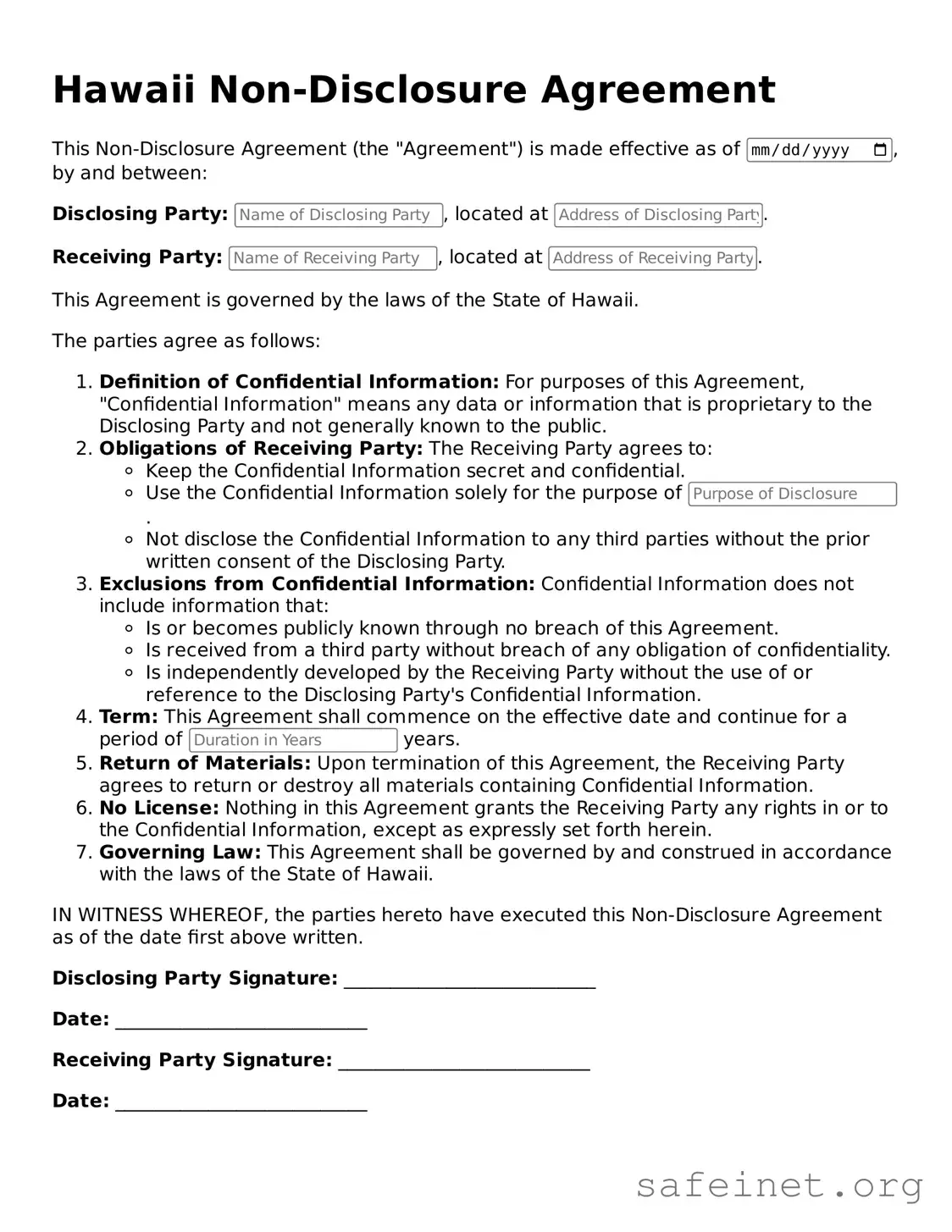
In the vibrant business landscape of Hawaii, protecting sensitive information is crucial for entrepreneurs and established companies alike. The Hawaii Non-disclosure Agreement (NDA) serves as a vital tool in safeguarding proprietary data, trade secrets, and confidential information from unauthorized disclosure. This legally binding document outlines the terms under which parties can share sensitive information while ensuring that it remains protected. Typically, the NDA specifies the obligations of the receiving party, detailing what constitutes confidential information and the duration of the agreement. It also includes provisions for the return or destruction of confidential materials upon termination of the agreement. By utilizing a well-crafted NDA, businesses can foster trust and collaboration while minimizing the risk of information leaks, ultimately contributing to a more secure and competitive business environment in the islands.
Hawaii Non-Disclosure Agreement
This Non-Disclosure Agreement (the "Agreement") is made effective as of , by and between:
Disclosing Party: , located at .
Receiving Party: , located at .
This Agreement is governed by the laws of the State of Hawaii.
The parties agree as follows:
IN WITNESS WHEREOF, the parties hereto have executed this Non-Disclosure Agreement as of the date first above written.
Disclosing Party Signature: ___________________________
Date: ___________________________
Receiving Party Signature: ___________________________
Date: ___________________________
| Fact Name | Description |
|---|---|
| Purpose | The Hawaii Non-disclosure Agreement (NDA) is used to protect confidential information shared between parties. |
| Parties Involved | The NDA typically involves a disclosing party and a receiving party. |
| Governing Law | The NDA is governed by the laws of the State of Hawaii. |
| Duration | The agreement usually specifies how long the confidentiality obligations last. |
| Exclusions | Information that is public knowledge or independently developed is often excluded from the NDA. |
| Enforcement | Violating the NDA can lead to legal action and financial penalties. |
| Format | The NDA can be written or oral, but a written form is recommended for clarity. |
| Signature Requirement | Both parties should sign the NDA to make it legally binding. |
| Modification | Changes to the NDA must be made in writing and signed by both parties. |
After you have gathered all necessary information, you can proceed to fill out the Hawaii Non-disclosure Agreement form. Following these steps will help ensure that the form is completed correctly.
Once the form is completed and signed, keep a copy for your records. It is important to ensure that both parties have a signed copy for their reference.
What is a Hawaii Non-disclosure Agreement (NDA)?
A Hawaii Non-disclosure Agreement is a legal contract that protects confidential information shared between parties. This agreement ensures that sensitive information remains private and is not disclosed to unauthorized individuals or entities. It is commonly used in business settings, where trade secrets, proprietary information, or other confidential data are exchanged.
Who should use a Non-disclosure Agreement in Hawaii?
Any individual or business that plans to share confidential information should consider using a Non-disclosure Agreement. This includes startups sharing ideas with potential investors, employers discussing proprietary processes with employees, or businesses engaging in negotiations with partners. Essentially, if you have information that you want to keep private, an NDA is a wise choice.
What are the key components of a Hawaii NDA?
A typical Hawaii NDA includes several important elements. First, it identifies the parties involved in the agreement. Second, it defines what constitutes confidential information. Third, it outlines the obligations of the receiving party regarding the use and protection of that information. Lastly, it specifies the duration of confidentiality and any exceptions to the agreement.
How long does the confidentiality obligation last under a Hawaii NDA?
The duration of confidentiality can vary depending on the terms set in the agreement. Generally, it lasts for a specified period, often ranging from two to five years. However, some information may remain confidential indefinitely, especially if it qualifies as a trade secret. It is essential to clearly outline the duration in the NDA to avoid any misunderstandings.
What happens if someone breaches a Non-disclosure Agreement in Hawaii?
If a party breaches an NDA, the injured party may seek legal remedies. This can include monetary damages or injunctive relief, which is a court order to stop the offending party from disclosing further information. The specific consequences should be detailed in the NDA itself, allowing both parties to understand the potential risks involved.
Can a Non-disclosure Agreement be enforced in Hawaii?
Yes, a Non-disclosure Agreement can be enforced in Hawaii, provided it meets legal requirements. The agreement must be clear, reasonable, and not against public policy. Courts in Hawaii generally uphold NDAs, as long as they protect legitimate business interests and do not impose undue restrictions on the parties involved.
Inaccurate Information: Many individuals mistakenly provide incorrect or outdated information in the personal details section. This can lead to complications in enforcing the agreement later on.
Missing Signatures: A common error is failing to sign the document. Without signatures from all parties involved, the agreement may not be legally binding.
Unclear Definitions: People often overlook the importance of clearly defining what constitutes confidential information. Vague language can lead to misunderstandings and disputes.
Omitting Duration of Agreement: Not specifying how long the confidentiality obligations last is a frequent mistake. This omission can create uncertainty about the enforceability of the agreement.
Ignoring Governing Law: Some individuals neglect to indicate which state’s laws will govern the agreement. This can complicate legal proceedings if a dispute arises.
A Non-disclosure Agreement (NDA) is a crucial document for protecting sensitive information. In Hawaii, as in other states, it often works in conjunction with several other forms and documents to ensure comprehensive protection and clarity in business relationships. Below are four key documents that are commonly used alongside an NDA.
Utilizing these documents in conjunction with a Non-disclosure Agreement can create a robust framework for safeguarding sensitive information and establishing clear expectations in business dealings. By understanding and implementing these forms, parties can navigate their professional relationships with greater confidence and security.
A Non-Disclosure Agreement (NDA) shares similarities with a Confidentiality Agreement, often used interchangeably. Both documents serve the purpose of protecting sensitive information shared between parties. They outline the obligations of the receiving party to keep the disclosed information private and restrict its use to specific purposes. The key difference may lie in the context of use; while NDAs are commonly associated with business relationships, Confidentiality Agreements can apply to various scenarios, including personal matters or legal situations.
Another document that resembles an NDA is the Proprietary Information Agreement. This type of agreement specifically focuses on safeguarding proprietary information, which is often critical to a business's competitive edge. Like an NDA, it establishes the parameters for how the information can be used and shared. Both documents aim to prevent unauthorized disclosure, but a Proprietary Information Agreement may delve deeper into the specifics of the proprietary data being protected.
A Mutual Non-Disclosure Agreement is similar to a standard NDA but involves two parties sharing confidential information with each other. Each party agrees to protect the other's sensitive information, creating a balanced approach to confidentiality. This type of agreement is particularly useful in negotiations where both parties have valuable information to safeguard. The essence remains the same: to ensure that neither party discloses the other’s confidential information without permission.
A Non-Circumvention Agreement also shares some characteristics with an NDA, particularly in its focus on protecting business interests. This document prevents one party from bypassing the other to engage directly with a third party that has been introduced during negotiations. While an NDA primarily addresses confidentiality, a Non-Circumvention Agreement emphasizes the protection of business relationships and potential opportunities, ensuring that both parties remain secure in their dealings.
Lastly, a Service Agreement may contain confidentiality clauses similar to those found in NDAs. While the primary purpose of a Service Agreement is to outline the terms of service between a provider and a client, it often includes provisions to protect confidential information exchanged during the course of the relationship. This document ensures that sensitive information, such as trade secrets or client data, is handled with care and not disclosed without proper authorization.
When filling out the Hawaii Non-disclosure Agreement (NDA) form, it is crucial to approach the process with care. Here are ten important dos and don'ts to consider:
By following these guidelines, you can help ensure that your Non-disclosure Agreement is completed correctly and effectively protects your confidential information.
Understanding the Hawaii Non-disclosure Agreement (NDA) form is essential for anyone considering its use. However, there are several misconceptions that can lead to confusion. Here are nine common misconceptions about the Hawaii NDA:
By addressing these misconceptions, individuals and businesses can better understand the purpose and function of NDAs in Hawaii.
When dealing with sensitive information in Hawaii, using a Non-disclosure Agreement (NDA) is essential. Below are key takeaways regarding the completion and application of the Hawaii Non-disclosure Agreement form.
By following these guidelines, parties can effectively use the Hawaii Non-disclosure Agreement to safeguard their sensitive information.