In the vibrant business landscape of Hawaii, the Non-compete Agreement form serves as a crucial tool for employers and employees alike. This legal document helps protect a company's trade secrets and proprietary information by restricting employees from engaging in similar work with competitors for a specified period after leaving the organization. The form outlines essential details such as the duration of the non-compete period, the geographical area it covers, and the specific activities that are prohibited. By clearly defining these parameters, the agreement aims to strike a balance between safeguarding business interests and allowing individuals the freedom to pursue their careers. Understanding the nuances of this form is vital for both parties, as it can influence future employment opportunities and the overall dynamics of the job market in the islands. Employers must ensure that the terms are reasonable and enforceable, while employees should be aware of their rights and the implications of signing such an agreement.
Hawaii Non-Compete Agreement
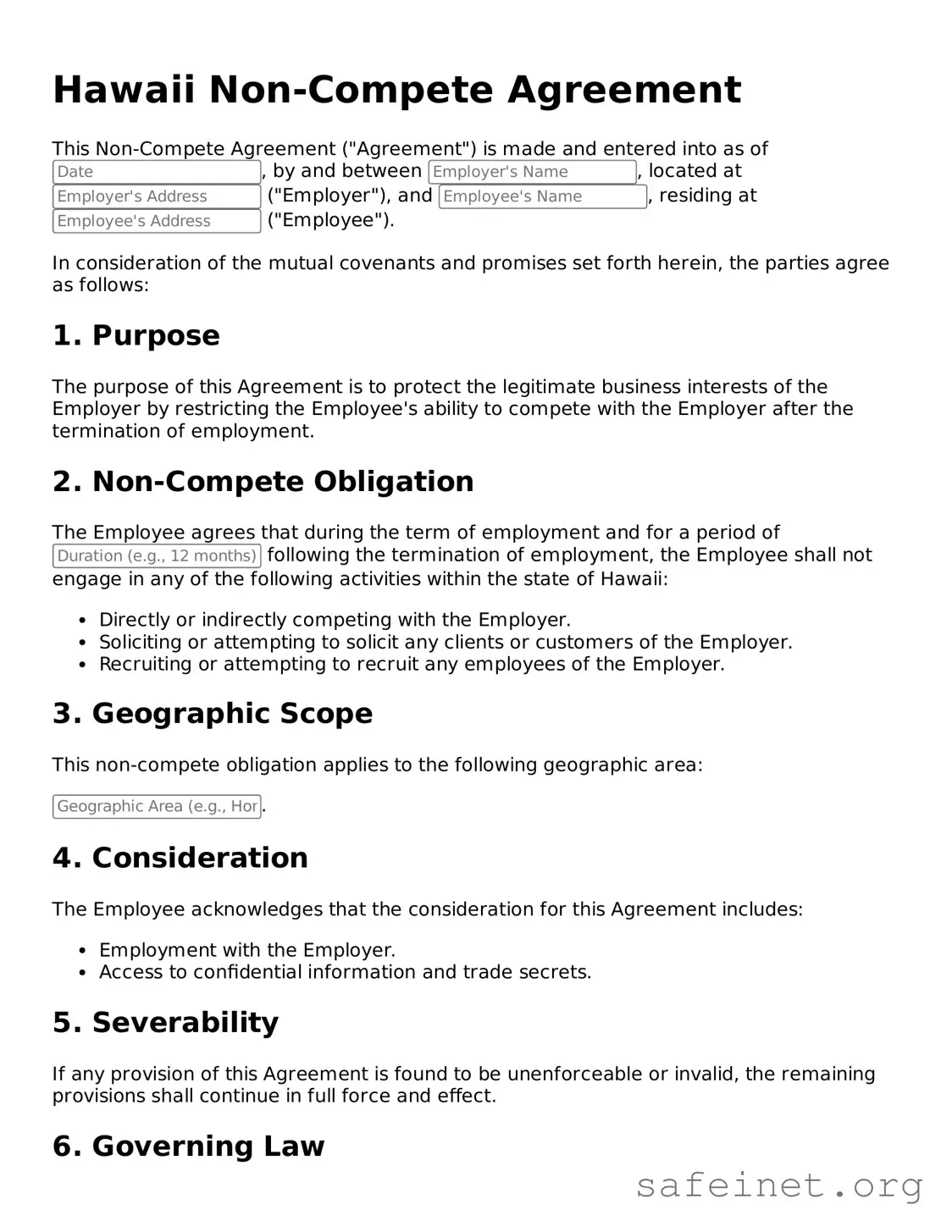
This Non-Compete Agreement ("Agreement") is made and entered into as of , by and between , located at ("Employer"), and , residing at ("Employee").
In consideration of the mutual covenants and promises set forth herein, the parties agree as follows:
1. Purpose
The purpose of this Agreement is to protect the legitimate business interests of the Employer by restricting the Employee's ability to compete with the Employer after the termination of employment.
2. Non-Compete Obligation
The Employee agrees that during the term of employment and for a period of following the termination of employment, the Employee shall not engage in any of the following activities within the state of Hawaii:
3. Geographic Scope
This non-compete obligation applies to the following geographic area:
.4. Consideration
The Employee acknowledges that the consideration for this Agreement includes:
5. Severability
If any provision of this Agreement is found to be unenforceable or invalid, the remaining provisions shall continue in full force and effect.
6. Governing Law
This Agreement shall be governed by and construed in accordance with the laws of the State of Hawaii.
7. Entire Agreement
This Agreement constitutes the entire understanding between the parties and supersedes all prior agreements, whether written or oral.
IN WITNESS WHEREOF, the parties hereto have executed this Non-Compete Agreement as of the date first above written.
______________________________
Employer's Signature
,
______________________________
Employee's Signature
| Fact Name | Description |
|---|---|
| Governing Law | Hawaii law governs non-compete agreements, specifically under Hawaii Revised Statutes § 480-4. |
| Enforceability | Non-compete agreements in Hawaii are generally enforceable if they are reasonable in scope and duration. |
| Reasonableness Test | The courts assess the reasonableness of the agreement based on geographic area, duration, and the nature of the restricted activities. |
| Employee Protection | Hawaii law aims to protect employees' rights, making overly restrictive non-compete clauses likely unenforceable. |
| Consideration Requirement | A valid non-compete agreement must provide consideration, meaning the employee must receive something of value in exchange. |
| Duration Limitations | Agreements that extend beyond a reasonable time frame, typically one to two years, may be deemed unenforceable. |
| Industry-Specific Rules | Certain industries, such as healthcare, have specific regulations regarding non-compete agreements. |
| Judicial Discretion | Hawaii courts have discretion to modify or limit the terms of a non-compete agreement rather than voiding it entirely. |
| Non-Solicitation Clauses | Non-solicitation agreements, which prevent employees from soliciting clients or employees, are often viewed more favorably than non-compete clauses. |
| Public Policy Considerations | Hawaii courts consider public policy when evaluating non-compete agreements, emphasizing the importance of employee mobility. |
Once you have the Hawaii Non-compete Agreement form, you can begin filling it out. Make sure to have all necessary information handy, as this will help streamline the process. Follow these steps to complete the form accurately.
After completing the form, review it for any errors or missing information. Once everything looks correct, you can submit it as required by your employer or organization. Keep a copy for your records.
What is a Non-compete Agreement in Hawaii?
A Non-compete Agreement is a legal contract between an employer and an employee. It restricts the employee from engaging in certain competitive activities after leaving the company. In Hawaii, these agreements must be reasonable in scope, duration, and geographic area to be enforceable.
Are Non-compete Agreements enforceable in Hawaii?
Yes, Non-compete Agreements can be enforceable in Hawaii, but they are subject to strict scrutiny. Courts will evaluate whether the agreement protects legitimate business interests and whether it imposes undue hardship on the employee.
What are legitimate business interests?
Legitimate business interests can include trade secrets, proprietary information, and customer relationships. Employers must demonstrate that the Non-compete Agreement is necessary to protect these interests from unfair competition.
How long can a Non-compete Agreement last in Hawaii?
The duration of a Non-compete Agreement in Hawaii should be reasonable. Typically, courts may find agreements lasting six months to two years acceptable, but this can vary based on the specific circumstances of the employment and the industry.
What geographic area can a Non-compete Agreement cover?
The geographic scope of a Non-compete Agreement must also be reasonable. It should be limited to areas where the employer conducts business or where the employee worked. Overly broad restrictions may lead to unenforceability.
Can I negotiate the terms of a Non-compete Agreement?
Yes, employees can negotiate the terms of a Non-compete Agreement before signing. It is advisable to discuss any concerns or desired changes with the employer to reach a mutually agreeable contract.
What happens if I violate a Non-compete Agreement?
If you violate a Non-compete Agreement, the employer may take legal action against you. This could include seeking an injunction to prevent you from working for a competitor or claiming damages for any losses incurred due to the violation.
Can I work in the same industry after signing a Non-compete Agreement?
Working in the same industry may be restricted depending on the terms of the Non-compete Agreement. If the agreement prohibits you from working for competitors, you may need to wait until the agreement expires before pursuing similar employment.
How can I get out of a Non-compete Agreement?
Getting out of a Non-compete Agreement can be challenging. You may seek to negotiate with your employer for a release, or you can consult with a legal expert to explore options such as proving the agreement is overly broad or unreasonable.
Is legal advice recommended before signing a Non-compete Agreement?
Yes, seeking legal advice before signing a Non-compete Agreement is highly recommended. A legal expert can help you understand the implications of the agreement and ensure that your rights are protected.
Not clearly defining the scope of the agreement. It's important to specify what activities are restricted.
Overlooking the duration of the non-compete. Make sure to set a reasonable time frame for the restrictions.
Failing to include the geographic area where the non-compete applies. Be specific about the locations affected.
Using vague language. Ambiguous terms can lead to misunderstandings and disputes.
Not considering the enforceability of the agreement. Ensure it complies with Hawaii's laws to avoid issues later.
Forgetting to have both parties sign the agreement. Without signatures, the document lacks legal weight.
Neglecting to provide consideration for the agreement. There should be something of value exchanged for the restrictions.
Not reviewing the agreement with a legal professional. A lawyer can help clarify terms and ensure compliance.
Ignoring the impact on future employment. Consider how the agreement may affect job opportunities down the line.
Failing to keep a copy of the signed agreement. Always maintain records for your own reference and protection.
When entering into a Non-compete Agreement in Hawaii, several other documents may be relevant to ensure clarity and legal compliance. These forms help define the relationship between the parties and outline specific expectations and obligations. Below is a list of commonly used documents that often accompany a Non-compete Agreement.
Understanding these documents is crucial for both employers and employees. Each plays a role in shaping the legal landscape of the employment relationship. Ensuring that all parties are aware of their rights and obligations can prevent future disputes and foster a more transparent working environment.
The Hawaii Non-compete Agreement form shares similarities with the Employment Agreement. Both documents outline the terms of employment, including the responsibilities of the employee and the employer. An Employment Agreement often includes clauses about confidentiality and non-solicitation, which can complement the non-compete provisions. Employers use both documents to protect their business interests while providing clarity to employees about their roles and limitations after leaving the company.
Another document akin to the Hawaii Non-compete Agreement is the Non-disclosure Agreement (NDA). An NDA focuses primarily on protecting sensitive information from being shared with outside parties. While the non-compete agreement restricts an employee's ability to work in similar industries, the NDA ensures that proprietary information remains confidential. Both agreements serve to safeguard a company's intellectual property and trade secrets.
The Independent Contractor Agreement also shares common ground with the Hawaii Non-compete Agreement. This document outlines the relationship between a business and a contractor, including the scope of work and compensation. Like the non-compete agreement, it may contain clauses that restrict the contractor from engaging with competitors during and after the contract period. This helps businesses maintain their competitive edge and ensures that contractors do not leverage their insider knowledge against them.
Similar to the Non-compete Agreement is the Confidentiality Agreement, which emphasizes the importance of protecting a company’s confidential information. While the non-compete focuses on employment restrictions, the Confidentiality Agreement explicitly prohibits the sharing of sensitive information. Both documents aim to prevent former employees or contractors from using their knowledge in ways that could harm the original employer.
The Partnership Agreement can also be compared to the Hawaii Non-compete Agreement. This document outlines the terms of a partnership, including each partner's roles and responsibilities. It may include non-compete clauses to prevent partners from starting competing businesses during and after the partnership. This helps to ensure that partners remain committed to the success of the business without diverting their efforts to rival enterprises.
The Licensing Agreement bears similarities to the Hawaii Non-compete Agreement as well. This document allows one party to use another party's intellectual property under specific conditions. Licensing Agreements may include non-compete clauses that restrict the licensee from using the licensed material to compete directly with the licensor. Both agreements are crucial in defining the boundaries of business relationships and protecting proprietary interests.
Lastly, the Shareholder Agreement can be likened to the Hawaii Non-compete Agreement. This document outlines the rights and responsibilities of shareholders within a corporation. It often contains non-compete provisions to prevent shareholders from engaging in competing businesses that could negatively impact the corporation. Both agreements are designed to protect the interests of the business while ensuring that all parties understand their commitments and limitations.
When filling out the Hawaii Non-compete Agreement form, it’s important to approach the task with care. Below are some key do's and don'ts to keep in mind.
Here are four common misconceptions about the Hawaii Non-compete Agreement form:
This is not true. In Hawaii, non-compete agreements must meet certain criteria to be enforceable. They must be reasonable in scope, duration, and geographic area. If they are overly restrictive, a court may not enforce them.
This misconception overlooks the fact that non-compete agreements are not mandatory for all employees. Employers may choose to require them for certain positions, especially those involving sensitive information or trade secrets.
This is incorrect. In Hawaii, non-compete agreements must have a reasonable duration. Courts typically find agreements lasting more than one or two years to be excessive, depending on the circumstances.
This is a misconception. Employees can challenge the enforceability of a non-compete agreement in court. Factors such as reasonableness and the circumstances under which the agreement was signed can be considered.
When dealing with the Hawaii Non-compete Agreement form, it is important to understand its purpose and implications. Here are some key takeaways to consider:
Understanding these points can help both employers and employees navigate the complexities of the Non-compete Agreement effectively.