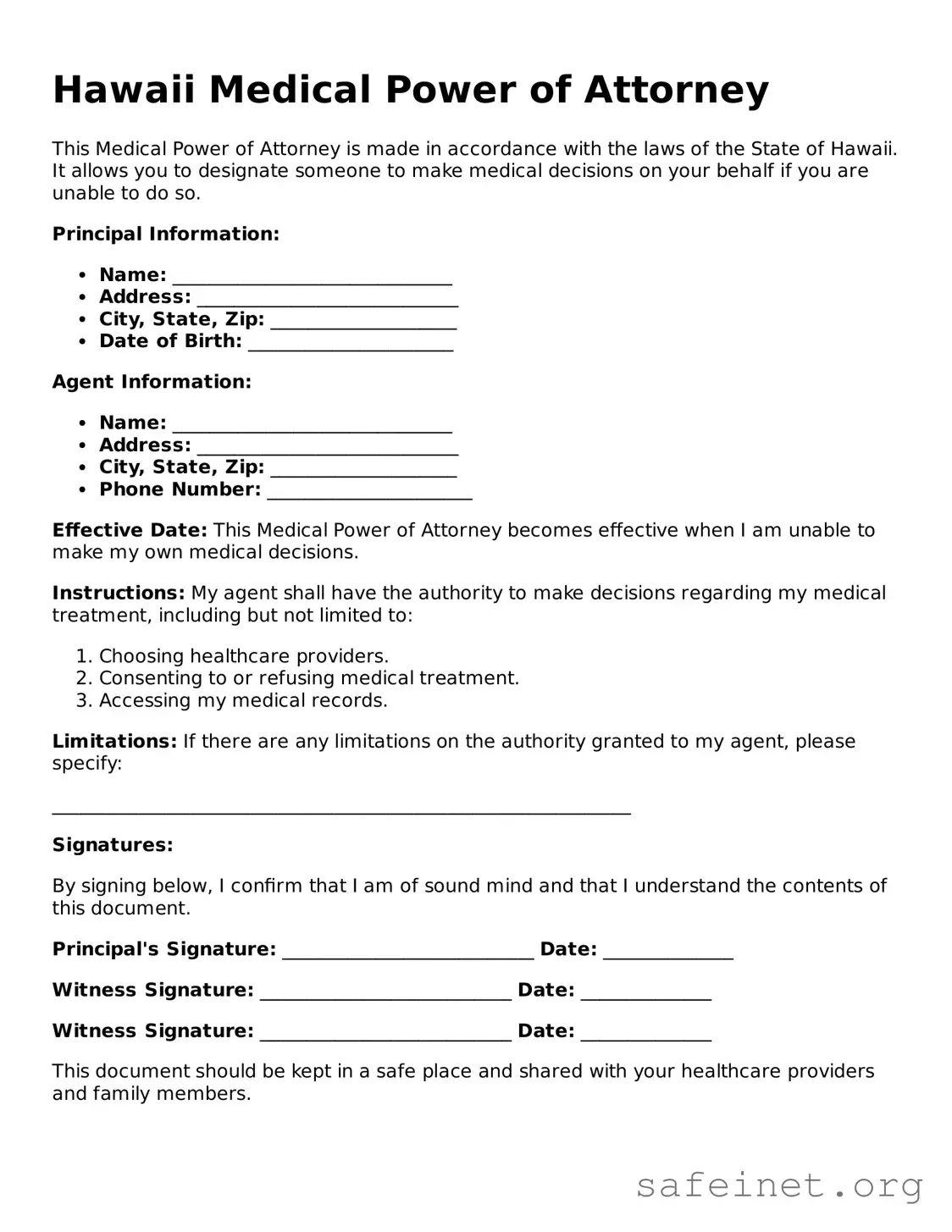
The Hawaii Medical Power of Attorney form is a vital legal document that empowers individuals to make critical healthcare decisions on behalf of another person in the event that they become unable to do so themselves. This form is particularly important for ensuring that a person’s medical preferences are honored, even when they cannot communicate those wishes directly. By designating a trusted individual, known as an agent or proxy, to make healthcare choices, individuals can ensure that their values and desires regarding treatment are respected. The form typically includes provisions for specifying the types of medical interventions one would prefer or refuse, as well as guidelines for end-of-life care. It is essential for residents of Hawaii to understand the nuances of this document, including the requirements for execution, which generally involve witnessing and notarization. Furthermore, having a Medical Power of Attorney in place can alleviate the burden on family members during challenging times, allowing them to focus on providing emotional support rather than navigating complex medical decisions. Understanding the importance and intricacies of this form can empower individuals to take charge of their healthcare decisions and ensure their wishes are clearly communicated and legally recognized.
Hawaii Medical Power of Attorney
This Medical Power of Attorney is made in accordance with the laws of the State of Hawaii. It allows you to designate someone to make medical decisions on your behalf if you are unable to do so.
Principal Information:
Agent Information:
Effective Date: This Medical Power of Attorney becomes effective when I am unable to make my own medical decisions.
Instructions: My agent shall have the authority to make decisions regarding my medical treatment, including but not limited to:
Limitations: If there are any limitations on the authority granted to my agent, please specify:
______________________________________________________________
Signatures:
By signing below, I confirm that I am of sound mind and that I understand the contents of this document.
Principal's Signature: ___________________________ Date: ______________
Witness Signature: ___________________________ Date: ______________
Witness Signature: ___________________________ Date: ______________
This document should be kept in a safe place and shared with your healthcare providers and family members.
| Fact Name | Description |
|---|---|
| Definition | A Hawaii Medical Power of Attorney allows an individual to designate someone to make healthcare decisions on their behalf if they become unable to do so. |
| Governing Laws | The form is governed by Hawaii Revised Statutes, specifically Chapter 327E, which outlines the legal framework for advance health care directives. |
| Requirements | The form must be signed by the principal and witnessed by two individuals or notarized to be legally valid in Hawaii. |
| Revocation | The principal can revoke the Medical Power of Attorney at any time, provided they communicate their decision clearly to the appointed agent and relevant healthcare providers. |
Filling out the Hawaii Medical Power of Attorney form is an important step in ensuring your healthcare wishes are respected. Once completed, this document allows you to designate someone to make medical decisions on your behalf in case you are unable to do so. Here’s how to fill out the form properly.
After completing the form, ensure that it is stored in a safe yet accessible location. It's wise to inform your family members about your decision and the location of the document, so they can easily find it if needed.
What is a Hawaii Medical Power of Attorney?
A Hawaii Medical Power of Attorney is a legal document that allows you to appoint someone to make healthcare decisions on your behalf if you become unable to do so. This person, known as your agent, will have the authority to make medical choices that align with your wishes and best interests.
Who can be appointed as an agent in a Medical Power of Attorney?
You can appoint any competent adult as your agent. This may include family members, friends, or trusted individuals. However, it is important to choose someone who understands your values and wishes regarding medical treatment.
What types of decisions can my agent make?
Your agent can make a wide range of medical decisions, including those related to surgeries, medications, and end-of-life care. They will act according to your preferences, which you can outline in the document.
How do I create a Medical Power of Attorney in Hawaii?
To create a Medical Power of Attorney in Hawaii, you need to complete a form that specifies your agent and any specific instructions regarding your healthcare. It is advisable to consult with a legal professional to ensure that the document meets all legal requirements.
Do I need witnesses or notarization for the document to be valid?
Yes, in Hawaii, your Medical Power of Attorney must be signed in the presence of two witnesses or a notary public. The witnesses cannot be your appointed agent or related to you by blood or marriage.
Can I revoke my Medical Power of Attorney?
Yes, you have the right to revoke your Medical Power of Attorney at any time. To do so, you must inform your agent and any relevant healthcare providers. It is also advisable to create a written revocation document for clarity.
What happens if I do not have a Medical Power of Attorney?
If you do not have a Medical Power of Attorney and become incapacitated, medical decisions may be made by family members or guardians. This can lead to disputes or decisions that may not reflect your wishes.
Is a Medical Power of Attorney the same as a Living Will?
No, a Medical Power of Attorney and a Living Will serve different purposes. A Living Will outlines your preferences for medical treatment in specific situations, while a Medical Power of Attorney designates someone to make decisions on your behalf. Both documents can work together to ensure your healthcare wishes are honored.
Not Designating a Health Care Agent: One common mistake is failing to choose a specific individual as a health care agent. This person will make medical decisions on your behalf if you are unable to do so. It is crucial to select someone you trust and who understands your wishes.
Overlooking the Witness Requirement: In Hawaii, the Medical Power of Attorney must be signed in the presence of two witnesses or a notary public. Neglecting this requirement can render the document invalid.
Not Discussing Wishes with the Agent: Some individuals fill out the form without having an open conversation with their chosen agent about their medical preferences. This can lead to confusion or decisions that do not align with the individual’s values.
Failing to Update the Document: Life circumstances change, and so do relationships. Forgetting to update the Medical Power of Attorney after significant life events, such as a divorce or the death of a designated agent, can create problems later.
Using Outdated Forms: Medical Power of Attorney forms can change over time. Using an outdated version may lead to legal complications. Always ensure that you are using the most current form available.
Neglecting to Include Specific Instructions: While it’s important to appoint an agent, it’s equally vital to provide clear instructions regarding your medical care preferences. Omitting these details can leave your agent uncertain about your wishes.
Not Storing the Document Safely: After completing the form, it is essential to store it in a secure but accessible location. Failing to do so may result in the document being lost or difficult to find when needed.
The Hawaii Medical Power of Attorney form allows individuals to designate someone to make healthcare decisions on their behalf if they become unable to do so. This form is often used alongside other important documents to ensure comprehensive planning for medical and financial matters. Below is a list of related forms and documents that may be beneficial in conjunction with the Medical Power of Attorney.
Having these documents in place can provide clarity and peace of mind for both individuals and their families. Each form serves a specific purpose, ensuring that personal wishes are honored and that there is a clear plan for both medical and financial decisions.
The Hawaii Medical Power of Attorney (MPOA) is similar to a Durable Power of Attorney (DPOA). Both documents allow individuals to designate someone to make decisions on their behalf. The DPOA covers a broader range of decisions, including financial matters, while the MPOA specifically focuses on healthcare choices. In both cases, the appointed agent is expected to act in the best interest of the individual, ensuring their wishes are respected in critical situations.
Another related document is the Living Will. A Living Will outlines an individual’s preferences regarding medical treatment in situations where they cannot communicate their wishes, such as terminal illness or incapacitation. While the MPOA appoints someone to make decisions, the Living Will provides specific instructions that guide those decisions. Both documents work together to ensure that an individual’s healthcare preferences are honored.
The Advance Healthcare Directive (AHD) is also comparable to the MPOA. An AHD combines elements of both the MPOA and Living Will, allowing individuals to express their healthcare preferences and appoint a decision-maker. This document offers a comprehensive approach to advance planning, ensuring that all aspects of an individual's healthcare wishes are clearly communicated and legally recognized.
Healthcare Proxy forms serve a similar purpose to the MPOA. A healthcare proxy allows an individual to appoint someone to make medical decisions on their behalf if they become unable to do so. Like the MPOA, the healthcare proxy focuses solely on medical decisions. The key difference lies in the terminology used, which may vary by state, but the intent remains the same: to ensure someone is available to advocate for the individual's healthcare choices.
The Do Not Resuscitate (DNR) order is another important document that relates to the MPOA. A DNR order specifies that an individual does not wish to receive cardiopulmonary resuscitation (CPR) in the event of cardiac arrest. While the MPOA allows for broader medical decision-making, the DNR specifically addresses a critical aspect of end-of-life care. Both documents are essential for ensuring that an individual’s wishes regarding life-sustaining treatment are respected.
Lastly, the Physician Orders for Life-Sustaining Treatment (POLST) form is similar to the MPOA in that it provides medical professionals with clear instructions regarding a patient's treatment preferences. The POLST is typically used for individuals with serious health conditions and outlines specific medical interventions they do or do not want. While the MPOA appoints a decision-maker, the POLST communicates the individual’s wishes directly to healthcare providers, ensuring that their preferences are followed in emergencies.
Filling out a Medical Power of Attorney form in Hawaii is a significant step in ensuring your healthcare preferences are respected. Here are some important dos and don’ts to keep in mind while completing the form.
By following these guidelines, you can feel confident that your Medical Power of Attorney will serve its intended purpose, providing clarity and peace of mind for you and your loved ones.
When it comes to the Hawaii Medical Power of Attorney form, there are several misconceptions that can lead to confusion. Here are five common misunderstandings:
Many people believe that a Medical Power of Attorney is only relevant when someone is nearing death. In reality, this document is useful for any situation where you are unable to make medical decisions for yourself, regardless of the circumstances.
While having legal guidance can be beneficial, it is not mandatory to have a lawyer draft your Medical Power of Attorney. Individuals can fill out the form themselves, as long as they follow the state's requirements.
A Medical Power of Attorney specifically addresses health care decisions. It does not grant authority over financial matters unless a separate financial power of attorney is created.
This is not true. You have the right to revoke or modify your Medical Power of Attorney at any time, as long as you are mentally competent to do so. It’s important to keep your documents updated.
People of all ages can benefit from having a Medical Power of Attorney. Accidents or sudden illnesses can happen to anyone, making it wise to have this document in place regardless of age.
Understanding these misconceptions can help ensure that you make informed decisions about your health care preferences and who will represent you when you can’t speak for yourself.
Filling out and using the Hawaii Medical Power of Attorney form is an important step in ensuring your healthcare wishes are respected. Here are key takeaways to consider: