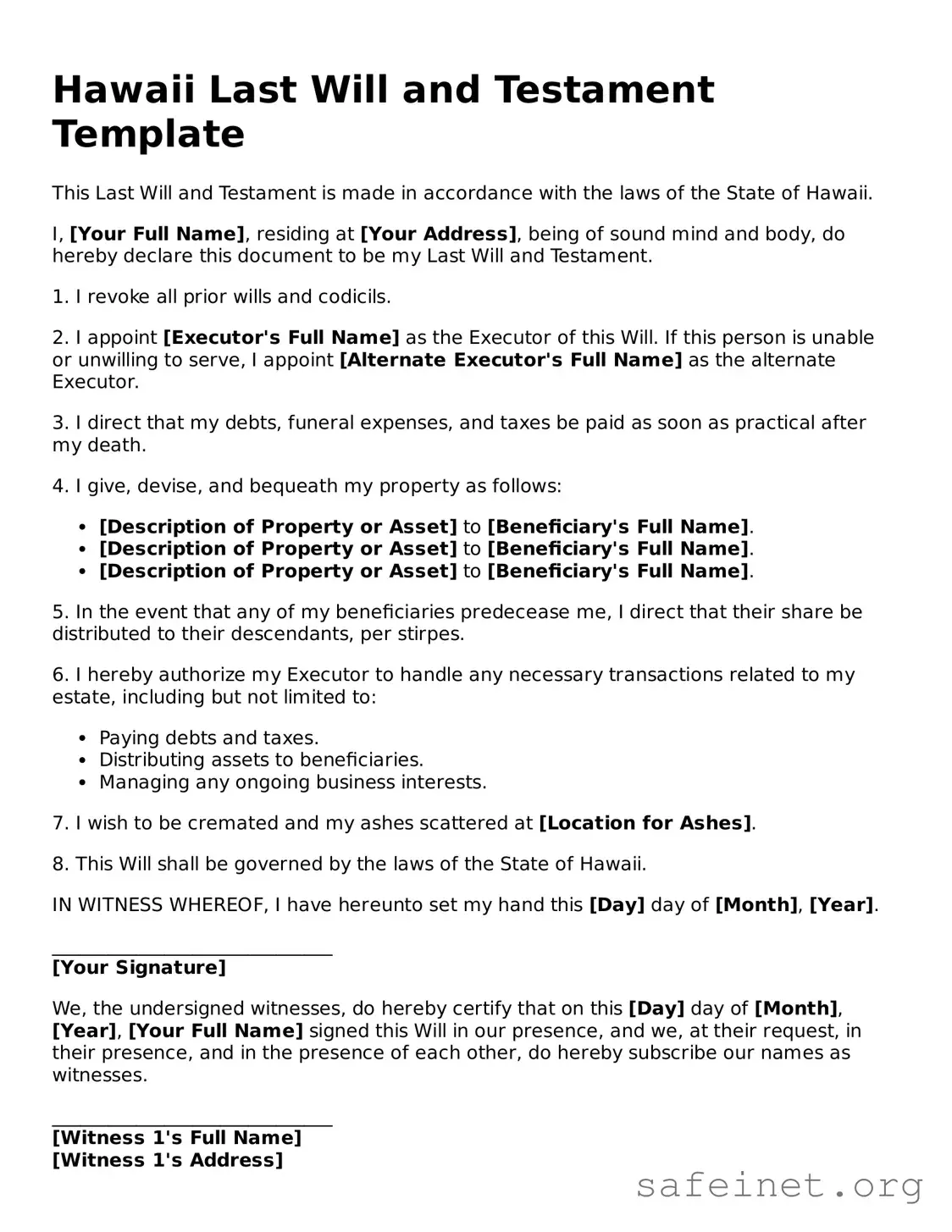
The Hawaii Last Will and Testament form is an essential legal document that allows individuals to outline their wishes regarding the distribution of their assets after death. This form serves several important functions, including the appointment of an executor, who will be responsible for managing the estate and ensuring that the deceased's wishes are carried out. It also allows individuals to designate guardians for any minor children, providing peace of mind about their care. In Hawaii, the form must be signed and witnessed to be considered valid, ensuring that the testator's intentions are clear and legally binding. Additionally, the form can include specific bequests, allowing individuals to leave particular items or amounts of money to chosen beneficiaries. Understanding the components and requirements of the Hawaii Last Will and Testament form is crucial for anyone looking to secure their legacy and provide for their loved ones in accordance with their wishes.
Hawaii Last Will and Testament Template
This Last Will and Testament is made in accordance with the laws of the State of Hawaii.
I, [Your Full Name], residing at [Your Address], being of sound mind and body, do hereby declare this document to be my Last Will and Testament.
1. I revoke all prior wills and codicils.
2. I appoint [Executor's Full Name] as the Executor of this Will. If this person is unable or unwilling to serve, I appoint [Alternate Executor's Full Name] as the alternate Executor.
3. I direct that my debts, funeral expenses, and taxes be paid as soon as practical after my death.
4. I give, devise, and bequeath my property as follows:
5. In the event that any of my beneficiaries predecease me, I direct that their share be distributed to their descendants, per stirpes.
6. I hereby authorize my Executor to handle any necessary transactions related to my estate, including but not limited to:
7. I wish to be cremated and my ashes scattered at [Location for Ashes].
8. This Will shall be governed by the laws of the State of Hawaii.
IN WITNESS WHEREOF, I have hereunto set my hand this [Day] day of [Month], [Year].
______________________________
[Your Signature]
We, the undersigned witnesses, do hereby certify that on this [Day] day of [Month], [Year], [Your Full Name] signed this Will in our presence, and we, at their request, in their presence, and in the presence of each other, do hereby subscribe our names as witnesses.
______________________________
[Witness 1's Full Name]
[Witness 1's Address]
______________________________
[Witness 2's Full Name]
[Witness 2's Address]
| Fact Name | Description |
|---|---|
| Governing Law | The Hawaii Last Will and Testament is governed by Hawaii Revised Statutes, Chapter 560. |
| Age Requirement | Testators must be at least 18 years old to create a valid will in Hawaii. |
| Witness Requirement | The will must be signed by at least two witnesses who are present at the same time. |
| Revocation | A will can be revoked by creating a new will or by physically destroying the existing one. |
| Holographic Wills | Hawaii recognizes holographic wills, which are handwritten and do not require witnesses. |
| Self-Proving Wills | A self-proving will includes an affidavit signed by the witnesses, simplifying the probate process. |
| Residency Requirement | There is no residency requirement for creating a will, but the estate must be probated in Hawaii if the decedent lived there. |
After obtaining the Hawaii Last Will and Testament form, it is essential to fill it out accurately to ensure your wishes are clearly stated. Completing this form is a critical step in planning your estate and ensuring that your assets are distributed according to your preferences.
What is a Last Will and Testament in Hawaii?
A Last Will and Testament is a legal document that outlines how a person's assets and affairs should be handled after their death. In Hawaii, this document allows individuals to specify who will inherit their property, appoint guardians for minor children, and designate an executor to manage the estate. It is essential for ensuring that your wishes are followed and can help prevent disputes among family members during a difficult time.
Do I need a lawyer to create a Last Will and Testament in Hawaii?
While it is not legally required to have a lawyer draft your Last Will and Testament in Hawaii, consulting with one can provide significant benefits. An attorney can help ensure that your will complies with state laws, is properly executed, and accurately reflects your wishes. They can also assist in addressing complex situations, such as blended families or significant assets, which may require more detailed planning.
What are the requirements for a valid Last Will and Testament in Hawaii?
To be considered valid in Hawaii, a Last Will and Testament must meet several requirements. First, the individual creating the will, known as the testator, must be at least 18 years old and of sound mind. The will must be in writing and signed by the testator. Additionally, it must be witnessed by at least two individuals who are present at the same time. These witnesses should not be beneficiaries of the will to avoid any potential conflicts of interest.
Can I change or revoke my Last Will and Testament in Hawaii?
Yes, you can change or revoke your Last Will and Testament at any time while you are alive, as long as you are of sound mind. To make changes, you can either create a new will that explicitly revokes the previous one or add a codicil, which is an amendment to the existing will. It is crucial to follow the same formalities for signing and witnessing when making these changes to ensure they are legally binding. Always keep your most current will in a safe place and inform your loved ones of its location.
Not specifying an executor: Failing to name someone to carry out your wishes can lead to confusion and disputes among family members.
Using outdated forms: Laws change, and using an old version of the will form might not comply with current legal requirements.
Not signing the will: A will is not valid unless it is signed by the testator (the person making the will). Forgetting this crucial step can render the document useless.
Failing to have witnesses: In Hawaii, you need at least two witnesses to sign your will. Without them, the will may be challenged in court.
Not being clear about distributions: Vague language can lead to misunderstandings. Clearly outline who gets what to avoid conflicts later.
Ignoring state-specific laws: Each state has unique rules regarding wills. Not adhering to Hawaii's specific requirements can invalidate your will.
Not updating the will: Life changes, such as marriage, divorce, or the birth of a child, should prompt a review and possible update of your will.
Overlooking digital assets: Today, many people have online accounts and digital assets. Failing to include instructions for these can lead to complications for your heirs.
When preparing a Last Will and Testament in Hawaii, several additional forms and documents may be necessary to ensure comprehensive estate planning. Each of these documents serves a specific purpose and can help clarify the testator's intentions.
These documents complement the Last Will and Testament by addressing various aspects of estate planning. Together, they help ensure that a person's wishes are respected and carried out effectively.
The Hawaii Last Will and Testament form shares similarities with a Living Will. While a Last Will outlines how a person wishes their assets to be distributed after death, a Living Will focuses on medical decisions during a person’s lifetime. Both documents allow individuals to express their wishes clearly, ensuring that their preferences are respected. A Living Will typically addresses situations where a person may be unable to communicate their healthcare choices, providing guidance to family members and medical professionals. This proactive approach can help prevent confusion and conflict during difficult times.
Another document akin to the Hawaii Last Will and Testament is the Durable Power of Attorney. This legal document grants someone the authority to make financial or legal decisions on behalf of another person if they become incapacitated. Like a Last Will, it allows for the clear designation of a trusted individual to manage affairs, ensuring that the person's wishes are followed. While a Last Will takes effect after death, a Durable Power of Attorney is effective during a person's lifetime, making it a crucial tool for managing both health and financial matters.
The Revocable Trust is also comparable to the Hawaii Last Will and Testament. A Revocable Trust allows individuals to place their assets into a trust during their lifetime, which can then be managed by a trustee. Upon the individual’s death, the assets in the trust can be distributed according to their wishes, similar to a Last Will. However, a key difference lies in the probate process; assets in a trust typically avoid probate, leading to a quicker and more private distribution. This can be particularly beneficial for families wanting to minimize delays and maintain confidentiality after a loved one passes away.
Finally, the Codicil is another document that relates closely to a Last Will. A Codicil serves as an amendment or addition to an existing will, allowing individuals to make changes without drafting an entirely new document. This can include updates to beneficiaries, asset distributions, or even the appointment of an executor. By using a Codicil, individuals can ensure that their Last Will remains current and reflects their most recent wishes, providing flexibility and ease in estate planning.
When filling out the Hawaii Last Will and Testament form, there are important dos and don'ts to consider. Following these guidelines can help ensure that your will is valid and reflects your wishes.
By adhering to these guidelines, you can create a will that stands up to legal scrutiny and accurately reflects your intentions.
Many people have misconceptions about the Hawaii Last Will and Testament form. Understanding these misconceptions can help individuals make informed decisions about their estate planning. Here are seven common misconceptions:
Many believe that only those with significant assets need a will. In reality, anyone can benefit from having a will, as it helps ensure that personal wishes are honored after death.
Some think that simply stating their wishes verbally is enough. However, Hawaii law requires a written will to be valid, so it is essential to document intentions properly.
This is not true. Individuals can revise or revoke their will at any time, as long as they follow the legal requirements for doing so.
Many people assume that having a will means their estate will not go through probate. In fact, a will typically must go through probate, which is the legal process of validating the will and distributing assets.
Some individuals believe that all their assets will automatically transfer to their spouse upon death. However, this depends on how assets are titled and whether there is a will that specifies otherwise.
While many think that handwritten wills (holographic wills) are not accepted, Hawaii does recognize them under certain conditions. It is important to ensure that they meet legal requirements.
While it is advisable to seek legal advice, individuals can create their own wills. However, they must ensure that the will complies with Hawaii's legal standards to be valid.
By addressing these misconceptions, individuals can better navigate the estate planning process and make choices that reflect their wishes.
When filling out and using the Hawaii Last Will and Testament form, consider these key takeaways: