Hawaii offers a unique opportunity for families who choose to educate their children at home, and the process begins with the Homeschool Letter of Intent form. This essential document serves as a formal notification to the state that you intend to homeschool your child. It requires basic information such as the name and age of the student, as well as the name and address of the parent or guardian. Additionally, the form prompts you to outline your educational philosophy and the curriculum you plan to use, ensuring that you have a clear plan for your child's education. Submitting this letter is not just a formality; it establishes your commitment to providing a quality educational experience outside of traditional schooling. By completing this form, you take an important step in shaping your child's learning journey while adhering to Hawaii's homeschooling regulations. Understanding the details of this form is crucial for a smooth homeschooling experience, allowing you to focus on what truly matters: nurturing your child's growth and education.
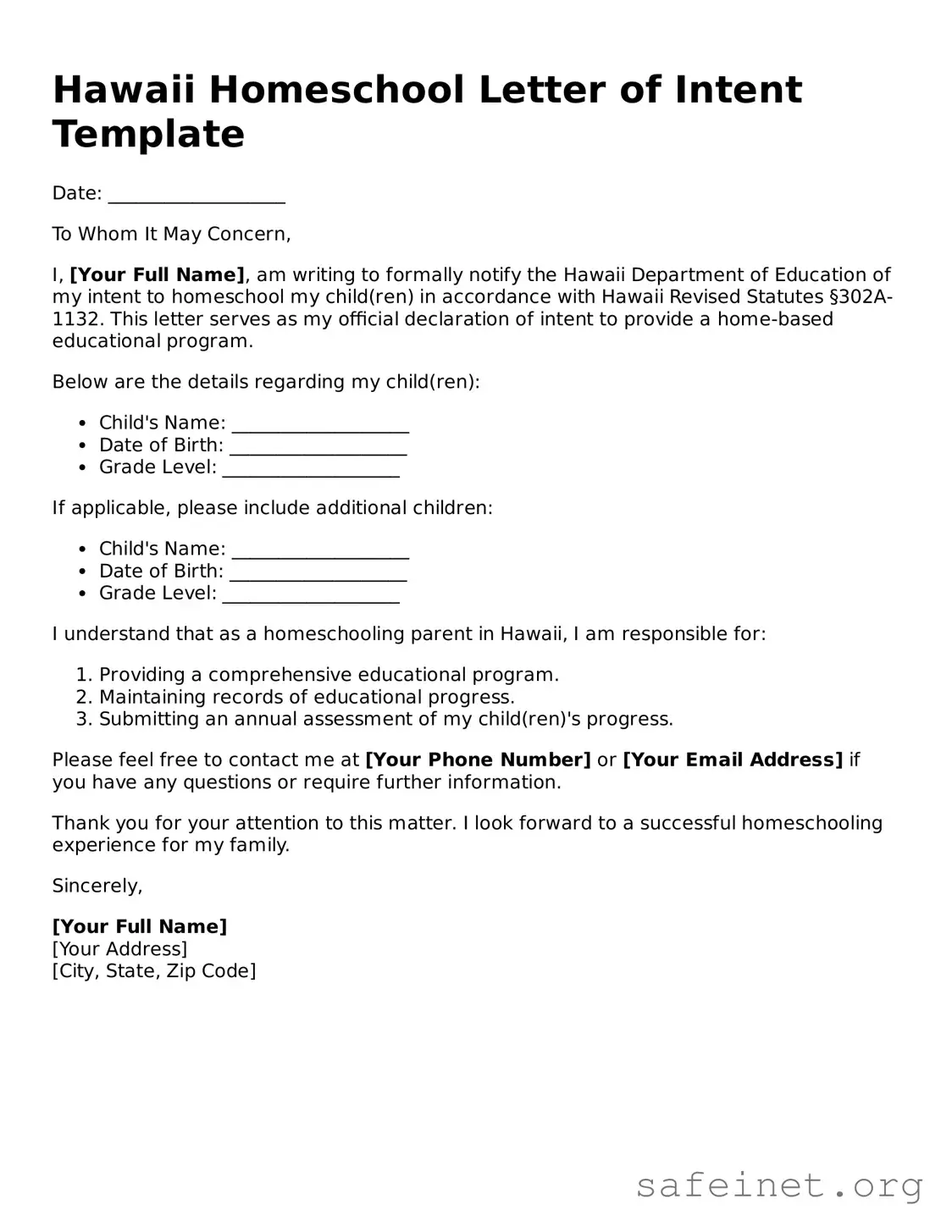
Hawaii Homeschool Letter of Intent Template
Date: ___________________
To Whom It May Concern,
I, [Your Full Name], am writing to formally notify the Hawaii Department of Education of my intent to homeschool my child(ren) in accordance with Hawaii Revised Statutes §302A-1132. This letter serves as my official declaration of intent to provide a home-based educational program.
Below are the details regarding my child(ren):
If applicable, please include additional children:
I understand that as a homeschooling parent in Hawaii, I am responsible for:
Please feel free to contact me at [Your Phone Number] or [Your Email Address] if you have any questions or require further information.
Thank you for your attention to this matter. I look forward to a successful homeschooling experience for my family.
Sincerely,
[Your Full Name]
[Your Address]
[City, State, Zip Code]
| Fact Name | Details |
|---|---|
| Governing Law | The Hawaii Homeschool Letter of Intent is governed by Hawaii Revised Statutes §302A-1132. |
| Submission Deadline | The Letter of Intent must be submitted annually, no later than July 30th. |
| Required Information | The form requires the name, address, and age of each child being homeschooled. |
| Educational Plan | Parents must provide a brief description of the educational plan for each child. |
Once you have the Hawaii Homeschool Letter of Intent form ready, you will need to complete it accurately. This form is essential for notifying the state of your intent to homeschool your child. After filling it out, you will submit it to the appropriate authorities.
What is the Hawaii Homeschool Letter of Intent form?
The Hawaii Homeschool Letter of Intent form is a document that parents or guardians must submit to the local school district when they decide to homeschool their children. This form officially notifies the school authorities of the intent to educate a child outside of the traditional school system. It is a necessary step to comply with state regulations regarding homeschooling.
Who needs to submit the Letter of Intent?
Any parent or guardian who wishes to homeschool a child in Hawaii must submit this form. This includes families with children who have never attended school as well as those who are withdrawing their children from public or private schools to begin homeschooling. It is important to submit the form for each child being homeschooled.
When should the Letter of Intent be submitted?
The Letter of Intent should be submitted at the beginning of the school year or as soon as a parent decides to homeschool their child. If a child is currently enrolled in school, it is advisable to submit the form before withdrawing them. This ensures that the local school district is informed and allows for a smooth transition to homeschooling.
What information is required on the form?
The form typically requires basic information about the child, such as their name, age, and grade level. Additionally, parents must provide their contact information and may need to outline their educational plans. This could include details about the curriculum they intend to use and the educational approach they will follow.
Is there a deadline for submitting the form?
What happens after the form is submitted?
Once the Letter of Intent is submitted, the local school district will acknowledge receipt of the form. Parents can then proceed with their homeschooling plans. It is important to keep a copy of the submitted form for personal records. Additionally, parents should be prepared to provide updates or additional information if requested by the school district throughout the homeschooling process.
Filling out the Hawaii Homeschool Letter of Intent form can be a straightforward process, but there are common mistakes that can lead to delays or complications. Here’s a list of seven mistakes to avoid:
By avoiding these common pitfalls, you can ensure a smoother process when submitting your Homeschool Letter of Intent in Hawaii. Taking the time to review your application carefully can save you from potential headaches down the line.
When families decide to homeschool in Hawaii, several forms and documents may accompany the Homeschool Letter of Intent. These documents help ensure compliance with state regulations and provide necessary information to educational authorities. Below is a list of commonly used forms that may be relevant in the homeschooling process.
Having these documents prepared and organized can facilitate a smoother homeschooling experience in Hawaii. Each form serves a specific purpose and contributes to a comprehensive educational framework for the child. Ensuring compliance with state requirements while fostering a positive learning environment is key to successful homeschooling.
The Hawaii Homeschool Letter of Intent form is similar to the Notice of Intent to Homeschool form used in many states. Both documents serve the purpose of formally notifying the state education department of a family's intention to homeschool their children. They typically require basic information about the student, the parent or guardian, and the educational plan. This ensures that the family is compliant with state laws regarding homeschooling and allows the state to keep track of homeschooled students.
Another document that resembles the Hawaii Homeschool Letter of Intent is the Educational Plan form, which some states require alongside the notice of intent. This form outlines the curriculum and educational methods that will be used during the homeschooling process. Like the Letter of Intent, it aims to provide transparency and assurance that the child will receive a quality education tailored to their needs.
The Individualized Education Program (IEP) is another document that shares similarities with the Hawaii Homeschool Letter of Intent. While the IEP is specifically designed for students with disabilities, both documents emphasize the importance of meeting educational requirements. An IEP details the special services and accommodations a child will receive, ensuring that their unique educational needs are addressed, much like how the Letter of Intent outlines the family's educational approach.
The Affidavit of Homeschooling form, used in some jurisdictions, is also comparable. This document serves as a sworn statement affirming that a family will provide an educational program at home. Similar to the Hawaii Homeschool Letter of Intent, the affidavit may require parents to provide information about their educational philosophy and teaching methods, reinforcing their commitment to homeschooling.
Finally, the Annual Assessment form is another document that aligns with the Hawaii Homeschool Letter of Intent. This form is often required to demonstrate that homeschooled students are making adequate academic progress. Like the Letter of Intent, it is part of a broader framework that ensures accountability in the homeschooling process, allowing parents to show that they are fulfilling their educational responsibilities.
When filling out the Hawaii Homeschool Letter of Intent form, it’s important to follow certain guidelines to ensure a smooth process. Here’s a list of what you should and shouldn’t do:
Following these guidelines will help ensure that your Letter of Intent is processed without issues. Make sure to double-check all information before submission.
When it comes to homeschooling in Hawaii, there are some common misconceptions about the Letter of Intent form. Understanding these can help you navigate the process more smoothly. Here are seven misconceptions to be aware of:
By clearing up these misconceptions, you can approach the homeschooling process in Hawaii with confidence and clarity.
Filling out and using the Hawaii Homeschool Letter of Intent form is an important step for families choosing to educate their children at home. Here are some key takeaways to consider:
By following these guidelines, families can navigate the process of homeschooling in Hawaii with greater confidence and clarity.