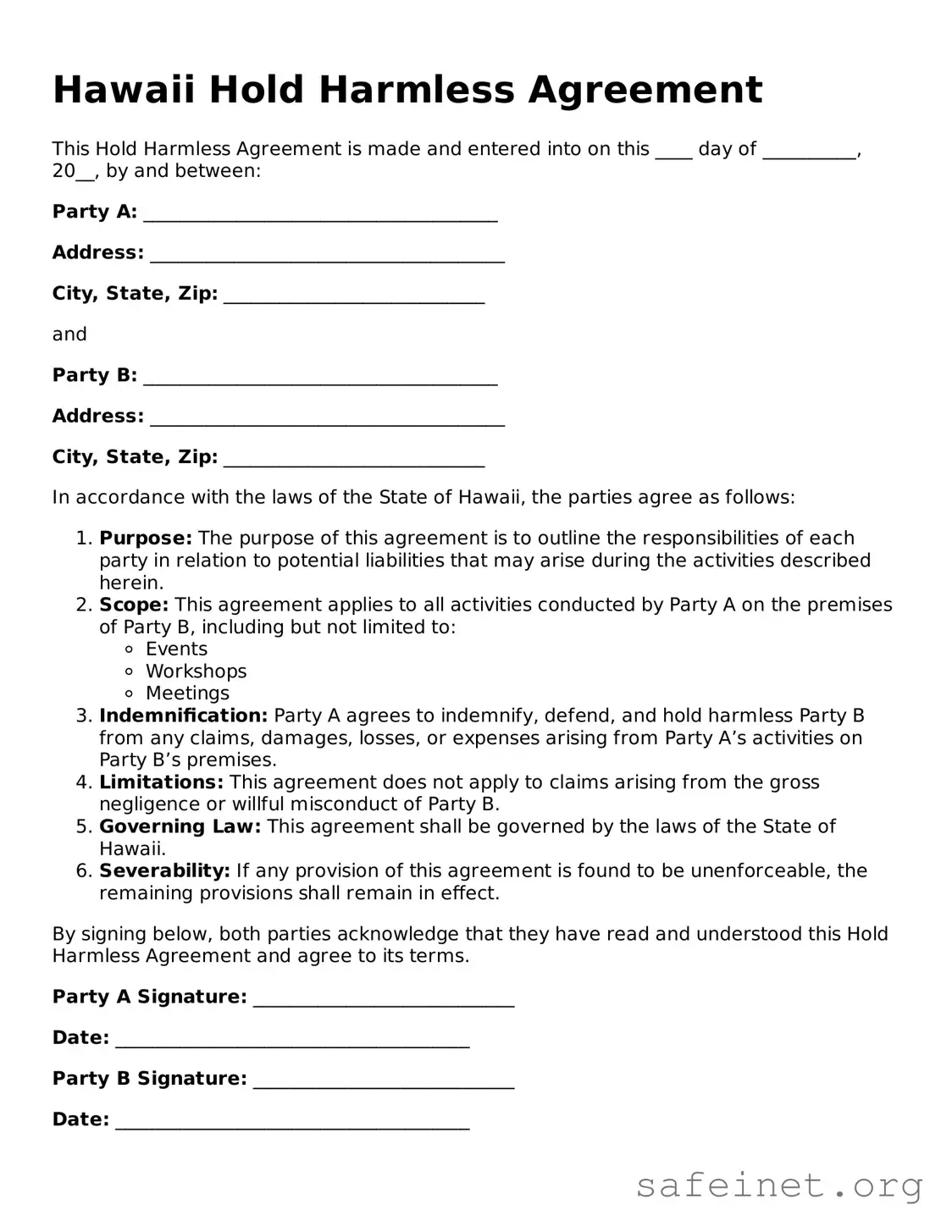
The Hawaii Hold Harmless Agreement form serves as a crucial legal document designed to protect parties from liability in various situations, particularly in activities that involve potential risks. This agreement typically outlines the responsibilities of each party and specifies that one party agrees to assume the risk of certain activities, thereby relieving the other party from any claims or damages that may arise. In many cases, this form is utilized in contexts such as recreational activities, events, or property use, where the potential for injury or loss exists. By signing the agreement, individuals acknowledge the inherent risks involved and agree not to hold the other party responsible for any accidents or injuries that may occur. This proactive approach to risk management not only fosters a sense of security for all involved but also encourages participation in activities that might otherwise be avoided due to fear of liability. Understanding the nuances of this agreement is essential for anyone considering its use, as it can significantly impact legal rights and responsibilities.
Hawaii Hold Harmless Agreement
This Hold Harmless Agreement is made and entered into on this ____ day of __________, 20__, by and between:
Party A: ______________________________________
Address: ______________________________________
City, State, Zip: ____________________________
and
Party B: ______________________________________
Address: ______________________________________
City, State, Zip: ____________________________
In accordance with the laws of the State of Hawaii, the parties agree as follows:
By signing below, both parties acknowledge that they have read and understood this Hold Harmless Agreement and agree to its terms.
Party A Signature: ____________________________
Date: ______________________________________
Party B Signature: ____________________________
Date: ______________________________________
| Fact Name | Description |
|---|---|
| Definition | The Hawaii Hold Harmless Agreement is a legal document that protects one party from liability for damages or injuries caused by another party. |
| Purpose | This agreement is often used in contracts to ensure that one party will not hold the other responsible for certain risks. |
| Governing Law | The agreement is governed by the laws of the State of Hawaii. |
| Parties Involved | Typically, two parties are involved: the indemnitor (the party providing protection) and the indemnitee (the party being protected). |
| Scope of Protection | The agreement can cover a wide range of liabilities, including personal injury, property damage, and legal fees. |
| Enforceability | For the agreement to be enforceable, it must be clear, specific, and voluntarily signed by both parties. |
| Limitations | Some liabilities, such as gross negligence or willful misconduct, may not be covered by the agreement. |
| Duration | The duration of the agreement can vary, depending on the terms set forth by the parties involved. |
| Importance | Having a Hold Harmless Agreement can provide peace of mind and clarity in business or personal transactions. |
After obtaining the Hawaii Hold Harmless Agreement form, you are ready to fill it out. Make sure you have all the necessary information at hand. Follow these steps to complete the form accurately.
What is a Hawaii Hold Harmless Agreement?
A Hawaii Hold Harmless Agreement is a legal document designed to protect one party from liability for any injuries or damages that may occur during a specific activity or event. By signing this agreement, one party agrees not to hold the other party responsible for any claims that arise from that activity.
Who typically uses a Hold Harmless Agreement in Hawaii?
This agreement is commonly used by businesses, event organizers, property owners, and individuals involved in activities that may pose risks, such as sports events, construction projects, or rental agreements. It helps ensure that all parties understand their responsibilities and the risks involved.
What are the key components of a Hold Harmless Agreement?
A typical Hold Harmless Agreement includes the names of the parties involved, a description of the activity or event, and a clear statement of the indemnification clause. This clause specifies that one party will not hold the other liable for any damages or injuries that occur as a result of the activity.
Is a Hold Harmless Agreement legally binding in Hawaii?
Yes, a Hold Harmless Agreement can be legally binding in Hawaii, provided it meets certain requirements. Both parties must voluntarily agree to the terms, and the agreement should be clear and specific. It’s important to ensure that the document is properly executed to avoid any potential legal disputes.
Can a Hold Harmless Agreement protect against gross negligence?
Generally, a Hold Harmless Agreement cannot protect a party from claims arising from gross negligence or willful misconduct. Courts often view these situations differently, and they may not enforce agreements that attempt to waive liability for serious wrongdoing.
How should a Hold Harmless Agreement be executed?
The agreement should be signed by all parties involved. It is advisable to have the signatures witnessed or notarized to strengthen its enforceability. Each party should keep a copy of the signed agreement for their records.
Can a Hold Harmless Agreement be revoked?
Yes, a Hold Harmless Agreement can be revoked if all parties agree to the termination. However, any claims that arose before the revocation may still be subject to the terms of the original agreement. It’s important to document the revocation in writing.
Do I need a lawyer to draft a Hold Harmless Agreement?
While it is not legally required to hire a lawyer, consulting with one can help ensure that the agreement is properly drafted and meets all legal requirements. A lawyer can provide valuable insights and help protect your interests.
Failing to read the entire agreement thoroughly. Understanding the terms is crucial before signing.
Not providing accurate personal information. Inaccurate details can lead to complications later.
Omitting signatures or dates. Every required signature and date must be included for the agreement to be valid.
Misunderstanding the implications of the agreement. It is important to know what liabilities you are agreeing to hold harmless.
Using unclear or ambiguous language when filling out the form. Clarity is essential to avoid misinterpretation.
Not consulting with a legal professional if uncertain. Seeking advice can prevent future issues.
Ignoring additional provisions or clauses. All sections of the agreement should be addressed.
Failing to keep a copy of the completed agreement. Retaining a copy is important for personal records.
Assuming the agreement is standard without checking for specific requirements. Each agreement may have unique stipulations.
The Hawaii Hold Harmless Agreement is a crucial document that protects one party from liability for certain actions or events. When using this agreement, it is often helpful to have other related forms and documents on hand. Below is a list of commonly used forms that complement the Hold Harmless Agreement.
Having these documents prepared alongside the Hawaii Hold Harmless Agreement can streamline processes and provide additional layers of protection for all parties involved. It is always advisable to review each document carefully to ensure clarity and compliance with local laws.
The Indemnity Agreement is a document that shares similarities with the Hawaii Hold Harmless Agreement. Both agreements serve to protect one party from liability caused by the actions or negligence of another party. An Indemnity Agreement typically requires one party to compensate the other for losses or damages incurred, creating a financial safety net. This ensures that if one party faces a lawsuit or claims, the other will cover associated costs, similar to the protective nature of a Hold Harmless Agreement.
The Liability Waiver is another document that resembles the Hawaii Hold Harmless Agreement. Like the Hold Harmless Agreement, a Liability Waiver releases one party from responsibility for any injuries or damages that may occur during a specific activity or event. Participants often sign this waiver before engaging in activities that carry inherent risks, acknowledging that they understand the potential dangers and agree not to hold the organizer liable for any resulting harm.
The Release of Liability form also aligns closely with the Hold Harmless Agreement. This document allows individuals to relinquish their right to pursue legal action against another party for injuries or damages sustained during an event or activity. By signing this release, individuals acknowledge the risks involved and agree that they will not hold the other party responsible, mirroring the intent of a Hold Harmless Agreement.
The Service Agreement can be compared to the Hawaii Hold Harmless Agreement in that it often contains indemnification clauses. These clauses protect one party from claims related to the services provided. If a dispute arises from the service rendered, the indemnification clause functions similarly to a Hold Harmless Agreement by ensuring that one party will not bear the financial burden of the other’s legal issues.
The Construction Contract frequently includes provisions similar to those found in a Hold Harmless Agreement. In construction projects, these contracts often stipulate that contractors or subcontractors agree to hold the property owner harmless from any claims arising from work performed. This ensures that the property owner is protected from liability related to accidents or damages that occur on-site, paralleling the protective intent of a Hold Harmless Agreement.
The Rental Agreement may also contain elements akin to the Hold Harmless Agreement. Many rental agreements include clauses that protect landlords from liability for injuries or damages that occur on their property. Tenants often agree to hold the landlord harmless for incidents that arise, thus creating a similar legal framework aimed at minimizing risk for the property owner.
The Partnership Agreement can reflect similar principles found in a Hold Harmless Agreement. In partnerships, members may agree to indemnify one another against losses incurred due to the actions of another partner. This agreement helps protect individual partners from financial repercussions stemming from the decisions or negligence of their co-partners, much like the protective nature of a Hold Harmless Agreement.
The Employment Agreement often includes indemnification clauses that are similar to those in a Hold Harmless Agreement. Employers may seek protection from claims arising from employee actions during their employment. In this context, employees may agree to indemnify the employer for any legal costs or damages resulting from their conduct, providing a layer of security akin to that found in Hold Harmless Agreements.
The Event Sponsorship Agreement is another document that shares characteristics with the Hold Harmless Agreement. Sponsors often require event organizers to agree to hold them harmless from any claims arising during the event. This ensures that sponsors are not held liable for accidents or injuries that may occur, thereby protecting their interests in a manner similar to the Hold Harmless Agreement.
Lastly, the Professional Services Agreement often contains indemnity clauses that resemble those in a Hold Harmless Agreement. Professionals, such as consultants or advisors, may agree to indemnify their clients against claims arising from their services. This protects clients from potential legal issues, ensuring that they are not financially responsible for the actions of the professional, reflecting the protective intent of a Hold Harmless Agreement.
When filling out the Hawaii Hold Harmless Agreement form, it's important to follow certain guidelines to ensure accuracy and compliance. Here are four things you should do and four things you should avoid.
Things You Should Do:
Things You Shouldn't Do:
The Hawaii Hold Harmless Agreement is often misunderstood. Here are ten common misconceptions about this form:
Many believe that signing a Hold Harmless Agreement removes all responsibility for any accidents or damages. In reality, it typically limits liability but does not eliminate it entirely.
This agreement is not exclusive to businesses. Individuals can also use it to protect themselves in various situations, such as events or personal services.
While the agreement is generally enforceable, certain conditions, such as gross negligence or illegal activities, can render it void.
Some think it covers every kind of damage or injury. However, it usually applies only to specified risks outlined in the agreement.
Signing this agreement does not protect a party from their own negligent actions. It mainly protects against claims made by third parties.
Each Hold Harmless Agreement should be tailored to the specific situation. Generic forms may not address unique risks or needs.
Even small gatherings can benefit from this agreement. It helps clarify responsibilities and protect against unforeseen issues.
While many associate it with bodily injury, the agreement can also cover property damage and other liabilities.
Parties can modify the agreement as needed, but all involved must agree to the changes and sign the revised document.
Although it provides a level of protection, it does not guarantee a favorable outcome in legal disputes. Courts may interpret the agreement differently based on circumstances.
When dealing with the Hawaii Hold Harmless Agreement form, it is essential to understand several key points to ensure proper use and compliance. Below are important takeaways to consider:
Understanding these key points can help ensure that the Hawaii Hold Harmless Agreement is filled out correctly and serves its intended purpose effectively.