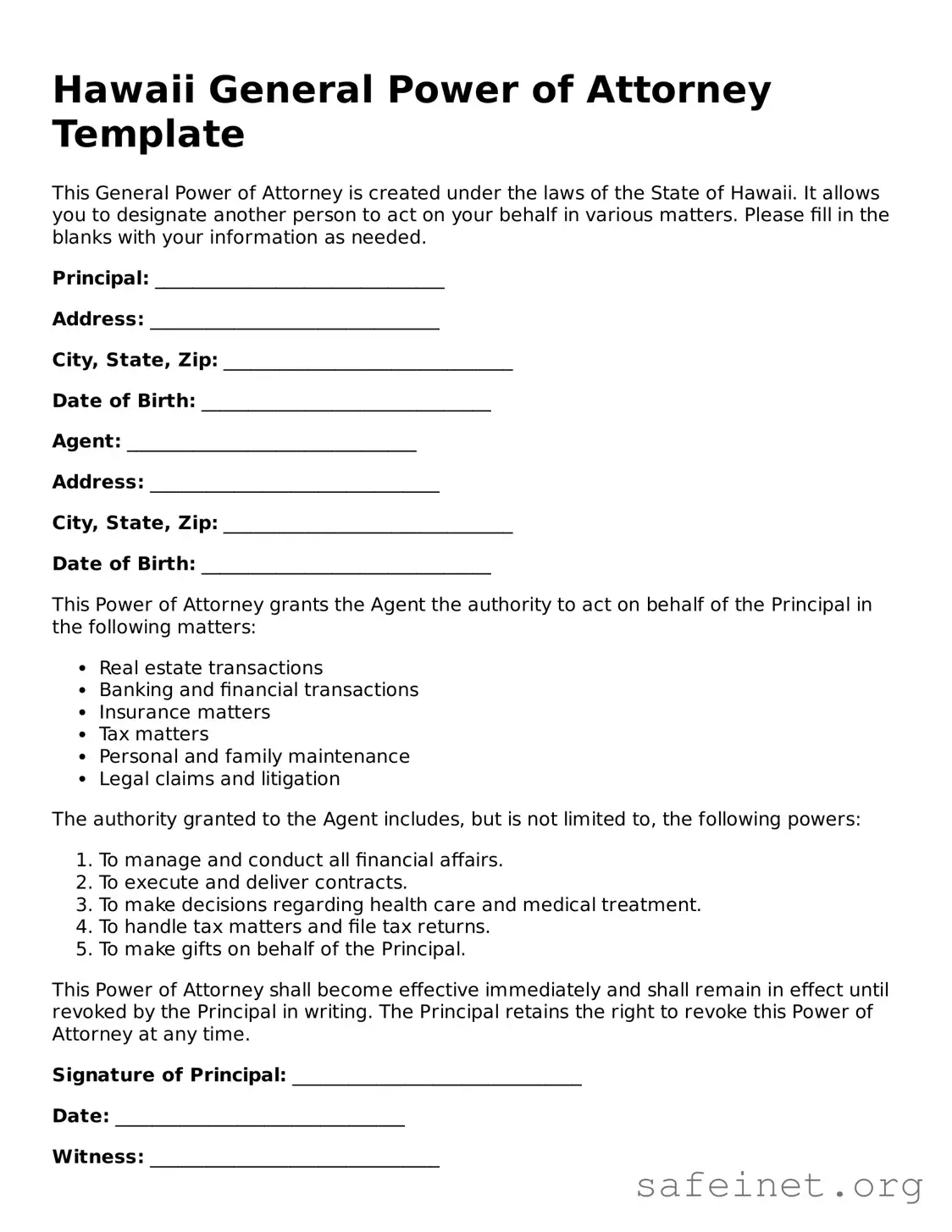
The Hawaii General Power of Attorney form is a crucial legal document that empowers an individual, known as the agent or attorney-in-fact, to make decisions on behalf of another person, referred to as the principal. This form is particularly important for those who may be unable to manage their affairs due to health issues, travel, or other circumstances. It allows the agent to handle various matters, including financial transactions, real estate decisions, and even legal issues. The document can be tailored to meet specific needs, granting broad or limited authority depending on the principal's preferences. Importantly, the General Power of Attorney can be revoked at any time, provided the principal is mentally competent. Understanding the implications and responsibilities associated with this form is essential for both the principal and the agent, as it ensures that decisions made align with the principal's wishes and best interests. Given the potential complexities involved, it is advisable to consider the implications of granting such powers carefully.
Hawaii General Power of Attorney Template
This General Power of Attorney is created under the laws of the State of Hawaii. It allows you to designate another person to act on your behalf in various matters. Please fill in the blanks with your information as needed.
Principal: _______________________________
Address: _______________________________
City, State, Zip: _______________________________
Date of Birth: _______________________________
Agent: _______________________________
Address: _______________________________
City, State, Zip: _______________________________
Date of Birth: _______________________________
This Power of Attorney grants the Agent the authority to act on behalf of the Principal in the following matters:
The authority granted to the Agent includes, but is not limited to, the following powers:
This Power of Attorney shall become effective immediately and shall remain in effect until revoked by the Principal in writing. The Principal retains the right to revoke this Power of Attorney at any time.
Signature of Principal: _______________________________
Date: _______________________________
Witness: _______________________________
Date: _______________________________
Notary Public: _______________________________
Date: _______________________________
| Fact Name | Description |
|---|---|
| Definition | A Hawaii General Power of Attorney allows an individual to grant another person the authority to make financial and legal decisions on their behalf. |
| Governing Law | The form is governed by Hawaii Revised Statutes, Chapter 551E, which outlines the rules and regulations for powers of attorney in Hawaii. |
| Durability | This form can be made durable, meaning it remains effective even if the principal becomes incapacitated. |
| Revocation | The principal can revoke the power of attorney at any time, provided they are mentally competent to do so. |
| Notarization | While notarization is not strictly required, it is highly recommended to ensure the document's validity and to prevent disputes. |
Filling out the Hawaii General Power of Attorney form is an important step in designating someone to make decisions on your behalf. Once you have completed the form, it will need to be signed and possibly notarized, depending on your specific needs. Here are the steps to help you fill it out correctly.
What is a Hawaii General Power of Attorney?
A Hawaii General Power of Attorney is a legal document that allows one person (the agent) to act on behalf of another person (the principal) in a variety of financial and legal matters. This form grants broad authority to the agent, enabling them to make decisions regarding property, finances, and other important matters as specified in the document. It is essential for individuals who may be unable to manage their affairs due to illness, travel, or other circumstances.
How do I create a General Power of Attorney in Hawaii?
To create a General Power of Attorney in Hawaii, you need to complete the required form, which can be obtained from various legal resources or online. The form must be signed by the principal in the presence of a notary public. It's important to ensure that the agent is someone you trust, as they will have significant control over your affairs. After signing, keep the document in a safe place and provide copies to your agent and any institutions that may require it.
Can I revoke a General Power of Attorney in Hawaii?
Yes, you can revoke a General Power of Attorney at any time, as long as you are mentally competent. To do this, you should create a written revocation document and notify your agent and any relevant institutions or individuals who may have received the original document. This ensures that your wishes are clear and that the agent no longer has authority over your affairs.
What happens if I become incapacitated and have a General Power of Attorney?
If you become incapacitated and have a General Power of Attorney in place, your designated agent can continue to make decisions on your behalf. This authority remains effective unless you have specified otherwise in the document. It's crucial to select an agent who understands your values and wishes, as they will be responsible for managing your affairs during this time.
Failing to specify the powers granted. It is essential to clearly outline the specific powers the agent will have. Without this clarity, the agent may not have the authority needed to act on behalf of the principal.
Not signing the form in the presence of a notary. In Hawaii, the General Power of Attorney must be notarized to be valid. Without a notary's signature, the document may not be recognized.
Overlooking the need for witnesses. Some situations may require the presence of witnesses when signing the form. Failing to include witnesses can lead to complications.
Using outdated forms. Laws and requirements can change. Always ensure that the most current version of the Hawaii General Power of Attorney form is being used to avoid legal issues.
Not reviewing the document after completion. It is important to carefully review the completed form for any errors or omissions. Mistakes can render the document invalid.
Neglecting to inform the agent. The principal should communicate with the agent about their responsibilities and the powers granted. This ensures that the agent is prepared to act when needed.
Failing to revoke an outdated or unnecessary power of attorney. If circumstances change, such as a new relationship or a change in health, it is crucial to revoke any previous power of attorney to prevent confusion.
A General Power of Attorney (POA) in Hawaii allows an individual, known as the principal, to designate another person, called the agent, to manage their financial and legal affairs. When creating or using a General Power of Attorney, several other forms and documents may be necessary to ensure comprehensive management of affairs. Below is a list of commonly used documents that often accompany a General Power of Attorney.
Understanding these documents can provide clarity and security when managing legal and financial matters. Each plays a distinct role in ensuring that the principal's intentions are honored and that their affairs are handled appropriately. It is advisable to consider these forms carefully when creating or updating a General Power of Attorney.
The Durable Power of Attorney is similar to the Hawaii General Power of Attorney in that it grants authority to an agent to make decisions on behalf of the principal. However, the key difference lies in its durability. While the General Power of Attorney typically becomes void if the principal becomes incapacitated, the Durable Power of Attorney remains effective even in such situations. This feature makes it particularly useful for long-term planning, ensuring that the agent can continue to act on behalf of the principal when they are unable to do so themselves.
The Medical Power of Attorney is another document that shares similarities with the Hawaii General Power of Attorney. This form specifically allows an individual to designate someone to make medical decisions on their behalf in the event they are unable to communicate their wishes. While the General Power of Attorney can cover a wide range of financial and legal matters, the Medical Power of Attorney focuses solely on health-related decisions. This distinction is crucial for individuals who want to ensure their healthcare preferences are respected during times of incapacity.
The Limited Power of Attorney is also comparable to the Hawaii General Power of Attorney, but with a significant limitation on the scope of authority granted. This document allows the principal to specify particular tasks or decisions that the agent is authorized to handle, rather than providing broad powers. This can be useful for specific transactions, such as selling a property or managing a bank account, where the principal wants to maintain control over other aspects of their affairs. The Limited Power of Attorney is ideal for situations requiring targeted authority without relinquishing overall control.
Lastly, the Springing Power of Attorney is similar in that it also designates an agent to act on behalf of the principal. However, it only becomes effective upon the occurrence of a specific event, typically the incapacitation of the principal. This type of document allows individuals to retain control over their affairs until a predetermined condition is met. In contrast, the Hawaii General Power of Attorney is effective immediately upon signing, making the Springing Power of Attorney a more cautious option for those who want to ensure their authority is only exercised under certain circumstances.
Filling out a General Power of Attorney form in Hawaii is an important task that requires careful attention. Here are ten things you should and shouldn't do when completing this form.
Following these guidelines will help ensure that your General Power of Attorney form is filled out correctly and meets legal requirements. It’s always wise to consult with a legal professional if you have any questions or concerns.
Understanding the Hawaii General Power of Attorney form can be challenging, especially with the many misconceptions surrounding it. Here are nine common misunderstandings that people often have:
Being informed about these misconceptions can help individuals make better decisions regarding their legal and financial affairs. It’s always best to consult with a professional to clarify any doubts and ensure that your documents reflect your intentions accurately.
When filling out and using the Hawaii General Power of Attorney form, consider the following key takeaways: