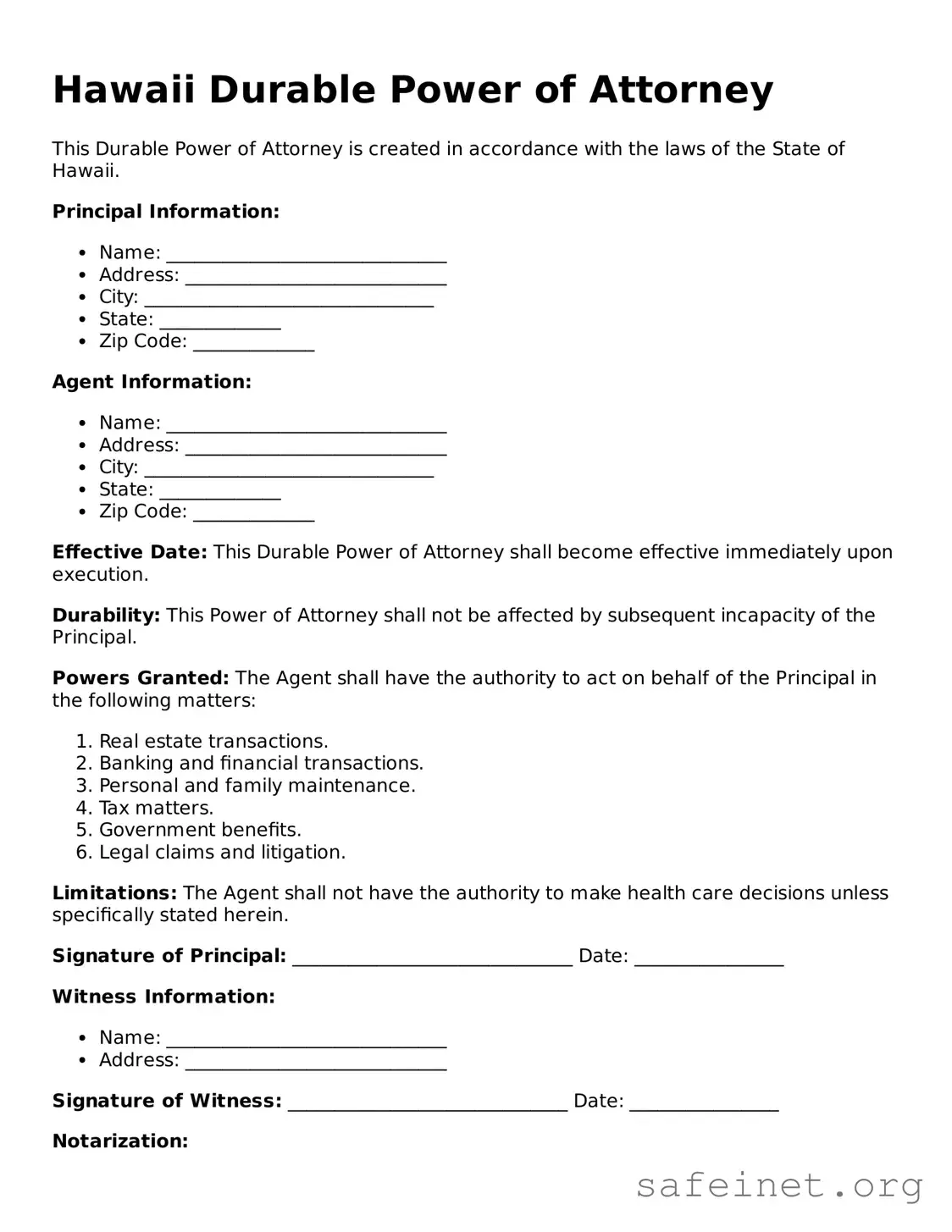
The Hawaii Durable Power of Attorney form serves as a crucial legal document, enabling individuals to appoint an agent to make financial and legal decisions on their behalf. This form is particularly significant because it remains effective even if the principal becomes incapacitated. By designating a trusted person, known as the attorney-in-fact, individuals can ensure that their financial matters are handled according to their wishes, without the need for court intervention. The form requires specific information, such as the names and addresses of both the principal and the agent, as well as the scope of authority granted. It is essential for the principal to clearly outline the powers bestowed upon the agent, which can range from managing bank accounts to handling real estate transactions. Additionally, the document must be signed and notarized to be legally binding, providing a safeguard against potential misuse. Understanding the nuances of this form is vital for anyone looking to secure their financial future and ensure their preferences are respected in times of need.
Hawaii Durable Power of Attorney
This Durable Power of Attorney is created in accordance with the laws of the State of Hawaii.
Principal Information:
Agent Information:
Effective Date: This Durable Power of Attorney shall become effective immediately upon execution.
Durability: This Power of Attorney shall not be affected by subsequent incapacity of the Principal.
Powers Granted: The Agent shall have the authority to act on behalf of the Principal in the following matters:
Limitations: The Agent shall not have the authority to make health care decisions unless specifically stated herein.
Signature of Principal: ______________________________ Date: ________________
Witness Information:
Signature of Witness: ______________________________ Date: ________________
Notarization:
State of Hawaii
County of ________________________
Subscribed and sworn before me this ______ day of ____________, 20____.
Notary Public: ______________________________
My commission expires: ________________
| Fact Name | Description |
|---|---|
| Definition | A Hawaii Durable Power of Attorney allows an individual to designate another person to manage their financial and legal affairs if they become incapacitated. |
| Governing Law | The form is governed by the Hawaii Revised Statutes, specifically Section 551E-1 through 551E-10. |
| Durability | This type of power of attorney remains effective even if the principal becomes mentally incompetent. |
| Principal and Agent | The person granting the power is known as the principal, while the person receiving the authority is called the agent or attorney-in-fact. |
| Scope of Authority | The agent can be granted broad or limited powers, depending on the principal's preferences outlined in the document. |
| Revocation | The principal can revoke the durable power of attorney at any time as long as they are mentally competent. |
| Witness and Notary Requirements | The document must be signed by the principal in the presence of two witnesses or a notary public to be valid. |
Filling out the Hawaii Durable Power of Attorney form is a straightforward process that allows you to designate someone to make decisions on your behalf. This is an important step in planning for your future and ensuring your wishes are respected.
What is a Durable Power of Attorney in Hawaii?
A Durable Power of Attorney is a legal document that allows an individual, known as the principal, to appoint another person, referred to as the agent or attorney-in-fact, to make decisions on their behalf. This authority remains effective even if the principal becomes incapacitated. In Hawaii, this document can cover a wide range of financial and health-related decisions, ensuring that the principal's wishes are honored when they are unable to communicate them directly.
How do I create a Durable Power of Attorney in Hawaii?
To create a Durable Power of Attorney in Hawaii, the principal must complete a form that meets state requirements. This form should clearly identify the principal and the agent, outline the specific powers granted, and be signed by the principal. It is advisable to have the document notarized to enhance its validity. While not required, having witnesses present during the signing can provide additional assurance that the document is executed properly.
Can I revoke a Durable Power of Attorney in Hawaii?
Yes, a Durable Power of Attorney can be revoked at any time by the principal, as long as they are mentally competent. To revoke the document, the principal should create a written notice stating their intention to revoke the Durable Power of Attorney and provide copies to the agent and any institutions or individuals who were relying on the original document. It is crucial to ensure that all parties are aware of the revocation to prevent any confusion or misuse of authority.
What powers can I grant to my agent in a Durable Power of Attorney?
The powers granted to an agent in a Durable Power of Attorney can be broad or limited, depending on the principal's wishes. Common powers include managing financial accounts, making healthcare decisions, selling property, and handling tax matters. It is essential for the principal to clearly outline which specific powers are granted to avoid ambiguity. This clarity helps ensure that the agent acts in the principal's best interest and adheres to their preferences.
What happens if I do not have a Durable Power of Attorney in place?
If a Durable Power of Attorney is not established and the principal becomes incapacitated, a court may need to appoint a guardian or conservator to make decisions on their behalf. This process can be time-consuming, costly, and may not align with the principal's wishes. Establishing a Durable Power of Attorney allows individuals to maintain control over their decisions and ensures that trusted individuals are in place to act according to their preferences during times of need.
Not specifying the powers granted. It's important to clearly outline what decisions the agent can make. Without this clarity, there could be confusion or disputes later.
Forgetting to date the document. A date is crucial as it indicates when the power of attorney becomes effective. An undated form may lead to complications.
Neglecting to sign in front of a notary. A notary public must witness the signatures to ensure the document is valid. Skipping this step can render the form ineffective.
Choosing the wrong agent. It’s essential to select someone trustworthy and capable of making decisions on your behalf. This choice should not be taken lightly.
Failing to inform the agent. After appointing an agent, it is crucial to discuss the role and responsibilities with them. This helps ensure they understand your wishes.
Not reviewing the form regularly. Life circumstances change, and so may your preferences. Regularly reviewing the document ensures it reflects your current wishes.
A Durable Power of Attorney (DPOA) allows an individual to designate someone to make decisions on their behalf, especially in financial or medical matters. When creating a DPOA in Hawaii, it is often beneficial to consider additional forms and documents that complement this legal tool. Below is a list of common documents that may be used alongside a DPOA.
Considering these additional forms can enhance the effectiveness of a Durable Power of Attorney. Each document serves a specific purpose and helps ensure that an individual's wishes are respected and their affairs are managed appropriately.
The Hawaii Durable Power of Attorney (DPOA) is similar to a General Power of Attorney (GPOA) in that both documents allow an individual, known as the principal, to designate someone else, called the agent, to make decisions on their behalf. However, the key difference lies in durability. While a GPOA becomes invalid if the principal becomes incapacitated, a DPOA remains effective even in such situations. This makes the DPOA particularly useful for long-term planning, ensuring that your financial and legal matters can be managed continuously, regardless of your health status.
Another document that shares similarities with the DPOA is the Medical Power of Attorney (MPOA). Like the DPOA, the MPOA allows you to appoint someone to make decisions on your behalf. However, the MPOA specifically focuses on medical and healthcare decisions. If you become unable to communicate your wishes regarding medical treatment, your designated agent can step in and make those critical choices for you. This ensures that your healthcare preferences are honored, even if you cannot voice them yourself.
A Living Will is also comparable to the DPOA in terms of planning for future scenarios. While a DPOA grants someone the authority to handle your financial and legal affairs, a Living Will outlines your preferences for medical treatment in specific situations, particularly at the end of life. This document communicates your wishes regarding life-sustaining measures and can guide your healthcare providers and loved ones in making decisions that align with your values and desires.
The Revocable Trust is another document that often goes hand in hand with a Durable Power of Attorney. A Revocable Trust allows you to place your assets into a trust while retaining control over them during your lifetime. Should you become incapacitated, the successor trustee can manage the assets on your behalf, similar to how an agent under a DPOA would operate. This can simplify the management of your estate and help avoid probate, offering a streamlined approach to handling your affairs.
Lastly, the Advance Healthcare Directive (AHD) is closely related to the DPOA. An AHD combines elements of a Living Will and a Medical Power of Attorney, allowing you to specify your healthcare preferences and appoint someone to make decisions for you. This document ensures that your medical wishes are clear and that a trusted individual can act on your behalf when you cannot. By having both a DPOA and an AHD, you create a comprehensive plan for both financial and medical decision-making, providing peace of mind for you and your loved ones.
When filling out a Durable Power of Attorney form in Hawaii, it is essential to approach the task with care and attention. This document grants someone the authority to make decisions on your behalf, so understanding the dos and don'ts is crucial. Below is a list to guide you through the process.
By following these guidelines, you can ensure that your Durable Power of Attorney form is completed correctly, providing peace of mind that your wishes will be honored when it matters most.
When it comes to the Hawaii Durable Power of Attorney (DPOA) form, there are several misconceptions that can lead to confusion. Understanding these misconceptions is crucial for making informed decisions. Here’s a breakdown of nine common misunderstandings:
Understanding these misconceptions can help individuals make better decisions regarding their legal planning and ensure their wishes are respected in the event of incapacity.
Filling out and using the Hawaii Durable Power of Attorney form can be an important step in planning for the future. Here are some key takeaways to keep in mind: