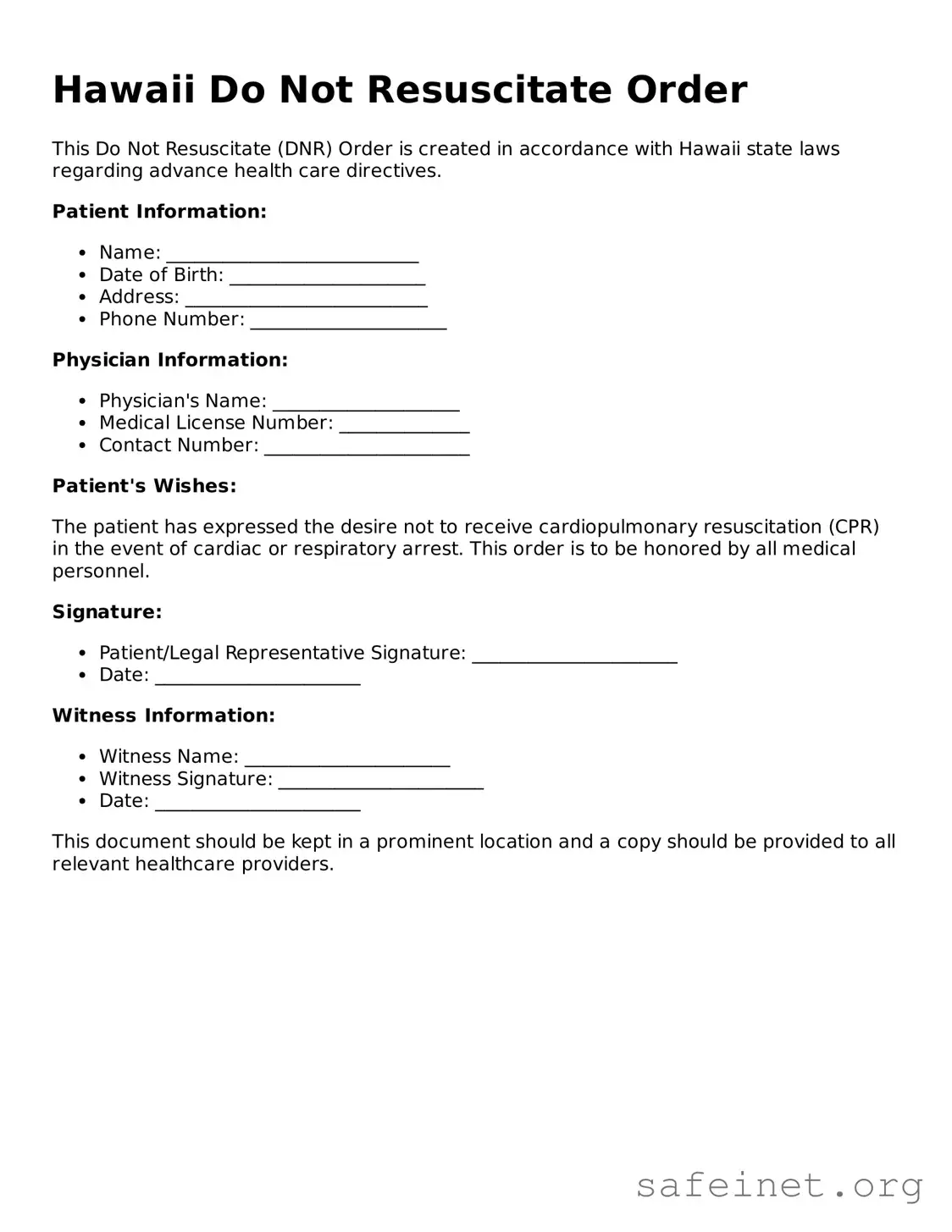
In the beautiful state of Hawaii, the Do Not Resuscitate (DNR) Order form serves as a crucial tool for individuals who wish to express their preferences regarding medical treatment in emergency situations. This form allows patients to communicate their desire not to receive cardiopulmonary resuscitation (CPR) or other life-saving measures if their heart stops beating or they stop breathing. It is important to understand that a DNR order is not a decision to forgo all medical care; rather, it specifically addresses the circumstances under which resuscitation efforts should not be initiated. The form must be completed and signed by a physician, ensuring that it reflects the patient’s wishes and is legally recognized. Additionally, the DNR Order must be readily accessible to medical personnel, often kept in a visible location or included in the patient's medical records. Understanding this form empowers individuals to take control of their healthcare decisions and ensures that their preferences are honored, particularly during critical moments when they may not be able to communicate their wishes themselves.
Hawaii Do Not Resuscitate Order
This Do Not Resuscitate (DNR) Order is created in accordance with Hawaii state laws regarding advance health care directives.
Patient Information:
Physician Information:
Patient's Wishes:
The patient has expressed the desire not to receive cardiopulmonary resuscitation (CPR) in the event of cardiac or respiratory arrest. This order is to be honored by all medical personnel.
Signature:
Witness Information:
This document should be kept in a prominent location and a copy should be provided to all relevant healthcare providers.
| Fact Name | Description |
|---|---|
| Definition | A Do Not Resuscitate (DNR) order is a legal document that instructs medical personnel not to perform cardiopulmonary resuscitation (CPR) in the event of cardiac arrest. |
| Governing Law | The Hawaii Do Not Resuscitate Order is governed by Hawaii Revised Statutes § 327-1 through § 327-3. |
| Eligibility | Individuals who are 18 years or older and are capable of making their own medical decisions can complete a DNR order. |
| Signature Requirement | The form must be signed by the patient or the patient's legal representative. |
| Healthcare Provider Signature | A physician must also sign the DNR order to validate it. |
| Form Availability | The DNR order form can be obtained from healthcare providers or the Hawaii Department of Health. |
| Revocation | A DNR order can be revoked at any time by the patient or their legal representative. |
| Emergency Medical Services | Emergency medical services must honor the DNR order if it is properly completed and signed. |
| Notification Requirement | Patients should inform family members and healthcare providers about the existence of a DNR order. |
| State Registry | Hawaii does not have a centralized registry for DNR orders; individuals should keep their forms accessible. |
Filling out the Hawaii Do Not Resuscitate Order form is an important step in expressing your healthcare preferences. This process allows individuals to communicate their wishes regarding medical treatment in situations where they may not be able to speak for themselves. It is essential to approach this task thoughtfully and with care.
After completing the form, it is crucial to keep it accessible. Providing copies to your healthcare provider and loved ones ensures that your preferences are known and can be honored in a medical setting.
What is a Do Not Resuscitate (DNR) Order in Hawaii?
A Do Not Resuscitate Order is a legal document that allows a person to refuse resuscitation efforts in the event of a medical emergency. In Hawaii, this order specifically instructs healthcare providers not to perform cardiopulmonary resuscitation (CPR) or other life-saving measures if a patient’s heart stops beating or they stop breathing.
Who can request a DNR Order in Hawaii?
In Hawaii, a DNR Order can be requested by any adult who is capable of making their own medical decisions. This includes individuals who are facing a terminal illness or a condition that significantly limits their quality of life. A physician must also be involved in the process to ensure that the order is medically appropriate.
How do I obtain a DNR Order in Hawaii?
To obtain a DNR Order, you should first discuss your wishes with your healthcare provider. If both you and your doctor agree that a DNR Order is appropriate, your doctor will help you complete the necessary form. The form must be signed by both you and your physician to be valid.
Is a DNR Order legally binding in Hawaii?
Yes, a DNR Order is legally binding in Hawaii as long as it is properly completed and signed by both the patient and their physician. Healthcare providers are required to honor this order in emergency situations, ensuring that the patient’s wishes are respected.
Can a DNR Order be revoked?
Yes, a DNR Order can be revoked at any time. If you decide that you no longer want the order to be in effect, you can verbally communicate this to your healthcare provider or complete a new form that states your wishes. It is important to inform all relevant parties, including family members and healthcare providers, of the revocation.
Where should I keep my DNR Order?
It is essential to keep your DNR Order in a place that is easily accessible. Many people choose to keep it in their medical records, with their advance directives, or in a visible location at home. Additionally, consider providing copies to your family members and healthcare providers to ensure everyone is aware of your wishes.
Will a DNR Order affect other medical treatments?
A DNR Order specifically addresses resuscitation efforts and does not affect other medical treatments. You will still receive appropriate medical care, including pain management and other interventions, as needed. It is important to discuss your overall treatment preferences with your healthcare provider.
Can I have a DNR Order if I am not terminally ill?
Yes, individuals who are not terminally ill can still request a DNR Order if they wish to avoid resuscitation efforts. This decision is personal and should be made in consultation with a healthcare provider, considering the individual’s overall health and quality of life.
What should I discuss with my family regarding my DNR Order?
It is crucial to have open conversations with your family about your DNR Order. Discuss your reasons for wanting the order, your values, and your wishes regarding end-of-life care. Ensuring that your family understands your preferences can help avoid confusion and conflict during critical moments.
Can I change my mind about a DNR Order?
Absolutely. You have the right to change your mind about a DNR Order at any time. If you decide to do so, make sure to communicate your new wishes clearly to your healthcare provider and family members. Keeping your documentation updated will help ensure that your preferences are respected.
Failing to understand the purpose of the form. Many individuals fill out the Hawaii Do Not Resuscitate Order form without fully grasping its implications. It’s essential to recognize that this document is a medical order indicating a patient’s wishes regarding resuscitation.
Not consulting with a healthcare provider. It’s a common mistake to complete the form without discussing it with a doctor or healthcare professional. Their guidance can help clarify the patient’s medical condition and prognosis, ensuring informed decisions.
Inadequate signature. Some people forget to sign the form or do not have the required witnesses present during the signing process. A valid signature is crucial for the document to be recognized legally.
Missing necessary information. Individuals often overlook filling in critical details, such as the patient’s full name, date of birth, and medical record number. Incomplete forms may lead to confusion or invalidation.
Not discussing the decision with family. It’s important to communicate intentions with family members. Failing to do so can lead to misunderstandings and conflicts during critical moments.
Choosing the wrong version of the form. Hawaii has specific forms for different situations. Using the incorrect version can result in the document not being honored in a medical emergency.
Neglecting to update the form. Life circumstances change, and so do medical preferences. Some individuals forget to revisit and update their Do Not Resuscitate Order as their health status or wishes evolve.
Assuming the form is automatically recognized. Some may believe that simply having the form means medical personnel will always honor it. However, it’s essential to ensure that healthcare providers are aware of the order and have access to it when needed.
Not keeping copies accessible. After completing the form, it’s vital to make copies and distribute them to relevant parties, including family members and healthcare providers. Storing the document in an accessible location ensures it can be easily retrieved in emergencies.
The Hawaii Do Not Resuscitate (DNR) Order form is an important document that allows individuals to express their wishes regarding resuscitation efforts in the event of a medical emergency. Along with this form, several other documents can help ensure that a person's healthcare preferences are respected. Here’s a list of commonly used forms that complement the DNR Order:
Having these documents in place can provide clarity and peace of mind for both individuals and their loved ones. It ensures that healthcare providers are aware of and respect a person's wishes regarding medical treatment and interventions.
The Advance Healthcare Directive is a crucial document that shares similarities with the Hawaii Do Not Resuscitate Order form. Both documents allow individuals to express their healthcare preferences in advance, ensuring that their wishes are respected when they can no longer communicate them. An Advance Healthcare Directive typically includes instructions about medical treatments and appoints a healthcare agent to make decisions on behalf of the individual. This proactive approach to healthcare planning empowers individuals to take control of their medical care even when they are unable to voice their choices directly.
The Physician Orders for Life-Sustaining Treatment (POLST) form is another document that aligns closely with the Hawaii Do Not Resuscitate Order. Like the DNR, the POLST is a medical order that outlines a patient’s preferences for life-sustaining treatments. However, the POLST goes a step further by addressing a broader range of medical interventions, including preferences for resuscitation, hospitalization, and other critical care measures. It is intended for individuals with serious health conditions and is typically completed in consultation with a healthcare provider, ensuring that the orders reflect the patient’s current medical situation and wishes.
The Living Will is also similar to the Hawaii Do Not Resuscitate Order, as both documents express a person's healthcare preferences. A Living Will specifically outlines the types of medical treatment an individual does or does not want in situations where they are terminally ill or permanently unconscious. While the DNR focuses primarily on resuscitation efforts, the Living Will encompasses a wider array of medical decisions. This document serves as a clear guide for family members and healthcare providers, helping to alleviate the burden of decision-making during emotionally challenging times.
When filling out the Hawaii Do Not Resuscitate Order form, it’s important to follow certain guidelines to ensure that your wishes are clearly communicated. Here’s a list of things you should and shouldn’t do:
Understanding the Hawaii Do Not Resuscitate (DNR) Order form is essential for making informed decisions about medical care. Here are four common misconceptions that can lead to confusion.
Clarifying these misconceptions can help individuals make better-informed decisions regarding their health care preferences and ensure that their wishes are respected.
When considering the Hawaii Do Not Resuscitate (DNR) Order form, it is important to understand its implications and requirements. Here are some key takeaways: