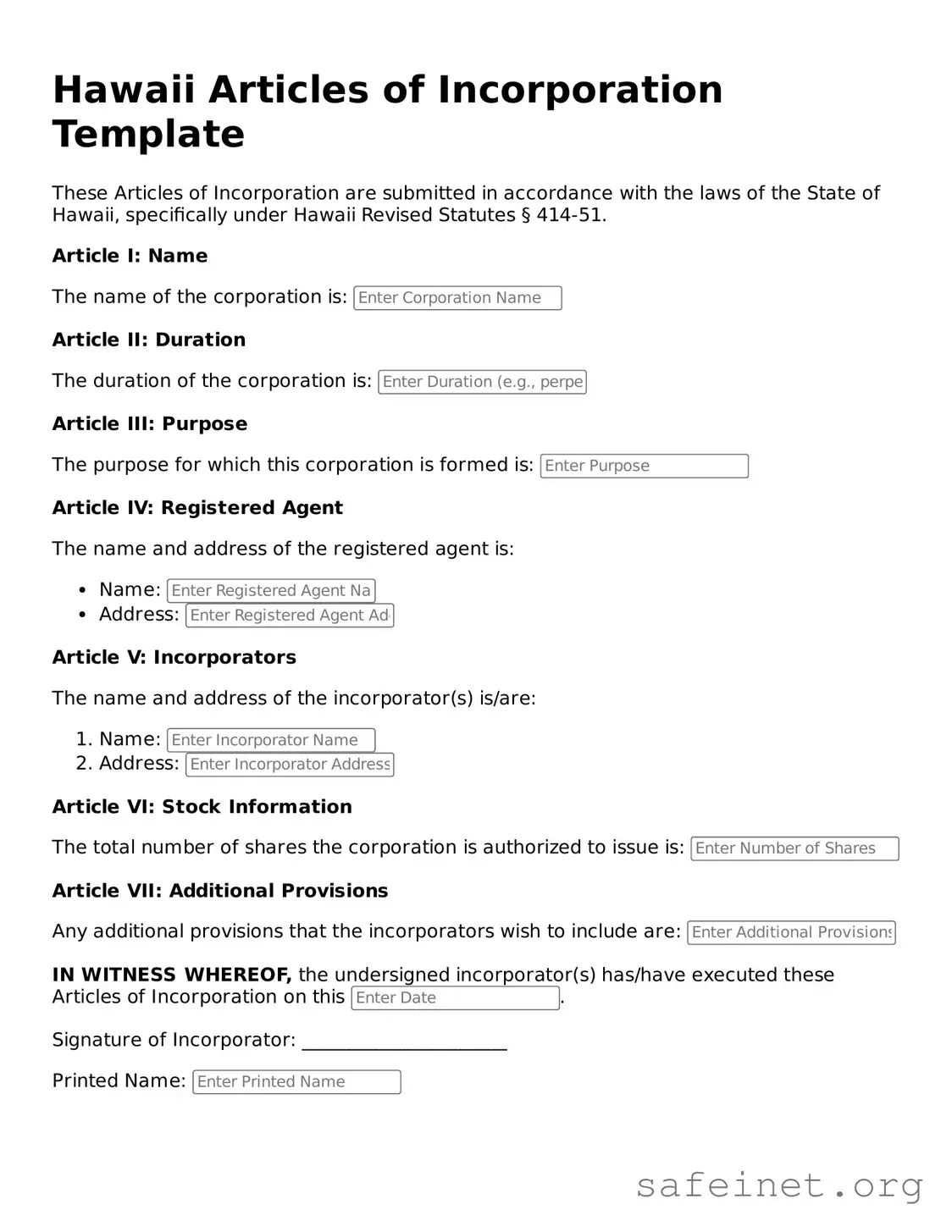
When starting a business in Hawaii, one of the first steps is to file the Articles of Incorporation form. This essential document lays the foundation for your corporation, providing vital information that the state requires to recognize your business officially. It includes key details such as the corporation's name, the purpose of the business, and the address of its principal office. Additionally, the form requires information about the registered agent, who will be responsible for receiving legal documents on behalf of the corporation. It's important to ensure that all information is accurate and complete, as any errors could delay the incorporation process. Filing this form not only establishes your business as a legal entity but also protects your personal assets from business liabilities. Understanding these aspects is crucial for anyone looking to navigate the incorporation process in Hawaii effectively.
Hawaii Articles of Incorporation Template
These Articles of Incorporation are submitted in accordance with the laws of the State of Hawaii, specifically under Hawaii Revised Statutes § 414-51.
Article I: Name
The name of the corporation is:
Article II: Duration
The duration of the corporation is:
Article III: Purpose
The purpose for which this corporation is formed is:
Article IV: Registered Agent
The name and address of the registered agent is:
Article V: Incorporators
The name and address of the incorporator(s) is/are:
Article VI: Stock Information
The total number of shares the corporation is authorized to issue is:
Article VII: Additional Provisions
Any additional provisions that the incorporators wish to include are:
IN WITNESS WHEREOF, the undersigned incorporator(s) has/have executed these Articles of Incorporation on this .
Signature of Incorporator: ______________________
Printed Name:
| Fact Name | Description |
|---|---|
| Governing Law | The Hawaii Articles of Incorporation are governed by the Hawaii Revised Statutes, Chapter 414. |
| Purpose | The form is used to legally establish a corporation in the state of Hawaii. |
| Filing Requirement | All corporations must file the Articles of Incorporation with the Department of Commerce and Consumer Affairs. |
| Information Needed | Key information includes the corporation's name, purpose, and the registered agent's details. |
| Processing Time | Typically, processing takes about 10 business days, but expedited options are available. |
After you complete the Hawaii Articles of Incorporation form, you will need to submit it to the appropriate state office along with the required filing fee. This is a crucial step in establishing your business as a legal entity in Hawaii.
What is the purpose of the Hawaii Articles of Incorporation form?
The Hawaii Articles of Incorporation form is a legal document that establishes a corporation in the state of Hawaii. It serves to officially create a corporation as a separate legal entity, distinct from its owners. This form outlines essential details such as the corporation's name, its purpose, the address of its principal office, and information about its directors and officers. By filing this document, individuals can gain limited liability protection, meaning their personal assets are generally protected from the corporation's debts and liabilities.
Who is required to file the Articles of Incorporation in Hawaii?
Any individual or group wishing to form a corporation in Hawaii must file the Articles of Incorporation. This includes entrepreneurs, business partners, and organizations that seek to operate as a corporation. The form must be completed and submitted to the Department of Commerce and Consumer Affairs (DCCA) in Hawaii. It is important to ensure that the information provided is accurate and complies with state regulations to avoid delays in the incorporation process.
What information is needed to complete the Articles of Incorporation form?
To complete the Articles of Incorporation form, several key pieces of information are required. This includes the proposed name of the corporation, which must be unique and not already in use by another entity in Hawaii. Additionally, the form requires the corporation's purpose, the address of the principal office, and the names and addresses of the initial directors and officers. Depending on the type of corporation being formed, other details may also be necessary, such as the number of shares the corporation is authorized to issue.
How long does it take for the Articles of Incorporation to be processed?
The processing time for the Articles of Incorporation in Hawaii can vary. Typically, it may take several days to a few weeks, depending on the volume of filings the Department of Commerce and Consumer Affairs is handling at that time. To expedite the process, individuals may choose to file online, which can often lead to quicker processing times. Once the Articles are approved, the corporation will receive a Certificate of Incorporation, officially recognizing its existence as a legal entity in Hawaii.
Failing to choose a unique name for the corporation. The name must not be similar to existing businesses registered in Hawaii.
Omitting the designation of the corporation type. It's essential to specify whether it is a profit or nonprofit corporation.
Not providing a physical address for the corporation's principal office. A P.O. Box is not acceptable.
Leaving out the registered agent's information. This individual or entity must be located in Hawaii and is responsible for receiving legal documents.
Incorrectly listing the number of authorized shares. Ensure that the figures reflect the corporation's structure accurately.
Failing to include the names and addresses of the initial directors. This information is crucial for the formation process.
Not signing the form. The Articles of Incorporation must be signed by the incorporator, confirming their intent to form the corporation.
Using outdated forms. Always ensure you are using the most current version of the Articles of Incorporation form.
Neglecting to check for spelling and grammatical errors. Such mistakes can lead to delays or rejections.
Submitting the form without the required filing fee. Payment must accompany the submission for the process to proceed.
When forming a corporation in Hawaii, the Articles of Incorporation is a crucial document. However, several other forms and documents are often necessary to complete the incorporation process and ensure compliance with state regulations. Here are some key documents that are commonly used alongside the Articles of Incorporation.
Each of these documents plays a significant role in establishing and maintaining a corporation in Hawaii. By preparing and filing them correctly, you can help ensure your business operates smoothly and in compliance with applicable laws.
The Articles of Incorporation form in Hawaii is similar to the Certificate of Incorporation used in many other states. Both documents serve as the foundational legal paperwork required to officially create a corporation. They typically include essential information such as the corporation's name, purpose, and the address of its registered office. While the specifics may vary by state, the overall purpose remains the same: to establish a legal entity recognized by the state and to delineate the rights and responsibilities of the corporation and its stakeholders.
Another document comparable to the Articles of Incorporation is the Bylaws of a corporation. While the Articles provide the basic framework for the corporation's existence, the Bylaws outline the internal rules and procedures for governance. This includes details on how meetings are conducted, how directors are elected, and the roles of officers. Essentially, while the Articles lay the groundwork, the Bylaws provide the operational blueprint for how the corporation will function day-to-day.
The Operating Agreement is similar to the Articles of Incorporation but is specific to Limited Liability Companies (LLCs). Like the Articles, it is a foundational document that outlines the structure and management of the LLC. It details the members' rights and responsibilities, how profits and losses will be distributed, and the procedures for adding or removing members. While the Articles of Incorporation are necessary for corporations, an Operating Agreement is crucial for LLCs, providing a clear framework for operation.
In addition, the Partnership Agreement is akin to the Articles of Incorporation in that it establishes the terms under which a partnership will operate. This document outlines the roles of each partner, how profits and losses will be shared, and the procedures for resolving disputes. Just as the Articles define the legal structure of a corporation, the Partnership Agreement defines the relationship and responsibilities among partners, ensuring clarity and reducing potential conflicts.
The Certificate of Good Standing, while not a formation document, is also related to the Articles of Incorporation. This certificate verifies that a corporation exists and is compliant with state regulations. It is often required for various business transactions, such as applying for loans or entering into contracts. Just as the Articles of Incorporation establish the corporation, the Certificate of Good Standing confirms its ongoing legitimacy and adherence to legal requirements.
Another similar document is the Statement of Information, which some states require corporations to file periodically after incorporation. This document provides updated information about the corporation, such as its officers, address, and business activities. It serves to keep the state informed about the corporation’s current status, much like how the Articles of Incorporation initially inform the state of the corporation’s formation and purpose.
Lastly, the Business License is another document that, while different in purpose, shares similarities with the Articles of Incorporation. Both are essential for legal operation within a state. The Articles of Incorporation establish the corporation's legal identity, while the Business License grants permission to operate within a specific jurisdiction. Each document plays a crucial role in ensuring that the business is recognized and allowed to function within the legal framework of its location.
When filling out the Hawaii Articles of Incorporation form, it's essential to follow specific guidelines to ensure a smooth process. Here are six things you should and shouldn't do:
By adhering to these guidelines, you can help ensure that your Articles of Incorporation are processed efficiently.
When it comes to the Hawaii Articles of Incorporation form, there are several misconceptions that can lead to confusion. Understanding the truth behind these myths is essential for anyone looking to incorporate in Hawaii.
This is not true. You can incorporate in Hawaii even if you live outside the state. However, you will need a registered agent who has a physical address in Hawaii.
Incorporating does not ensure success. It provides legal protection and structure, but the success of your business depends on various factors, including your business plan and market conditions.
While the Articles are important, you may also need other documents, such as bylaws, operating agreements, and permits, depending on your business type.
There are specific times when filing is advisable, especially concerning tax deadlines and business licenses. It's best to check local regulations.
This is incorrect. You can amend your Articles of Incorporation if changes are needed, such as a change in business name or address.
While the process may seem daunting, many resources are available to help small business owners navigate incorporation. It's often simpler than it appears.
This is a common misconception. Not every business needs to incorporate. Depending on your goals and structure, you may choose other options like sole proprietorship or partnership.
Filling out the Hawaii Articles of Incorporation form is a crucial step for anyone looking to establish a corporation in the Aloha State. Here are some key takeaways to keep in mind:
By keeping these points in mind, you can navigate the process of completing and submitting the Hawaii Articles of Incorporation with confidence.