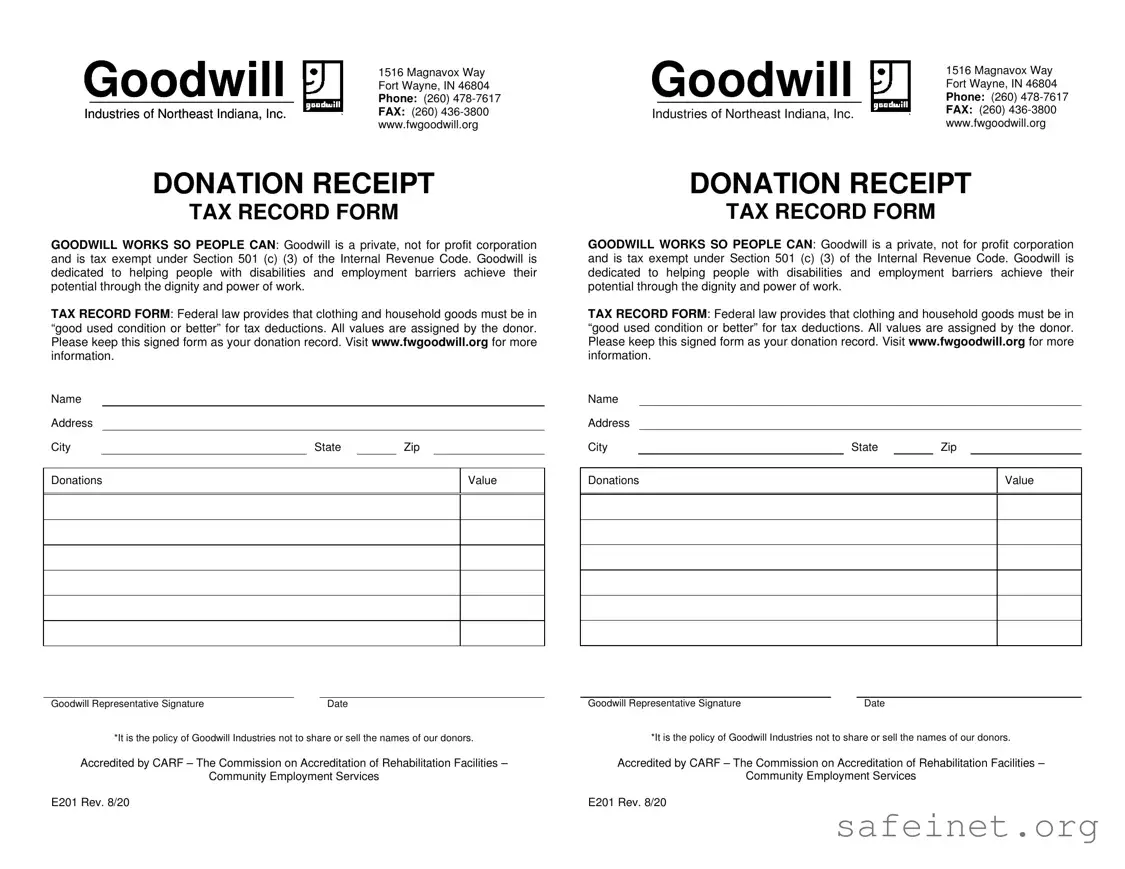
When donating items to Goodwill, many people may overlook the importance of obtaining a donation receipt. This simple yet vital document serves multiple purposes, ensuring that donors can acknowledge their charitable contributions for tax purposes. The Goodwill donation receipt form typically includes essential details such as the date of the donation, a description of the items donated, and their estimated value. It also provides space for the donor’s name and contact information, which can be crucial for record-keeping. By filling out this form, donors not only support Goodwill’s mission of providing job training and employment services but also gain a tangible record of their generosity. Understanding how to properly complete and utilize this receipt can enhance the donation experience and ensure that both the donor and Goodwill benefit from the transaction.
| Fact Name | Description |
|---|---|
| Purpose of the Receipt | The Goodwill donation receipt serves as proof of a charitable contribution for tax purposes. |
| Tax Deductibility | Donations made to Goodwill may be tax-deductible, subject to IRS regulations. |
| Itemization Requirement | Donors must itemize their contributions on their tax returns to claim deductions. |
| Value of Donations | Donors should provide a reasonable estimate of the fair market value of their items. |
| State-Specific Forms | Some states may have specific requirements for donation receipts; check local laws. |
| Governing Laws | IRS guidelines under Section 170 govern the tax treatment of charitable contributions. |
| Record Keeping | Donors should keep the receipt for their records, especially for tax filing. |
| Donation Limits | There may be limits on the amount of charitable contributions that can be deducted. |
| Non-Cash Donations | The receipt is particularly important for non-cash donations, which require valuation. |
After you have gathered your items for donation to Goodwill, you will need to complete a donation receipt form. This form serves as a record of your contribution, which may be useful for tax purposes. Follow these steps to fill out the form accurately.
What is a Goodwill donation receipt form?
A Goodwill donation receipt form is a document that you receive when you donate items to Goodwill Industries. This receipt serves as proof of your donation and can be used for tax purposes. It typically includes details such as the date of the donation, a description of the items donated, and the estimated value of those items. Keeping this receipt is important, as it can help you claim a charitable deduction on your tax return.
How do I obtain a Goodwill donation receipt?
When you make a donation to Goodwill, you can request a receipt from the staff at the donation center. In most cases, they will provide you with a printed receipt right at the time of your donation. If you are donating items through a drop-off location, be sure to ask for a receipt before you leave. Some locations may also offer digital receipts, which can be sent to your email.
What items can I donate to Goodwill?
Goodwill accepts a wide range of items, including clothing, household goods, electronics, and furniture. However, there are some restrictions. Items that are damaged, soiled, or otherwise unsellable may not be accepted. It's always best to check with your local Goodwill for specific guidelines on acceptable donations. This ensures that your donation is helpful and aligns with Goodwill's mission.
Can I deduct the value of my donations on my taxes?
Yes, you can typically deduct the value of your donations on your federal tax return, provided you itemize your deductions. The IRS allows you to claim a deduction for the fair market value of the items you donated. To determine this value, you may want to consult resources such as the IRS guidelines or donation valuation guides. Keeping your Goodwill donation receipt will help substantiate your claim in case of an audit.
What should I do if I lose my Goodwill donation receipt?
If you lose your Goodwill donation receipt, it may be challenging to claim a deduction. However, you can still try to reconstruct your donation history. Consider keeping a detailed list of the items you donated, along with their estimated values. You might also reach out to your local Goodwill location, as they may have records of your donation. While they may not be able to provide a duplicate receipt, they could offer assistance in verifying your donation.
Incorrect Date: Many donors forget to write the correct date of the donation. This can lead to confusion when tracking donations for tax purposes.
Missing Signature: A signature is often required on the receipt. Without it, the receipt may not be valid for tax deductions.
Inaccurate Item Descriptions: Donors sometimes fail to provide detailed descriptions of the items donated. Vague descriptions can make it difficult to determine the value of the donation.
Failure to Estimate Value: Some individuals neglect to estimate the fair market value of their donated items. This information is crucial for tax deductions.
Not Keeping a Copy: Donors often do not keep a copy of the receipt for their records. This can create issues when filing taxes or if proof of donation is needed later.
Leaving Out Contact Information: Some people forget to include their contact information on the receipt. This can hinder Goodwill's ability to reach out if there are questions about the donation.
Not Checking for Errors: Before submitting the form, donors sometimes overlook simple mistakes. Reviewing the form can prevent potential issues.
When making donations to organizations like Goodwill, several forms and documents may accompany the Goodwill donation receipt. These documents serve various purposes, from providing additional information about the donation to ensuring compliance with tax regulations. Below is a list of common forms and documents often used alongside the Goodwill donation receipt.
Understanding these documents can enhance the donation experience and ensure that all necessary information is accurately recorded. This not only aids in tax preparation but also strengthens the relationship between donors and charitable organizations.
The Goodwill donation receipt form is similar to a charitable contribution receipt. Both documents serve as proof of donation for tax purposes. When individuals donate items to a charitable organization, they often receive a receipt that details the items donated and their estimated value. This receipt can be used when filing taxes to claim deductions, thus providing financial benefits to the donor. Just like the Goodwill form, the charitable contribution receipt helps ensure transparency and accountability in the donation process.
An additional document that shares similarities is the IRS Form 8283, which is used for noncash charitable contributions. This form is required when the total value of noncash donations exceeds $500. Like the Goodwill receipt, Form 8283 provides a way for donors to report the items they have donated, along with their fair market value. Both documents are crucial for individuals seeking to maximize their tax deductions while supporting charitable causes.
Finally, a donor's tax return itself can be compared to the Goodwill donation receipt form. While the tax return is a comprehensive document that includes all income and deductions, it relies on supporting documents like the Goodwill receipt to substantiate claims made about charitable contributions. Both documents work together to ensure that donors can accurately report their charitable giving, ultimately benefiting both the donor and the charitable organization.
When filling out the Goodwill donation receipt form, it's important to follow some best practices. Here’s a list of things you should and shouldn’t do:
By following these guidelines, you can ensure that your donation process goes smoothly and that you have the necessary documentation for tax purposes.
Many people have misconceptions about the Goodwill donation receipt form. Understanding the truth can help ensure that your donations are handled correctly and that you receive the appropriate acknowledgment for your generosity. Here are five common misconceptions:
While the receipt can be used for tax deductions, it serves another important purpose. It also acts as proof of your charitable contribution, which can be useful for personal records or when tracking your donations over time.
This is not true. You can receive a receipt for any donation made to Goodwill, even if you do not list specific items. However, providing details can help with tax deductions.
Actually, it is the donor's responsibility to assign a value to their items. Goodwill provides a general guideline for valuing items, but it is up to you to determine what you believe your items are worth.
While donations to Goodwill are generally tax-deductible, there are exceptions. For example, if you receive something in return for your donation, such as a service or product, the donation may not be fully deductible.
This is a common misunderstanding. You can receive the receipt after you make your donation. Goodwill staff will provide you with the receipt once your items have been dropped off.
When filling out and using the Goodwill donation receipt form, keep the following key takeaways in mind:
Following these steps can simplify the donation process and help maximize your benefits.