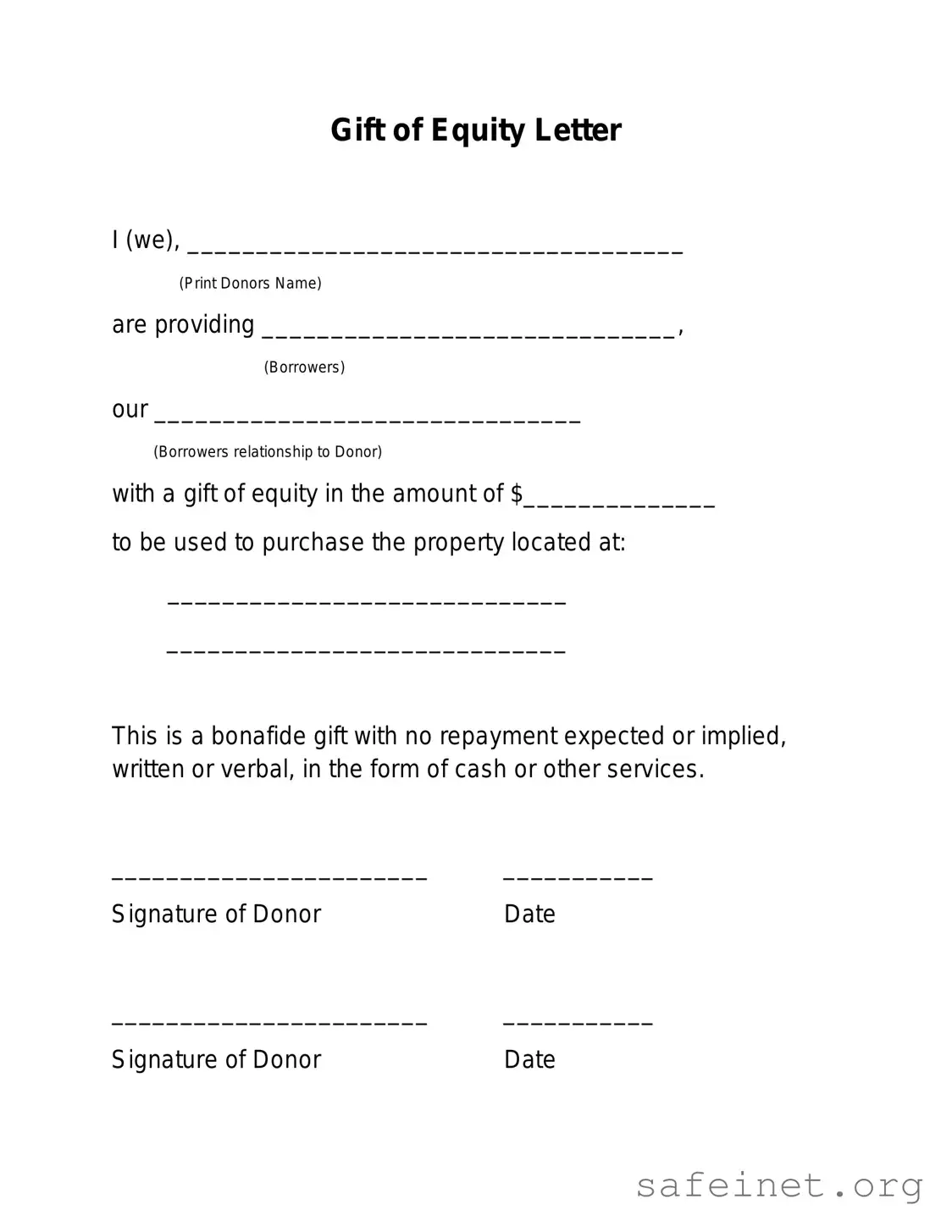
The Gift of Equity Letter form serves a crucial role in real estate transactions, particularly when family members or close friends assist one another in purchasing property. This document allows the donor, typically a family member, to provide a financial gift in the form of equity to the borrower, who is often a relative or close friend. The letter specifies the amount of equity being gifted and clarifies that this is a genuine gift with no expectation of repayment, either in cash or through services. Key details include the names of the donor and borrower, their relationship, and the property address. Additionally, the form requires the signatures of the donors, along with the date, to validate the transaction. By clearly outlining these elements, the Gift of Equity Letter helps ensure a smooth and transparent process for all parties involved.

| Fact Name | Description |
|---|---|
| Purpose | The Gift of Equity Letter is used to document a gift of equity from a donor to a borrower for the purchase of property. |
| Donor Information | The letter requires the donor's name to be printed clearly, ensuring proper identification. |
| Borrower Relationship | It is essential to specify the relationship between the donor and the borrower, which can include family members or close friends. |
| Gift Amount | The amount of equity being gifted must be clearly stated, providing transparency in the transaction. |
| No Repayment | The letter confirms that the gift is a bona fide gift with no expectation of repayment, either in cash or services. |
| State-Specific Laws | Each state may have specific laws governing the use of gift letters, including tax implications. It's important to check local regulations. |
Completing the Gift Of Equity Letter form is an important step in facilitating a property transaction. This letter outlines the terms of the gift and ensures clarity for all parties involved. Follow the steps below to accurately fill out the form.
What is a Gift of Equity Letter?
A Gift of Equity Letter is a formal document that outlines a financial gift provided by a donor to a borrower, typically a family member or close friend. This letter specifies the amount of equity being gifted, which can be used toward the purchase of a property. The letter confirms that the gift is genuine, with no expectation of repayment, ensuring that both parties have a clear understanding of the transaction.
Who can be a donor and a borrower in a Gift of Equity Letter?
The donor is typically a person who owns a property and wishes to assist someone in purchasing it. This could be a parent, grandparent, sibling, or other close relatives. The borrower is the individual receiving the gift of equity, often a family member who is purchasing the property. The relationship between the donor and borrower should be clearly stated in the letter to establish the nature of the transaction.
What information is required in the Gift of Equity Letter?
The Gift of Equity Letter should include the full names of both the donor and the borrower, their relationship, the specific amount of equity being gifted, and the address of the property involved. Additionally, the letter must be signed by the donor, along with the date of signing. This information ensures that the gift is documented properly and can be referenced in any future transactions or discussions.
Is the Gift of Equity Letter legally binding?
Failing to include complete names of both the donor and borrower. It is essential to provide full names as they appear on legal documents.
Not specifying the relationship between the donor and borrower. This information is crucial to establish the context of the gift.
Leaving the amount of the gift blank. Clearly stating the monetary value of the gift of equity is necessary for clarity.
Omitting the property address. The form must include the exact location of the property to avoid confusion.
Not indicating that the gift is a bonafide gift. This statement is important to clarify that the gift does not require repayment.
Using ambiguous language or terms that could be misinterpreted. Clear and straightforward language helps prevent misunderstandings.
Neglecting to provide signatures and dates. Both donor signatures and the date are necessary for the document to be valid.
Not keeping a copy of the letter for personal records. It is wise to retain a copy for future reference and documentation.
Failing to consult with a legal expert if there are uncertainties. Seeking professional advice can help ensure the form is filled out correctly.
When preparing a Gift of Equity Letter, several additional forms and documents may be necessary to ensure a smooth transaction. These documents help clarify the details of the gift, outline any related agreements, and comply with legal requirements. Below is a list of commonly used documents alongside the Gift of Equity Letter.
Each of these documents plays a crucial role in the process surrounding a Gift of Equity. By preparing them accurately, all parties can navigate the transaction with confidence and clarity.
The Gift of Equity Letter shares similarities with a Gift Letter, which is often used in real estate transactions. A Gift Letter confirms that a donor is providing a monetary gift to a borrower for the purpose of making a home purchase. Like the Gift of Equity Letter, it specifies the amount of the gift and states that no repayment is expected. Both documents are crucial for lenders to verify that the borrower is not taking on additional debt, ensuring the financial integrity of the transaction.
Another document that resembles the Gift of Equity Letter is the Down Payment Gift Letter. This letter is specifically tailored for situations where a family member provides funds to cover the down payment on a property. It outlines the relationship between the donor and the borrower, similar to the Gift of Equity Letter. Both letters serve to assure lenders that the funds are a gift and not a loan, which is essential for qualifying for certain mortgage programs.
The Affidavit of Gift is also akin to the Gift of Equity Letter. This document is a sworn statement that confirms the donor's intent to gift funds to the borrower. It includes details about the gift, such as the amount and the relationship between the parties. Both documents serve as legal proof that the funds provided are a gift, which can help in securing mortgage approval.
In addition, the Family Gift Letter is similar in nature. This letter is often used when family members provide financial assistance to help with a home purchase. Like the Gift of Equity Letter, it clarifies that the funds are a gift and not a loan. This distinction is vital for lenders to ensure the borrower can meet mortgage obligations without additional debt.
The Loan Gift Letter is another document that bears resemblance to the Gift of Equity Letter. This letter is used when a donor lends money to a borrower for a home purchase, but it is structured to appear as a gift. The intention behind both documents is to clarify the nature of the funds provided, ensuring that the borrower does not have to repay the amount, which is a key factor in mortgage underwriting.
The Charitable Gift Letter also shares some similarities. While it is typically used for donations to charitable organizations, it can be adapted for personal gifts in real estate. This letter outlines the donor's intent to give and the amount, similar to the Gift of Equity Letter. Both documents serve to establish that the funds are not expected to be returned, which is important for financial records and tax purposes.
The Gift Tax Return (Form 709) relates to the Gift of Equity Letter in that it documents the transfer of assets without compensation. While the Gift of Equity Letter is focused on the transaction itself, the Gift Tax Return is a formal declaration to the IRS about the gift. Both documents highlight the importance of understanding the financial implications of gifting, especially in real estate transactions.
Lastly, the Closing Disclosure can be considered similar, albeit in a different context. This document provides a detailed breakdown of all costs associated with a real estate transaction, including any gifts of equity. While the Gift of Equity Letter specifies the nature of the gift, the Closing Disclosure ensures that all parties are aware of how the gift impacts the overall financial picture of the transaction.
When filling out the Gift of Equity Letter form, there are several important steps to follow. Here are five things you should and shouldn't do:
Many people have misunderstandings about the Gift of Equity Letter form. Here are some common misconceptions:
When filling out and using the Gift of Equity Letter form, keep these key takeaways in mind: