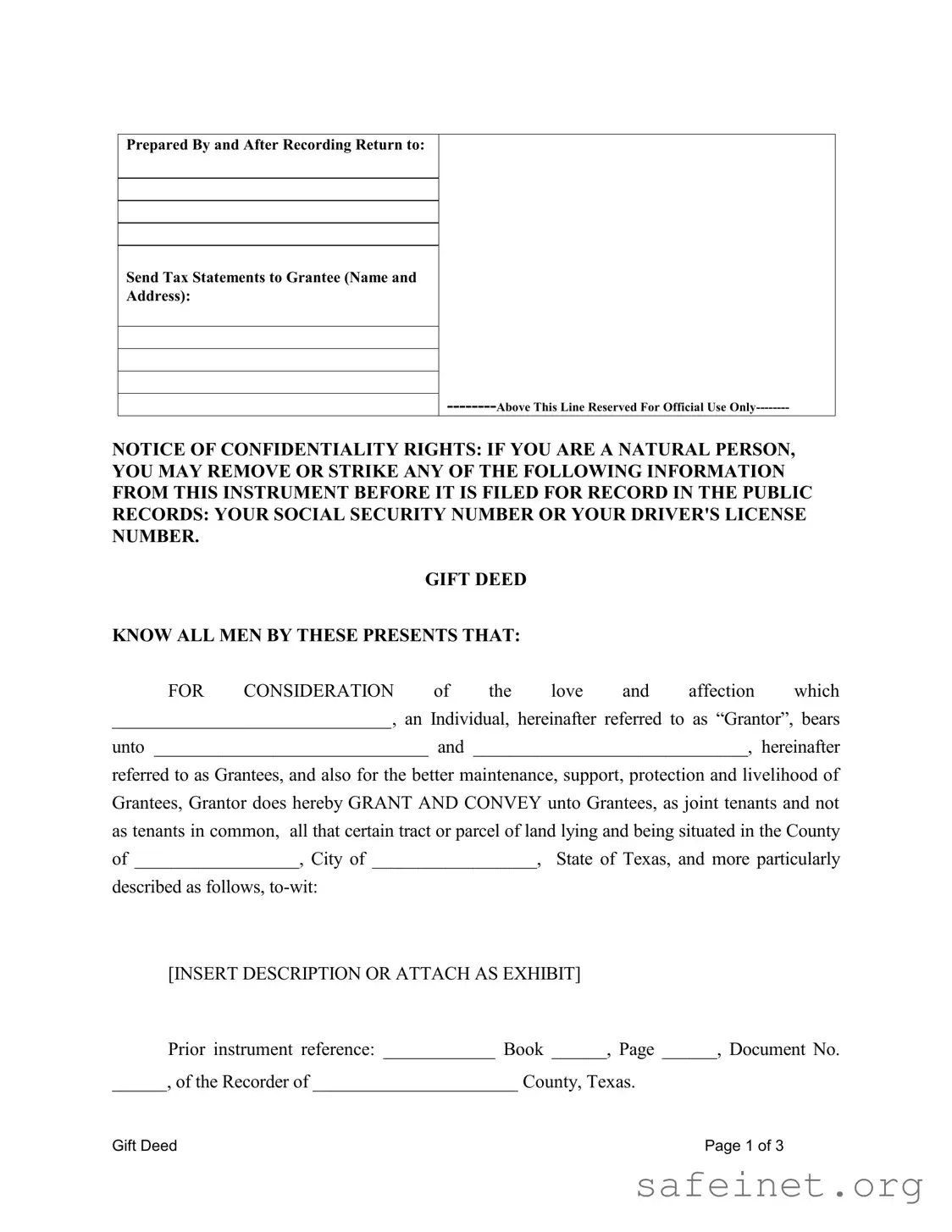
The Gift Deed Texas form serves as a legal instrument for individuals wishing to transfer property without financial consideration, often motivated by love and affection. This form is essential for documenting the transfer of real estate, ensuring that the intentions of the Grantor are clearly expressed and legally binding. Key elements of the form include the identification of the Grantor and Grantees, the description of the property being conveyed, and the stipulation that the Grantees will hold the property as joint tenants with rights of survivorship. This means that, should one Grantee pass away, the surviving Grantee automatically inherits the entire interest in the property. Additionally, the form outlines any existing restrictions or easements affecting the property and clarifies whether the property is part of the Grantor's homestead. Notably, the form includes a confidentiality notice, allowing individuals to protect sensitive information, such as Social Security numbers. By adhering to the requirements outlined in the Gift Deed Texas form, individuals can ensure a smooth and legally sound transfer of property, fostering familial bonds and securing the future of their loved ones.



| Fact Name | Description |
|---|---|
| Governing Law | The Gift Deed in Texas is governed by the Texas Property Code. |
| Purpose | This form is used to transfer property as a gift from one individual (Grantor) to another (Grantees). |
| Joint Tenancy | The deed establishes joint tenancy with right of survivorship, meaning if one Grantee passes away, the other automatically inherits the entire property. |
| Confidentiality Notice | Individuals can remove personal information, such as Social Security numbers or driver's license numbers, before filing the deed. |
| Property Description | The deed requires a detailed description of the property being transferred, which can be attached as an exhibit. |
| Consideration | The only consideration required for the transfer is love and affection, making it a non-monetary transaction. |
| Restrictions | The property transfer may be subject to existing restrictions, covenants, or easements that are recorded in the county. |
| Homestead Status | The deed must indicate whether the property is part of the Grantor's homestead, which can affect the validity of the transfer. |
| Notarization Requirement | The deed must be acknowledged before a notary public to be valid and enforceable. |
After you have gathered the necessary information, you can proceed to fill out the Gift Deed Texas form. This form requires specific details about the parties involved and the property being transferred. Make sure to provide accurate information to ensure a smooth process.
What is a Gift Deed in Texas?
A Gift Deed in Texas is a legal document used to transfer ownership of property from one person (the Grantor) to another (the Grantee) without any exchange of money. This type of deed is often executed out of love and affection, making it a common choice for family members or close friends who wish to gift real estate. The deed outlines the details of the property being transferred and ensures that the Grantee has full rights to the property.
Who can be a Grantor and Grantee in a Gift Deed?
In a Gift Deed, the Grantor is the individual giving the gift, and the Grantee is the individual receiving it. Both parties can be natural persons or entities, such as corporations or trusts. However, it is important that the Grantor has the legal authority to transfer the property, meaning they must be the rightful owner. The Grantees can be individuals or multiple parties, and they can hold the property as joint tenants or tenants in common, depending on the intention stated in the deed.
What information is required in a Gift Deed?
A Gift Deed must include specific information to be valid. This includes the names of the Grantor and Grantee, a legal description of the property being gifted, and the county and city where the property is located. The deed should also state the intention of the Grantor to gift the property and include any conditions or restrictions that apply. Additionally, the document must be signed and acknowledged by a notary public to be legally binding.
Do I need to pay taxes on a Gift Deed in Texas?
Generally, the transfer of property through a Gift Deed may be subject to gift tax, depending on the value of the property and the relationship between the Grantor and Grantee. However, there are annual exclusions and lifetime exemptions that can apply. It is advisable to consult with a tax professional to understand the implications of gifting property and to ensure compliance with IRS regulations.
Can a Gift Deed be revoked or changed?
Once a Gift Deed is executed and recorded, it typically cannot be revoked unilaterally. However, if the Grantor wishes to change the terms or revoke the gift, they may need to take legal steps, such as creating a new deed or executing a revocation document. If the Grantees agree, they may also execute a deed to return the property to the Grantor. Legal advice is recommended in such situations to ensure all actions are valid and enforceable.
What are the confidentiality rights related to a Gift Deed?
In Texas, individuals have certain confidentiality rights when it comes to the information included in a Gift Deed. If the Grantor is a natural person, they may remove or strike their Social Security number or driver's license number from the document before it is filed for public record. This provision helps protect personal information from being publicly accessible.
How is a Gift Deed executed and recorded?
To execute a Gift Deed, the Grantor must sign the document in the presence of a notary public, who will then acknowledge the signature. After the deed is signed and notarized, it must be filed with the county clerk's office in the county where the property is located. Recording the deed provides public notice of the transfer and protects the Grantee's ownership rights. It is recommended to keep a copy of the recorded deed for personal records.
Incomplete Grantee Information: Failing to fill in the names and addresses of all grantees can lead to confusion and delays. Ensure that all details are accurate and complete.
Missing Property Description: Not including a proper description of the property can invalidate the deed. Attach an exhibit or provide a clear description in the designated area.
Incorrect County or City Information: Entering the wrong county or city can cause issues with recording. Double-check this information before submission.
Omitting Prior Instrument Reference: Forgetting to include the reference to any prior deed can complicate the title transfer. Always provide this information if applicable.
Not Notarizing the Document: A gift deed must be notarized to be valid. Ensure that a notary public signs and stamps the document before filing.
Ignoring Confidentiality Rights: Not removing personal information, like Social Security numbers, can expose you to privacy risks. Take advantage of your rights to redact sensitive information.
Failure to Specify Joint Tenancy: Not indicating whether the grantees are joint tenants can lead to unintended ownership structures. Clearly state the intention regarding joint tenancy.
Neglecting to Confirm Homestead Status: Misunderstanding whether the property is part of the homestead can affect the deed's validity. Clarify this status to avoid complications.
When preparing a Gift Deed in Texas, several other forms and documents may be necessary to ensure a smooth and legally compliant transfer of property. Below is a list of common documents that often accompany the Gift Deed, each serving a unique purpose in the process.
Each of these documents plays a vital role in the property transfer process, ensuring that all legal requirements are met and that the interests of both the grantor and grantees are protected. Proper preparation and understanding of these forms can lead to a successful and seamless transfer of property ownership.
The Gift Deed in Texas shares similarities with a Quitclaim Deed. Both documents transfer ownership of property, but they do so in different ways. A Quitclaim Deed conveys whatever interest the grantor has in the property without any warranties or guarantees. This means the grantor is not promising that they own the property outright or that there are no claims against it. In contrast, a Gift Deed often carries an implied promise of ownership and the intent to gift the property out of love or affection, which adds a personal touch to the transaction.
Another document similar to the Gift Deed is the Warranty Deed. A Warranty Deed provides a higher level of protection for the grantee because it guarantees that the grantor holds clear title to the property and has the right to transfer it. This means that if any issues arise regarding ownership, the grantor is responsible for resolving them. While both deeds transfer property, the Warranty Deed offers more security, whereas the Gift Deed emphasizes the emotional intent behind the transfer.
The Special Warranty Deed is also comparable to the Gift Deed. Like a Warranty Deed, it provides certain guarantees about the title, but only for the period during which the grantor owned the property. This means that the grantor is not liable for any issues that arose before their ownership. The Gift Deed, on the other hand, does not typically include such guarantees, focusing instead on the act of gifting the property.
A Bill of Sale is another document that shares some similarities with the Gift Deed, though it is typically used for personal property rather than real estate. A Bill of Sale transfers ownership of items like vehicles or furniture, often without any warranties. Like a Gift Deed, it can be executed out of love or affection, making it a personal transaction. However, a Bill of Sale does not involve the complexities of real estate law, which can make the Gift Deed more intricate.
The Deed of Trust is also relevant in this context, particularly when property is involved in financing. While a Gift Deed transfers property outright, a Deed of Trust is used to secure a loan with the property as collateral. In some cases, a property may be gifted but still have a mortgage attached, making a Deed of Trust necessary to protect the lender's interest. This highlights the differences in intent and function between these two documents.
Similarly, a Life Estate Deed is akin to a Gift Deed in that it transfers property but retains certain rights for the grantor. In a Life Estate Deed, the grantor can live on the property for the rest of their life, after which the property passes to the grantee. This contrasts with a Gift Deed, where the transfer is immediate and unconditional, emphasizing the gift aspect rather than retaining any rights to the property.
Lastly, a Transfer on Death Deed (TODD) is a document that allows property owners to designate beneficiaries who will receive the property upon their death. While the Gift Deed transfers ownership during the grantor's lifetime, a TODD allows for a seamless transfer after death, without the need for probate. This highlights the different timing and intent behind these two types of deeds, as one is about immediate gifting while the other focuses on future transfer.
When filling out the Gift Deed Texas form, it’s important to follow certain guidelines to ensure the document is valid and meets legal requirements. Here’s a list of things you should and shouldn’t do:
Understanding the Gift Deed form in Texas can be tricky, especially with the various misconceptions that often arise. Here are nine common misunderstandings, along with clarifications to help demystify the process.
By clarifying these misconceptions, individuals can navigate the process of using a gift deed in Texas with greater confidence and understanding.
When filling out and using the Gift Deed Texas form, it’s essential to keep several key points in mind to ensure a smooth process.