The Georgia Small Estate Affidavit serves as a vital tool for individuals navigating the probate process when dealing with smaller estates. This form allows heirs or beneficiaries to bypass the lengthy and often costly formal probate proceedings, simplifying the transfer of assets. In Georgia, an estate qualifies as a small estate if the total value of the assets is below a certain threshold, which can vary based on the year and specific circumstances. By utilizing the Small Estate Affidavit, individuals can claim property, settle debts, and distribute assets without court intervention, provided they meet specific eligibility requirements. The form requires detailed information, including the names of heirs, a description of the decedent's assets, and any outstanding debts. This streamlined process not only saves time but also reduces the emotional burden often associated with estate administration. Understanding the intricacies of the Small Estate Affidavit is essential for those looking to efficiently manage the affairs of a loved one who has passed away, ensuring that the wishes of the deceased are honored while adhering to Georgia law.
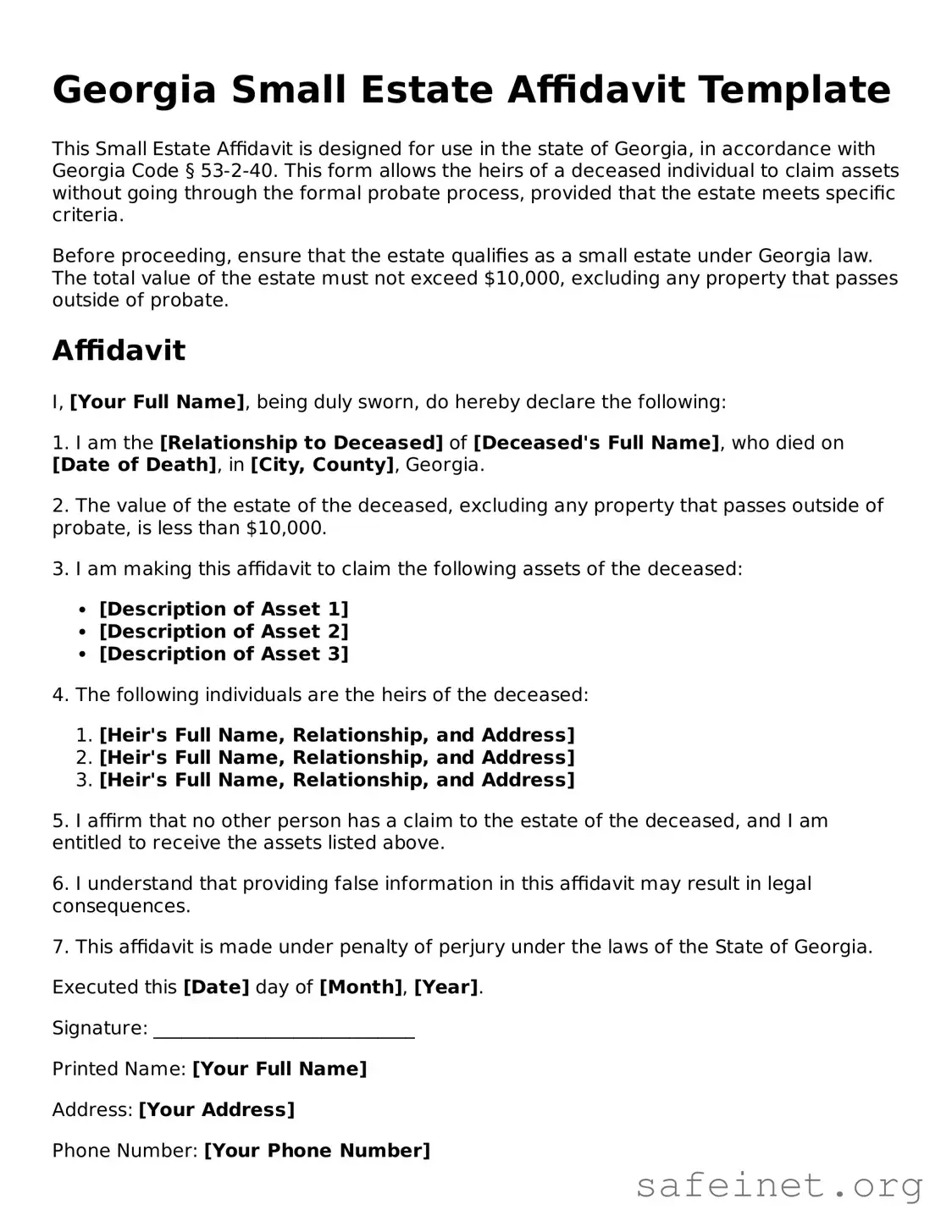
Georgia Small Estate Affidavit Template
This Small Estate Affidavit is designed for use in the state of Georgia, in accordance with Georgia Code § 53-2-40. This form allows the heirs of a deceased individual to claim assets without going through the formal probate process, provided that the estate meets specific criteria.
Before proceeding, ensure that the estate qualifies as a small estate under Georgia law. The total value of the estate must not exceed $10,000, excluding any property that passes outside of probate.
Affidavit
I, [Your Full Name], being duly sworn, do hereby declare the following:
1. I am the [Relationship to Deceased] of [Deceased's Full Name], who died on [Date of Death], in [City, County], Georgia.
2. The value of the estate of the deceased, excluding any property that passes outside of probate, is less than $10,000.
3. I am making this affidavit to claim the following assets of the deceased:
4. The following individuals are the heirs of the deceased:
5. I affirm that no other person has a claim to the estate of the deceased, and I am entitled to receive the assets listed above.
6. I understand that providing false information in this affidavit may result in legal consequences.
7. This affidavit is made under penalty of perjury under the laws of the State of Georgia.
Executed this [Date] day of [Month], [Year].
Signature: ____________________________
Printed Name: [Your Full Name]
Address: [Your Address]
Phone Number: [Your Phone Number]
Sworn to and subscribed before me this [Date] day of [Month], [Year].
Notary Public: ____________________________
My Commission Expires: [Expiration Date]
| Fact Name | Description |
|---|---|
| Purpose | The Georgia Small Estate Affidavit allows heirs to claim property without going through formal probate. |
| Eligibility | This form is applicable when the decedent's total assets do not exceed $10,000, excluding certain types of property. |
| Governing Law | The process is governed by O.C.G.A. § 53-2-40 through § 53-2-43. |
| Filing Location | The affidavit must be filed in the probate court of the county where the decedent resided. |
| Required Information | Heirs must provide details such as the decedent's name, date of death, and a list of assets. |
| Signature Requirement | All heirs must sign the affidavit, affirming their relationship to the decedent. |
| Asset Types | Real estate, bank accounts, and personal property can be claimed using this affidavit. |
| Exclusions | Certain assets, like life insurance and retirement accounts, are not included in the total for eligibility. |
| Notarization | The affidavit must be notarized to be considered valid. |
| Limitations | This process does not apply if there is a will or if the estate is larger than the specified limit. |
Filling out the Georgia Small Estate Affidavit form is a straightforward process that allows you to handle a small estate without going through probate. Once you complete the form, you can present it to the appropriate institutions to access the deceased person's assets.
What is a Georgia Small Estate Affidavit?
The Georgia Small Estate Affidavit is a legal document that allows heirs to claim the assets of a deceased person without going through the lengthy and often costly probate process. This form is typically used when the total value of the estate is below a certain threshold, making it a simpler alternative for settling smaller estates.
Who is eligible to use the Small Estate Affidavit in Georgia?
To use the Small Estate Affidavit, the estate must meet specific criteria. Generally, the total value of the estate must be less than $100,000, excluding any real estate. Additionally, the person filing the affidavit must be an heir or a beneficiary as defined by Georgia law, meaning they are directly related to the deceased or named in the will.
What assets can be claimed using the Small Estate Affidavit?
The affidavit can be used to claim various types of assets, including bank accounts, personal property, and vehicles. However, it does not cover real estate. If the deceased owned real property, a different legal process must be followed to transfer ownership.
How do I complete the Small Estate Affidavit?
Completing the Small Estate Affidavit involves gathering necessary information about the deceased, including their name, date of death, and a list of assets. The affidavit must be signed by the heirs and notarized. It’s essential to ensure that all information is accurate and complete to avoid delays or legal issues later on.
Do I need to file the Small Estate Affidavit with the court?
No, the Small Estate Affidavit does not need to be filed with the court. Instead, it is presented to institutions, such as banks or the Department of Motor Vehicles, to access the deceased's assets. However, it’s a good idea to keep a copy for your records.
What happens if there are disputes among heirs?
If disputes arise among heirs regarding the distribution of assets, the situation can become complicated. It may be necessary to seek legal advice or mediation to resolve conflicts. In some cases, formal probate proceedings may be required to settle disputes and ensure that the estate is divided according to the law or the deceased's wishes.
Incorrectly identifying the decedent: It is crucial to provide the full legal name of the deceased. Omitting middle names or using nicknames can lead to complications.
Failing to list all heirs: All heirs must be identified on the affidavit. Neglecting to include someone can result in disputes or delays in the estate settlement process.
Not including the correct date of death: The date of death is essential for determining the validity of the affidavit. An inaccurate date can create confusion and potential legal issues.
Overlooking asset valuation: Accurately valuing the assets of the estate is necessary. Underestimating or overestimating can affect the distribution among heirs.
Inadequate witness signatures: The affidavit requires signatures from witnesses. Not having the required number of witnesses can invalidate the document.
Not notarizing the affidavit: A notary public must witness the signing of the affidavit. Failing to have it notarized can lead to rejection by the probate court.
Ignoring local court requirements: Each county may have specific rules regarding the Small Estate Affidavit. Not adhering to these can result in delays or rejection of the filing.
When navigating the process of settling a small estate in Georgia, several forms and documents may be necessary alongside the Georgia Small Estate Affidavit. Each of these documents plays a crucial role in ensuring that the estate is handled according to the law. Below is a list of commonly used forms that you might encounter.
Understanding these documents can simplify the process of managing a small estate in Georgia. Each form serves a specific purpose, helping to ensure that everything is handled correctly and efficiently. Always consider consulting a legal professional for guidance tailored to your situation.
The Georgia Small Estate Affidavit is similar to the Affidavit of Heirship. Both documents help establish the rightful heirs to a deceased person's estate. The Affidavit of Heirship is often used when there is no will. It allows heirs to claim property without going through a lengthy probate process. Like the Small Estate Affidavit, it provides a way to settle an estate more quickly and with less expense.
Another document that shares similarities is the Will. A Will outlines how a person's assets should be distributed after their death. While the Small Estate Affidavit is used when an estate is small enough to avoid probate, a Will can still be probated if the estate exceeds certain limits. Both documents aim to ensure that a person's wishes regarding their assets are honored, but they operate under different circumstances.
The Affidavit for Collection of Personal Property is another related form. This document allows individuals to collect a deceased person's personal property without going through probate. Similar to the Small Estate Affidavit, it simplifies the process of transferring assets. However, it is typically used for personal property only, whereas the Small Estate Affidavit can address a broader range of estate assets.
The Petition for Letters of Administration is also comparable. This legal document is filed when a person dies without a Will. It allows someone to be appointed as the administrator of the estate. While the Small Estate Affidavit can expedite the process for small estates, the Petition for Letters of Administration is necessary for larger estates that require formal probate proceedings.
The Affidavit of Support is another document that serves a different purpose but shares some procedural similarities. This form is used in immigration cases to show that a sponsor can financially support an immigrant. While it does not deal with estate matters, both documents require a sworn statement and can help facilitate a legal process without extensive court involvement.
The Transfer on Death Deed (TOD) is also worth mentioning. This document allows a person to transfer real estate to a beneficiary upon their death without going through probate. Like the Small Estate Affidavit, it simplifies the transfer of assets. However, the TOD specifically addresses real property, while the Small Estate Affidavit can cover a wider array of estate assets.
Lastly, the Durable Power of Attorney has some overlapping features. This document allows someone to make financial decisions on behalf of another person while they are alive. Although it does not deal with post-death asset distribution, both documents empower individuals to manage assets more efficiently. They aim to streamline processes, whether during life or after death.
When completing the Georgia Small Estate Affidavit form, it is important to follow specific guidelines to ensure accuracy and compliance with state requirements. Here is a list of things to do and avoid:
Following these guidelines can help streamline the process and reduce the likelihood of complications. It is essential to approach this task with care and attention to detail.
Understanding the Georgia Small Estate Affidavit can be tricky. Here are nine common misconceptions that people often have about this form:
Clearing up these misconceptions can help individuals better understand the Small Estate Affidavit and its role in the estate management process in Georgia.
Filling out and using the Georgia Small Estate Affidavit form can simplify the process of settling an estate with limited assets. Here are some key takeaways to keep in mind: