When it comes to ensuring that a will is executed smoothly and without disputes, the Georgia Self-Proving Affidavit form plays a crucial role. This legal document allows a testator, or the person creating the will, to affirm their intentions and the authenticity of their signature in the presence of witnesses. By incorporating this form, individuals can streamline the probate process, minimizing the need for witnesses to appear in court later on. It’s designed to provide a straightforward way to verify that the will is genuine and that the testator was of sound mind when making their decisions. Additionally, the Self-Proving Affidavit includes sections for both the testator and witnesses to sign, making it a vital part of the estate planning process. Understanding how to properly complete and file this form can save families time, money, and emotional strain during an already challenging time.
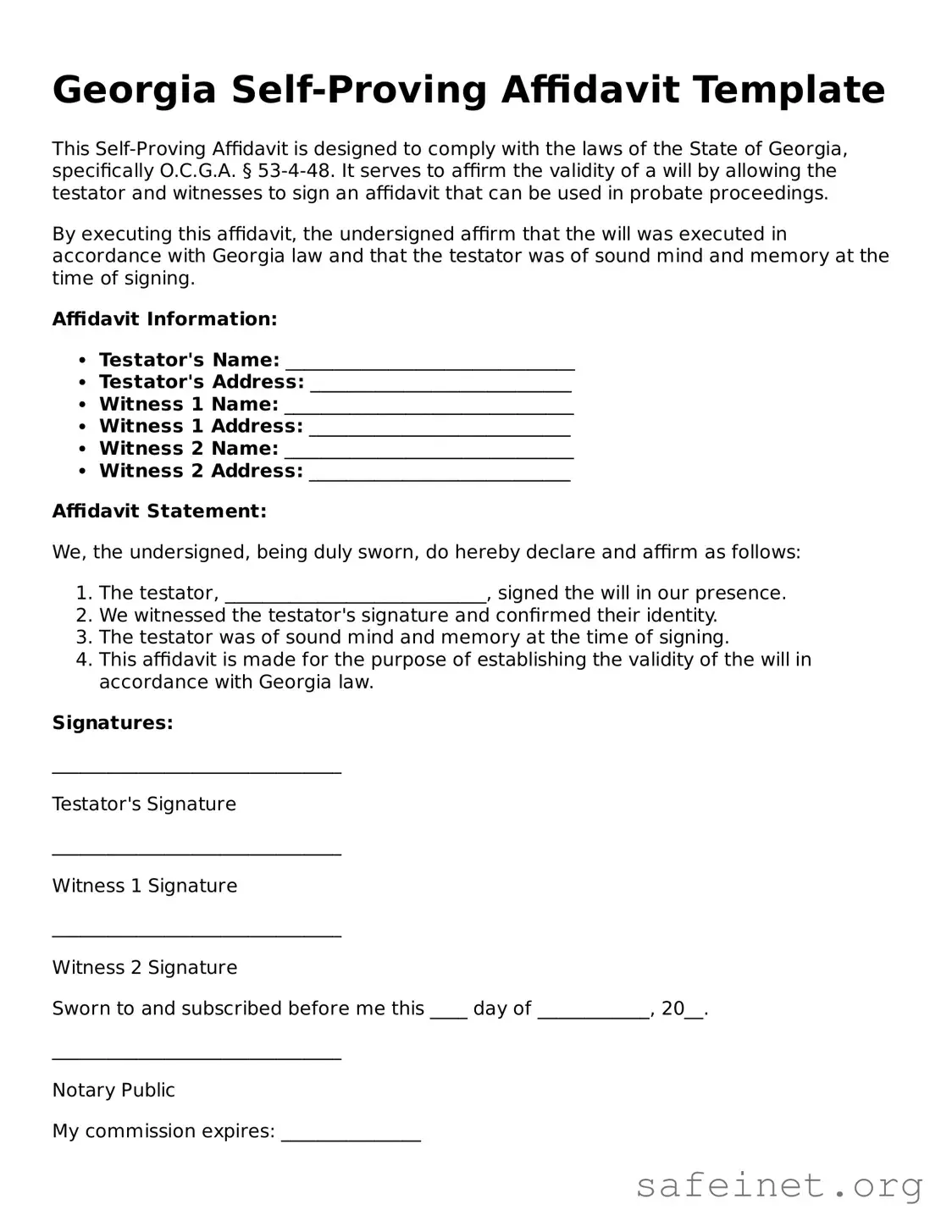
Georgia Self-Proving Affidavit Template
This Self-Proving Affidavit is designed to comply with the laws of the State of Georgia, specifically O.C.G.A. § 53-4-48. It serves to affirm the validity of a will by allowing the testator and witnesses to sign an affidavit that can be used in probate proceedings.
By executing this affidavit, the undersigned affirm that the will was executed in accordance with Georgia law and that the testator was of sound mind and memory at the time of signing.
Affidavit Information:
Affidavit Statement:
We, the undersigned, being duly sworn, do hereby declare and affirm as follows:
Signatures:
_______________________________
Testator's Signature
_______________________________
Witness 1 Signature
_______________________________
Witness 2 Signature
Sworn to and subscribed before me this ____ day of ____________, 20__.
_______________________________
Notary Public
My commission expires: _______________
| Fact Name | Description |
|---|---|
| Purpose | The Georgia Self-Proving Affidavit allows a will to be validated without the need for witnesses to testify in court. |
| Governing Law | This form is governed by O.C.G.A. § 53-4-25, which outlines the requirements for self-proving wills in Georgia. |
| Signature Requirements | The testator and two witnesses must sign the affidavit in the presence of a notary public. |
| Notarization | Notarization is essential for the affidavit to be considered valid and self-proving in court. |
| Revocation | A self-proving affidavit can be revoked if the will is revoked or if the testator changes their mind about the will. |
| Benefits | This affidavit simplifies the probate process, saving time and reducing potential disputes over the will's validity. |
Filling out the Georgia Self-Proving Affidavit form is a straightforward process that requires careful attention to detail. Once completed, this form will be ready for submission alongside a will, ensuring that the necessary legal requirements are met.
What is a Georgia Self-Proving Affidavit?
A Georgia Self-Proving Affidavit is a legal document that allows a will to be validated without requiring the witnesses to appear in court. This affidavit is typically signed by the testator (the person making the will) and the witnesses in front of a notary public. By including this affidavit with the will, the probate process can be streamlined, making it easier for the executor to carry out the testator's wishes.
How do I create a Self-Proving Affidavit in Georgia?
To create a Self-Proving Affidavit, you need to follow a few steps. First, ensure your will is properly signed by you and two witnesses. Next, you and your witnesses should sign the Self-Proving Affidavit in front of a notary public. The notary will then acknowledge your signatures, making the affidavit valid. It is crucial to ensure all signatures are done in the presence of the notary to avoid any issues later on.
Is a Self-Proving Affidavit necessary for my will in Georgia?
Can I revoke a Self-Proving Affidavit?
Yes, you can revoke a Self-Proving Affidavit. If you decide to change your will or create a new one, the previous Self-Proving Affidavit becomes invalid. It’s important to ensure that any new will includes a new Self-Proving Affidavit if you wish to maintain that streamlined probate process. Always keep your estate planning documents updated to reflect your current wishes.
Incomplete Information: Many individuals fail to provide all required details on the affidavit. This can include missing names, dates, or signatures. Each piece of information is crucial for the document's validity.
Improper Witness Signatures: The law requires that the affidavit be signed by at least two witnesses. Often, people overlook this requirement, leading to an invalid affidavit. Ensure that all witnesses are present and sign the document at the same time.
Not Notarizing the Document: A common oversight is neglecting to have the affidavit notarized. This step is essential for the affidavit to be accepted in court. Without a notary's signature, the document may be deemed ineffective.
Failing to Follow State-Specific Guidelines: Each state may have unique requirements for self-proving affidavits. People often assume that the process is the same everywhere. It is vital to familiarize oneself with Georgia's specific rules to avoid complications.
In the estate planning process, various forms and documents often accompany the Georgia Self-Proving Affidavit. Each of these documents plays a crucial role in ensuring that a will is executed and validated properly. Below is a list of common forms that are typically used alongside the Self-Proving Affidavit.
Understanding these documents is essential for effective estate planning in Georgia. Each plays a distinct role in the overall process, ensuring that an individual’s wishes are honored and legally upheld.
The Georgia Self-Proving Affidavit is similar to the Affidavit of Execution. This document serves to confirm that a will was properly signed and witnessed according to state laws. Like the Self-Proving Affidavit, it requires the signatures of witnesses and the testator, ensuring that the will's execution is validated. Both documents aim to establish the authenticity of a will, but the Affidavit of Execution focuses more on the process of signing rather than the testator's intent.
Another document comparable to the Georgia Self-Proving Affidavit is the Will Contest Affidavit. This affidavit is used when someone challenges the validity of a will. It can include statements from witnesses or other parties regarding the circumstances surrounding the will's creation. While the Self-Proving Affidavit affirms the will's validity, the Will Contest Affidavit serves to dispute it, highlighting the importance of witness testimony in both situations.
The Durable Power of Attorney (DPOA) shares similarities with the Self-Proving Affidavit in terms of establishing authority and intent. A DPOA allows an individual to designate someone to make decisions on their behalf if they become incapacitated. Both documents require signatures and may involve witnesses to ensure that the person's wishes are clearly expressed and legally recognized. However, the DPOA focuses on decision-making authority rather than the distribution of assets after death.
The Living Will is another document that bears resemblance to the Self-Proving Affidavit. A Living Will outlines a person's preferences for medical treatment in the event they cannot communicate their wishes. Both documents are critical in expressing an individual's intentions and require clear, documented consent. However, the Living Will is concerned with healthcare decisions, while the Self-Proving Affidavit pertains to the disposition of property after death.
The Revocable Trust Agreement also parallels the Self-Proving Affidavit in that it provides a way to manage and distribute assets. A Revocable Trust allows individuals to retain control over their assets during their lifetime while specifying how those assets should be handled after their passing. Both documents require careful drafting and may involve witnesses to ensure that the individual's wishes are honored, but they serve different purposes in estate planning.
The Affidavit of Heirship is similar in that it establishes the heirs of a deceased person. This document is often used when there is no will to clarify who is entitled to inherit the deceased's assets. Like the Self-Proving Affidavit, it relies on the testimony of witnesses to affirm the legitimacy of the claims made regarding the deceased's heirs. However, the Affidavit of Heirship focuses on identifying heirs, while the Self-Proving Affidavit confirms the validity of a will.
Lastly, the Certificate of Trust has similarities to the Self-Proving Affidavit in that it provides proof of the existence of a trust and the authority of the trustee. This document can be presented to financial institutions and other entities to demonstrate that the trustee has the right to manage the trust assets. Both documents are essential in estate planning, but the Certificate of Trust centers on the management of assets during a person's lifetime, while the Self-Proving Affidavit pertains to the distribution of assets after death.
When filling out the Georgia Self-Proving Affidavit form, it is important to approach the process with care. Below are some guidelines on what to do and what to avoid.
Understanding the Georgia Self-Proving Affidavit can be tricky. Here are ten common misconceptions about this important legal document:
Filling out and using the Georgia Self-Proving Affidavit form is an important step in the estate planning process. Here are some key takeaways to keep in mind: