When engaging in activities that carry inherent risks, understanding the importance of a Georgia Release of Liability form is crucial. This legal document is designed to protect individuals and organizations from being held liable for injuries or damages that may occur during specific activities. Whether you're organizing a sports event, hosting a recreational class, or running a business that involves physical activity, this form can serve as a valuable tool. It outlines the responsibilities of all parties involved and ensures that participants acknowledge the risks associated with the activity. By signing the form, participants agree to waive their right to sue for any accidents that may happen, thus providing a layer of protection for the organizers. It's essential to ensure that the form is clear and comprehensive, detailing the scope of the activities covered and any potential hazards. Ultimately, the Georgia Release of Liability form not only fosters a safer environment but also promotes transparency and trust between participants and organizers.
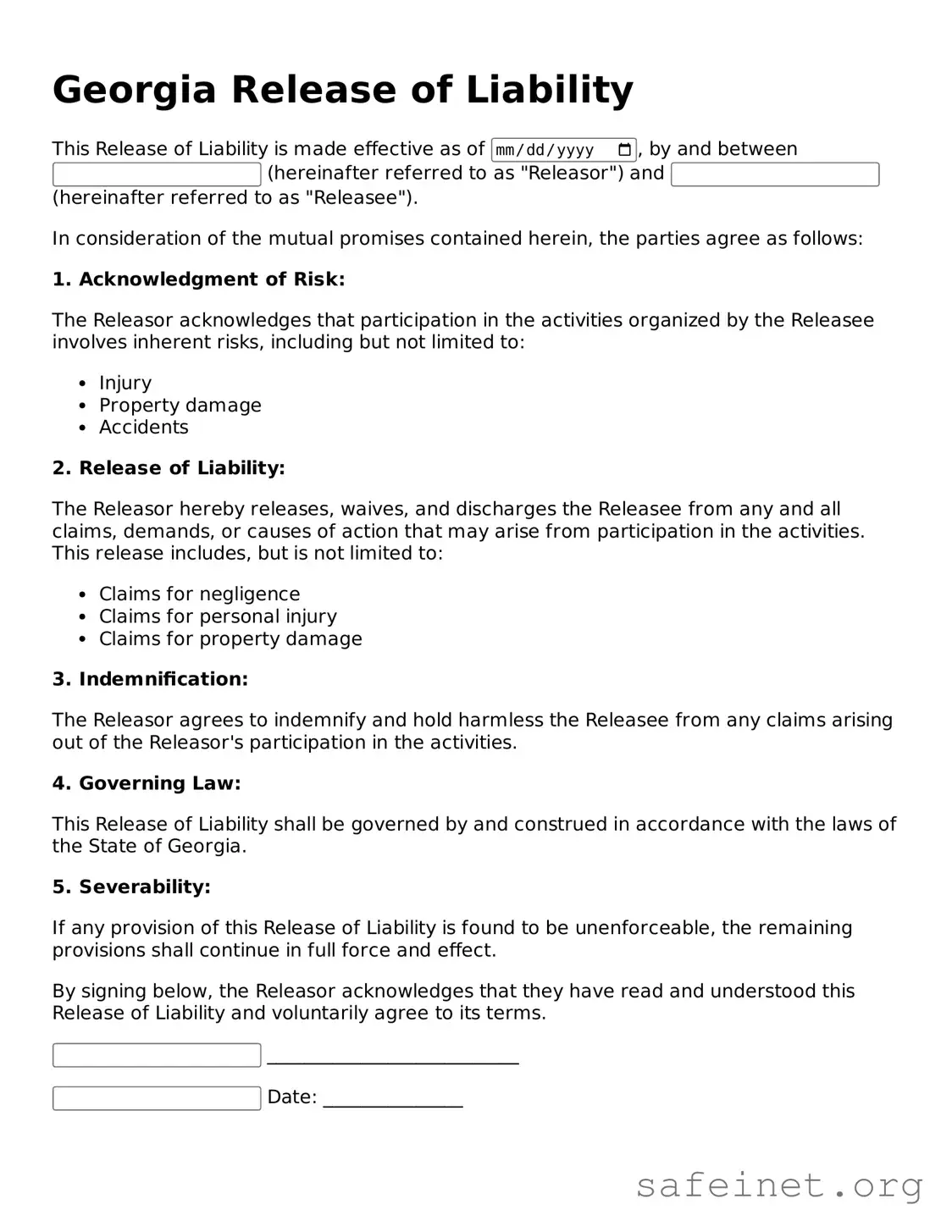
Georgia Release of Liability
This Release of Liability is made effective as of , by and between (hereinafter referred to as "Releasor") and (hereinafter referred to as "Releasee").
In consideration of the mutual promises contained herein, the parties agree as follows:
1. Acknowledgment of Risk:
The Releasor acknowledges that participation in the activities organized by the Releasee involves inherent risks, including but not limited to:
2. Release of Liability:
The Releasor hereby releases, waives, and discharges the Releasee from any and all claims, demands, or causes of action that may arise from participation in the activities. This release includes, but is not limited to:
3. Indemnification:
The Releasor agrees to indemnify and hold harmless the Releasee from any claims arising out of the Releasor's participation in the activities.
4. Governing Law:
This Release of Liability shall be governed by and construed in accordance with the laws of the State of Georgia.
5. Severability:
If any provision of this Release of Liability is found to be unenforceable, the remaining provisions shall continue in full force and effect.
By signing below, the Releasor acknowledges that they have read and understood this Release of Liability and voluntarily agree to its terms.
___________________________
Date: _______________
| Fact Name | Description |
|---|---|
| Purpose | The Georgia Release of Liability form is designed to protect individuals and organizations from legal claims arising from injuries or damages that may occur during specific activities. |
| Governing Law | This form is governed by Georgia state law, particularly the principles of contract law and tort law. |
| Parties Involved | The form typically involves two parties: the releasor (the individual waiving their rights) and the releasee (the party being protected from liability). |
| Scope of Release | The release can cover a wide range of activities, including recreational events, sports, and other potentially hazardous activities. |
| Voluntary Agreement | Signing the form indicates that the releasor voluntarily agrees to waive their rights, acknowledging the risks involved in the activity. |
| Enforceability | For the release to be enforceable, it must be clear, unambiguous, and not violate public policy or statutory regulations. |
| Legal Considerations | Individuals should consider consulting with a legal professional before signing or drafting a Release of Liability to ensure it meets all necessary legal standards. |
Completing the Georgia Release of Liability form is a straightforward process. After filling out the form, it will be necessary to submit it to the appropriate party, typically the organization or individual requiring the release. Ensure all information is accurate to avoid complications.
What is a Georgia Release of Liability form?
The Georgia Release of Liability form is a legal document that protects one party from being held liable for any injuries or damages that may occur during an activity or event. By signing this form, participants acknowledge the risks involved and agree not to hold the organizer responsible for any accidents or injuries that may arise. It is commonly used in recreational activities, sports events, and other situations where risks are present.
Who should use a Release of Liability form?
This form is typically used by event organizers, businesses, or individuals hosting activities where there is a potential for injury. Examples include sports leagues, adventure parks, and community events. It is important for anyone facilitating an activity that involves risk to consider using this form to protect themselves legally.
Is the Release of Liability form legally binding?
Yes, the form can be legally binding if it meets certain requirements. It must be clear, concise, and voluntarily signed by the participant. However, courts may not enforce a release if it is deemed overly broad or if it waives liability for gross negligence. Participants should read the document carefully before signing.
Can a minor sign a Release of Liability form?
No, minors cannot legally sign a Release of Liability form on their own. A parent or legal guardian must sign on behalf of the minor. This ensures that the minor is protected while also allowing the organizer to mitigate their liability. It is essential to include the guardian's information and signature for the document to be valid.
What should be included in the Release of Liability form?
The form should include the names of the parties involved, a description of the activity, a clear statement of the risks involved, and a clause indicating that the participant understands and accepts these risks. Additionally, it should have a section for signatures and dates. Clarity is crucial to ensure that all parties understand the terms.
How can I ensure that my Release of Liability form is effective?
To enhance the effectiveness of the form, ensure that it is written in plain language and is easy to understand. Avoid using legal jargon that may confuse participants. It is also advisable to consult with a legal professional to review the document, ensuring it complies with state laws and adequately protects your interests.
What happens if someone is injured despite signing the Release of Liability?
Even with a signed Release of Liability, there may be circumstances where the organizer could still be held liable, especially in cases of gross negligence or willful misconduct. The form does not absolve the organizer from all responsibility. If an injury occurs, the specifics of the situation will determine the legal outcome.
Where can I obtain a Georgia Release of Liability form?
Release of Liability forms can often be found online through legal document services or templates. It is crucial to ensure that the form is specifically tailored for Georgia laws. Additionally, local legal offices or attorneys can provide assistance in drafting a customized form that meets your specific needs.
Failing to read the entire form carefully. Many individuals overlook important details that could affect their rights.
Not providing complete information. Omitting necessary details, such as personal contact information, can lead to complications.
Signing without understanding the terms. It’s crucial to comprehend what you are agreeing to before signing the document.
Using incorrect dates. Ensure that all dates are accurate, as mistakes can invalidate the form.
Not including witnesses if required. Some forms may need a witness signature to be valid, so check the requirements.
Ignoring the need for notarization. Certain situations may require the form to be notarized, which should not be overlooked.
Failing to keep a copy. Always retain a copy of the signed form for your records in case of future disputes.
When engaging in activities that carry inherent risks, individuals often use a Georgia Release of Liability form to protect themselves from potential legal claims. This form is commonly accompanied by several other documents that further clarify responsibilities and expectations. Below is a list of other forms and documents frequently used in conjunction with the Release of Liability in Georgia.
Utilizing these documents alongside the Georgia Release of Liability form can help clarify expectations and responsibilities for all parties involved. Each document serves a specific purpose and contributes to a safer and more informed experience for participants.
The Georgia Release of Liability form is similar to a Waiver of Liability. Both documents serve to protect an individual or organization from legal claims resulting from injuries or damages that may occur during an activity. A Waiver of Liability is often used in recreational settings, such as sports or outdoor events, where participants acknowledge the risks involved and agree not to hold the organizers responsible for accidents. This mutual understanding helps to clarify expectations and minimize disputes after an incident occurs.
Another document that resembles the Georgia Release of Liability form is the Indemnity Agreement. This agreement shifts the responsibility of any losses or damages from one party to another. In many cases, businesses use indemnity agreements to protect themselves from claims arising from the actions of their clients or contractors. Like the Release of Liability, it emphasizes the importance of understanding risks and responsibilities, ensuring that all parties are aware of their obligations.
A Participant Agreement is also similar in nature. This document is commonly used in sports and recreational activities to outline the terms under which individuals agree to participate. By signing a Participant Agreement, individuals acknowledge the inherent risks and agree to follow specific rules. This document, like the Release of Liability, emphasizes the importance of informed consent and helps mitigate potential legal issues arising from participation.
The Consent to Treat form bears similarities as well. This document is often used in medical or sports contexts, allowing healthcare providers to administer treatment in emergencies. While its primary purpose is to grant permission for medical care, it also serves to limit liability for healthcare providers. Participants acknowledge the risks associated with treatment and agree to hold the provider harmless, much like in a Release of Liability.
Another related document is the Safety Agreement. This form outlines safety protocols and responsibilities for participants in various activities. By signing a Safety Agreement, individuals commit to following safety guidelines, which helps reduce the likelihood of accidents. Similar to the Release of Liability, it emphasizes awareness of risks and personal accountability in maintaining a safe environment.
The Rental Agreement is also comparable. Often used in the context of renting equipment or facilities, this document outlines the responsibilities of both the renter and the owner. It typically includes clauses that limit liability for damages or injuries that may occur during the rental period. Like the Release of Liability, it establishes clear expectations and responsibilities, helping to prevent misunderstandings and disputes.
A Non-Disclosure Agreement (NDA) shares some characteristics with the Release of Liability form as well. While NDAs primarily protect confidential information, they can also include clauses that limit liability for the disclosure of sensitive information. Both documents require parties to acknowledge their responsibilities and the potential consequences of their actions, fostering a sense of trust and clarity in business relationships.
Lastly, a Hold Harmless Agreement is quite similar. This document is designed to protect one party from legal claims made by another party. By signing a Hold Harmless Agreement, individuals or organizations agree not to pursue legal action for any injuries or damages that may occur during a specified activity. This agreement, like the Release of Liability, helps clarify the responsibilities of all parties involved and serves to minimize legal risks.
When filling out the Georgia Release of Liability form, it’s important to get it right. Here’s a list of things you should and shouldn’t do:
There are several misconceptions about the Georgia Release of Liability form that can lead to confusion. Understanding these misconceptions is important for anyone considering using this form.
This is not true. While the form can limit liability for certain activities, it does not protect against all claims. For example, if gross negligence or intentional misconduct occurs, the form may not be enforceable.
This is misleading. Signing the form typically means you waive your right to sue for specific incidents related to the activity. However, it does not eliminate the right to sue for other issues, such as fraud or breach of contract.
This is a common misunderstanding. While it is often used for activities like skydiving or rock climbing, any activity that involves some level of risk can benefit from a Release of Liability form. It helps clarify expectations for both parties.
This is incorrect. In Georgia, a Release of Liability form does not need to be notarized to be legally binding. However, having it notarized can add an extra layer of authenticity.
When filling out and using the Georgia Release of Liability form, consider the following key points: