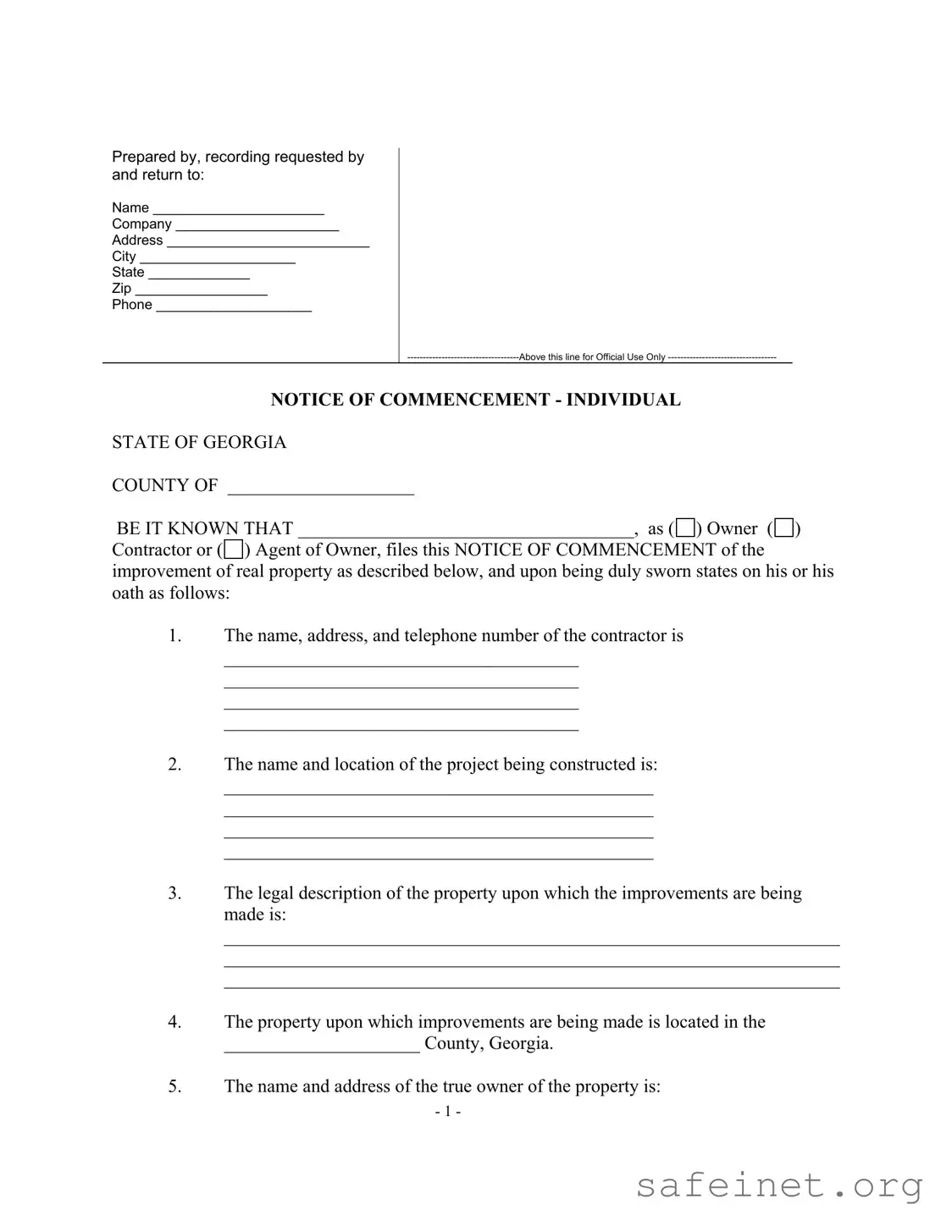
The Georgia Notice form is a critical document in the construction process, serving as a formal declaration of the commencement of work on real property. This form must be completed and filed by the owner, contractor, or an agent of the owner, ensuring that all relevant parties are informed about the construction activities taking place. Key components of the form include the identification of the contractor, details about the project location, and the legal description of the property involved. Additionally, the form requires the disclosure of the true owner of the property, as well as any other parties involved, such as construction lenders or sureties for performance and payment bonds. Importantly, the Notice of Commencement must be filed within fifteen days of the contractor starting work, which helps establish a timeline for the project and protects the rights of subcontractors and material suppliers. Failure to provide a copy of this notice to those who request it can have significant legal implications, making it essential for contractors to understand their responsibilities. By adhering to these requirements, all parties can ensure a smoother construction process while safeguarding their interests.



| Fact Name | Description |
|---|---|
| Governing Law | This form is governed by Georgia Code Section 44-14-361.5. |
| Purpose | The Notice of Commencement informs interested parties about the beginning of construction on a property. |
| Filing Deadline | The notice must be filed within 15 days after the contractor starts work on the property. |
| Required Information | Contractor's name, project location, legal property description, and owner details are all required. |
| Distribution Requirement | Contractors must provide a copy of the notice to any subcontractor or material supplier who requests it. |
| Consequences of Non-Compliance | If the contractor fails to provide the notice within ten days of a request, certain legal protections may not apply. |
Once you have gathered all the necessary information, you’re ready to fill out the Georgia Notice form. This form is essential for notifying relevant parties about the commencement of construction on a property. It’s important to be accurate and thorough as you complete each section. Here’s how to do it step by step:
What is the Georgia Notice form?
The Georgia Notice form, specifically the Notice of Commencement, is a legal document that serves to inform all parties involved in a construction project about the commencement of work on a property. This form must be filed by the owner, contractor, or an agent of the owner, and it contains essential details about the project, including the contractor's information, the project's location, and the legal description of the property. Filing this notice helps protect the rights of those who may provide labor or materials for the construction project.
Who is required to file the Notice of Commencement?
The Notice of Commencement must be filed by the owner of the property, the contractor, or an authorized agent of the owner. It is important for the individual filing the notice to ensure that it is completed accurately, as this document is crucial for establishing the timeline and protecting the rights of those involved in the project.
What information must be included in the Notice of Commencement?
The Notice of Commencement requires several key pieces of information. This includes the name and address of the contractor, the name and location of the project, the legal description of the property, and the name and address of the true owner of the property. Additionally, if applicable, it should include information about any surety for performance and payment bonds and the construction lender involved in the project.
When should the Notice of Commencement be filed?
The Notice of Commencement must be filed within fifteen days after the contractor physically begins work on the property. Timely filing is essential, as it establishes a clear record of when the construction project commenced, which can be important for legal and financial reasons.
What happens if the Notice of Commencement is not filed?
If the Notice of Commencement is not filed within the required timeframe, it may affect the ability of subcontractors, material suppliers, or laborers to secure lien rights on the property. In some cases, failing to file this notice can lead to complications in the event of disputes or claims related to the project.
Is there a requirement to provide copies of the Notice of Commencement?
Yes, the contractor is required to provide a copy of the Notice of Commencement to any subcontractor, materialman, or individual who makes a written request for it. If the contractor fails to provide this copy within ten calendar days of receiving the request, the provisions of the notice may not apply to the requesting party, potentially impacting their rights.
What is the role of a notary in the Notice of Commencement?
A notary public must witness the signing of the Notice of Commencement. This adds a layer of authenticity to the document, ensuring that the person filing the notice is indeed who they claim to be. The notary will also provide their signature and seal, which confirms the validity of the document.
Can the Notice of Commencement be amended?
Yes, if there are changes to the information provided in the original Notice of Commencement, an amended notice may be necessary. This ensures that all parties involved have the most current and accurate information regarding the construction project. It is advisable to consult with a legal expert to ensure that any amendments are made correctly and filed appropriately.
Where should the Notice of Commencement be filed?
The Notice of Commencement should be filed with the appropriate county office in Georgia where the property is located. This is typically the county clerk or recorder's office. Ensuring that the notice is filed in the correct location is vital for maintaining proper public records related to the construction project.
Failing to provide complete information in the Prepared by section. It's essential to fill in the name, company, address, and phone number accurately.
Not specifying the correct role of the filer. Indicating whether the individual is the owner, contractor, or agent is crucial for clarity.
Omitting the legal description of the property. This section must be filled out thoroughly to avoid any legal issues related to property boundaries.
Ignoring the county location of the property. This information is necessary for proper record-keeping and jurisdictional purposes.
Not filing the notice within the required 15 days after work commencement. Timeliness is key to ensure compliance with Georgia law.
Neglecting to provide a signature and date. The absence of a signature can render the notice invalid, leading to complications down the line.
The Georgia Notice form serves as an essential document in the construction process, ensuring that all parties involved are informed about the commencement of work on a property. Along with this form, several other documents are commonly used to support the construction process and protect the rights of the parties involved. Here are five important forms often associated with the Georgia Notice form:
Utilizing these forms in conjunction with the Georgia Notice form can help streamline the construction process and protect the interests of all parties involved. Proper documentation is key to ensuring a successful project and minimizing potential disputes.
The Georgia Notice form shares similarities with the "Notice of Intent to Lien." This document serves as a preliminary notice to property owners and general contractors about a potential lien that may be placed on a property due to unpaid services or materials. Like the Georgia Notice form, the Notice of Intent to Lien must be filed within a specific timeframe after work begins. Both documents aim to protect the rights of contractors and subcontractors, ensuring that they are compensated for their contributions to a project. The clarity provided by these notices helps to establish communication among all parties involved, reducing the risk of disputes.
Another related document is the "Mechanic's Lien." This legal claim is filed by contractors or suppliers against a property when payment has not been received for services rendered. Similar to the Georgia Notice form, a Mechanic's Lien requires detailed information about the property, the owner, and the work performed. Both documents serve as safeguards for those in the construction industry, allowing them to assert their rights to payment. The Mechanic's Lien can lead to a legal claim against the property, making it a powerful tool for ensuring that individuals and businesses are paid for their labor and materials.
The "Notice of Completion" is also akin to the Georgia Notice form. This document is filed to officially declare that construction on a project has been completed. Like the Notice of Commencement, it includes essential details about the project, such as the location and the parties involved. The Notice of Completion serves to inform all stakeholders that the work has concluded, which can trigger various timelines for payment and lien rights. Both forms are crucial in the lifecycle of a construction project, providing clarity and transparency to all parties involved.
Lastly, the "Construction Contract" shares a connection with the Georgia Notice form. While the Construction Contract outlines the terms and conditions between the parties involved in a project, it also establishes the framework for the work to be done. The Georgia Notice form complements this by providing a formal notification that work has commenced. Both documents are essential for maintaining clear communication and expectations, helping to mitigate misunderstandings that could arise during the construction process. They work together to ensure that all parties are aware of their rights and responsibilities from the start of the project.
When filling out the Georgia Notice form, attention to detail is crucial. Here’s a list of things to do and avoid to ensure a smooth process.
By following these guidelines, you can help ensure that your Notice of Commencement is properly completed and filed, paving the way for a successful construction project.
Understanding the Georgia Notice form is crucial for anyone involved in construction projects. However, several misconceptions can lead to confusion. Here are six common misconceptions:
By clearing up these misconceptions, individuals can better navigate the requirements of the Georgia Notice form and ensure compliance with state regulations.
Understanding the Georgia Notice form is crucial for anyone involved in construction projects within the state. Here are six key takeaways that can help ensure proper completion and use of the form:
By keeping these points in mind, individuals can navigate the process of using the Georgia Notice form more effectively, ensuring compliance and reducing the risk of issues arising during construction projects.