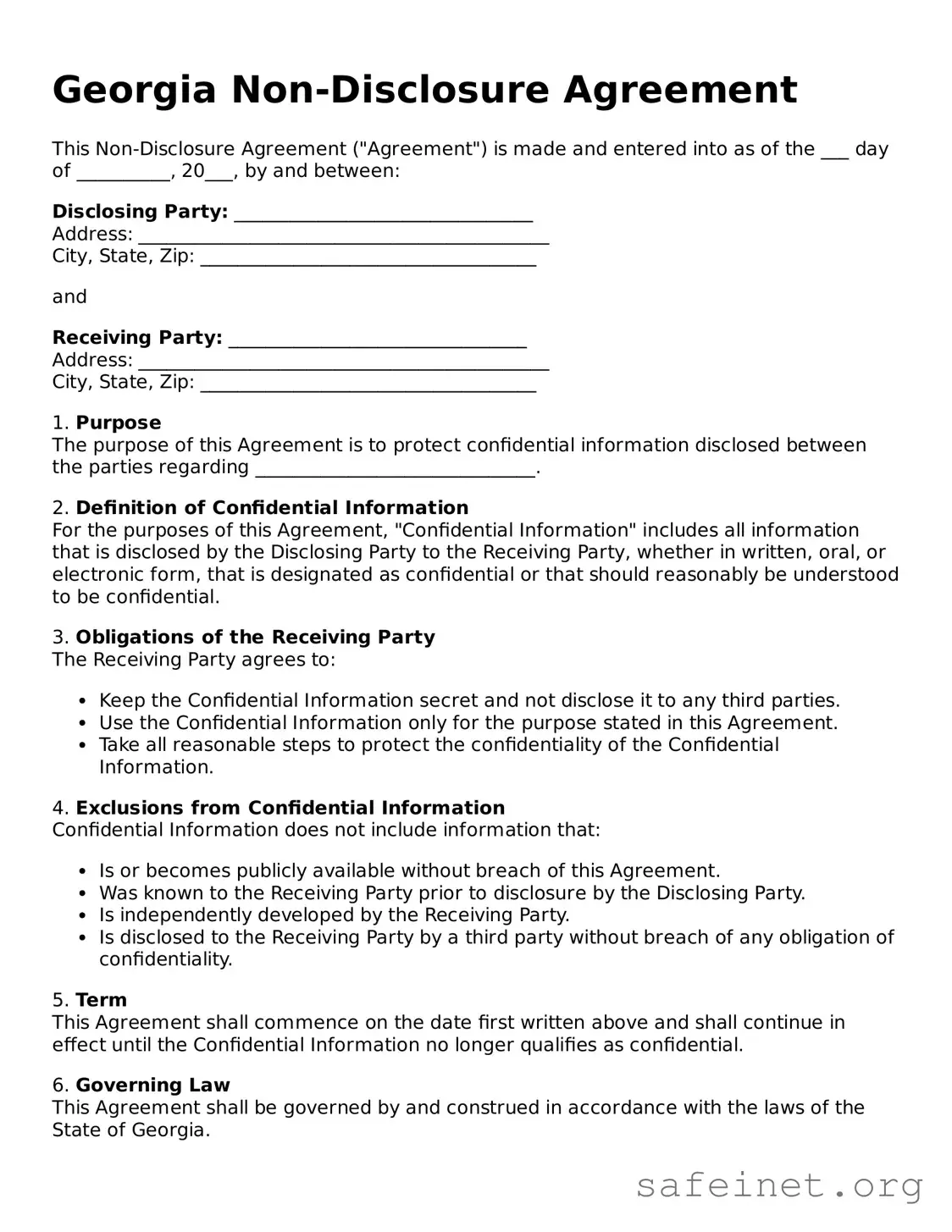
The Georgia Non-disclosure Agreement (NDA) serves as a crucial legal tool for individuals and businesses seeking to protect sensitive information from unauthorized disclosure. In an increasingly competitive landscape, safeguarding proprietary data, trade secrets, and confidential communications is paramount. This form outlines the obligations of the parties involved, ensuring that any shared information remains confidential and is used solely for its intended purpose. Key components of the Georgia NDA include definitions of what constitutes confidential information, the duration of the confidentiality obligation, and the consequences of breach. Additionally, the agreement may specify the jurisdiction for resolving disputes and the permissible uses of the disclosed information. By establishing clear terms, the Georgia Non-disclosure Agreement fosters trust between parties while minimizing the risk of information leaks that could jeopardize business interests.
Georgia Non-Disclosure Agreement
This Non-Disclosure Agreement ("Agreement") is made and entered into as of the ___ day of __________, 20___, by and between:
Disclosing Party: ________________________________
Address: ____________________________________________
City, State, Zip: ____________________________________
and
Receiving Party: ________________________________
Address: ____________________________________________
City, State, Zip: ____________________________________
1. Purpose
The purpose of this Agreement is to protect confidential information disclosed between the parties regarding ______________________________.
2. Definition of Confidential Information
For the purposes of this Agreement, "Confidential Information" includes all information that is disclosed by the Disclosing Party to the Receiving Party, whether in written, oral, or electronic form, that is designated as confidential or that should reasonably be understood to be confidential.
3. Obligations of the Receiving Party
The Receiving Party agrees to:
4. Exclusions from Confidential Information
Confidential Information does not include information that:
5. Term
This Agreement shall commence on the date first written above and shall continue in effect until the Confidential Information no longer qualifies as confidential.
6. Governing Law
This Agreement shall be governed by and construed in accordance with the laws of the State of Georgia.
7. Miscellaneous
This Agreement constitutes the entire agreement between the parties regarding the subject matter hereof and supersedes all prior agreements, understandings, and negotiations.
IN WITNESS WHEREOF, the parties hereto have executed this Non-Disclosure Agreement as of the date first above written.
Disclosing Party Signature: ________________________________
Date: ________________
Receiving Party Signature: ________________________________
Date: ________________
| Fact Name | Description |
|---|---|
| Purpose | A Non-disclosure Agreement (NDA) protects confidential information shared between parties. |
| Governing Law | The NDA in Georgia is governed by the laws of the State of Georgia. |
| Parties Involved | Typically, an NDA involves at least two parties: the disclosing party and the receiving party. |
| Types of Information | Confidential information can include trade secrets, business strategies, and proprietary data. |
| Duration | The duration of confidentiality obligations can vary, often lasting several years. |
| Exclusions | Information that is public knowledge or independently developed is usually excluded from the NDA. |
| Enforcement | If breached, the injured party may seek legal remedies, including damages or injunctions. |
| Written Agreement | While verbal agreements can exist, a written NDA is strongly recommended for clarity. |
| Mutual vs. Unilateral | NDAs can be mutual, where both parties share information, or unilateral, where only one party discloses information. |
| Signatures | Both parties must sign the NDA for it to be legally binding and enforceable. |
Completing the Georgia Non-disclosure Agreement form is an important step in protecting sensitive information. Following these steps will help ensure that you fill out the form accurately and completely.
Once the form is completed and signed, it is essential to keep it in a safe place. This document can serve as a crucial reference should any disputes arise in the future regarding the confidentiality of the shared information.
What is a Georgia Non-disclosure Agreement (NDA)?
A Georgia Non-disclosure Agreement is a legal contract that protects confidential information shared between parties. It ensures that sensitive information, such as trade secrets or proprietary data, remains private and is not disclosed to unauthorized individuals or entities.
Who should use a Georgia NDA?
Any individual or business that plans to share confidential information should consider using a Georgia NDA. This includes entrepreneurs, businesses, employees, and contractors who need to protect sensitive information during negotiations or collaborations.
What information can be protected under a Georgia NDA?
Confidential information that can be protected includes business plans, financial data, customer lists, marketing strategies, and any other proprietary information that gives a competitive advantage. The NDA should clearly define what constitutes confidential information.
How long does the confidentiality obligation last?
The duration of the confidentiality obligation is typically specified in the NDA. It can vary based on the nature of the information shared. Common terms range from a few years to indefinitely, depending on the agreement between the parties involved.
What happens if someone breaches the NDA?
If a party breaches the NDA, the injured party may seek legal remedies. This can include monetary damages, injunctive relief, or specific performance. The NDA may also outline the consequences of a breach, which can help deter violations.
Can a Georgia NDA be modified after it is signed?
Yes, a Georgia NDA can be modified, but both parties must agree to the changes. Any modifications should be documented in writing and signed by both parties to ensure they are legally enforceable.
Is it necessary to have a lawyer review the NDA?
While it is not legally required, having a lawyer review the NDA is highly recommended. A legal professional can ensure that the agreement is comprehensive, protects your interests, and complies with Georgia law.
Incomplete Information: One of the most common mistakes is failing to provide all necessary details. Ensure that all fields are filled out completely, including names, addresses, and contact information.
Incorrect Dates: People often overlook the importance of accurate dates. Make sure to enter the correct start and end dates for the agreement to avoid confusion later.
Missing Signatures: A signature is crucial for the validity of the agreement. Double-check that all parties involved have signed the document where required.
Ambiguous Terms: Clarity is key. Avoid using vague language that could lead to misunderstandings. Clearly define what constitutes confidential information.
Not Reviewing the Agreement: Failing to read the entire document before submission can lead to oversights. Take the time to review all terms and conditions carefully.
Ignoring State-Specific Requirements: Each state may have specific requirements for non-disclosure agreements. Ensure that you are aware of and comply with Georgia's regulations.
Forgetting to Specify Duration: Some individuals forget to include how long the confidentiality obligation lasts. Clearly state the duration to avoid future disputes.
Assuming All Information is Covered: Not all information may be considered confidential. Be specific about what is included and what is not, to protect all parties involved.
When engaging in business transactions or partnerships in Georgia, a Non-disclosure Agreement (NDA) is often used to protect confidential information. However, several other forms and documents are typically associated with an NDA to ensure comprehensive legal protection and clarity in the business relationship. Below is a list of commonly used documents alongside the Georgia Non-disclosure Agreement.
These documents work in tandem with the Non-disclosure Agreement to create a robust framework for protecting sensitive information and establishing clear expectations in business relationships. Understanding each of these documents can help parties navigate their legal obligations effectively.
The Georgia Non-disclosure Agreement (NDA) shares similarities with the Confidentiality Agreement. Both documents serve the primary purpose of protecting sensitive information shared between parties. A Confidentiality Agreement may be used in various contexts, including employment relationships and business partnerships. Just like the NDA, it outlines the types of information considered confidential and establishes the obligations of the parties involved to maintain that confidentiality. The focus remains on preventing unauthorized disclosure of proprietary or sensitive information.
Another document akin to the Georgia NDA is the Non-compete Agreement. While the NDA focuses on confidentiality, the Non-compete Agreement restricts an individual's ability to engage in competitive activities after leaving a company. Both documents are often used in business settings to protect a company's interests. They can be combined to ensure that not only is sensitive information kept private, but also that former employees do not use that information to benefit a competing business.
The Non-solicitation Agreement also resembles the Georgia NDA. This document prevents one party from soliciting clients or employees of another party. Like the NDA, it aims to protect business interests and relationships. While the NDA focuses on safeguarding confidential information, the Non-solicitation Agreement specifically addresses the potential for competitive harm that can arise when one party attempts to lure clients or employees away from another.
The Proprietary Information Agreement is another document similar to the Georgia NDA. This agreement specifically addresses the handling of proprietary information, which may include trade secrets, business strategies, or unique processes. The Proprietary Information Agreement, like the NDA, outlines the expectations for confidentiality and can be used in various contexts, such as business partnerships or employment situations. Both documents emphasize the importance of protecting valuable information from unauthorized disclosure.
The Mutual Non-disclosure Agreement is also comparable to the Georgia NDA. This type of agreement involves two parties sharing confidential information with each other. Each party agrees to keep the other's information private, creating a balanced approach to confidentiality. This mutual understanding is essential in situations where both parties may have sensitive information to protect, and it ensures that trust is maintained throughout their relationship.
Lastly, the Employment Agreement often includes confidentiality clauses that are similar to those found in the Georgia NDA. This document outlines the terms of employment and may specify the employee's obligations regarding the protection of confidential information. By including confidentiality provisions, the Employment Agreement ensures that employees understand their responsibilities to safeguard the employer's sensitive information during and after their tenure, reinforcing the importance of confidentiality in the workplace.
When filling out the Georgia Non-disclosure Agreement form, it's important to approach the task thoughtfully. Here are some things you should and shouldn't do:
There are several misconceptions about the Georgia Non-disclosure Agreement (NDA) form that can lead to confusion. Let’s clear these up.
Many believe that only big companies need NDAs. In reality, any business, regardless of size, can benefit from protecting its confidential information.
While legal documents can seem daunting, NDAs can be straightforward. They simply outline what information is confidential and how it should be handled.
This is not true. NDAs restrict sharing specific confidential information, but they do not prevent all communication.
NDAs can be used at any point, even after a relationship has begun. They can protect ongoing projects and discussions.
Every NDA can be tailored to fit specific needs. The terms can vary widely based on the situation and the parties involved.
Trust is important, but an NDA provides a legal safeguard. It sets clear expectations and can help prevent misunderstandings.
When dealing with sensitive information in Georgia, a Non-disclosure Agreement (NDA) is a vital tool. Here are some key takeaways to keep in mind when filling out and using the Georgia NDA form:
Using these guidelines will help ensure that your Non-disclosure Agreement is effective and protects your confidential information appropriately.