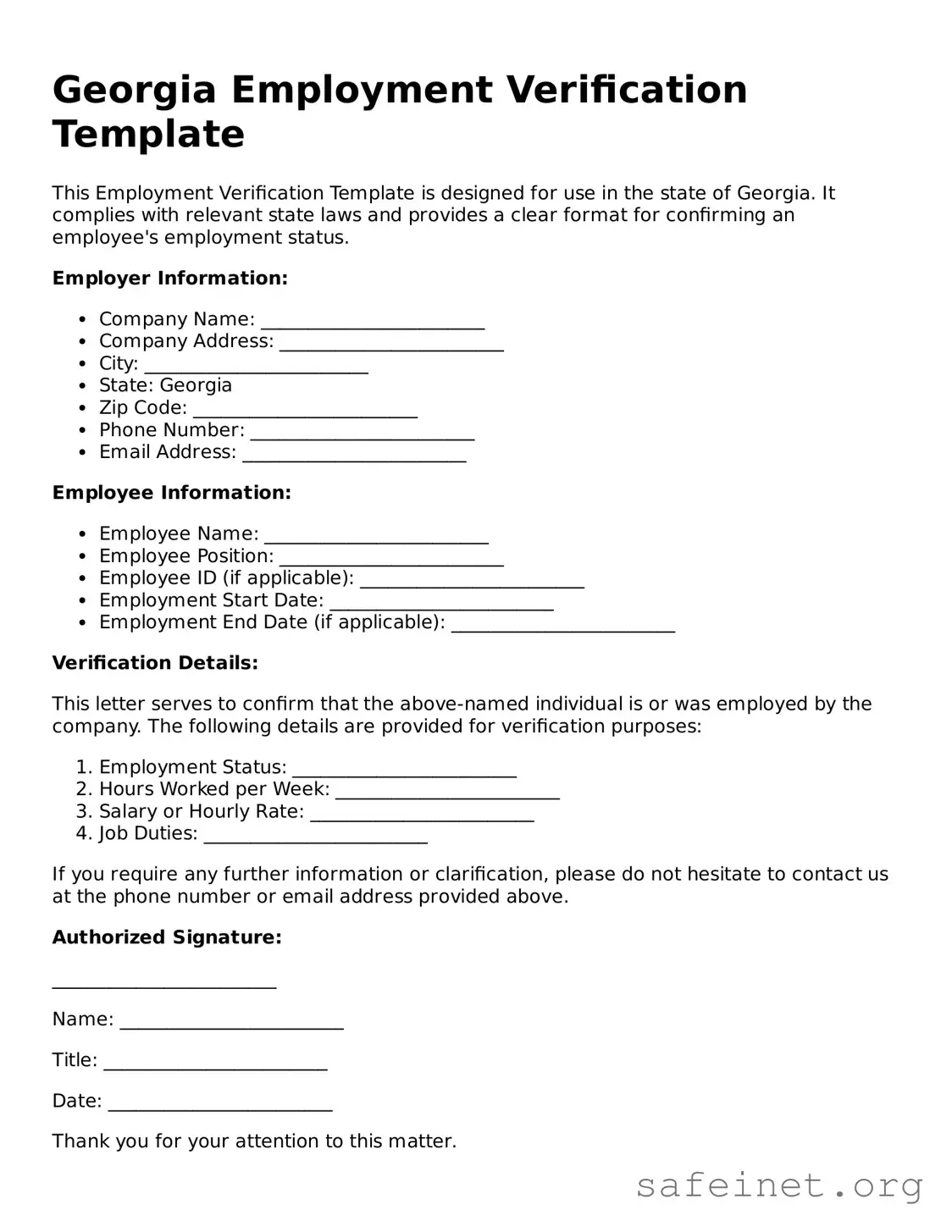
The Georgia Employment Verification form plays a crucial role in the hiring process, serving as a key document that employers use to confirm the employment status of their workers. This form not only helps verify an employee's job title and dates of employment but also provides essential information regarding their salary and job performance. Employers and employees alike benefit from this verification process, as it ensures that all parties have accurate and reliable information. In addition to aiding in background checks, the form can also be pivotal when applying for loans, renting property, or securing other forms of credit. Understanding the nuances of this form is vital for both employers who must comply with state regulations and employees who need to ensure their employment history is accurately represented. With the right knowledge, individuals can navigate the employment verification process with confidence, ensuring that their rights and interests are protected.
Georgia Employment Verification Template
This Employment Verification Template is designed for use in the state of Georgia. It complies with relevant state laws and provides a clear format for confirming an employee's employment status.
Employer Information:
Employee Information:
Verification Details:
This letter serves to confirm that the above-named individual is or was employed by the company. The following details are provided for verification purposes:
If you require any further information or clarification, please do not hesitate to contact us at the phone number or email address provided above.
Authorized Signature:
________________________
Name: ________________________
Title: ________________________
Date: ________________________
Thank you for your attention to this matter.
| Fact Name | Description |
|---|---|
| Purpose | The Georgia Employment Verification form is used to confirm the employment status of an individual, often for purposes such as loan applications or government benefits. |
| Governing Law | This form is governed by Georgia state law, specifically under the Georgia Employment Security Law. |
| Who Uses It | Employers, banks, and government agencies commonly use the form to verify an employee's job status and income. |
| Required Information | The form typically requires details such as the employee's name, job title, employment dates, and salary information. |
| Signature Requirement | A signature from the employer or authorized representative is usually required to validate the information provided. |
| Submission Process | Once completed, the form can be submitted directly to the requesting party, such as a bank or government office. |
| Confidentiality | Employers must ensure that the information shared on the form complies with privacy laws and protects the employee's personal data. |
Filling out the Georgia Employment Verification form requires careful attention to detail. Once you have completed the form, it will be submitted to the relevant party for processing. Follow these steps to ensure that you provide all necessary information accurately.
What is the Georgia Employment Verification form?
The Georgia Employment Verification form is a document used to confirm an individual's employment status, job title, and dates of employment with a specific employer in Georgia. It is often required by lenders, government agencies, or other organizations to validate a person's income and employment history.
Who needs to fill out the Employment Verification form?
Typically, the form is filled out by employers or human resources personnel. Employees may need to request this verification for various reasons, such as applying for a loan, renting an apartment, or verifying employment for a new job. The employee usually provides consent for the employer to release this information.
What information is included in the Employment Verification form?
The form generally includes the employee's name, job title, dates of employment, and salary information. Employers may also provide additional details, such as the nature of the employee's job duties and whether the employee is currently employed or has left the company.
How can I obtain a copy of my Employment Verification form?
To obtain a copy, you should contact your employer's human resources department. They will guide you through the process and may require you to submit a written request or sign a consent form before releasing the information.
Is there a fee for obtaining the Employment Verification form?
In most cases, there is no fee for obtaining your Employment Verification form. Employers typically provide this service as part of their human resources functions. However, if a third-party service is involved, they may charge a fee.
What should I do if my employer refuses to complete the form?
If your employer refuses to complete the Employment Verification form, first ask for the reason. Sometimes, it may be due to company policy or a misunderstanding. If the issue persists, consider discussing it with a supervisor or human resources manager. You may also explore alternative methods of verifying your employment, such as providing pay stubs or tax documents.
Not providing complete information. Many individuals forget to fill out all required fields, which can delay the verification process.
Incorrect employer details. Some people mistakenly enter the wrong name or address of their employer, leading to confusion.
Missing signatures. Failing to sign the form can render it invalid, preventing the verification from being processed.
Using outdated information. Individuals sometimes provide old job titles or dates of employment, which can mislead the verification team.
Not including contact information. Omitting phone numbers or email addresses can hinder communication between the verifier and the employer.
Neglecting to check for errors. Simple typos can create significant issues, so it is crucial to review the form carefully before submission.
Failing to provide supporting documents. Some people forget to attach necessary documents, such as pay stubs or offer letters, which may be required for verification.
Not understanding the purpose of the form. A lack of clarity about what information is needed can lead to incomplete or irrelevant responses.
Ignoring submission guidelines. Each organization may have specific instructions on how to submit the form. Not following these can cause delays.
Submitting the form late. Delays in submission can impact job applications or benefits, so it’s essential to send it promptly.
The Georgia Employment Verification form is a crucial document used to confirm an individual's employment status. Along with this form, several other documents may be necessary to provide a complete picture of employment history and qualifications. Below is a list of additional forms and documents that are often used in conjunction with the Employment Verification form.
These documents, when used alongside the Georgia Employment Verification form, can help create a comprehensive employment profile. Ensuring all necessary paperwork is in order will facilitate smoother verification processes.
The Georgia Employment Verification form shares similarities with the I-9 Employment Eligibility Verification form. Both documents serve the purpose of confirming an individual's employment status and eligibility to work in the United States. The I-9 form, required by federal law, necessitates that employers verify the identity and employment authorization of their employees. This process involves collecting specific documentation from the employee, such as a passport or driver's license, much like the Georgia Employment Verification form, which also requires employers to affirm the employment details of their staff.
Another document that resembles the Georgia Employment Verification form is the W-2 Wage and Tax Statement. While the W-2 primarily focuses on reporting an employee's annual wages and the taxes withheld from their paychecks, it also serves as a verification of employment. Employers issue this form to their employees at the end of each tax year, providing crucial information that confirms the individual's employment status and earnings, similar to how the Georgia Employment Verification form confirms ongoing employment for various purposes.
The Social Security Administration's Form SSA-89, Authorization for the Social Security Administration (SSA) to Release Social Security Number (SSN) Verification, is another document that parallels the Georgia Employment Verification form. This form is used to obtain verification of an individual's Social Security number from the SSA, which can be critical for employers needing to confirm an employee's identity and work eligibility. Both documents aim to provide a level of assurance regarding an individual's identity and employment status, facilitating compliance with employment regulations.
Lastly, the Form 4506-T, Request for Transcript of Tax Return, also bears resemblance to the Georgia Employment Verification form. This document allows individuals to request a transcript of their tax returns from the IRS, which can serve as a means of verifying income and employment history. Employers and lenders often use this form to confirm an applicant's financial background, similar to how the Georgia Employment Verification form is utilized to validate an employee's current employment status. Both forms are instrumental in establishing trust and accountability in employment and financial transactions.
When filling out the Georgia Employment Verification form, it is important to approach the task with care. Here are some key dos and don'ts to keep in mind:
Following these guidelines will help ensure that your Employment Verification form is processed smoothly and efficiently.
Many individuals encounter misconceptions about the Georgia Employment Verification form. Understanding these misconceptions is crucial for both employers and employees. Here are four common misunderstandings:
While the form is often associated with new employees, it is also required for existing employees when verifying their employment status for various purposes, such as loan applications or government assistance.
All employers in Georgia, regardless of size or industry, must utilize the Employment Verification form when requested. This applies to both public and private sectors.
Completing the Employment Verification form does not guarantee that the individual will be employed. It simply verifies the employment status of the individual at the time of completion.
While certain details may be sensitive, the information provided on the Employment Verification form can be disclosed under specific circumstances, such as legal inquiries or employer verification requests.
Filling out the Georgia Employment Verification form is an important step for both employers and employees. Here are some key takeaways to consider: