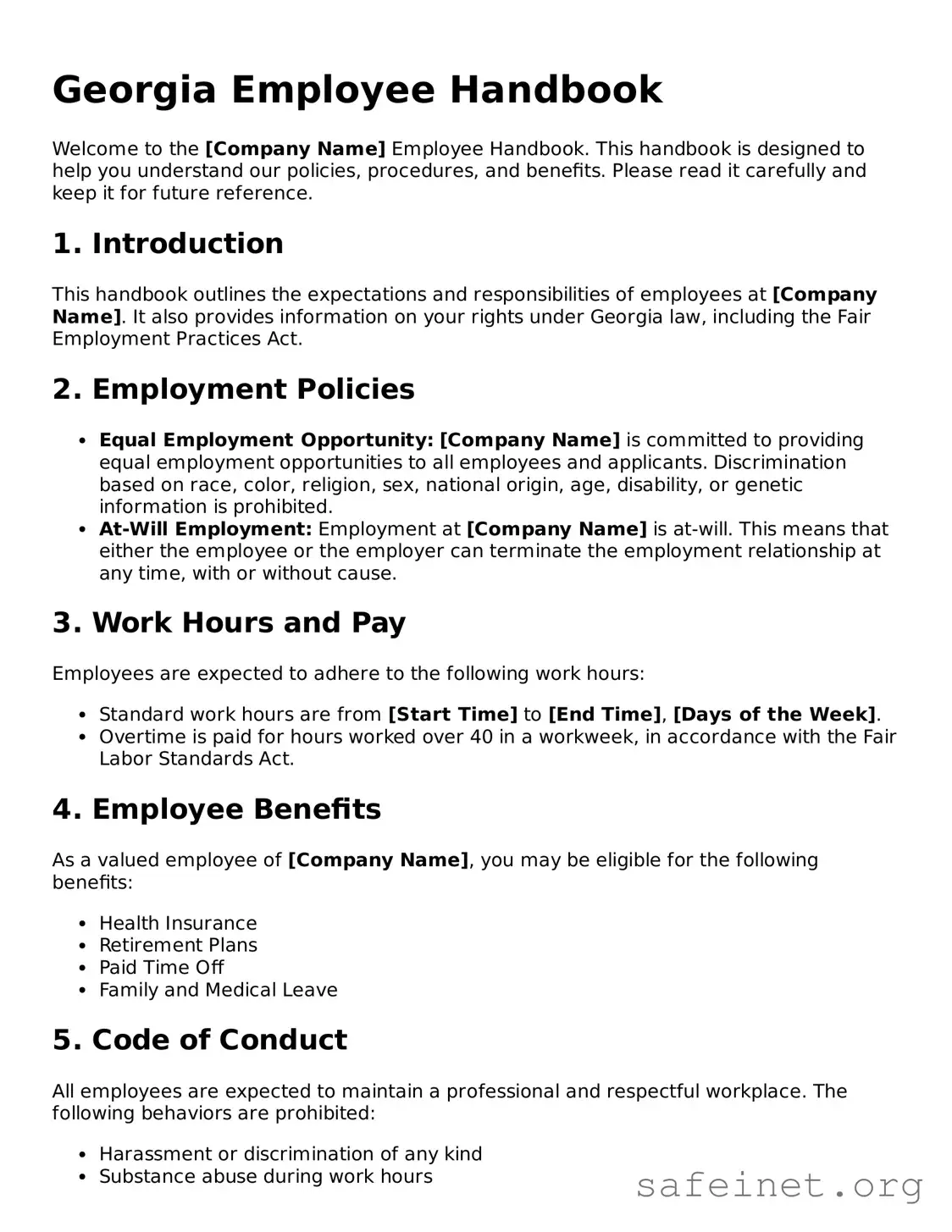
Creating a comprehensive Employee Handbook is a vital step for businesses operating in Georgia. This document serves as a guide for employees, outlining company policies, procedures, and expectations. It covers essential topics such as workplace conduct, attendance policies, benefits, and safety regulations. Additionally, the handbook addresses employee rights and responsibilities, ensuring that all team members are informed about their entitlements and obligations. By providing clear guidelines, the Employee Handbook helps foster a positive work environment and can mitigate potential disputes. It also serves as a legal safeguard for the employer, as it demonstrates adherence to state and federal labor laws. With this form, companies can customize their handbooks to reflect their unique culture and operational needs, promoting transparency and consistency across the organization.
Georgia Employee Handbook
Welcome to the [Company Name] Employee Handbook. This handbook is designed to help you understand our policies, procedures, and benefits. Please read it carefully and keep it for future reference.
1. Introduction
This handbook outlines the expectations and responsibilities of employees at [Company Name]. It also provides information on your rights under Georgia law, including the Fair Employment Practices Act.
2. Employment Policies
3. Work Hours and Pay
Employees are expected to adhere to the following work hours:
4. Employee Benefits
As a valued employee of [Company Name], you may be eligible for the following benefits:
5. Code of Conduct
All employees are expected to maintain a professional and respectful workplace. The following behaviors are prohibited:
6. Safety and Health
[Company Name] is committed to providing a safe work environment. Employees are encouraged to report any unsafe conditions to their supervisor immediately.
7. Acknowledgment
By signing below, you acknowledge that you have received and read the [Company Name] Employee Handbook and understand the policies outlined within.
Employee Name: ________________________
Date: ________________________
| Fact Name | Description |
|---|---|
| Purpose | The Georgia Employee Handbook serves as a guide for employees regarding workplace policies, procedures, and expectations. |
| Legal Requirement | While not mandated by law, providing an employee handbook is considered a best practice for Georgia employers. |
| Governing Laws | The handbook should comply with federal laws such as the Fair Labor Standards Act and the Family and Medical Leave Act, as well as Georgia state laws. |
| Content Recommendations | It is advisable to include sections on anti-discrimination policies, workplace safety, and employee rights. |
| Employee Acknowledgment | Employers should obtain written acknowledgment from employees confirming they have received and understood the handbook. |
| Updates | Regular updates to the handbook are necessary to reflect changes in laws and company policies. |
Once you have the Georgia Employee Handbook form in front of you, it’s time to complete it carefully. This process ensures that all necessary information is accurately recorded. Follow these steps to fill out the form effectively.
What is the purpose of the Georgia Employee Handbook form?
The Georgia Employee Handbook form serves as a comprehensive guide for employees, outlining the policies, procedures, and expectations within the workplace. It helps ensure that employees understand their rights and responsibilities, as well as the company’s standards. This document can also protect employers by clearly communicating rules and regulations, thereby minimizing misunderstandings and potential disputes.
Who is required to have an Employee Handbook in Georgia?
While not mandated by law, having an Employee Handbook is highly recommended for all employers in Georgia, regardless of size. It is particularly beneficial for businesses with multiple employees, as it creates a consistent framework for managing workplace issues. This handbook can be an essential tool for both large corporations and small businesses to foster a positive work environment.
What should be included in a Georgia Employee Handbook?
A well-crafted Employee Handbook should include several key components. Start with an introduction that outlines the company’s mission and values. Next, cover topics such as employment policies, anti-discrimination policies, workplace conduct, and disciplinary procedures. Additionally, it should detail benefits, leave policies, and any other important information relevant to employees. Regular updates are necessary to reflect changes in laws or company policies.
How can employees access the Employee Handbook?
Incomplete Information: Many individuals forget to fill out all required fields. This can lead to delays in processing or even rejection of the form.
Incorrect Personal Details: Providing inaccurate information, such as a misspelled name or wrong address, can create confusion and may affect communication with the employer.
Neglecting to Read Policies: Some employees skip over important sections of the handbook. Failing to understand company policies can result in unintentional violations.
Not Asking Questions: Employees often hesitate to seek clarification. If something is unclear, it’s crucial to ask for help rather than making assumptions.
Forgetting to Sign and Date: A common oversight is neglecting to sign or date the form. Without a signature, the form may not be considered valid.
The Georgia Employee Handbook serves as a crucial resource for both employers and employees, outlining workplace policies, procedures, and expectations. In addition to this handbook, several other documents are commonly utilized to ensure clarity and compliance within the workplace. Below is a list of these documents, each playing a vital role in the employment relationship.
These documents, when used in conjunction with the Georgia Employee Handbook, contribute to a well-organized and transparent workplace environment. Together, they help establish clear communication and expectations, which can enhance employee satisfaction and productivity.
The Georgia Employee Handbook serves as a vital resource for employees and employers alike, outlining workplace policies, procedures, and expectations. A similar document is the Employee Manual. Both documents provide comprehensive information about company policies, including attendance, dress code, and workplace behavior. The Employee Manual often includes additional details about employee benefits, job descriptions, and performance evaluations, making it a useful companion to the Employee Handbook.
Another comparable document is the Company Policy Guide. This guide focuses on specific policies that govern employee conduct and company operations. Like the Employee Handbook, it addresses issues such as harassment, discrimination, and disciplinary actions. However, the Company Policy Guide may delve deeper into particular policies, offering more extensive explanations and examples to clarify expectations for employees.
The Orientation Handbook is also similar in purpose. It is typically provided to new hires to help them acclimate to the company culture and understand their roles. While the Employee Handbook is more comprehensive, the Orientation Handbook emphasizes immediate information that new employees need, such as introductions to team members, initial training schedules, and essential operational procedures.
The Code of Conduct document aligns closely with the Employee Handbook as well. It outlines the ethical standards and behavioral expectations for employees. Both documents aim to foster a respectful and productive workplace environment. However, the Code of Conduct may focus more on ethical dilemmas and decision-making processes, whereas the Employee Handbook covers a broader range of employment-related topics.
Similarly, the Workplace Safety Manual shares a connection with the Employee Handbook. This manual details safety protocols, emergency procedures, and health regulations. While the Employee Handbook may touch on safety policies, the Workplace Safety Manual is dedicated to ensuring that employees understand and adhere to safety measures, thus promoting a secure work environment.
The Benefits Guide is another document that bears similarities to the Employee Handbook. It specifically outlines employee benefits, including health insurance, retirement plans, and leave policies. While the Employee Handbook may briefly mention these benefits, the Benefits Guide provides in-depth information, helping employees navigate their options and make informed decisions regarding their benefits.
The Performance Evaluation Policy document also parallels the Employee Handbook. It describes the criteria and processes for evaluating employee performance. Both documents aim to set clear expectations and provide feedback mechanisms. However, the Performance Evaluation Policy focuses more on the evaluation process itself, including timelines, criteria, and potential outcomes, while the Employee Handbook addresses performance in a broader context.
The Employee Rights and Responsibilities document is similar as well. It outlines the rights of employees under federal and state laws, such as the right to fair treatment and protection against discrimination. The Employee Handbook may reference these rights, but this document provides a more detailed examination of legal protections, ensuring employees understand their entitlements and obligations.
The Leave of Absence Policy is another relevant document. It specifies the types of leave available to employees, such as medical leave, family leave, and personal leave. While the Employee Handbook may summarize leave policies, the Leave of Absence Policy offers a more detailed account of eligibility, application procedures, and the rights of employees during their time away from work.
Lastly, the Training and Development Plan shares similarities with the Employee Handbook. This plan outlines the company’s commitment to employee growth and professional development. While the Employee Handbook may highlight training opportunities, the Training and Development Plan provides specific information about available programs, resources, and expectations for employee participation in ongoing education and skill enhancement.
When filling out the Georgia Employee Handbook form, it is important to approach the task with care. Here are five things you should and shouldn't do:
By following these guidelines, you can help ensure that your form is completed accurately and efficiently.
Understanding the Georgia Employee Handbook form is essential for both employers and employees. However, several misconceptions can lead to confusion. Below are nine common misconceptions regarding this important document.
By addressing these misconceptions, both employers and employees can better navigate the complexities of the workplace and foster a more informed and cohesive environment.
When it comes to the Georgia Employee Handbook form, understanding its importance and how to fill it out correctly can significantly impact both employers and employees. Here are some key takeaways to keep in mind:
By keeping these points in mind, you can create an effective employee handbook that serves as a foundational document for your workplace.