Homepage > Blank Ftc Identity Theft Affidavit Template
Article Structure

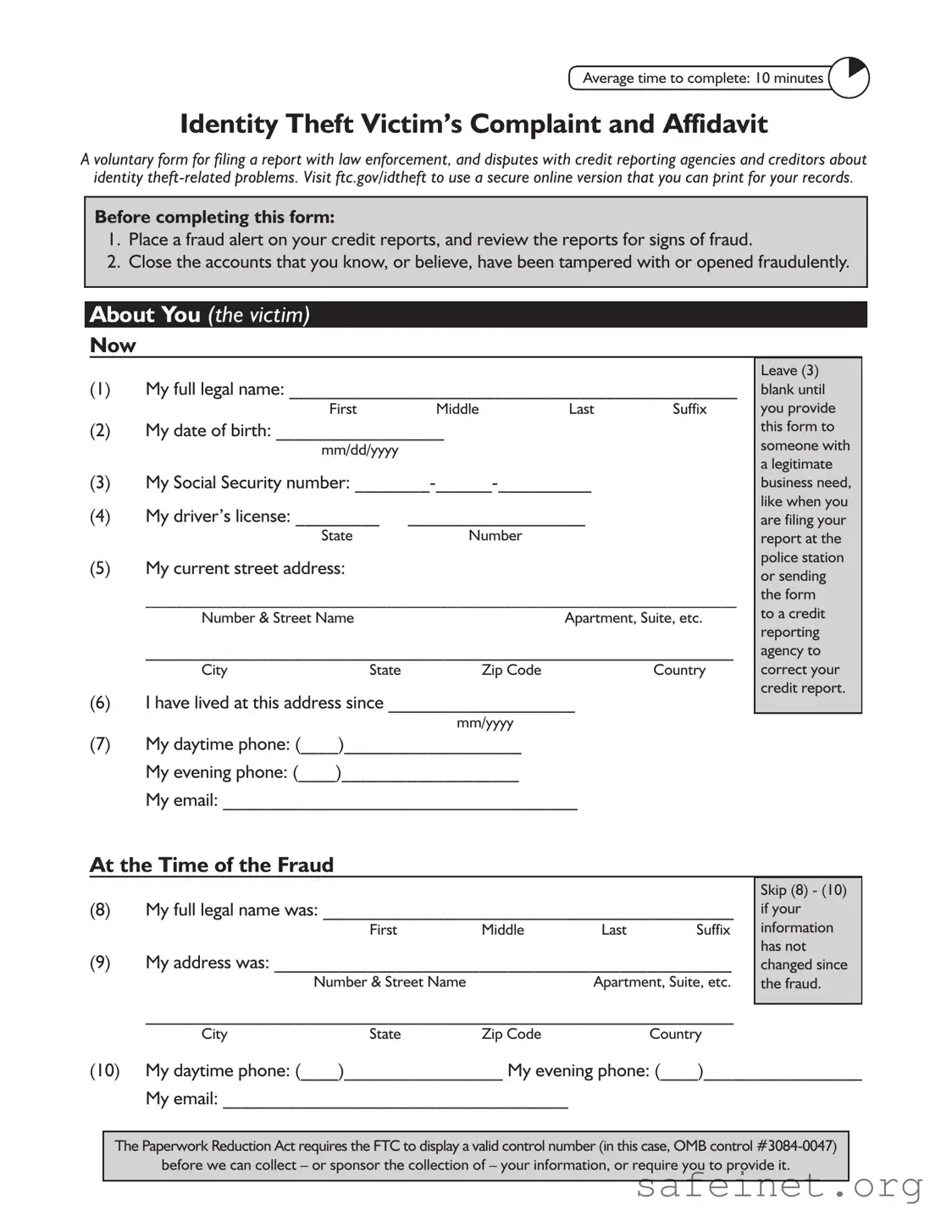
Identity theft can be a distressing experience, leaving victims feeling vulnerable and overwhelmed. To assist those affected, the Federal Trade Commission (FTC) provides the Identity Theft Affidavit form, a crucial tool for reporting and disputing identity theft-related issues. This voluntary form is designed to help victims communicate with law enforcement and resolve disputes with credit reporting agencies and creditors. Completing the form typically takes around ten minutes, and it serves as a formal complaint that outlines the specifics of the theft. Before filling out the affidavit, victims are advised to take essential preliminary steps, such as placing a fraud alert on their credit reports and closing any accounts that may have been compromised. The form requires personal information about the victim, details about the fraudulent activity, and any relevant documentation to verify identity. By using the secure online version available at ftc.gov/idtheft, individuals can easily print the affidavit for their records. This form not only empowers victims to take control of their situation but also facilitates communication with various institutions, aiding in the recovery process.


Form Sample

Leave (3)
blank until
you provide
this form to
someone with
a legitimate
business need,
like when you
are filing your
report at the
police station
or sending
the form
to a credit
reporting
agency to
correct your
credit report.
Skip (8) - (10)
if your
information
has not
changed since
the fraud.
Now
About You (the victim)
Identity Theft Victim’s Complaint and Affidavit
A voluntary form for filing a report with law enforcement, and disputes with credit reporting agencies and creditors about
identity theft-related problems. Visit ftc.gov/idtheft to use a secure online version that you can print for your records.
Before completing this form:
Place a fraud alert on your credit reports, and review the reports for signs of fraud.1.
Close the accounts that you know, or believe, have been tampered with or opened fraudulently.2.
(1) My full legal name: ________________________________________________
First Middle Last Suffix
(2) My date of birth: __________________
mm/dd/yyyy
(3) My Social Security number: ________-______-__________
(4) My driver’s license: _________ ___________________
State Number
(5) My current street address:
____________________________________________________________________________
Number & Street Name Apartment, Suite, etc.
_______________________________________________________________
City State Zip Code Country
(6) I have lived at this address since ____________________
mm/yyyy
(7) My daytime phone: (____)___________________
My evening phone: (____)___________________
My email: ______________________________________
At the Time of the Fraud
(8) My full legal name was: ____________________________________________
First Middle Last Suffix
(9) My address was: _________________________________________________
Number & Street Name Apartment, Suite, etc.
_______________________________________________________________
City State Zip Code Country
The Paperwork Reduction Act requires the FTC to display a valid control number (in this case, OMB control #3084-0047)
before we can collect – or sponsor the collection of – your information, or require you to provide it.
Average time to complete: 10 minutes
(10) My daytime phone: (____)_________________ My evening phone: (____)_________________
My email: _____________________________________
(11) I did OR did not authorize anyone to use my name or personal information to
obtain money, credit, loans, goods, or services — or for any
other purpose — as described in this report.
(12) I did OR did not receive any money, goods, services, or other benefit as a
result of the events described in this report.
(13) I am OR am not willing to work with law enforcement if charges are brought
against the person(s) who committed the fraud.
(14) I believe the following person used my information or identification
documents to open new accounts, use my existing accounts, or commit other
fraud.
Victim’s Name _______________________________ Phone number (____)_________________ Page 2
Declarations
About You (the victim) (Continued)
(14):
Enter what
you know
about anyone
you believe
was involved
(even if you
don’t have
complete
information).
Name: ___________________________________________________
First Middle Last Suffix
Address: __________________________________________________
Number & Street Name Apartment, Suite, etc.
__________________________________________________________
City State Zip Code Country
Phone Numbers: (____)_______________ (____)________________
Additional information about this person: _____________________________________
_______________________________________________________________________
_______________________________________________________________________
_______________________________________________________________________
_______________________________________________________________________
_______________________________________________________________________
_______________________________________________________________________
_______________________________________________________________________
_______________________________________________________________________
_______________________________________________________________________
_______________________________________________________________________
About the Fraud
Victim’s Name _______________________________ Phone number (____)_________________ Page 3
(15) Additional information about the crime (for example, how the identity thief
gained access to your information or which documents or information were
used):
________________________________________________________________
________________________________________________________________
________________________________________________________________
______________________________________________________________________________
______________________________________________________________________________
______________________________________________________________________________
______________________________________________________________________________
About the Information or Accounts
(17) The following personal information (like my name, address, Social Security number, or date of
birth) in my credit report is inaccurate as a result of this identity theft:
(A) __________________________________________________________________________
(B) __________________________________________________________________________
(C) __________________________________________________________________________
(18) Credit inquiries from these companies appear on my credit report as a result of this identity
theft:
Company Name: _______________________________________________________________
(14) and (15):
Attach
additional
sheets as
needed.
(16): Reminder:
Attach copies
of your identity
documents
when sending
this form to
creditors
and credit
reporting
agencies.
(16) I can verify my identity with these documents:
A valid government-issued photo identification card (for example, my driver’s
license, state-issued ID card, or my passport).
If you are under 16 and don’t have a photo-ID, a copy of your birth certificate or
a copy of your official school record showing your enrollment and legal address is
acceptable.
Proof of residency during the time the disputed charges occurred, the loan
was made, or the other event took place (for example, a copy of a rental/lease
agreement in my name, a utility bill, or an insurance bill).
Documentation
___________________________________________________________________
Name of Institution Contact Person Phone Extension
___________________________________________________________________
Account Number Routing Number Affected Check Number(s)
Account Type: Credit Bank Phone/Utilities Loan
Government Benefits Internet or Email Other
Select ONE:
This account was opened fraudulently.
This was an existing account that someone tampered with.
___________________________________________________________________
Date Opened or Misused (mm/yyyy) Date Discovered (mm/yyyy) Total Amount Obtained ($)
___________________________________________________________________
Name of Institution Contact Person Phone Extension
___________________________________________________________________
Account Number Routing Number Affected Check Number(s)
Account Type: Credit Bank Phone/Utilities Loan
Government Benefits Internet or Email Other
Select ONE:
This account was opened fraudulently.
This was an existing account that someone tampered with.
___________________________________________________________________
Date Opened or Misused (mm/yyyy) Date Discovered (mm/yyyy) Total Amount Obtained ($)
___________________________________________________________________
Name of Institution Contact Person Phone Extension
___________________________________________________________________
Account Number Routing Number Affected Check Number(s)
Account Type: Credit Bank Phone/Utilities Loan
Government Benefits Internet or Email Other
Select ONE:
This account was opened fraudulently.
This was an existing account that someone tampered with.
___________________________________________________________________
Date Opened or Misused (mm/yyyy) Date Discovered (mm/yyyy) Total Amount Obtained ($)
Victim’s Name _______________________________ Phone number (____)_________________ Page 4
(19) Below are details about the different frauds committed using my personal information.
(19):
If there were
more than three
frauds, copy this
page blank, and
attach as many
additional copies
as necessary.
Enter any
applicable
information that
you have, even if
it is incomplete
or an estimate.
If the thief
committed two
types of fraud at
one company,
list the company
twice, giving
the information
about the two
frauds separately.
Contact Person:
Someone you
dealt with, whom
an investigator
can call about this
fraud.
Account Number:
The number of
the credit or
debit card, bank
account, loan, or
other account
that was misused.
Dates: Indicate
when the thief
began to misuse
your information
and when you
discovered the
problem.
Amount Obtained:
For instance,
the total amount
purchased with
the card or
withdrawn from
the account.
Victim’s Name _______________________________ Phone number (____)_________________ Page 5
(20) One way to get a credit reporting agency to quickly block identity theft-
related information from appearing on your credit report is to submit a
detailed law enforcement report (“Identity Theft Report”). You can obtain
an Identity Theft Report by taking this form to your local law enforcement
office, along with your supporting documentation. Ask an officer to witness
your signature and complete the rest of the information in this section. It’s
important to get your report number, whether or not you are able to file in
person or get a copy of the official law enforcement report. Attach a copy of
any confirmation letter or official law enforcement report you receive when
sending this form to credit reporting agencies.
Select ONE:
I have not filed a law enforcement report.
I was unable to file any law enforcement report.
I filed an automated report with the law enforcement agency listed
below.
I filed my report in person with the law enforcement
officer and agency listed below.
____________________________________________________________________
Law Enforcement Department State
____________________________ _____________________
Report Number Filing Date (mm/dd/yyyy)
____________________________________________________________________
Officer’s Name (please print) Officer’s Signature
____________________________ (____)_______________
Badge Number Phone Number
Did the victim receive a copy of the report from the law enforcement officer? Yes OR No
Victim’s FTC complaint number (if available): ________________________
Your Law Enforcement Report
(20):
Check “I have
not...” if you have
not yet filed a
report with law
enforcement or
you have chosen
not to. Check “I
was unable...” if
you tried to file
a report but law
enforcement
refused to take it.
Automated report:
A law
enforcement
report filed
through an
automated
system, for
example, by
telephone, mail,
or the Internet,
instead of a
face-to-face
interview with a
law enforcement
officer.
As applicable, sign and date IN THE PRESENCE OF a law enforcement officer, a notary, or
a witness.
(21) I certify that, to the best of my knowledge and belief, all of the information on and attached to
this complaint is true, correct, and complete and made in good faith. I understand that this
complaint or the information it contains may be made available to federal, state, and/or local
law enforcement agencies for such action within their jurisdiction as they deem appropriate. I
understand that knowingly making any false or fraudulent statement or representation to the
government may violate federal, state, or local criminal statutes, and may result in a fine,
imprisonment, or both.
_______________________________________ _________________________________________
Signature Date Signed (mm/dd/yyyy)
Signature
(22) If you do not choose to file a report with law enforcement, you may use this form as an Identity
Theft Affidavit to prove to each of the companies where the thief misused your information that
you are not responsible for the fraud. While many companies accept this affidavit, others require
that you submit different forms. Check with each company to see if it accepts this form. You
should also check to see if it requires notarization. If so, sign in the presence of a notary. If it
does not, please have one witness (non-relative) sign that you completed and signed this Affidavit.
_______________________________________
Notary
Witness:
_______________________________________ _________________________________________
Signature Printed Name
_______________________________________ _________________________________________
Date Telephone Number
Your Affidavit
Victim’s Name _______________________________ Phone number (____)_________________ Page 6

Document Specifications

Fact Name Description
Completion Time The average time to complete the FTC Identity Theft Affidavit form is about 10 minutes.
Purpose This form serves as a complaint and affidavit for victims of identity theft, allowing them to file reports with law enforcement and dispute issues with credit reporting agencies.
Online Access You can visit ftc.gov/idtheft to access a secure online version of the form, which you can print for your records.
Fraud Alert Before filling out the form, victims should place a fraud alert on their credit reports and review them for signs of fraud.
Documentation Requirement Victims must attach copies of their identity documents when submitting the form to creditors or credit reporting agencies.
Law Enforcement Report Filing a law enforcement report can help in blocking identity theft-related information from appearing on credit reports.
Declarations Section The form includes a declarations section where victims can confirm whether they authorized the use of their personal information.
Control Number The FTC must display a valid control number, OMB control #3084-0047, as required by the Paperwork Reduction Act.
State-Specific Forms Some states may have their own forms or additional requirements for reporting identity theft, governed by state-specific laws.

Steps to Filling Out Ftc Identity Theft Affidavit

Completing the FTC Identity Theft Affidavit form is a crucial step in addressing identity theft. After filling out this form, you will be better equipped to file a report with law enforcement and dispute any fraudulent activity with creditors and credit reporting agencies. This process can help you regain control over your identity and financial well-being.

  1. Gather Your Information: Before you start, collect all necessary documents, including your identification and proof of residency.
  2. Start with Your Information: Fill in your full legal name, date of birth, Social Security number, driver’s license information, and current address.
  3. Provide Contact Details: Include your daytime and evening phone numbers, along with your email address.
  4. Document Changes: If your information has changed since the fraud, fill in the previous name, address, and contact details.
  5. Declare Your Authorization: Indicate whether you authorized anyone to use your information and if you received any benefits as a result of the fraud.
  6. Identify the Fraud: Provide details about the person you believe used your information and any documents they may have used.
  7. Describe the Crime: Write down how the identity thief accessed your information and any relevant details about the crime.
  8. Verify Your Identity: List the documents you will use to verify your identity, such as a government-issued ID or proof of residency.
  9. Report Inaccuracies: Note any inaccuracies in your credit report due to identity theft.
  10. Detail Fraudulent Accounts: Provide information about any accounts that were opened or tampered with fraudulently, including account numbers and amounts obtained.
  11. Law Enforcement Report: Indicate whether you have filed a report with law enforcement and provide the necessary details if you have.
  12. Signature: Sign the affidavit, and ensure that it is witnessed by a law enforcement officer if required.

Once you have completed the form, make sure to keep a copy for your records. You can then submit it to the appropriate authorities and credit reporting agencies to help resolve your identity theft issues.

More About Ftc Identity Theft Affidavit

What is the FTC Identity Theft Affidavit form?

The FTC Identity Theft Affidavit form is a voluntary document that victims of identity theft can use to report the crime. This form helps in filing a report with law enforcement and disputing fraudulent accounts with credit reporting agencies and creditors. It can be completed online at ftc.gov/idtheft, where you can also print it for your records.

How long does it take to complete the form?

On average, it takes about 10 minutes to fill out the FTC Identity Theft Affidavit form. However, the time may vary based on the amount of information you need to provide about the identity theft incident.

What should I do before completing the form?

Before filling out the form, you should place a fraud alert on your credit reports. This alert notifies creditors to take extra steps to verify your identity before opening new accounts. Additionally, review your credit reports for any signs of fraud and close any accounts that you believe have been tampered with or opened fraudulently.

What information do I need to provide about myself?

You will need to provide your full legal name, date of birth, Social Security number, driver's license number, current address, and contact information. If your information has changed since the fraud occurred, you will also need to provide your previous address and contact details.

What details about the fraud must I include?

In the form, you must describe how the identity thief accessed your information. This includes detailing what documents were used to open new accounts or commit fraud. You should also provide any information you have about the person who committed the fraud, if known.

Do I need to provide documentation with the form?

Yes, you should attach copies of documents that verify your identity. Acceptable documents include a government-issued photo ID, proof of residency, and any other relevant documentation. This helps strengthen your case when disputing fraudulent activity.

What should I do after completing the form?

After completing the FTC Identity Theft Affidavit form, you should take it to your local law enforcement agency to file a report. This report is crucial for blocking identity theft-related information from your credit report. Be sure to keep a copy of the report and any confirmation letters for your records.

Common mistakes

  1. Incomplete Information: Many individuals fail to fill in all required fields. Omitting essential details, such as your full legal name or Social Security number, can delay the processing of your affidavit.

  2. Incorrect Dates: Providing inaccurate dates, especially for your date of birth or the dates of fraud, can lead to confusion. Ensure that all dates are correct and formatted properly.

  3. Missing Documentation: Some people neglect to attach necessary documents that verify their identity. Always include a valid government-issued ID and proof of residency to support your claims.

  4. Failure to Review Credit Reports: Before submitting the affidavit, it’s crucial to review your credit reports for signs of fraud. Not doing so may result in missing out on additional fraudulent accounts that need to be reported.

  5. Not Providing Contact Information: Leaving out your daytime and evening phone numbers can hinder communication. Make sure to provide multiple ways for law enforcement and creditors to reach you.

  6. Ignoring Follow-Up Steps: After submitting the affidavit, individuals often overlook the importance of following up with law enforcement and credit reporting agencies. Stay proactive to ensure your case is being handled appropriately.

Documents used along the form

When dealing with identity theft, the FTC Identity Theft Affidavit is a crucial document. However, there are several other forms and documents that often accompany it to help victims navigate the recovery process. Here’s a list of common forms and documents that may be useful:

  • Law Enforcement Report: This is a detailed report filed with local law enforcement that documents the identity theft incident. It serves as official proof of the crime and can be essential for disputing fraudulent accounts.
  • Credit Report: A comprehensive report from credit reporting agencies that outlines your credit history. Reviewing this can help identify any unauthorized accounts or activities linked to your identity theft case.
  • Fraud Alert Request: A request to place a fraud alert on your credit report. This alert warns potential creditors to take extra steps to verify your identity before extending credit, helping to prevent further fraud.
  • Credit Freeze Request: This document allows you to freeze your credit report, preventing new accounts from being opened in your name. A freeze can be lifted temporarily or permanently as needed.
  • Dispute Letters: These letters are sent to creditors and credit reporting agencies to formally dispute fraudulent charges or accounts. They outline the inaccuracies and request corrections.
  • Identity Theft Recovery Plan: A personalized plan that outlines the steps you need to take to recover from identity theft. This can include contacting creditors, filing reports, and monitoring your accounts.
  • Affidavit of Forgery: This document is used to declare that a signature or document was forged. It can be necessary for disputing unauthorized transactions or accounts.
  • IRS Form 14039 (Identity Theft Affidavit): This form is used to report identity theft to the IRS, especially if someone has used your Social Security number to file a fraudulent tax return.
  • Notification Letters: Letters sent to banks, creditors, and other institutions to inform them of identity theft. These letters help ensure that they are aware of the situation and can take appropriate action.
  • Consumer Financial Protection Bureau (CFPB) Complaint Form: A form to file a complaint with the CFPB regarding issues with financial institutions related to identity theft. This can help resolve disputes and seek restitution.

Having these documents ready can significantly streamline the process of recovering from identity theft. Each plays a unique role in helping you regain control of your personal information and financial standing.

Similar forms

The FTC Identity Theft Affidavit form shares similarities with the police report. A police report is an official document created by law enforcement when a crime has been reported. Like the FTC affidavit, it serves as a formal record of the identity theft incident. This document can be used to support claims with creditors and credit reporting agencies, helping victims to establish the legitimacy of their situation. Both documents require specific details about the victim and the fraudulent activity, ensuring that there is a clear account of what occurred. Furthermore, a police report can be essential for legal proceedings and may provide additional weight to the victim's claims.

Another document that parallels the FTC Identity Theft Affidavit is the credit freeze request. A credit freeze is a tool that allows individuals to restrict access to their credit reports. This is particularly useful for victims of identity theft, as it prevents new accounts from being opened in their name. Similar to the affidavit, a credit freeze request requires personal information and details about the identity theft incident. Both documents aim to protect the victim’s financial identity and help mitigate further damage from the theft. By submitting a credit freeze request alongside the affidavit, victims can take proactive steps to secure their credit profile.

The identity theft protection service agreement is also akin to the FTC Identity Theft Affidavit. These agreements often provide a range of services designed to help victims recover from identity theft. They typically include monitoring of credit reports, identity restoration assistance, and sometimes insurance against losses. Like the affidavit, these services require victims to provide personal information and details about the theft. Both documents emphasize the importance of taking immediate action to address identity theft and offer support in navigating the recovery process.

Lastly, the dispute letter to creditors is another document that aligns with the FTC Identity Theft Affidavit. This letter is used to formally challenge inaccuracies in credit reports resulting from identity theft. Similar to the affidavit, it outlines the victim's situation and provides evidence of fraudulent activity. Both documents serve the purpose of rectifying the victim's credit report and ensuring that creditors are aware of the identity theft. By utilizing a dispute letter in conjunction with the affidavit, victims can more effectively communicate their circumstances and seek resolution from creditors.

Dos and Don'ts

When filling out the FTC Identity Theft Affidavit form, it is essential to approach the process with care. Below is a list of things you should and shouldn't do to ensure that your submission is accurate and effective.

  • Do place a fraud alert on your credit reports before completing the form. This will help protect your accounts while you address the issue.
  • Do close any accounts that you suspect have been tampered with or opened fraudulently. This step is crucial for preventing further misuse of your personal information.
  • Do provide accurate and complete information about yourself and the fraud. This includes your full legal name, address, and any relevant details regarding the fraudulent activity.
  • Do keep copies of all documents you submit. This ensures you have a record of your communications and can follow up if necessary.
  • Don't leave any sections blank unless instructed to do so. Missing information can delay the processing of your affidavit.
  • Don't provide false information. Honesty is crucial, as inaccuracies can hinder your ability to resolve the situation.
  • Don't forget to attach supporting documents when sending the form to creditors or credit reporting agencies. These documents can include proof of identity and residency.
  • Don't hesitate to seek help if you're unsure about any part of the form. It’s better to ask for assistance than to submit incorrect information.

Misconceptions

Misconceptions about the FTC Identity Theft Affidavit form can lead to confusion for victims trying to navigate the recovery process. Here are nine common misconceptions explained:

  • The form is mandatory for all identity theft cases. Many believe that completing the FTC Identity Theft Affidavit is required for every case. In reality, it is a voluntary form designed to assist victims in reporting identity theft and disputing fraudulent accounts.
  • You must file a police report before using the affidavit. Some think that a police report is a prerequisite. While having a report can strengthen your case, it is not necessary to complete the affidavit.
  • The affidavit guarantees the removal of fraudulent charges. Victims often assume that submitting the affidavit will automatically resolve their issues with creditors. However, it serves as a tool to initiate disputes, not a guarantee of resolution.
  • You can only submit the affidavit to one creditor. Many believe the form is limited to a single creditor. In fact, you can use it to dispute multiple accounts across different creditors and credit reporting agencies.
  • All personal information must be provided immediately. Some victims feel pressured to complete the form in one sitting. It’s acceptable to leave certain sections blank and fill them in later when necessary.
  • The affidavit is only useful for credit reporting issues. While it is commonly used for disputes with credit reporting agencies, the affidavit also helps in reporting the crime to law enforcement and resolving issues with creditors.
  • You need a lawyer to complete the affidavit. Some individuals believe that legal assistance is necessary. However, the affidavit is designed for victims to complete on their own without legal expertise.
  • Once submitted, the affidavit is final and cannot be changed. Victims may think that they cannot make modifications after submission. In fact, you can update the affidavit if new information arises.
  • The affidavit can be submitted online only. While there is a secure online version available, victims can also print the form and submit it via mail or in person, depending on their preference.

Understanding these misconceptions can help victims of identity theft navigate the recovery process more effectively and utilize the FTC Identity Theft Affidavit form to its fullest potential.

Key takeaways

Key Takeaways for Using the FTC Identity Theft Affidavit Form

  • Time Efficiency: Completing the form typically takes about 10 minutes. Being prepared can help expedite the process.
  • Initial Steps: Before filling out the affidavit, place a fraud alert on your credit reports and review them for any signs of fraudulent activity.
  • Documentation is Crucial: Attach copies of your identity documents when sending the form to creditors and credit reporting agencies. This includes a government-issued ID and proof of residency.
  • Law Enforcement Report: Obtaining a law enforcement report can facilitate the blocking of identity theft-related information from your credit report. Make sure to get a report number.
  • Accurate Information: Provide precise details about the fraud, including names of institutions and account numbers affected. Even incomplete information can be helpful.