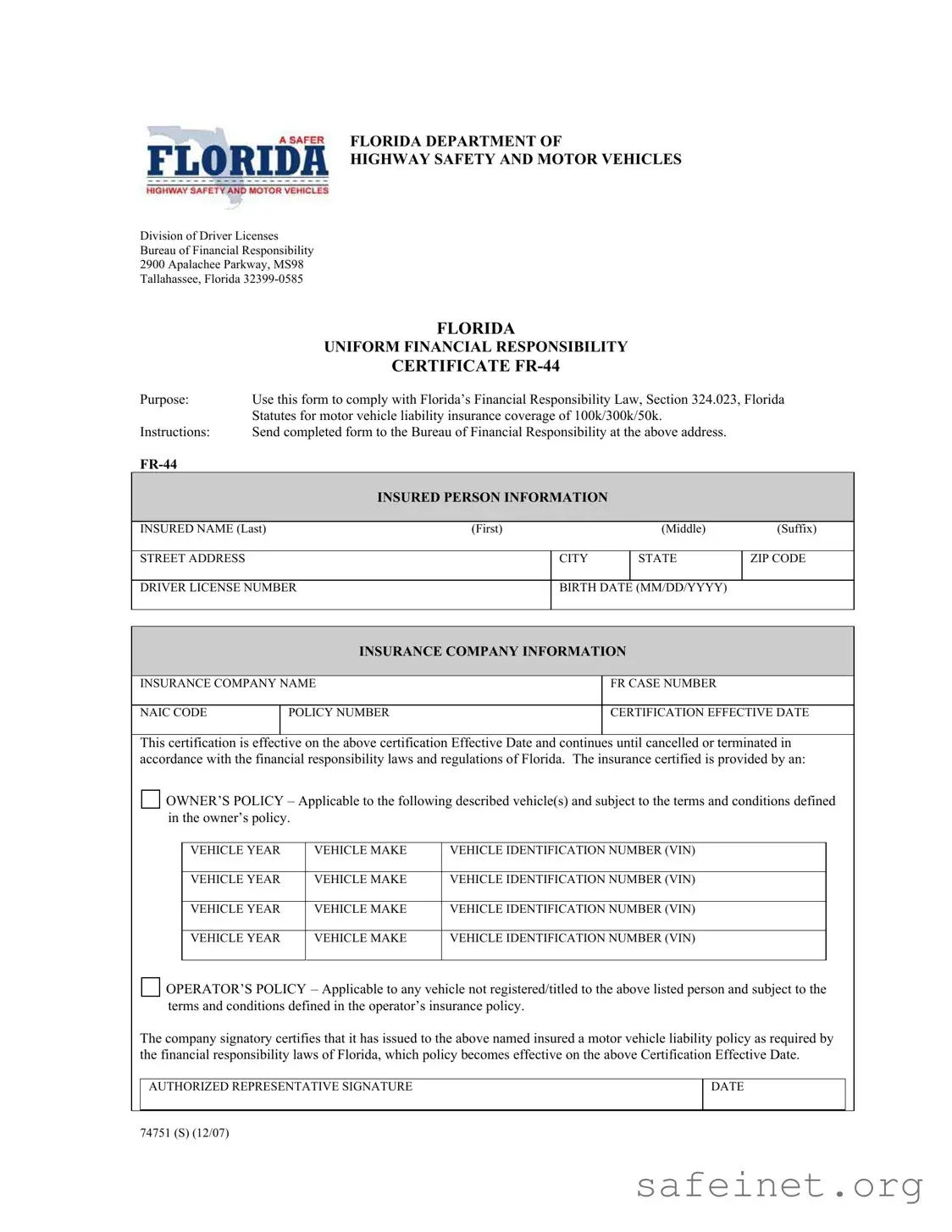
The FR-44 form is a crucial document for Florida drivers seeking to meet the state's financial responsibility requirements. This form ensures that individuals maintain adequate motor vehicle liability insurance coverage, specifically set at $100,000 for bodily injury per person, $300,000 for bodily injury per accident, and $50,000 for property damage. It serves as a certification that the insured has the necessary insurance in place, which is essential for compliance with Florida's Financial Responsibility Law, as outlined in Section 324.023 of the Florida Statutes. Completing the FR-44 involves providing personal information about the insured, including their name, address, and driver’s license number, as well as details about the insurance company, such as the policy number and effective date. The form can cover multiple vehicles under an owner's policy or extend to any vehicle under an operator's policy, depending on the circumstances. Once completed, the form must be submitted to the Bureau of Financial Responsibility in Tallahassee, ensuring that drivers are held accountable for their insurance obligations. This proactive measure protects both the insured and other road users, reinforcing the importance of financial responsibility in Florida's driving landscape.
| Fact Name | Description |
|---|---|
| Purpose | The FR-44 form is used to comply with Florida's Financial Responsibility Law, ensuring that drivers maintain adequate motor vehicle liability insurance coverage of $100,000 per person, $300,000 per accident, and $50,000 for property damage. |
| Governing Law | This form is governed by Section 324.023 of the Florida Statutes, which outlines the requirements for financial responsibility in motor vehicle operation. |
| Submission | Completed forms must be sent to the Bureau of Financial Responsibility at the Florida Department of Highway Safety and Motor Vehicles, located at 2900 Apalachee Parkway, MS98, Tallahassee, Florida 32399-0585. |
| Policy Types | The FR-44 can certify either an owner's policy, which applies to specific vehicles, or an operator's policy, which covers any vehicle not registered to the insured individual. |
Filling out the FR44 form is a straightforward process that requires specific information about the insured person and their vehicle. Once completed, the form must be sent to the Bureau of Financial Responsibility at the address provided. Follow these steps to ensure the form is filled out correctly.
Once you have completed these steps, review the form for accuracy before mailing it to the Bureau of Financial Responsibility. Ensure that all required fields are filled out to avoid any delays in processing.
What is the purpose of the FR-44 form in Florida?
The FR-44 form serves to comply with Florida’s Financial Responsibility Law. This law mandates that drivers maintain specific levels of motor vehicle liability insurance coverage, which are set at $100,000 for bodily injury per person, $300,000 for total bodily injury per accident, and $50,000 for property damage. By submitting the FR-44, drivers confirm their compliance with these requirements.
Who needs to file an FR-44 form?
How do I complete the FR-44 form?
Where should I send the completed FR-44 form?
How long is the FR-44 certification valid?
What happens if I do not file the FR-44 form?
Can I use the FR-44 form for multiple vehicles?
Incomplete Personal Information: Failing to provide all necessary details, such as the last name, first name, and middle name, can lead to delays in processing the form.
Incorrect Address: Providing an incorrect street address, city, or zip code may result in the form not reaching the intended recipient.
Missing Driver License Number: Omitting the driver license number can hinder the verification process and may cause complications.
Improper Date Format: Using an incorrect format for the birth date, such as MM/DD/YYYY, can lead to confusion and potential rejection of the form.
Insurance Company Details: Not providing accurate information about the insurance company, including the name and policy number, can create significant issues.
Missing Certification Effective Date: Failing to fill in the certification effective date can result in uncertainty regarding the validity of the insurance coverage.
Vehicle Information Errors: Providing incorrect details about the vehicle, such as the year, make, or VIN, can lead to complications with insurance coverage.
Signature Issues: Not signing the form or having an unauthorized person sign can invalidate the submission.
Failure to Send to the Correct Address: Sending the completed form to the wrong address may result in delays or non-processing of the application.
Not Keeping a Copy: Failing to retain a copy of the submitted form can create difficulties if there are questions or issues later on.
The FR-44 form is essential for individuals in Florida who need to demonstrate financial responsibility for motor vehicle liability insurance. Alongside this form, several other documents and forms may be required to ensure compliance with state regulations. Below is a list of these related documents, each briefly described to provide clarity on their purpose.
Understanding these documents can help individuals navigate the requirements set forth by Florida law regarding motor vehicle insurance and financial responsibility. Each document plays a crucial role in ensuring compliance and protecting both drivers and the public.
The FR-44 form in Florida serves as a financial responsibility certificate, primarily for individuals who have been convicted of certain driving offenses. It is similar to the SR-22 form, which also demonstrates financial responsibility. The SR-22 is often required for drivers who have had their licenses suspended or revoked due to violations like DUI or reckless driving. Both forms ensure that the driver maintains a specific level of liability insurance, but the FR-44 mandates higher coverage limits, specifically $100,000 for bodily injury per person, $300,000 for total bodily injury per accident, and $50,000 for property damage.
Another document similar to the FR-44 is the Proof of Insurance Card. This card is typically issued by an insurance company and serves as immediate proof that a driver has the required insurance coverage. Unlike the FR-44, which is specifically for compliance with Florida’s Financial Responsibility Law, the Proof of Insurance Card is a more general document that can be used in various situations, such as during traffic stops or when registering a vehicle. However, both documents confirm that the driver has the necessary insurance coverage.
The Financial Responsibility Law Affidavit is another related document. This affidavit is often used when a driver needs to prove that they have met the financial responsibility requirements after an accident or violation. While the FR-44 is a proactive measure taken before a driver can legally operate a vehicle, the affidavit is more of a reactive measure that confirms compliance after an incident has occurred. Both documents aim to ensure that drivers are financially responsible, but they serve different purposes in the timeline of a driver's legal obligations.
Additionally, the Certificate of Insurance can be compared to the FR-44. This certificate is issued by an insurance company and outlines the specific terms of a driver’s insurance policy. While the FR-44 is a formal declaration required by the state, the Certificate of Insurance is often used in various contexts, such as for loan applications or vehicle registration. Both documents provide evidence of insurance coverage, but the FR-44 is specifically tailored for compliance with state laws regarding financial responsibility.
The Motor Vehicle Liability Insurance Policy itself is another document that aligns with the FR-44. This policy is the actual contract between the insured and the insurance company that outlines coverage details. While the FR-44 serves as a certification that the policy exists and meets state requirements, the liability insurance policy contains the specific terms, conditions, and limits of coverage. Both documents are essential for ensuring that drivers have adequate protection in the event of an accident.
The Non-Owner Car Insurance Policy also bears similarities to the FR-44. This type of policy provides liability coverage for individuals who do not own a vehicle but still need insurance coverage for driving. Like the FR-44, which can apply to operators of vehicles not registered in their name, the Non-Owner Policy ensures that these drivers comply with financial responsibility laws. Both documents highlight the importance of having adequate coverage, regardless of vehicle ownership.
Lastly, the Vehicle Registration Application may be mentioned in this context. While it does not directly serve the same purpose as the FR-44, it often requires proof of insurance as part of the registration process. The application ensures that a vehicle is legally registered and that the owner has the necessary insurance coverage. Both the FR-44 and the Vehicle Registration Application play crucial roles in maintaining compliance with state laws regarding vehicle operation and insurance requirements.
When filling out the FR-44 Florida form, there are important guidelines to follow to ensure accuracy and compliance. Below are recommendations on what to do and what to avoid.
Understanding the FR-44 form in Florida can be challenging due to various misconceptions. Here are ten common misunderstandings about this important document:
This is not entirely accurate. While the FR-44 is often required for drivers who have been convicted of certain offenses, such as DUI, it can also apply to others who may need to demonstrate financial responsibility.
While both forms serve to prove financial responsibility, they are different. The SR-22 is typically used for standard liability insurance, whereas the FR-44 requires higher coverage limits.
This is a misconception. In fact, filing an FR-44 may lead to higher premiums due to the increased liability coverage required.
The FR-44 must remain in effect for a minimum of three years, but it can last longer if the driver does not maintain the required insurance.
This is misleading. The driver must ensure that their insurance remains active and meets the required coverage limits throughout the duration of the FR-44.
The form must be completed by an authorized representative of the insurance company providing the coverage. It cannot be filled out by the driver themselves.
This is not true. The FR-44 can apply to any vehicle, including commercial vehicles, as long as the appropriate coverage is in place.
In fact, the FR-44 can be canceled if the driver obtains a different insurance policy that meets the financial responsibility requirements.
This misconception overlooks the fact that if a driver has multiple violations, they may need to file the FR-44 multiple times over the years.
While the FR-44 is specific to Florida, other states have similar requirements. However, the details and forms may differ significantly from Florida's FR-44.
Clarifying these misconceptions can help individuals better navigate the requirements surrounding the FR-44 form and ensure compliance with Florida's financial responsibility laws.
When filling out the FR44 form in Florida, keep these key takeaways in mind: