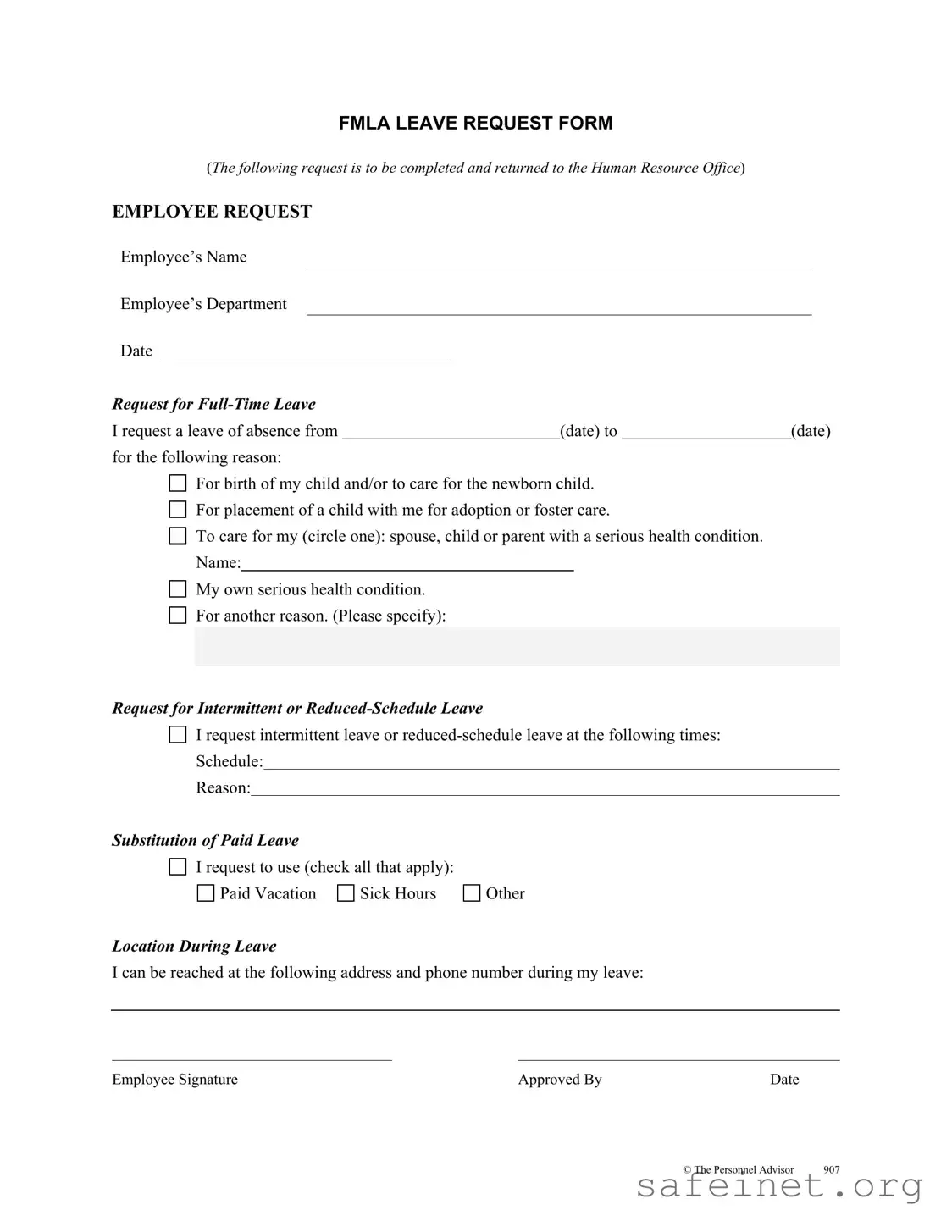
The Family and Medical Leave Act (FMLA) Leave Request Form is an essential document for employees seeking time off for specific family or medical reasons. This form must be completed and submitted to the Human Resource Office to initiate the leave process. It encompasses several key components, starting with the employee's name and department, followed by the dates for which leave is requested. Employees can indicate their reason for leave, whether it is for the birth of a child, adoption, or to care for a family member with a serious health condition. Additionally, the form allows for requests for intermittent or reduced-schedule leave, providing flexibility for those who need to balance work with ongoing caregiving responsibilities. Employees can also specify if they wish to use paid leave, such as vacation or sick hours, during their absence. Finally, the form includes a section for employees to provide contact information, ensuring that they can be reached if necessary. The completion of this form is a critical step in securing the rights and protections afforded under the FMLA, enabling employees to manage their personal and family health needs while maintaining job security.
| Fact Name | Details |
|---|---|
| Purpose of FMLA Leave | The FMLA Leave form is used to request leave for specific family and medical reasons, including childbirth, adoption, or caring for a family member with a serious health condition. |
| Full-Time Leave Request | Employees can request a full-time leave of absence by specifying the start and end dates, along with the reason for the leave. |
| Intermittent or Reduced-Schedule Leave | The form allows employees to request intermittent leave or a reduced schedule, detailing specific times and reasons for the leave. |
| Substitution of Paid Leave | Employees may choose to use paid vacation or sick hours during their leave, as indicated on the form. |
| Contact Information | Employees must provide their contact address and phone number, ensuring they can be reached during their leave period. |
| Approval Process | The completed form must be submitted to the Human Resource Office for approval, and it requires the signature of the employee and an HR representative. |
| State-Specific Forms | Some states may have additional laws governing family leave, such as the California Family Rights Act (CFRA) or the New York Paid Family Leave (PFL) law. |
Filling out the FMLA Leave form is an important step in requesting time off for personal or family health needs. After completing the form, return it to your Human Resource Office for processing. Here are the steps to fill out the form correctly.
What is the FMLA Leave Request Form?
The FMLA Leave Request Form is a document that employees use to formally request leave under the Family and Medical Leave Act (FMLA). It outlines the reason for the leave, the duration, and any additional details required by the Human Resource Office.
Who is eligible to use the FMLA Leave Request Form?
Employees who have worked for their employer for at least 12 months and have logged at least 1,250 hours of service in the past year are eligible to use the FMLA Leave Request Form. Additionally, the employer must have 50 or more employees within a 75-mile radius.
What reasons can I provide for requesting FMLA leave?
You can request FMLA leave for several reasons, including: the birth of your child, to care for a newborn, for the placement of a child for adoption or foster care, to care for a spouse, child, or parent with a serious health condition, or for your own serious health condition. You may also specify another reason if applicable.
How do I complete the FMLA Leave Request Form?
To complete the form, fill in your name, department, and the dates for which you are requesting leave. Indicate the reason for your leave and whether you want to take it all at once or intermittently. If you plan to use paid leave during your absence, check the appropriate boxes. Finally, provide your contact information and sign the form before submitting it to the Human Resource Office.
What should I do if I need intermittent leave?
If you need intermittent or reduced-schedule leave, specify the times you will be absent on the form. Clearly outline your schedule and the reason for your intermittent leave to ensure your employer understands your request.
Can I use paid leave during my FMLA leave?
Yes, you can choose to use paid leave during your FMLA leave. The form allows you to indicate which types of paid leave you wish to use, such as vacation or sick hours. Be sure to check all applicable options on the form.
What happens after I submit the FMLA Leave Request Form?
After you submit your FMLA Leave Request Form, your Human Resource Office will review your request. They will notify you of their decision and provide any further instructions. It is important to maintain communication with HR during this process.
Incomplete Information: Many individuals fail to provide all required details, such as their full name, department, or specific dates for the leave. Omitting this information can delay the processing of the request.
Incorrect Reason for Leave: Some employees do not accurately select the reason for their leave. It is essential to choose the correct option, whether it is for the birth of a child, adoption, or caring for a family member with a serious health condition.
Failure to Specify Dates: When requesting leave, it is crucial to clearly indicate the start and end dates. Leaving this section blank or providing vague information can lead to misunderstandings and complications.
Not Indicating Intermittent Leave: Employees sometimes overlook the option for intermittent or reduced-schedule leave. If this is needed, it should be clearly stated along with the specific schedule.
Ignoring Contact Information: Providing a way to be reached during the leave is often neglected. Including a current address and phone number ensures that the Human Resource Office can communicate if necessary.
The Family and Medical Leave Act (FMLA) allows eligible employees to take unpaid leave for specific family and medical reasons. When submitting an FMLA Leave Request Form, there are several other documents that may be necessary to support the request. Below is a list of commonly used forms and documents that accompany the FMLA Leave form, each serving a specific purpose.
These documents play a crucial role in the FMLA process, helping to clarify the employee's situation and ensuring that all parties understand their rights and responsibilities. Proper documentation can facilitate a smoother leave process and provide necessary protections under the law.
The Family and Medical Leave Act (FMLA) Leave Form is similar to a Medical Leave of Absence Form. Both documents serve the purpose of requesting time off from work due to medical reasons. The Medical Leave of Absence Form typically requires details about the employee's health condition and the expected duration of the leave. While the FMLA form focuses on specific qualifying reasons, the Medical Leave of Absence Form may encompass a broader range of medical issues, allowing employees to provide supporting documentation from healthcare providers.
Another document that shares similarities with the FMLA Leave Form is the Short-Term Disability Claim Form. This form is used when an employee is unable to work due to a medical condition and seeks compensation during their recovery. Like the FMLA form, it requires information about the medical condition and the anticipated recovery timeline. However, the Short-Term Disability Claim Form is specifically aimed at securing financial benefits, whereas the FMLA form primarily addresses job protection and unpaid leave.
The Leave of Absence Request Form is also comparable to the FMLA Leave Form. Both forms require employees to specify the reason for their leave and the duration. However, the Leave of Absence Request Form may cover various types of leave beyond family and medical reasons, such as personal or educational leave. This form often allows for more flexibility in the reasons for taking time off, while the FMLA form is limited to specific qualifying events outlined in the law.
Additionally, the Parental Leave Request Form is similar to the FMLA Leave Form, as it is specifically designed for employees seeking time off for parental reasons, such as childbirth or adoption. Both forms ask for the employee's name, department, and the dates of leave. However, the Parental Leave Request Form may not provide the same level of job protection as the FMLA, depending on the employer's policies and the jurisdiction in which the employee works.
The Sick Leave Request Form also bears resemblance to the FMLA Leave Form. Both forms require the employee to indicate the reason for their absence and the expected duration. However, the Sick Leave Request Form typically pertains to short-term illnesses and may not cover extended leave for serious health conditions, which is a key aspect of the FMLA form. The Sick Leave Request Form is often used for more immediate, short-term needs.
Another related document is the ADA Leave Request Form, which is used by employees seeking leave as a reasonable accommodation under the Americans with Disabilities Act. Similar to the FMLA form, it requires the employee to provide information about their health condition. However, the ADA Leave Request Form focuses specifically on disability-related leave, while the FMLA form addresses a broader range of family and medical situations.
Lastly, the Workers' Compensation Leave Form is similar to the FMLA Leave Form in that both involve time off due to health-related issues. The Workers' Compensation Leave Form is specifically for employees who are injured on the job and seek time off to recover. While both forms require documentation regarding the leave, the Workers' Compensation Leave Form is tied to specific workplace injuries and may involve different legal protections compared to the FMLA, which applies to various family and medical situations.
When filling out the FMLA Leave form, there are important steps to follow to ensure that your request is processed smoothly. Below is a list of things you should and shouldn't do.
By following these guidelines, you can help ensure that your FMLA Leave request is handled effectively and efficiently.
Understanding the Family and Medical Leave Act (FMLA) Leave form is crucial for employees seeking time off. However, several misconceptions can lead to confusion. Here are six common misunderstandings:
Addressing these misconceptions can help employees navigate the FMLA process more effectively and ensure they receive the benefits to which they are entitled.
When filling out the FMLA Leave form, consider the following key takeaways: