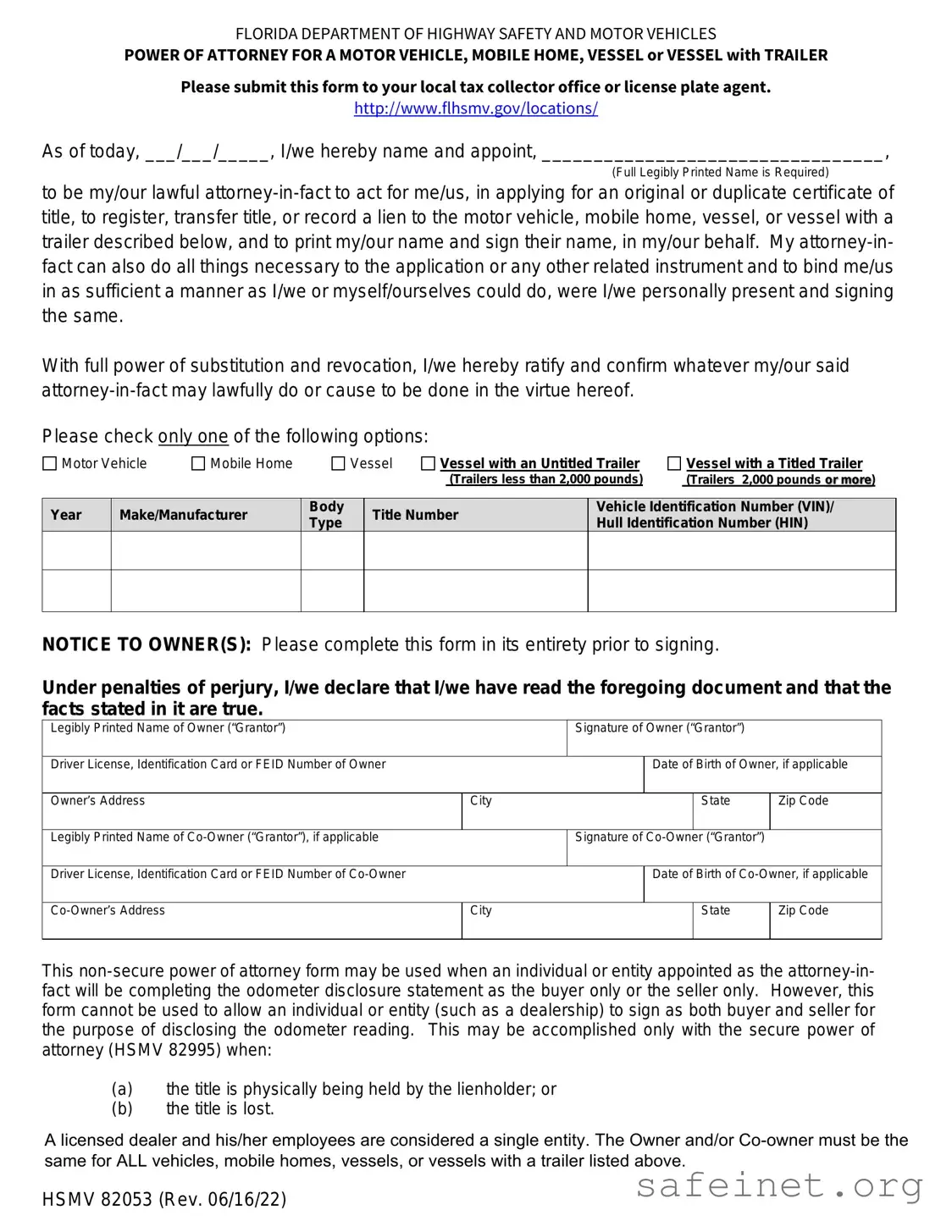
The Florida Vehicle Power of Attorney (POA) Form 82053 is a crucial document for anyone looking to delegate authority over vehicle-related matters in the state of Florida. This form allows an individual, known as the principal, to appoint another person, referred to as the agent, to act on their behalf regarding various vehicle transactions. These transactions can include signing titles, transferring ownership, and handling registration issues. The form is particularly useful when the principal cannot be present to complete these tasks due to time constraints, health issues, or other reasons. By using the POA, the principal ensures that their vehicle affairs are managed efficiently and legally, providing peace of mind. It is essential to complete the form accurately, including the necessary signatures and date, to avoid any complications in the future. Understanding the implications and proper usage of the Florida Vehicle POA Form 82053 is vital for both the principal and the agent to ensure that all vehicle-related transactions proceed smoothly.
| Fact Name | Description |
|---|---|
| Purpose | The Florida Vehicle POA Form 82053 allows an individual to authorize another person to act on their behalf regarding vehicle-related transactions. |
| Governing Law | This form is governed by Florida Statutes, specifically Section 319.23, which outlines the requirements for vehicle title transfers. |
| Signature Requirement | The form must be signed by the vehicle owner, and the signature must be notarized to ensure its validity. |
| Usage | It is commonly used for tasks such as transferring vehicle ownership, obtaining title replacements, or registering vehicles. |
| Validity Period | Once completed, the POA remains valid until the specific transaction is completed or revoked by the vehicle owner. |
After obtaining the Florida Vehicle POA form 82053, you will need to complete it accurately. This form allows you to designate someone to act on your behalf regarding vehicle matters. Ensure you have all necessary information ready before starting.
Once the form is filled out and signed, you can submit it to the appropriate agency or share it with the designated individual. Keep in mind any specific requirements that may apply to your situation.
What is the Florida Vehicle POA Form 82053?
The Florida Vehicle POA Form 82053, or Power of Attorney for Vehicle Transactions, allows an individual to appoint another person to act on their behalf regarding vehicle-related matters. This can include tasks like transferring ownership, registering a vehicle, or signing documents related to the sale or purchase of a vehicle.
Who can use the Florida Vehicle POA Form 82053?
This form is designed for anyone who needs assistance with vehicle transactions in Florida. Whether you are unable to handle these matters due to time constraints, health issues, or being out of state, you can designate someone you trust to act on your behalf.
How do I fill out the Florida Vehicle POA Form 82053?
To complete the form, you will need to provide your name, address, and the details of the person you are appointing as your agent. Be sure to specify the powers you are granting them, such as the ability to sign documents or transfer titles. Clear and accurate information will help ensure that the form is valid.
Do I need to have the Florida Vehicle POA Form 82053 notarized?
Yes, the form must be notarized to be considered valid. This means that a notary public must witness your signature on the form. Notarization helps to verify your identity and confirms that you are signing the document willingly.
Can I revoke the Florida Vehicle POA Form 82053?
Absolutely. You can revoke the Power of Attorney at any time as long as you are of sound mind. To do this, you should complete a revocation form and notify your agent and any relevant parties, such as the Department of Motor Vehicles, to ensure that they are aware of the change.
How long is the Florida Vehicle POA Form 82053 valid?
The validity of the form depends on the specific powers granted and the circumstances surrounding its use. Generally, it remains effective until you revoke it or until the purpose for which it was created is fulfilled. Always check with your agent to ensure they are aware of its status.
Can I use the Florida Vehicle POA Form 82053 for multiple vehicles?
Yes, you can use the form for multiple vehicles. However, you should clearly list each vehicle in the document to avoid confusion. This way, your agent will have the authority to act on your behalf for all specified vehicles.
Where do I submit the Florida Vehicle POA Form 82053?
The completed form should be submitted to the Florida Department of Highway Safety and Motor Vehicles, or the local tax collector's office, depending on the specific transaction you are conducting. Always keep a copy for your records.
Is there a fee associated with using the Florida Vehicle POA Form 82053?
While there is no fee specifically for completing the form itself, there may be fees associated with the transactions you authorize your agent to perform, such as title transfers or vehicle registrations. Check with the local DMV or tax collector's office for specific fee information.
Not providing complete information. It’s important to fill out every section of the form. Leaving out details can lead to delays.
Using incorrect or outdated information. Always double-check that the vehicle identification number (VIN) and other details are accurate.
Forgetting to sign the form. A signature is crucial. Without it, the form is not valid.
Not having a witness or notary when required. Depending on the situation, you may need someone to witness the signing or a notary public to validate it.
Failing to keep a copy of the completed form. Always make a copy for your records. This can help if there are any questions later.
Ignoring submission guidelines. Make sure to follow the specific instructions for submitting the form to avoid any issues.
The Florida Vehicle Power of Attorney (POA) form 82053 is a crucial document that allows one person to authorize another to act on their behalf regarding vehicle-related matters. When dealing with vehicle transactions or management, several other forms and documents may also be necessary. Below is a list of commonly used documents that may accompany the Florida Vehicle POA form.
Each of these documents plays a significant role in ensuring that vehicle transactions are conducted smoothly and legally. It is essential to have the right paperwork in place to avoid complications and to protect the interests of all parties involved.
The Florida Vehicle Power of Attorney (POA) form 82053 allows an individual to designate someone else to handle specific vehicle-related transactions on their behalf. This form is particularly useful for those who may be unable to attend to these matters in person. It grants authority for tasks such as title transfers, registration, and other vehicle-related activities, ensuring that the designated person can act in the best interest of the vehicle owner.
One similar document is the General Power of Attorney. This form grants broader authority to an individual, allowing them to make a variety of decisions on behalf of the principal, including financial and legal matters. While the Florida Vehicle POA is limited to vehicle transactions, the General POA can cover a wider range of responsibilities, making it more versatile for different situations.
The Medical Power of Attorney is another related document. This form allows an individual to appoint someone to make healthcare decisions if they become unable to do so. Like the Vehicle POA, it is a way to ensure that someone trusted can act on behalf of the principal. However, the focus here is on medical decisions rather than vehicle-related matters.
The Durable Power of Attorney is similar in that it remains effective even if the principal becomes incapacitated. This document can cover a wide array of financial and legal decisions. The key difference from the Vehicle POA is the scope of authority; the Durable POA can encompass much more than just vehicle transactions.
The Limited Power of Attorney is another document that shares similarities. This form gives someone the authority to act on behalf of the principal for a specific purpose or for a limited time. Like the Vehicle POA, it is tailored to specific needs, but it can be used for various other transactions beyond vehicle-related issues.
The Real Estate Power of Attorney is also noteworthy. This document allows an individual to appoint someone to handle real estate transactions on their behalf, such as buying or selling property. While both the Vehicle POA and Real Estate POA are focused on specific types of transactions, the latter deals exclusively with real estate rather than vehicles.
Another document that bears resemblance is the Financial Power of Attorney. This form allows an individual to designate someone to manage their financial affairs. Although the scope is broader than the Vehicle POA, both forms provide a means for someone to act on behalf of another in specific areas, ensuring that important tasks are completed even if the principal is unavailable.
Lastly, the Trust Agreement can be compared to the Vehicle POA. A Trust Agreement allows a person to place assets into a trust, appointing a trustee to manage those assets for the benefit of beneficiaries. While the Vehicle POA is specifically about vehicle transactions, both documents facilitate the management of assets and ensure that the principal’s wishes are carried out effectively.
When filling out the Florida Vehicle Power of Attorney (POA) form 82053, it is essential to approach the process with care and attention to detail. Below are ten important dos and don’ts to keep in mind.
When dealing with the Florida Vehicle Power of Attorney (POA) form 82053, several misconceptions often arise. Understanding these can help individuals navigate the process more effectively.
While many people associate the Florida Vehicle POA form with selling a vehicle, it can also be used for various other purposes. These include registering a vehicle, transferring title, and handling any necessary paperwork on behalf of the vehicle owner.
Although notarization adds an extra layer of authenticity, it is not always required for the Florida Vehicle POA form. In many cases, simply signing the document is sufficient, as long as it meets the necessary criteria outlined by the state.
This is not true. Individuals can complete the Florida Vehicle POA form themselves without needing a lawyer's assistance. However, seeking legal advice can be beneficial, especially for complex situations.
In reality, a Power of Attorney can be revoked at any time by the principal, as long as they are mentally competent. This means that if circumstances change, the individual can cancel the POA through a written notice.
While many people choose family members as their agents, it is not a requirement. Anyone the principal trusts can be appointed as an agent, including friends or professionals, as long as they are willing to take on the responsibility.
Filling out the Florida Vehicle POA form 82053 can seem daunting, but understanding the key points can make the process smoother. Here are some important takeaways to keep in mind:
Understanding these points can help ensure that you use the Florida Vehicle POA form effectively and avoid potential pitfalls.