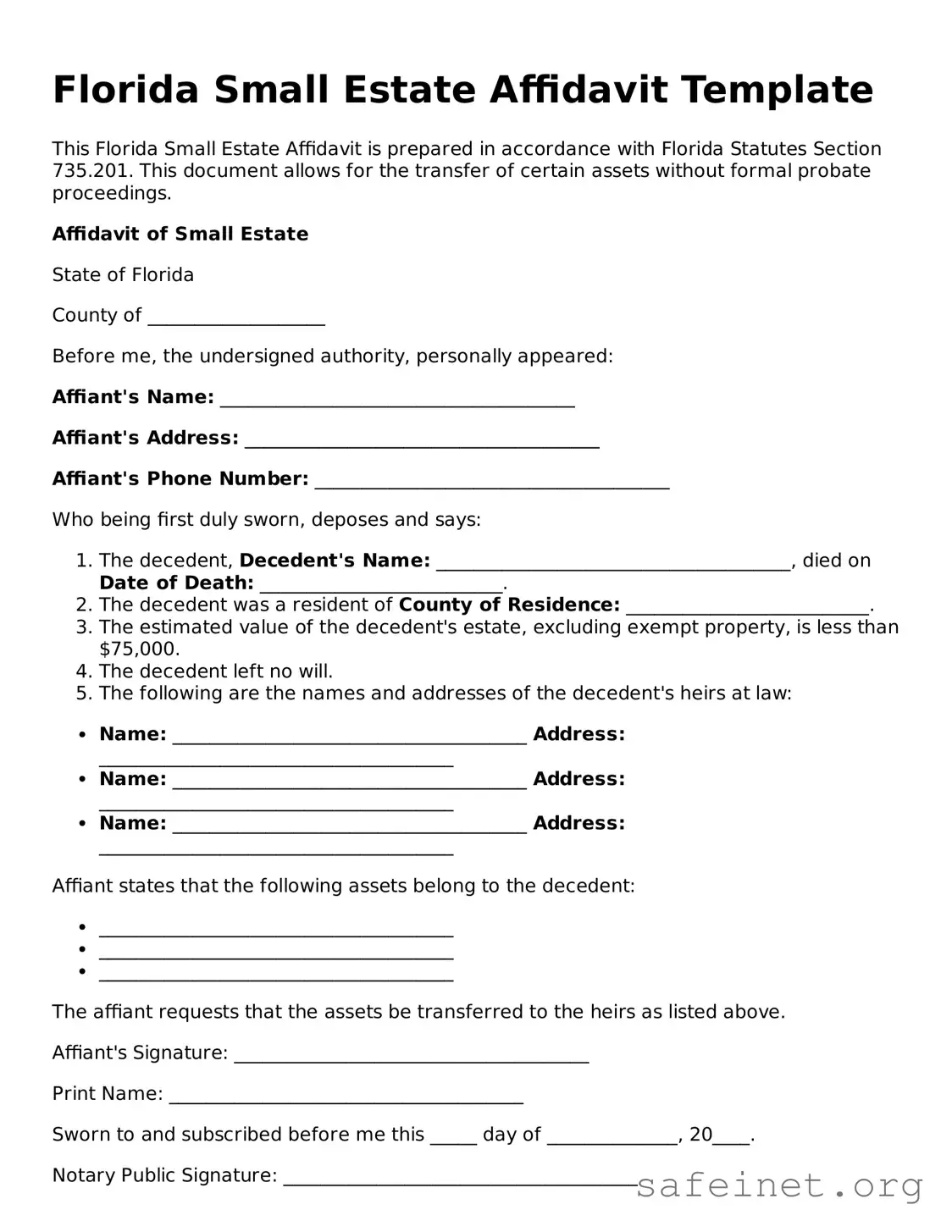
In Florida, when someone passes away and leaves behind a modest estate, the process of settling their affairs can often be simplified through the use of a Small Estate Affidavit. This legal document provides a streamlined approach for heirs to claim the deceased's assets without the need for a lengthy probate process. Generally, the Small Estate Affidavit can be utilized when the total value of the estate falls below a certain threshold, which is currently set at $75,000, excluding any exempt property. By completing this form, eligible heirs can assert their rights to the deceased’s assets, such as bank accounts, personal property, and other holdings. The affidavit requires specific information, including the names of the heirs, a description of the assets, and an affirmation that no probate proceedings are pending. Importantly, this tool not only expedites the transfer of property but also reduces the emotional and financial burden on families during a challenging time. Understanding how to properly complete and file the Small Estate Affidavit is crucial for those navigating the complexities of estate management in Florida.
Florida Small Estate Affidavit Template
This Florida Small Estate Affidavit is prepared in accordance with Florida Statutes Section 735.201. This document allows for the transfer of certain assets without formal probate proceedings.
Affidavit of Small Estate
State of Florida
County of ___________________
Before me, the undersigned authority, personally appeared:
Affiant's Name: ______________________________________
Affiant's Address: ______________________________________
Affiant's Phone Number: ______________________________________
Who being first duly sworn, deposes and says:
Affiant states that the following assets belong to the decedent:
The affiant requests that the assets be transferred to the heirs as listed above.
Affiant's Signature: ______________________________________
Print Name: ______________________________________
Sworn to and subscribed before me this _____ day of ______________, 20____.
Notary Public Signature: ______________________________________
Notary Public Name: ______________________________________
My Commission Expires: ____________________________
| Fact Name | Description |
|---|---|
| Eligibility | The Florida Small Estate Affidavit can be used when the total value of the estate is $100,000 or less, excluding homestead property. |
| Governing Law | This form is governed by Florida Statutes, specifically Section 735.201 through 735.206. |
| Filing Process | The affidavit must be filed with the local court, and it allows heirs to claim assets without going through formal probate. |
| Required Information | The form requires details about the deceased, the heirs, and a list of assets to be transferred. |
Completing the Florida Small Estate Affidavit form is a crucial step in managing the estate of a deceased individual when the estate qualifies as a small estate under Florida law. Once the form is filled out correctly, it can be submitted to the appropriate court or used to transfer assets without the need for formal probate proceedings.
What is a Florida Small Estate Affidavit?
A Florida Small Estate Affidavit is a legal document that allows heirs to claim the assets of a deceased person without going through a formal probate process. This form is typically used when the total value of the estate is below a certain threshold, which is currently set at $75,000, excluding exempt property.
Who can use the Small Estate Affidavit?
The Small Estate Affidavit can be used by individuals who are entitled to the deceased person's assets. This includes heirs, beneficiaries named in a will, or individuals who would inherit under Florida law if there is no will. Generally, at least one of the heirs must sign the affidavit.
What assets are included in the Small Estate Affidavit?
The affidavit can be used to claim various types of assets, such as bank accounts, vehicles, and real estate. However, it must be noted that the total value of these assets must not exceed the $75,000 limit. Certain exempt property, like homestead property, may not be included in this calculation.
How do I complete the Small Estate Affidavit?
To complete the Small Estate Affidavit, you will need to provide specific information, including the deceased person's details, the names of the heirs, and a description of the assets. It is important to ensure that all information is accurate and complete. You may also need to gather supporting documentation, such as a death certificate and proof of the deceased's assets.
Do I need to file the Small Estate Affidavit with the court?
No, you do not need to file the Small Estate Affidavit with the court unless you are specifically required to do so by a financial institution or another entity. However, it is a good idea to keep a copy for your records and provide it to any institutions holding the deceased's assets.
How long does it take to process the Small Estate Affidavit?
The processing time for a Small Estate Affidavit can vary. Since the affidavit is not filed with the court, the time it takes to access the deceased's assets largely depends on the policies of the institutions involved. Some may process the affidavit quickly, while others may take longer. It's advisable to follow up with these institutions after submitting the affidavit.
What if the estate exceeds the Small Estate threshold?
If the total value of the estate exceeds the $75,000 limit, you will need to go through the formal probate process. This involves filing a petition with the court and may require legal assistance. It is essential to evaluate the estate's value carefully to determine the appropriate course of action.
Failing to include all required information. It’s crucial to provide complete details about the deceased, including their full name, date of death, and last known address.
Not signing the affidavit. The form must be signed by the person making the affidavit, often referred to as the affiant. Without a signature, the document is invalid.
Overlooking the requirement for witnesses. In Florida, the affidavit must be signed in the presence of two witnesses who also need to sign the document.
Incorrectly estimating the value of the estate. The total value of the estate must not exceed the threshold set by Florida law. Miscalculating this can lead to complications.
Neglecting to provide supporting documents. Attach necessary documents, such as the death certificate and proof of assets. Omitting these can delay the process.
Using outdated forms. Ensure that you are using the most current version of the Small Estate Affidavit form. Laws and requirements can change, making older forms invalid.
Failing to check for additional requirements. Some counties may have specific rules or additional forms needed. It’s important to verify local requirements before submission.
The Florida Small Estate Affidavit is a useful tool for simplifying the process of settling an estate when the total value of the estate is below a certain threshold. However, several other forms and documents may accompany this affidavit to ensure a smooth transition of assets. Below is a list of commonly used documents that can aid in the estate settlement process.
Using these documents in conjunction with the Florida Small Estate Affidavit can facilitate a more efficient and organized estate settlement process. Each document plays a vital role in ensuring that all legal requirements are met and that the wishes of the deceased are honored.
The Florida Small Estate Affidavit form shares similarities with the Affidavit of Heirship. Both documents serve to establish the rightful heirs of a deceased individual’s estate without the need for formal probate proceedings. The Affidavit of Heirship is typically used when the estate is not large enough to warrant a full probate process. It allows heirs to claim property and assets by providing sworn statements regarding the family relationships and the decedent's wishes, much like the Small Estate Affidavit facilitates the transfer of assets to heirs without extensive legal procedures.
Another document that parallels the Florida Small Estate Affidavit is the Will. A Will outlines the decedent's wishes regarding the distribution of their assets after death. While a Will may go through probate, the Small Estate Affidavit allows for a more streamlined process in cases where the estate falls below a certain value. Both documents identify beneficiaries and delineate how assets should be distributed, but the Small Estate Affidavit is designed for simpler situations where formal probate is not necessary.
The Declaration of Trust is also similar to the Small Estate Affidavit in that it can facilitate the transfer of assets. A Declaration of Trust outlines how assets are managed and distributed according to the trustor's wishes. Like the Small Estate Affidavit, it allows for the transfer of property outside of the probate process, providing a means to ensure that assets are passed on to designated beneficiaries efficiently. However, a trust is typically established during the trustor's lifetime, whereas the Small Estate Affidavit is used posthumously.
The Power of Attorney (POA) document shares some functional similarities with the Small Estate Affidavit, particularly in terms of asset management. A POA grants an individual the authority to act on behalf of another person in financial matters. While the Small Estate Affidavit is used after death to claim assets, a POA can manage assets while the individual is still alive. Both documents aim to streamline the handling of assets, but they operate in different contexts—one during life and the other after death.
Lastly, the Transfer on Death (TOD) designation is comparable to the Small Estate Affidavit in that it allows for the direct transfer of assets upon death. A TOD designation is often used for financial accounts and real estate, enabling the asset to pass directly to a named beneficiary without going through probate. Similar to the Small Estate Affidavit, this method simplifies the transfer process, ensuring that beneficiaries can access their inheritance without lengthy legal proceedings.
When filling out the Florida Small Estate Affidavit form, it's essential to follow certain guidelines to ensure accuracy and compliance. Below is a list of things to do and avoid during this process.
Things You Should Do:
Things You Shouldn't Do:
By following these guidelines, you can help facilitate a smoother process when dealing with the Florida Small Estate Affidavit.
Many individuals have misunderstandings about the Florida Small Estate Affidavit form. Here are six common misconceptions:
Understanding these points can help clarify the purpose and use of the Florida Small Estate Affidavit form.
When dealing with the Florida Small Estate Affidavit form, it's essential to understand its purpose and requirements. Here are key takeaways to guide you through the process:
Understanding these points will help you navigate the Small Estate Affidavit process more effectively.