The Florida Self-Proving Affidavit is an essential legal tool designed to simplify the probate process for wills in the state of Florida. This form allows a testator—the person who created the will—and witnesses to affirm the validity of the will without needing to appear in court. By signing this affidavit, the witnesses confirm that they observed the testator sign the will, and they do so in the presence of each other. This process not only streamlines the administration of the will but also provides a layer of protection against potential disputes regarding the will's authenticity. In essence, the Self-Proving Affidavit eliminates the need for witnesses to testify in court, making the probate process more efficient and less burdensome for families during what can be a challenging time. Understanding how to properly complete and file this form is crucial for anyone involved in estate planning in Florida, as it can save time and reduce complications down the line.
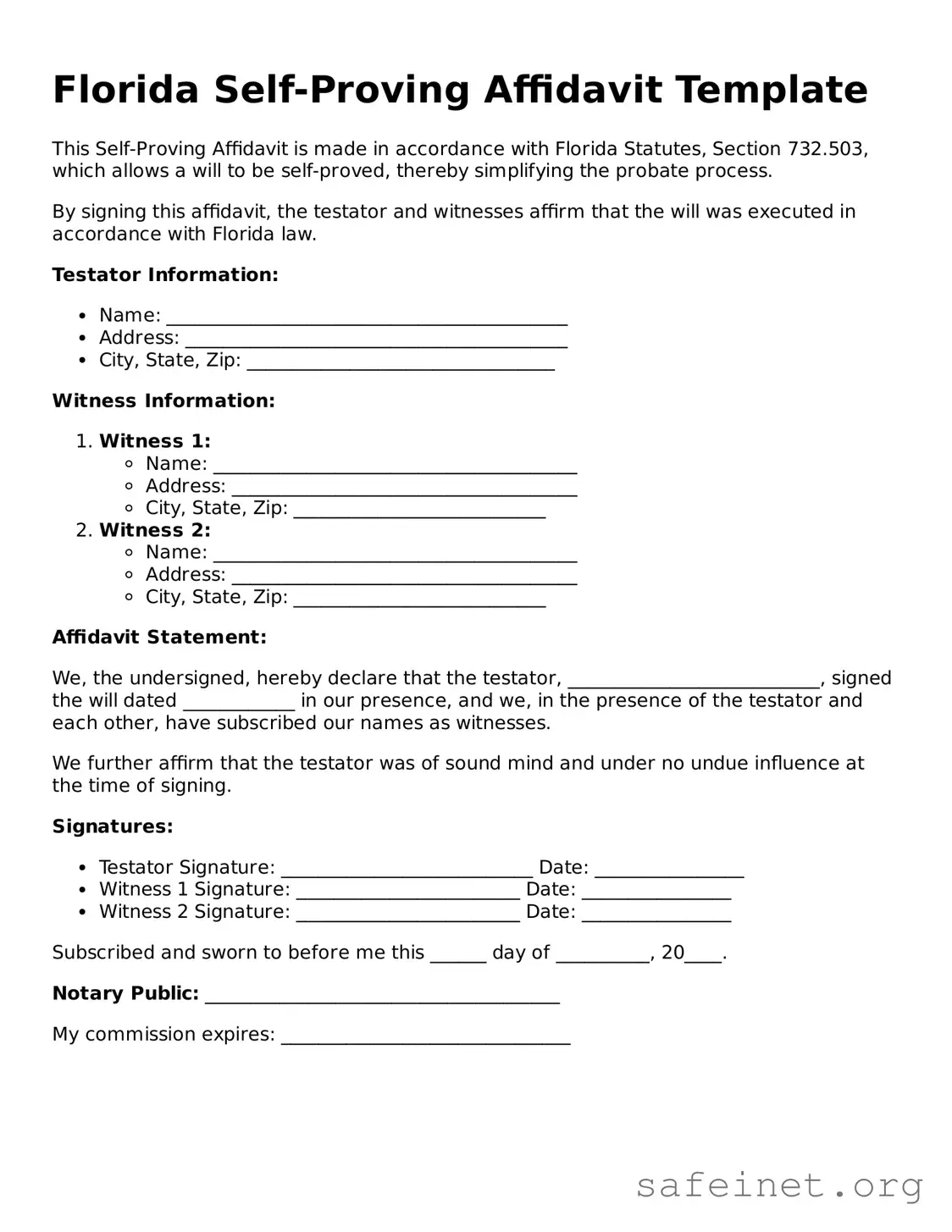
Florida Self-Proving Affidavit Template
This Self-Proving Affidavit is made in accordance with Florida Statutes, Section 732.503, which allows a will to be self-proved, thereby simplifying the probate process.
By signing this affidavit, the testator and witnesses affirm that the will was executed in accordance with Florida law.
Testator Information:
Witness Information:
Affidavit Statement:
We, the undersigned, hereby declare that the testator, ___________________________, signed the will dated ____________ in our presence, and we, in the presence of the testator and each other, have subscribed our names as witnesses.
We further affirm that the testator was of sound mind and under no undue influence at the time of signing.
Signatures:
Subscribed and sworn to before me this ______ day of __________, 20____.
Notary Public: ______________________________________
My commission expires: _______________________________
| Fact Name | Description |
|---|---|
| Purpose | The Florida Self-Proving Affidavit allows a will to be accepted in probate without the need for witnesses to testify. |
| Governing Law | This form is governed by Florida Statutes, specifically Section 732.503. |
| Requirements | The affidavit must be signed by the testator and two witnesses in the presence of a notary public. |
| Benefits | Using this affidavit simplifies the probate process and helps avoid disputes regarding the will's validity. |
After gathering the necessary information, you can proceed to fill out the Florida Self-Proving Affidavit form. This document requires specific details about the testator and witnesses. Follow the steps below to complete the form accurately.
What is a Florida Self-Proving Affidavit?
A Florida Self-Proving Affidavit is a legal document that allows a will to be validated without the need for witnesses to testify in court. This affidavit is signed by the testator (the person making the will) and witnesses in front of a notary public. It simplifies the probate process and helps expedite the administration of the estate.
Why should I use a Self-Proving Affidavit?
Using a Self-Proving Affidavit can save time and reduce complications during the probate process. It eliminates the need for witnesses to appear in court, which can be especially helpful if witnesses are unavailable or if their testimony could be challenged. This can lead to a smoother transition of assets to beneficiaries.
Who can sign a Self-Proving Affidavit?
The testator and at least two witnesses must sign the Self-Proving Affidavit. All parties must be of sound mind and at least 18 years old. Additionally, a notary public must also sign the affidavit to validate it. This ensures that the document meets legal requirements and can be accepted by the court.
How do I complete a Self-Proving Affidavit?
To complete a Self-Proving Affidavit, first, ensure that your will is properly drafted and signed. Then, have the testator and witnesses present to sign the affidavit in front of a notary public. The notary will verify the identities of all parties and then sign and seal the document. Make sure to keep the signed affidavit with the original will.
Is a Self-Proving Affidavit required in Florida?
No, a Self-Proving Affidavit is not legally required in Florida. However, it is highly recommended. Having one can significantly ease the probate process and help avoid potential disputes among heirs. Without it, witnesses may need to be located and called to testify, which can delay proceedings.
What happens if I don’t have a Self-Proving Affidavit?
If you do not have a Self-Proving Affidavit, the will can still be probated. However, the process may become more complicated. Witnesses may need to be located and may have to testify about the will's validity. This can lead to delays and additional costs in the probate process.
Can I revoke a Self-Proving Affidavit?
Yes, a Self-Proving Affidavit can be revoked. If you decide to change your will or create a new one, the previous affidavit becomes invalid. It’s important to ensure that any new will includes a new Self-Proving Affidavit to maintain the same level of convenience during probate.
Where should I keep my Self-Proving Affidavit?
Store your Self-Proving Affidavit with your original will in a safe place. Consider using a fireproof safe or a safety deposit box. Make sure that your executor or a trusted family member knows where to find these documents when the time comes. This will help ensure that your wishes are honored without unnecessary complications.
Failing to include all required information. The form requires specific details such as the names of the testator and witnesses, along with their signatures. Omitting any of these can lead to complications.
Not having the affidavit signed in the presence of a notary. The form must be notarized to be valid. If this step is skipped, the affidavit may not hold up in court.
Using incorrect witness signatures. The witnesses must be individuals who are not beneficiaries of the will. If a beneficiary signs, it can invalidate the affidavit.
Neglecting to date the affidavit. A missing date can create uncertainty regarding when the affidavit was executed, which may affect its validity.
Not following the correct format. The affidavit should be filled out in accordance with the prescribed format. Deviating from this can lead to rejection.
Inadequate understanding of the affidavit's purpose. Some individuals may not fully grasp the function of the self-proving affidavit, leading to improper completion.
Overlooking state-specific requirements. Florida has particular rules regarding self-proving affidavits. Failing to comply with these can result in legal challenges.
Not keeping copies of the completed affidavit. It is essential to retain copies for personal records and for any future legal proceedings.
The Florida Self-Proving Affidavit is an important document used in estate planning. It helps to simplify the probate process by allowing a will to be accepted without the need for witnesses to testify. Along with this affidavit, there are several other forms and documents that are commonly used. Below is a list of these documents, each accompanied by a brief description.
Each of these documents plays a vital role in estate planning and management. Understanding their purpose can help ensure that your wishes are honored and your loved ones are protected.
The Florida Self-Proving Affidavit is similar to the Witness Affidavit. Both documents serve to validate the authenticity of a will. A Witness Affidavit is typically signed by individuals who were present during the signing of the will. This affidavit confirms that the testator was of sound mind and acted voluntarily. While the Self-Proving Affidavit includes a notary public's acknowledgment, the Witness Affidavit relies solely on the testimony of the witnesses. Both documents aim to reduce the need for witnesses to testify in court, streamlining the probate process.
Another document akin to the Florida Self-Proving Affidavit is the Durable Power of Attorney. This document grants an agent the authority to make decisions on behalf of a principal if they become incapacitated. Like the Self-Proving Affidavit, the Durable Power of Attorney requires signatures and notarization to be valid. Both documents provide clarity and assurance regarding the intentions of the individual involved. They serve to protect the interests of the principal and ensure that their wishes are honored in legal matters.
The Affidavit of Death is another document that shares similarities with the Self-Proving Affidavit. This affidavit is used to declare an individual's death, which may be necessary for settling estates. Both documents require sworn statements and are typically notarized. They serve to establish facts that may be disputed or unclear. The Affidavit of Death can facilitate the transfer of assets, much like the Self-Proving Affidavit helps confirm the validity of a will during the probate process.
The Living Will also bears resemblance to the Florida Self-Proving Affidavit. A Living Will outlines an individual's preferences regarding medical treatment in the event of incapacitation. Both documents require signatures and may be notarized to ensure their legality. While the Self-Proving Affidavit focuses on the validity of a will, the Living Will addresses healthcare decisions. Each document serves to communicate the individual's wishes, providing clarity to family members and healthcare providers during critical times.
Lastly, the Affidavit of Heirship is similar to the Florida Self-Proving Affidavit in that it establishes the heirs of a deceased person. This document is often used in situations where no will exists. Both documents require sworn statements and can help clarify the intentions of the deceased. While the Self-Proving Affidavit affirms the validity of a will, the Affidavit of Heirship confirms the rightful heirs, aiding in the probate process and asset distribution.
When filling out the Florida Self-Proving Affidavit form, there are some important guidelines to follow. Here are four things you should do and four things you shouldn't do.
Things You Should Do:
Things You Shouldn't Do:
When it comes to the Florida Self-Proving Affidavit, many people hold misconceptions that can lead to confusion. Understanding these misconceptions can help ensure that your estate planning is on the right track. Here are six common myths about this important legal document:
This is not true. A Self-Proving Affidavit is a document that accompanies a will to simplify the probate process. It serves as proof that the will was properly executed, but it does not replace the will itself.
Actually, you do need witnesses. The affidavit must be signed in the presence of two witnesses, just like the will it supports. This ensures that the will is valid and can be accepted by the court.
This is misleading. The affidavit must be executed at the same time as the will, or shortly thereafter, to be effective. Waiting too long may complicate matters during probate.
While it’s advisable to consult a legal professional, anyone can prepare this affidavit as long as they follow the correct format and requirements. However, having a lawyer can help avoid mistakes.
This is a common misconception. Regardless of the size of the estate, a Self-Proving Affidavit can help streamline the probate process, making it beneficial for everyone.
This is not accurate. If circumstances change, such as the death of a witness or a change in the testator's wishes, the will and the accompanying affidavit can be updated or revoked as needed.
By debunking these myths, you can approach the Florida Self-Proving Affidavit with clarity and confidence, ensuring your estate planning is effective and aligned with your wishes.
When navigating the Florida Self-Proving Affidavit form, several important considerations can enhance understanding and compliance. Here are key takeaways to keep in mind:
Understanding these aspects can help ensure that the process of creating and validating a will in Florida is as smooth and efficient as possible.