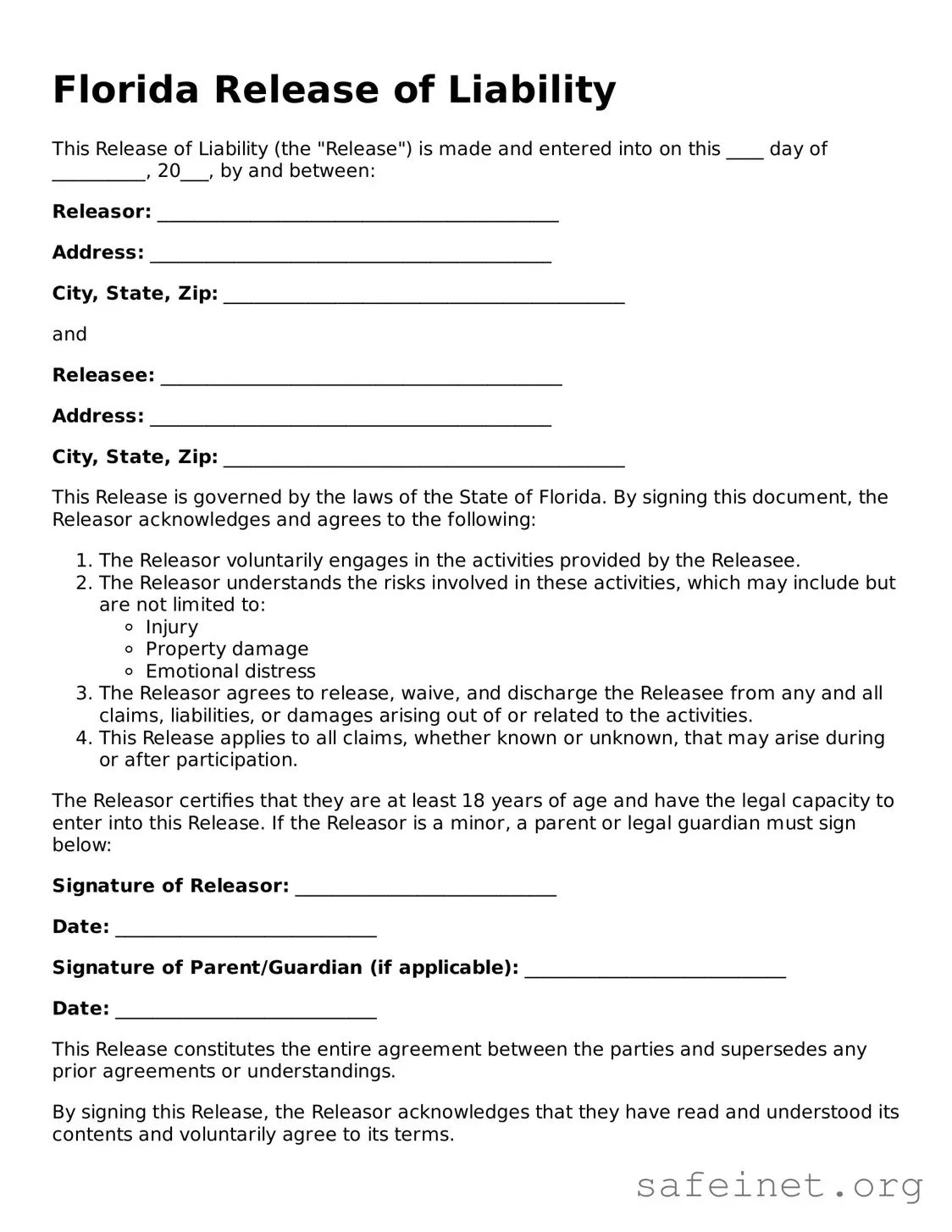
The Florida Release of Liability form serves as an essential legal document designed to protect individuals and organizations from potential claims or lawsuits arising from injuries or damages that may occur during specific activities. This form is particularly relevant in contexts such as recreational events, sports, or any situation where participants engage in activities that carry inherent risks. By signing the release, participants acknowledge their understanding of these risks and agree to relinquish their right to hold the organizer or provider accountable for any accidents that may occur. The form typically includes details about the event, the parties involved, and a clear statement of the risks associated with the activity. Additionally, it often requires the signature of the participant, and in some cases, a parent or guardian if the participant is a minor. Understanding the nuances of this document is crucial for both organizers and participants to ensure that all parties are adequately informed and protected.
Florida Release of Liability
This Release of Liability (the "Release") is made and entered into on this ____ day of __________, 20___, by and between:
Releasor: ___________________________________________
Address: ___________________________________________
City, State, Zip: ___________________________________________
and
Releasee: ___________________________________________
Address: ___________________________________________
City, State, Zip: ___________________________________________
This Release is governed by the laws of the State of Florida. By signing this document, the Releasor acknowledges and agrees to the following:
The Releasor certifies that they are at least 18 years of age and have the legal capacity to enter into this Release. If the Releasor is a minor, a parent or legal guardian must sign below:
Signature of Releasor: ____________________________
Date: ____________________________
Signature of Parent/Guardian (if applicable): ____________________________
Date: ____________________________
This Release constitutes the entire agreement between the parties and supersedes any prior agreements or understandings.
By signing this Release, the Releasor acknowledges that they have read and understood its contents and voluntarily agree to its terms.
| Fact Name | Details |
|---|---|
| Purpose | The Florida Release of Liability form is designed to protect individuals and organizations from legal claims or lawsuits resulting from injuries or damages that may occur during activities. |
| Governing Law | This form is governed by Florida state law, particularly under the principles of tort law and contract law. |
| Voluntary Participation | Participants must voluntarily agree to the terms outlined in the release, indicating their understanding of the risks involved. |
| Scope of Release | The form typically covers a wide range of activities, including recreational sports, events, and other potentially hazardous activities. |
| Minors | If a participant is a minor, a parent or legal guardian must sign the release on their behalf to ensure legal validity. |
| Legal Enforceability | For the release to be enforceable, it must be clear, unambiguous, and not contrary to public policy. |
| Indemnification Clause | Many forms include an indemnification clause, where the participant agrees to hold the organizer harmless from any claims arising from the activity. |
| Duration | The release of liability typically remains in effect for the duration of the activity, but some may specify a longer period for claims related to that activity. |
Once you have the Florida Release of Liability form in hand, it’s time to fill it out accurately. Make sure you have all necessary information ready before you begin.
After completing the form, review it for accuracy. Ensure that all fields are filled out correctly before submitting it to the appropriate party.
What is a Florida Release of Liability form?
A Florida Release of Liability form is a legal document designed to protect one party from being held liable for injuries or damages that may occur during a specific activity or event. This form is commonly used in various situations, such as recreational activities, sports events, or when individuals participate in potentially hazardous experiences. By signing this form, participants acknowledge the risks involved and agree not to hold the organizer or provider responsible for any accidents or injuries that may arise. It is essential to understand that this form does not absolve the provider of all responsibility, especially in cases of gross negligence or willful misconduct.
Who should use a Release of Liability form in Florida?
This form is beneficial for businesses and organizations that offer activities where there is a risk of injury. This includes, but is not limited to, sports facilities, adventure companies, and event organizers. Individuals participating in activities such as zip-lining, rock climbing, or even recreational sports should also consider using this form. It serves as a mutual understanding between the parties involved, ensuring that everyone is aware of the potential risks and agrees to proceed with those risks in mind.
Is a Release of Liability form enforceable in Florida?
Yes, a Release of Liability form can be enforceable in Florida, provided it meets certain legal criteria. The form must be clear and unambiguous, explicitly stating the risks involved and the rights being waived. It should also be signed voluntarily by all parties involved, without any coercion. However, it is crucial to note that Florida courts may not enforce a release if it is deemed overly broad or if it attempts to waive liability for intentional misconduct or gross negligence. Therefore, careful drafting and consideration of the specific circumstances are essential for the form to hold up in court.
Can minors sign a Release of Liability form in Florida?
Failing to read the entire form thoroughly. Many people rush through the document without understanding all the terms and conditions.
Not providing complete personal information. It's essential to include your full name, address, and contact details.
Overlooking the date. A common mistake is forgetting to date the form, which can lead to complications later.
Signing without understanding the implications. Some individuals sign the form without realizing they are waiving certain rights.
Not having a witness or notary when required. Some situations may require a witness or notarization, and skipping this step can invalidate the form.
Using vague language. Be specific about the activities or events covered by the release to avoid confusion.
Ignoring the expiration date. If the release has a time limit, ensure you fill it out within that period to maintain its validity.
When engaging in activities that carry a certain level of risk, it’s essential to have the right legal forms in place. The Florida Release of Liability form is a key document, but it often works in conjunction with other important forms. Below is a list of documents that can help protect both parties involved in various activities.
Having these documents in place not only protects all parties involved but also fosters a sense of trust and understanding. Each form serves a specific purpose, contributing to a safer and more organized environment for everyone. Always consider consulting a legal expert to ensure that your forms meet all necessary requirements.
The Waiver of Liability form is similar to the Florida Release of Liability form in that both documents aim to protect individuals or organizations from legal claims. A Waiver of Liability is often used in recreational activities, such as sports or adventure outings, where participants acknowledge the risks involved and agree not to hold the organizers responsible for injuries. Like the Florida form, it requires clear language to ensure that participants understand the risks and willingly accept them, thus limiting the liability of the organizers.
The Hold Harmless Agreement also shares similarities with the Florida Release of Liability form. This document is designed to protect one party from being held liable for damages or injuries that may occur during a specific event or activity. In both cases, the parties involved agree to relinquish the right to sue for any claims that may arise. The Hold Harmless Agreement often includes specific details about the nature of the activity and the risks involved, similar to the information typically found in a Release of Liability form.
The Indemnity Agreement is another document that serves a similar purpose. It requires one party to compensate another for any losses or damages that may occur. While the Florida Release of Liability form focuses on waiving the right to sue, the Indemnity Agreement emphasizes financial responsibility for any claims made by third parties. Both documents are used to manage risk and protect against potential legal issues, but they differ in their approach to liability and compensation.
The Consent to Treat form is related to the Florida Release of Liability form, especially in medical or sports contexts. This document allows individuals to grant permission for medical treatment in the event of an injury. While the Release of Liability form focuses on waiving rights to sue for injuries sustained, the Consent to Treat form ensures that medical personnel can provide care without legal complications. Both documents emphasize informed consent and the understanding of risks involved in activities.
Finally, the Event Liability Insurance Waiver is akin to the Florida Release of Liability form. This document is often used by event organizers to limit their liability in case of accidents or injuries during an event. While the Release of Liability form requires participants to acknowledge risks, the Event Liability Insurance Waiver often includes provisions for insurance coverage that protects the organizers. Both documents work together to minimize risk and ensure that participants are aware of their responsibilities and the potential dangers involved.
Filling out the Florida Release of Liability form can seem daunting, but it doesn’t have to be. Here’s a handy list of things you should and shouldn’t do to ensure you complete the form correctly and protect yourself.
Things You Should Do:
Things You Shouldn't Do:
By following these tips, you can fill out the Florida Release of Liability form with confidence and clarity. Remember, it’s all about protecting yourself while enjoying your activities!
When it comes to the Florida Release of Liability form, many people have misunderstandings that can lead to confusion. Here are six common misconceptions:
It completely protects against all lawsuits. Many believe that signing a release form means they cannot be sued at all. However, while it can limit liability, it does not provide absolute protection, especially in cases of negligence or intentional harm.
It is only for extreme activities. Some think that a release of liability is only necessary for high-risk activities like skydiving or rock climbing. In reality, it can be used in a variety of situations, including sports events, recreational activities, and even simple gatherings.
Verbal agreements are just as effective. Many assume that a verbal agreement can replace a written release form. However, written documentation is much more enforceable in court and provides clear evidence of the agreement.
It is a one-size-fits-all document. Some people think that any release of liability form will suffice for any situation. In truth, these forms should be tailored to the specific activity and risks involved to be effective.
Signing means you accept all risks. While a release of liability does indicate that you understand the risks, it doesn’t mean you waive your right to compensation for injuries caused by negligence or misconduct.
Minors cannot sign a release. There is a belief that minors are unable to sign these forms. In Florida, a parent or guardian can sign on behalf of a minor, which makes it possible to include young participants in activities.
Understanding these misconceptions can help individuals make informed decisions when it comes to participating in activities that require a Release of Liability form. Always consider consulting a legal expert for personalized advice.
When it comes to the Florida Release of Liability form, understanding its purpose and proper usage is essential for both parties involved. Here are some key takeaways to consider: