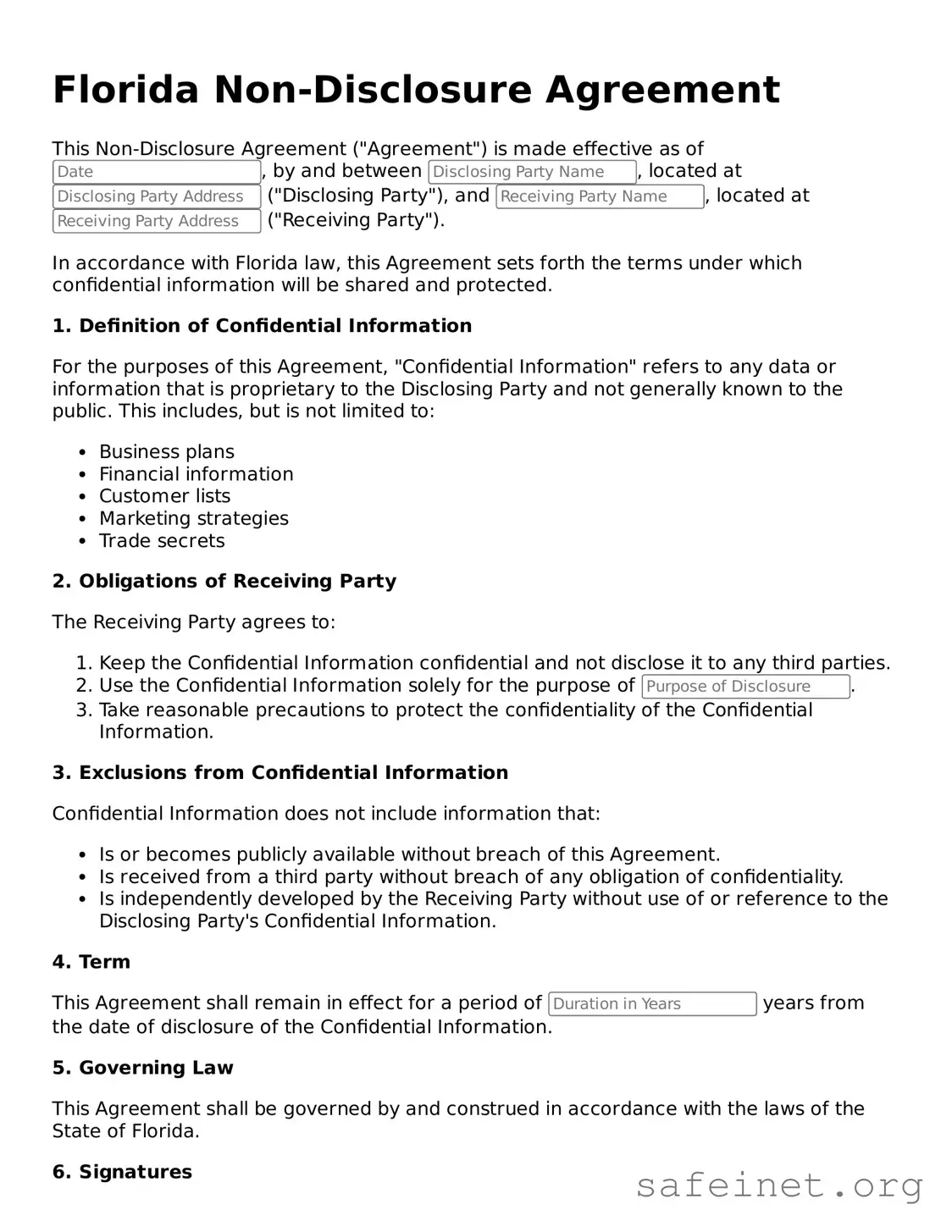
In the competitive landscape of business, protecting sensitive information is crucial for success. The Florida Non-disclosure Agreement (NDA) form serves as a vital tool for individuals and organizations seeking to safeguard their proprietary data. This legally binding document outlines the terms under which confidential information can be shared and establishes the obligations of the parties involved. Key elements of the NDA include the definition of what constitutes confidential information, the duration of confidentiality, and the consequences for breaches. The form is designed to ensure that trade secrets, business plans, and other sensitive materials remain secure, fostering trust between parties while allowing for collaboration. By clearly delineating rights and responsibilities, the Florida NDA empowers businesses to engage in discussions and negotiations without the fear of information leaks, making it an essential component of any professional relationship.
Florida Non-Disclosure Agreement
This Non-Disclosure Agreement ("Agreement") is made effective as of , by and between , located at ("Disclosing Party"), and , located at ("Receiving Party").
In accordance with Florida law, this Agreement sets forth the terms under which confidential information will be shared and protected.
1. Definition of Confidential Information
For the purposes of this Agreement, "Confidential Information" refers to any data or information that is proprietary to the Disclosing Party and not generally known to the public. This includes, but is not limited to:
2. Obligations of Receiving Party
The Receiving Party agrees to:
3. Exclusions from Confidential Information
Confidential Information does not include information that:
4. Term
This Agreement shall remain in effect for a period of years from the date of disclosure of the Confidential Information.
5. Governing Law
This Agreement shall be governed by and construed in accordance with the laws of the State of Florida.
6. Signatures
IN WITNESS WHEREOF, the parties hereto have executed this Non-Disclosure Agreement as of the date first above written.
Disclosing Party: ___________________________
Date: ________________
Receiving Party: ___________________________
Date: ________________
| Fact Name | Description |
|---|---|
| Purpose | A Florida Non-disclosure Agreement (NDA) is used to protect confidential information shared between parties. |
| Governing Law | The NDA is governed by Florida state law, specifically under the Florida Uniform Trade Secrets Act. |
| Parties Involved | The agreement can involve individuals or businesses, ensuring that both parties understand their obligations regarding confidentiality. |
| Duration | The duration of confidentiality can vary, but it typically lasts for a specified period, often between 1 to 5 years. |
| Enforceability | Florida courts generally uphold NDAs as long as they are reasonable in scope and duration. |
| Exclusions | Common exclusions from NDAs include information that is publicly available or independently developed by the receiving party. |
After obtaining the Florida Non-disclosure Agreement form, you are ready to proceed with filling it out. This document will require specific information from both parties involved. Ensure that you have all necessary details at hand to complete the form accurately.
What is a Florida Non-disclosure Agreement (NDA)?
A Florida Non-disclosure Agreement is a legal contract designed to protect confidential information shared between parties. This agreement ensures that sensitive information, such as trade secrets, business strategies, or proprietary data, remains private. By signing an NDA, both parties agree not to disclose this information to unauthorized individuals or entities.
When should I use a Non-disclosure Agreement?
You should consider using an NDA when you plan to share confidential information with another party. This is particularly important in business settings, such as during negotiations, partnerships, or when hiring employees. An NDA can help protect your intellectual property and maintain a competitive edge by preventing others from using your ideas without permission.
What are the key components of a Florida NDA?
A typical Florida NDA includes several essential components. First, it identifies the parties involved. Next, it defines what constitutes confidential information. Additionally, it outlines the obligations of each party regarding the handling of this information. Finally, the agreement specifies the duration of confidentiality and any exceptions to the agreement, such as information that becomes public knowledge through no fault of the receiving party.
How long does a Non-disclosure Agreement last?
The duration of an NDA can vary depending on the terms agreed upon by the parties involved. Typically, the confidentiality obligations last for a specified number of years, often ranging from two to five years. However, in some cases, the obligations can continue indefinitely, especially if the information shared remains sensitive or proprietary over time.
What happens if someone breaches the NDA?
If a party breaches the NDA, the injured party may seek legal remedies. This could include monetary damages for any losses incurred as a result of the breach. In some cases, the injured party may also request injunctive relief, which is a court order to prevent further disclosure of the confidential information. The specific consequences will depend on the terms of the agreement and the circumstances surrounding the breach.
Can I create my own Non-disclosure Agreement?
Yes, you can create your own Non-disclosure Agreement. However, it's essential to ensure that the agreement is clear, comprehensive, and legally enforceable. While there are templates available online, it may be beneficial to consult with a legal professional to tailor the NDA to your specific needs and circumstances. This can help prevent potential issues down the line and ensure that your interests are adequately protected.
Incomplete Information: Many individuals fail to provide all necessary details, such as names, addresses, and contact information. This can lead to confusion and potential disputes later on.
Incorrect Dates: Entering the wrong dates for the agreement's duration can invalidate the contract. It is crucial to ensure that all dates are accurate and clearly stated.
Missing Signatures: Without signatures from all parties involved, the agreement lacks legal enforceability. Each party must sign and date the document to confirm their acceptance.
Vague Language: Using ambiguous terms can lead to misunderstandings. It is essential to define key terms clearly to avoid misinterpretation of the agreement's intent.
Neglecting to Review: Failing to thoroughly review the document before submission can result in overlooking errors. A careful review helps ensure accuracy and completeness.
Ignoring State-Specific Requirements: Each state may have unique regulations regarding Non-disclosure Agreements. Not adhering to Florida's specific requirements can render the agreement ineffective.
When entering into a Florida Non-disclosure Agreement (NDA), several other documents may also be necessary to ensure comprehensive protection of sensitive information. Here are four commonly used forms that complement an NDA.
Having these documents in place can enhance the protection of your interests when dealing with confidential information. It is crucial to ensure that all parties involved understand their responsibilities and obligations clearly.
A Confidentiality Agreement is similar to a Non-disclosure Agreement (NDA) in that both documents aim to protect sensitive information. A Confidentiality Agreement is often used in business relationships where one party may share proprietary information with another. Like an NDA, it outlines the types of information that must remain confidential and the obligations of the parties involved. Both agreements serve to prevent the unauthorized disclosure of information that could harm a business or individual if made public.
A Proprietary Information Agreement (PIA) is another document that shares similarities with an NDA. A PIA specifically focuses on protecting proprietary or trade secret information. It establishes the legal framework for how proprietary information should be handled and disclosed. Like an NDA, a PIA typically includes definitions of what constitutes proprietary information and the responsibilities of the parties in safeguarding that information.
An Employment Agreement often includes confidentiality clauses similar to those found in NDAs. In an Employment Agreement, the employer may require the employee to keep certain information confidential as a condition of employment. These clauses serve to protect the employer’s trade secrets and sensitive business information, much like an NDA does between two independent parties.
A Non-circumvention Agreement is related to NDAs, especially in business dealings. This document prevents one party from bypassing another to engage in a business transaction directly with a third party. While the primary focus of an NDA is on confidentiality, a Non-circumvention Agreement also emphasizes the protection of business relationships and opportunities, thus serving a complementary purpose.
A Non-solicitation Agreement can also be compared to a Non-disclosure Agreement. This document restricts one party from soliciting employees or clients of another party. While NDAs primarily protect confidential information, Non-solicitation Agreements focus on preserving business relationships and preventing competition. Both agreements aim to safeguard the interests of the parties involved and maintain the integrity of business operations.
When filling out the Florida Non-disclosure Agreement form, it is important to follow certain guidelines to ensure accuracy and compliance. Here are some dos and don'ts to consider:
Understanding the Florida Non-disclosure Agreement (NDA) is crucial for anyone considering entering into one. However, several misconceptions can lead to confusion. Here are five common misconceptions:
Clarifying these misconceptions can help individuals and businesses make informed decisions about using NDAs effectively.
When filling out and using the Florida Non-disclosure Agreement (NDA) form, keep these key takeaways in mind: