When it comes to employment in Florida, the Employment Verification form plays a crucial role in the hiring process. This document is essential for employers who need to confirm a candidate's work history and qualifications. It typically includes details such as the employee's name, job title, dates of employment, and reasons for leaving previous positions. Additionally, employers often use this form to ensure compliance with state regulations and to verify that a potential employee meets the necessary criteria for the job. By providing accurate and up-to-date information, both employers and employees can foster a transparent and trustworthy work environment. Understanding how to complete and submit this form correctly can streamline the hiring process and help avoid potential misunderstandings down the line.
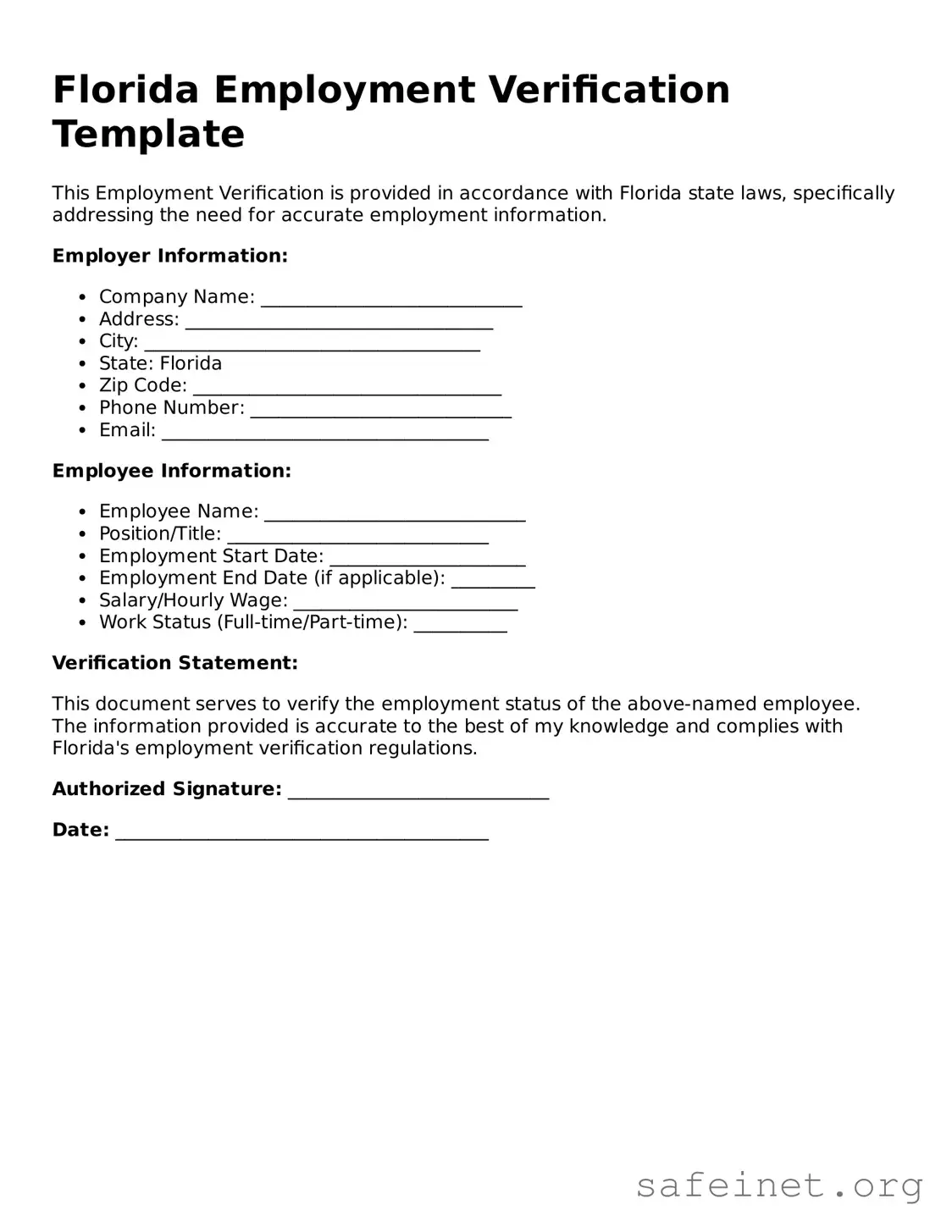
Florida Employment Verification Template
This Employment Verification is provided in accordance with Florida state laws, specifically addressing the need for accurate employment information.
Employer Information:
Employee Information:
Verification Statement:
This document serves to verify the employment status of the above-named employee. The information provided is accurate to the best of my knowledge and complies with Florida's employment verification regulations.
Authorized Signature: ____________________________
Date: ________________________________________
| Fact Name | Details |
|---|---|
| Purpose | The Florida Employment Verification form is used to confirm the employment status of an individual. |
| Governing Law | Florida Statutes, Chapter 448.095 outlines the requirements for employment verification. |
| Required Information | The form typically requires the employee's name, Social Security number, and employment dates. |
| Use by Employers | Employers use this form to comply with various legal and regulatory requirements. |
| Submission | Completed forms are often submitted to state agencies or financial institutions for verification purposes. |
| Confidentiality | Information provided on the form must be kept confidential and used solely for verification. |
| Signature Requirement | The form usually requires the signature of the employee and the employer to validate the information. |
| Record Keeping | Employers are advised to keep copies of the completed forms for their records. |
Filling out the Florida Employment Verification form is straightforward. Once you have completed the form, you will be ready to submit it to the appropriate party. Follow these steps to ensure everything is filled out correctly.
What is the Florida Employment Verification form?
The Florida Employment Verification form is a document used to confirm an employee's job status, including their position, salary, and duration of employment. Employers typically complete this form when requested by a third party, such as a lender or government agency, to verify the employment details of an individual.
Who needs to fill out the Employment Verification form?
Employers are responsible for completing the Employment Verification form. This includes businesses, government agencies, and non-profit organizations that employ individuals in Florida. Employees may request this verification for various reasons, such as applying for a loan, renting an apartment, or qualifying for benefits.
How can I obtain the Florida Employment Verification form?
What information is typically required on the form?
The form generally requires the employee's name, job title, dates of employment, salary information, and the employer's contact details. Some forms may also ask for additional information, such as the employee's work schedule or job responsibilities.
Is there a fee associated with completing the Employment Verification form?
Typically, there is no fee for completing the Employment Verification form. However, some employers may have policies in place regarding administrative fees for processing such requests. It's best to check with your HR department for any specific policies.
How long does it take to process the Employment Verification request?
The processing time can vary depending on the employer's policies and workload. Generally, you can expect a response within a few business days. If the request is urgent, it’s advisable to communicate that to your HR department to expedite the process.
Can I request my own Employment Verification form?
Yes, as an employee, you can request your own Employment Verification form. It’s important to communicate your needs clearly to your employer or HR department. They will assist you in obtaining the necessary documentation.
What should I do if my Employment Verification form contains errors?
If you notice any errors on your Employment Verification form, contact your employer immediately. Provide them with the correct information and request a revised form. It’s crucial to ensure that all details are accurate, as errors could affect your applications or benefits.
When filling out the Florida Employment Verification form, individuals may encounter several common pitfalls. Understanding these mistakes can help ensure that the form is completed accurately and efficiently. Below is a list of eight mistakes to avoid:
Incomplete Information: Failing to provide all required fields can delay the verification process. Ensure that every section is filled out completely.
Incorrect Dates: Providing inaccurate employment dates can lead to confusion. Double-check the start and end dates of employment.
Missing Signatures: Not signing the form can render it invalid. Always include your signature at the designated area.
Wrong Employer Details: Listing incorrect information about the employer, such as the name or address, can cause verification issues. Verify these details before submission.
Inconsistent Job Titles: Using different job titles than what the employer has on record can lead to discrepancies. Use the title as it appears on official documents.
Not Providing Contact Information: Omitting your contact details can hinder communication. Always include a phone number and email address.
Failing to Review: Skipping a final review of the form can lead to overlooked errors. Take a moment to read through the entire form before submission.
Submitting Without Supporting Documents: Not including necessary documentation, such as pay stubs or tax forms, can slow down the verification process. Ensure all required documents are attached.
By being aware of these common mistakes, individuals can navigate the Florida Employment Verification process more smoothly and effectively. Taking the time to carefully complete the form can make a significant difference in the outcome of employment verification.
When navigating employment processes in Florida, the Employment Verification form is just one piece of the puzzle. Several other documents often accompany it, providing essential information for employers and employees alike. Below is a list of forms and documents commonly used in conjunction with the Florida Employment Verification form.
Understanding these documents can streamline the employment process and ensure compliance with various regulations. Each form plays a vital role in establishing clear communication and expectations between employers and employees in Florida.
The Florida Employment Verification form serves as a crucial tool for employers to confirm the employment status of individuals. Similar to this form, the I-9 form is widely used across the United States. The I-9 form is a federal document that verifies an employee’s identity and eligibility to work in the U.S. Both forms require personal information from the employee and are essential in ensuring compliance with labor laws. However, while the I-9 focuses on identity verification, the Florida Employment Verification form is more about confirming employment history and status.
Another document that shares similarities is the W-2 form, which is used to report an employee's annual wages and taxes withheld. While the W-2 is primarily concerned with financial information, both forms require accurate reporting of employment details. Employers use the W-2 to provide information to the IRS, while the Florida Employment Verification form helps in verifying employment for various purposes, such as loan applications or background checks.
The pay stub, or paycheck, is also comparable to the Florida Employment Verification form. Pay stubs provide a record of earnings, deductions, and hours worked. Like the Employment Verification form, they serve as proof of employment and can be used by employees to validate their work status. However, pay stubs focus more on financial compensation, while the Employment Verification form emphasizes employment duration and position held.
The Social Security Administration (SSA) verification letter is another document that shares a purpose with the Florida Employment Verification form. This letter confirms an individual's earnings history and is often required for various applications, including loans or social services. Both documents help to establish an individual's work history, but the SSA letter is specifically tied to social security benefits, whereas the Florida form is more general in its employment verification.
Similarly, the Employment Reference Letter serves a comparable function. This letter, typically written by a previous employer, attests to an individual's job performance and employment duration. Both documents provide validation of employment, but the Employment Reference Letter often includes subjective assessments of the employee's capabilities, while the Florida Employment Verification form is more factual and straightforward.
The job offer letter is yet another document that aligns with the Florida Employment Verification form. A job offer letter outlines the terms of employment, including job title, salary, and start date. Both documents are essential for establishing an individual’s employment status, but the job offer letter is more about the future, whereas the Employment Verification form focuses on confirming past employment.
The Certificate of Employment is also similar in its purpose. This document is issued by employers to confirm that an individual was employed with them for a specified period. Both the Certificate of Employment and the Florida Employment Verification form serve to validate employment history, but the former is often used in international contexts, while the latter is more localized within Florida.
Lastly, the Background Check Authorization form can be likened to the Florida Employment Verification form. This document allows employers to verify an applicant's employment history as part of the hiring process. Both forms are essential in ensuring that the information provided by a candidate is accurate. However, the Background Check Authorization form is more focused on the consent aspect, allowing employers to conduct a thorough check on an applicant’s background, while the Florida Employment Verification form is strictly for confirming employment status.
When filling out the Florida Employment Verification form, it is essential to adhere to specific guidelines to ensure accuracy and compliance. Below is a list of do's and don'ts to consider.
Following these guidelines will help ensure that the Employment Verification form is completed correctly and efficiently.
Many individuals have misunderstandings about the Florida Employment Verification form. Here are six common misconceptions:
This is not true. The Florida Employment Verification form can be used for current employees as well, especially when there is a need to confirm employment status or income for loans or other purposes.
While employers typically complete the form, employees can also provide necessary information to ensure accuracy. Collaboration can lead to a more reliable verification process.
This misconception overlooks the fact that the form can be used by private employers as well. Any organization may request employment verification for various reasons.
The verification process can be straightforward. With clear communication between the employee and employer, completion can often occur quickly.
Changes can be made if necessary. If new information arises or corrections are needed, the employer can issue an updated form.
While the form itself may not be a contract, it serves as an official record of employment status and can be used in legal contexts if disputes arise.
When filling out and using the Florida Employment Verification form, there are several important points to keep in mind. Below are key takeaways to ensure the process goes smoothly: