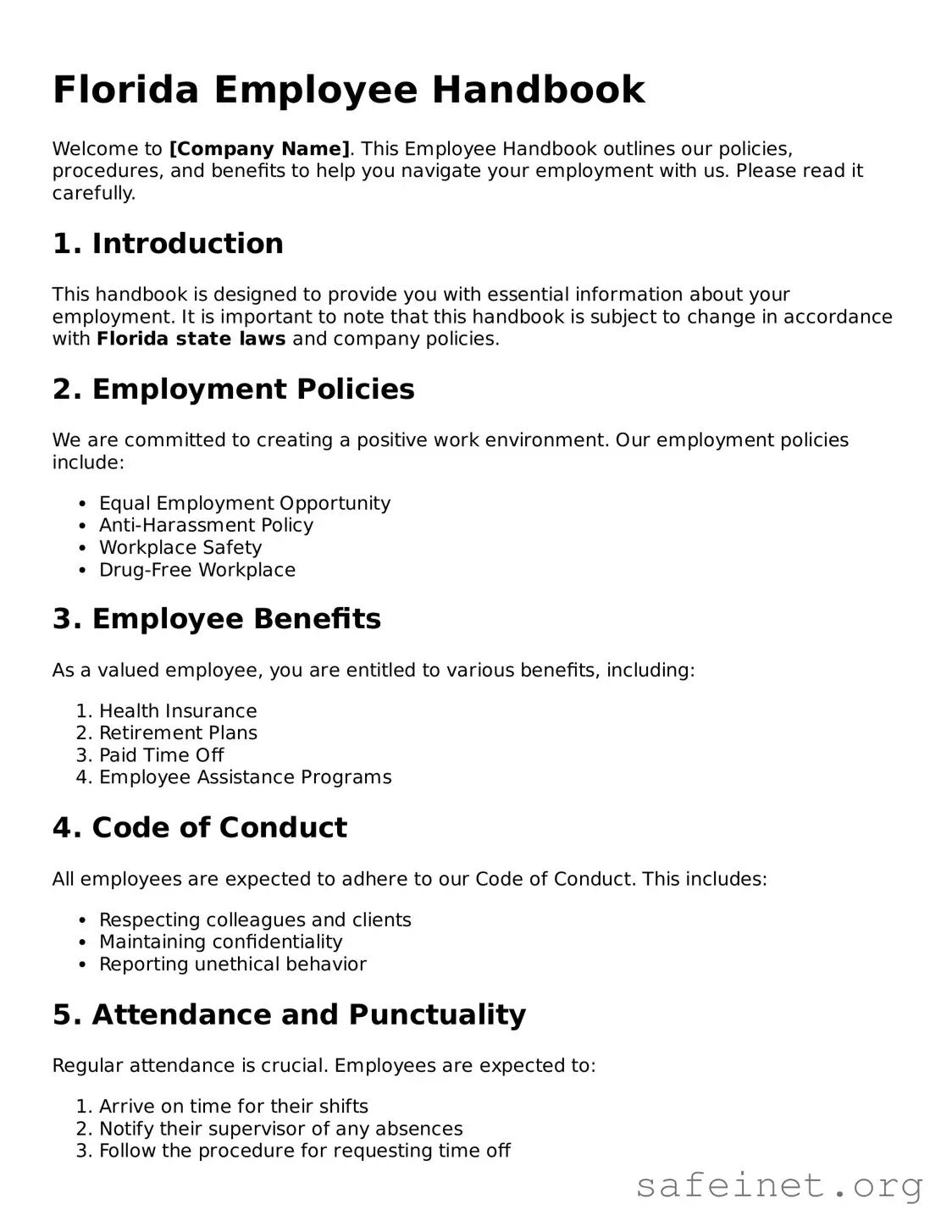
In Florida, the Employee Handbook serves as a crucial document for both employers and employees, outlining essential policies and procedures within the workplace. This form typically includes vital information such as workplace expectations, employee rights, and the company's code of conduct. Additionally, it addresses topics like anti-discrimination policies, harassment prevention, and disciplinary procedures, ensuring that employees understand their rights and responsibilities. The handbook also often contains details on benefits, leave policies, and safety protocols, fostering a transparent work environment. By providing clear guidelines, the Employee Handbook helps to mitigate misunderstandings and establishes a foundation for a positive employer-employee relationship. Understanding the components of this form is essential for compliance with state and federal laws, as well as for promoting a culture of respect and accountability in the workplace.
Florida Employee Handbook
Welcome to [Company Name]. This Employee Handbook outlines our policies, procedures, and benefits to help you navigate your employment with us. Please read it carefully.
1. Introduction
This handbook is designed to provide you with essential information about your employment. It is important to note that this handbook is subject to change in accordance with Florida state laws and company policies.
2. Employment Policies
We are committed to creating a positive work environment. Our employment policies include:
3. Employee Benefits
As a valued employee, you are entitled to various benefits, including:
4. Code of Conduct
All employees are expected to adhere to our Code of Conduct. This includes:
5. Attendance and Punctuality
Regular attendance is crucial. Employees are expected to:
6. Acknowledgment of Receipt
By signing below, you acknowledge that you have received and read the Florida Employee Handbook.
Employee Name: [Employee Name]
Date: [Date]
Signature: [Employee Signature]
7. Contact Information
If you have any questions regarding this handbook, please contact:
Human Resources Department
[Company Address]
Phone: [Phone Number]
Email: [Email Address]
Thank you for being a part of [Company Name]. We look forward to a successful journey together.
| Fact Name | Details |
|---|---|
| Purpose | The Florida Employee Handbook serves as a guide for employees regarding company policies and procedures. |
| Legal Requirement | While not legally required, having an employee handbook can help protect employers from legal disputes. |
| Governing Laws | The handbook should comply with federal laws, such as the Fair Labor Standards Act (FLSA) and state laws, including the Florida Civil Rights Act. |
| Content Guidelines | Common sections include company culture, employee rights, benefits, and disciplinary procedures. |
| Updates | It is essential to regularly update the handbook to reflect changes in laws and company policies. |
| Distribution | Employees should receive a copy of the handbook upon hiring and whenever significant updates occur. |
| Employee Acknowledgment | Employers often require employees to sign an acknowledgment form confirming they have read and understood the handbook. |
| Legal Protection | A well-drafted handbook can serve as a defense in employment-related lawsuits by demonstrating fair treatment of employees. |
Once you have the Florida Employee Handbook form, you can begin filling it out. This process is straightforward, and following these steps will help ensure that you complete the form accurately.
What is the Florida Employee Handbook form?
The Florida Employee Handbook form is a document that outlines the policies, procedures, and expectations of an employer regarding their employees. It serves as a guide for employees to understand their rights and responsibilities within the workplace. This form can help ensure that both employers and employees are on the same page regarding workplace standards.
Why is an Employee Handbook important?
An Employee Handbook is important because it sets clear expectations for behavior and performance. It can help prevent misunderstandings and disputes by providing a reference point for company policies. Additionally, having a well-structured handbook can protect the employer from potential legal issues by demonstrating that policies are consistently communicated and enforced.
Who should receive a copy of the Employee Handbook?
All employees should receive a copy of the Employee Handbook, whether they are full-time, part-time, or temporary workers. It’s essential that every employee understands the company’s policies and procedures. Employers should also consider providing a copy to new hires during the onboarding process to ensure they start with a clear understanding of expectations.
How often should the Employee Handbook be updated?
The Employee Handbook should be reviewed and updated regularly, at least once a year. Changes in laws, company policies, or workplace practices may necessitate updates. Regular reviews help ensure that the handbook remains relevant and compliant with current regulations, providing employees with accurate information.
Can an Employee Handbook be used in legal disputes?
Yes, an Employee Handbook can be used in legal disputes. If a dispute arises, the handbook can serve as evidence of the company's policies and the expectations set for employees. However, it is crucial that the handbook is well-drafted, clear, and consistently enforced to be effective in legal situations.
What should be included in the Employee Handbook?
The Employee Handbook should include key information such as company policies, employee rights, code of conduct, anti-discrimination policies, disciplinary procedures, and benefits information. It may also cover topics like attendance, dress code, and procedures for reporting grievances. The goal is to provide comprehensive guidance on workplace expectations.
Is it necessary to have employees sign an acknowledgment of receipt?
Yes, it is advisable to have employees sign an acknowledgment of receipt of the Employee Handbook. This signature serves as proof that the employee has received the handbook and understands its contents. It can also help protect the employer by showing that employees are aware of the policies in place.
What should I do if an employee violates a policy in the Handbook?
If an employee violates a policy in the Handbook, it is important to follow the disciplinary procedures outlined in the document. Consistent enforcement of policies is crucial for maintaining fairness and accountability. Depending on the violation, consequences may range from a verbal warning to termination, based on the severity of the infraction.
Can an Employee Handbook be customized for specific workplaces?
Yes, an Employee Handbook can and should be customized to reflect the specific needs and culture of a workplace. Each company has unique values, policies, and procedures. Tailoring the handbook ensures that it accurately represents the organization and addresses the specific issues relevant to its employees.
Failing to read the entire handbook thoroughly. Many people skim through the document and miss important policies.
Not providing accurate personal information. Incorrect names, addresses, or contact details can lead to issues later.
Overlooking the acknowledgment section. It's crucial to sign and date this part to confirm understanding of the policies.
Ignoring the confidentiality agreement. Some employees forget to review this section, which can have serious implications.
Not asking questions. If something is unclear, failing to seek clarification can result in misunderstandings.
Neglecting to update the form when personal circumstances change. Changes in address, marital status, or dependents should be reported.
Missing deadlines for submission. Late submissions can lead to complications with employment records.
Not keeping a copy of the completed form. This can be important for future reference or if any disputes arise.
When creating a comprehensive employee handbook in Florida, several other forms and documents can complement the handbook. These documents help ensure that employees understand their rights and responsibilities while also protecting the employer. Here’s a list of some commonly used forms and documents that can be beneficial:
Incorporating these forms and documents alongside the Florida Employee Handbook can create a well-rounded framework for employee relations. Clear communication and documentation are key to a successful workplace environment.
The Florida Employee Handbook serves as a vital resource for employees and employers alike. Similar to an employee manual, it outlines the policies, procedures, and expectations within a workplace. An employee manual typically includes information about company culture, job responsibilities, and conduct guidelines. Like the handbook, it aims to provide clarity and establish a consistent framework for all employees.
Another document akin to the Florida Employee Handbook is the workplace policy guide. This guide focuses on specific policies related to various aspects of employment, such as attendance, dress code, and workplace behavior. Both documents work together to ensure that employees understand their rights and responsibilities, fostering a respectful and productive work environment.
The orientation guide is also similar to the employee handbook. It is often provided to new hires during their onboarding process. While the handbook may cover a broader range of topics, the orientation guide typically focuses on the immediate needs of new employees, helping them acclimate to their new roles and the company culture.
Job descriptions share similarities with the employee handbook in that they outline specific roles and responsibilities. While the handbook provides an overview of company policies, job descriptions detail the expectations for individual positions. Both documents serve to align employee performance with organizational goals.
The code of conduct is another document that parallels the Florida Employee Handbook. It sets forth the ethical standards and behavioral expectations for employees. Like the handbook, the code of conduct aims to create a safe and respectful workplace, ensuring that all employees understand the importance of integrity and professionalism.
Employee agreements, including non-disclosure agreements (NDAs) and non-compete clauses, are also similar. These documents outline the terms of employment and protect the interests of the employer. While the employee handbook provides a broader overview of policies, agreements focus on specific legal obligations and protections for both parties.
Performance evaluation forms are related to the employee handbook as they establish criteria for assessing employee performance. The handbook may outline the evaluation process and expectations, while the forms provide a structured way to document and review employee performance. Both are essential for fostering growth and accountability in the workplace.
Training manuals are another document that aligns closely with the employee handbook. Training manuals provide detailed instructions and guidelines for specific tasks or roles within the company. While the handbook covers general policies, training manuals focus on the skills and knowledge employees need to succeed in their positions.
Safety manuals also share similarities with the Florida Employee Handbook. These documents outline safety protocols and procedures to ensure a safe working environment. The handbook may reference these safety guidelines, emphasizing the employer's commitment to employee well-being and compliance with regulations.
Lastly, the benefits guide is comparable to the employee handbook. This document details the benefits available to employees, such as health insurance, retirement plans, and paid time off. While the handbook provides an overview of workplace policies, the benefits guide focuses specifically on the perks and advantages of employment, helping employees understand their entitlements.
When filling out the Florida Employee Handbook form, it is important to follow certain guidelines to ensure accuracy and compliance. Below is a list of things you should and shouldn't do:
When it comes to the Florida Employee Handbook, several misconceptions often arise. Understanding these misunderstandings can help both employers and employees navigate workplace policies more effectively. Here are five common misconceptions:
By clarifying these misconceptions, both employers and employees can foster a better understanding of the role and importance of the Florida Employee Handbook in the workplace.
When filling out and using the Florida Employee Handbook form, consider these key takeaways:
By keeping these points in mind, the Florida Employee Handbook can serve as a valuable resource for both employees and management.