In the realm of legal communication, a Cease and Desist Letter serves as a powerful tool for individuals and businesses seeking to address perceived wrongs or infringements. Particularly in Florida, this form provides a structured way to formally request that another party stop certain actions that may be harmful or unlawful. The letter typically outlines the specific behavior that is objectionable, identifies the legal rights that are being violated, and sets a clear timeline for compliance. While it may seem straightforward, the effectiveness of such a letter hinges on its clarity and tone. A well-crafted Cease and Desist Letter not only conveys the seriousness of the situation but also lays the groundwork for potential legal action should the recipient fail to comply. Understanding the key components of this form, including the importance of including relevant details and maintaining a professional demeanor, is essential for anyone considering this course of action. By grasping the nuances of the Florida Cease and Desist Letter, individuals can better navigate disputes and protect their rights.
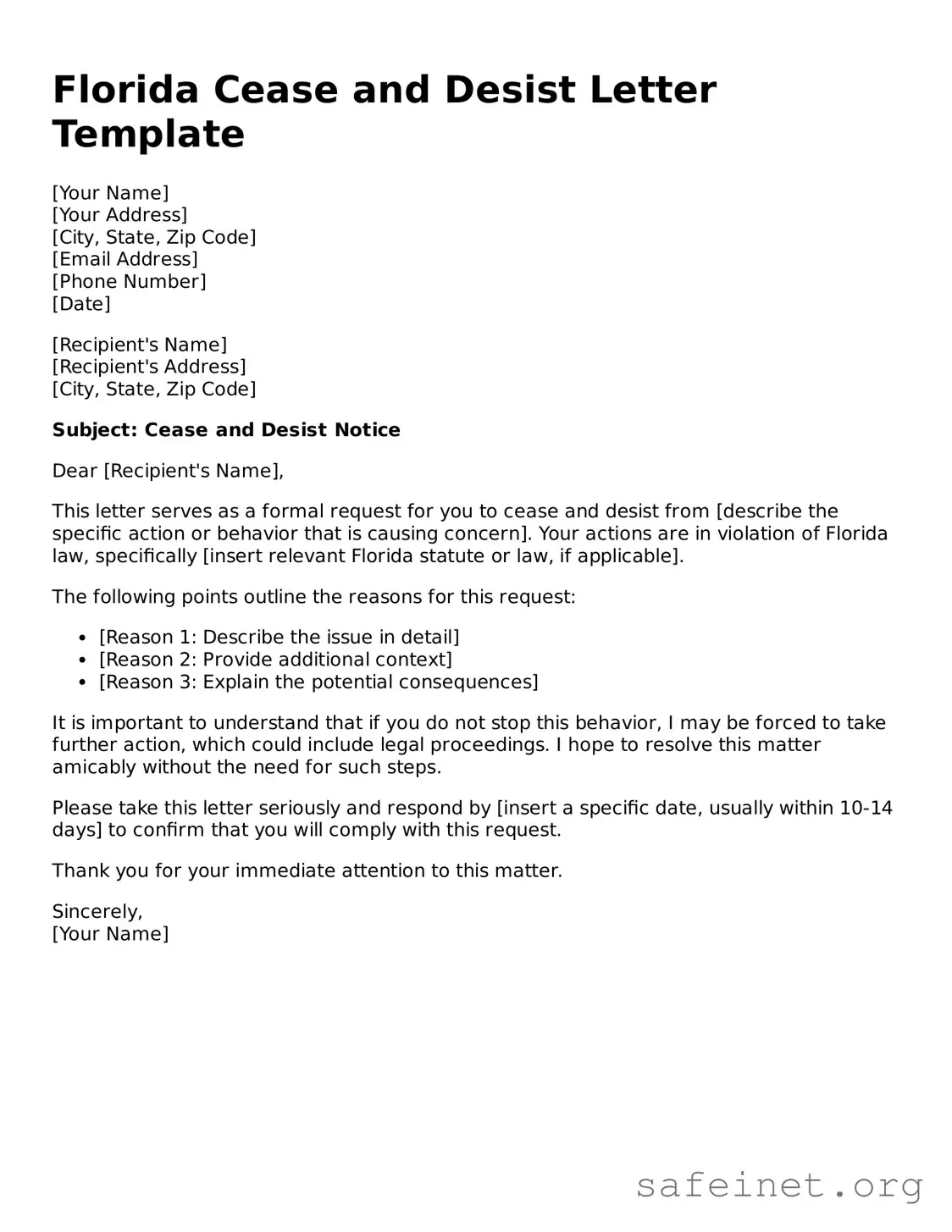
Florida Cease and Desist Letter Template
[Your Name]
[Your Address]
[City, State, Zip Code]
[Email Address]
[Phone Number]
[Date]
[Recipient's Name]
[Recipient's Address]
[City, State, Zip Code]
Subject: Cease and Desist Notice
Dear [Recipient's Name],
This letter serves as a formal request for you to cease and desist from [describe the specific action or behavior that is causing concern]. Your actions are in violation of Florida law, specifically [insert relevant Florida statute or law, if applicable].
The following points outline the reasons for this request:
It is important to understand that if you do not stop this behavior, I may be forced to take further action, which could include legal proceedings. I hope to resolve this matter amicably without the need for such steps.
Please take this letter seriously and respond by [insert a specific date, usually within 10-14 days] to confirm that you will comply with this request.
Thank you for your immediate attention to this matter.
Sincerely,
[Your Name]
| Fact Name | Description |
|---|---|
| Purpose | A Florida Cease and Desist Letter is used to formally request that an individual or organization stop certain actions that are believed to be unlawful or harmful. |
| Governing Law | This letter is governed by Florida state law, particularly statutes related to harassment, intellectual property, and business practices. |
| Format | The letter should be written in a clear and concise manner, detailing the specific actions to be ceased and the reasons for the request. |
| Delivery Methods | It can be delivered via mail, email, or personal delivery, but it is often recommended to send it via certified mail for proof of receipt. |
| Response Time | The recipient is typically given a specific timeframe to respond, often ranging from 10 to 30 days, depending on the situation. |
| Legal Standing | While a Cease and Desist Letter is not a legally binding document, it can serve as evidence of a request to stop harmful actions if legal action becomes necessary. |
| Consequences of Ignoring | If the recipient ignores the letter, the sender may choose to pursue legal action, which could lead to further legal consequences. |
| Customization | Each letter should be tailored to the specific circumstances and should include all relevant details to strengthen the request. |
Once you have the Florida Cease and Desist Letter form, you can begin filling it out. This process involves providing specific information related to your situation. Make sure to gather all necessary details before you start.
After you have filled out the form, you can send it to the recipient. It’s advisable to send it via certified mail to ensure they receive it and you have proof of delivery. Keep track of any responses you receive.
What is a Florida Cease and Desist Letter?
A Florida Cease and Desist Letter is a formal document sent to an individual or organization to demand that they stop certain actions that are believed to be harmful or unlawful. This letter serves as a warning and outlines the specific behavior that needs to cease, providing the recipient with an opportunity to address the issue before further legal action is taken.
When should I use a Cease and Desist Letter?
You should consider using a Cease and Desist Letter when someone is infringing on your rights, such as copyright, trademark, or privacy rights. It can also be used in cases of harassment, defamation, or other unlawful actions. This letter can be an effective first step in resolving disputes without resorting to litigation.
What should be included in the letter?
The letter should clearly state the specific actions that need to stop, the reasons why those actions are inappropriate or illegal, and a deadline for compliance. It is also helpful to include your contact information and any relevant documentation that supports your claims. The tone should remain professional and factual.
Is a Cease and Desist Letter legally binding?
A Cease and Desist Letter is not a legally binding document. However, it serves as an official notice of your intent to take action if the recipient does not comply. It can strengthen your position if you later decide to pursue legal remedies, as it shows that you attempted to resolve the issue amicably.
How do I deliver a Cease and Desist Letter?
You can deliver a Cease and Desist Letter through various methods, including certified mail, email, or personal delivery. Certified mail is often recommended, as it provides proof of delivery. Ensure that you keep a copy of the letter and any correspondence for your records.
What happens if the recipient ignores the letter?
If the recipient ignores the Cease and Desist Letter, you may have several options. You can choose to follow up with another letter, seek mediation, or consult with an attorney to discuss potential legal actions. Ignoring the letter may indicate that the recipient is unwilling to resolve the issue without further intervention.
Can I create my own Cease and Desist Letter?
Yes, you can create your own Cease and Desist Letter. There are templates available online that can guide you in drafting one. However, it is advisable to consult with a legal professional to ensure that your letter is appropriately worded and effective in conveying your demands.
Not providing clear details about the issue. It's crucial to describe the specific behavior or action that needs to stop. Without clarity, the recipient may not understand what they are being asked to cease.
Failing to include your contact information. Make sure to provide your name, address, and a way to reach you. This allows the recipient to respond or clarify any misunderstandings.
Using vague language. Be direct and specific in your wording. Avoid ambiguous terms that could lead to confusion about what actions are being requested.
Not stating the consequences of non-compliance. It’s important to outline what will happen if the recipient ignores the letter. This adds weight to your request and encourages compliance.
Neglecting to sign the letter. A signature adds authenticity and shows that you are serious about the matter. Without a signature, the letter may be disregarded.
Overlooking the need for a date. Including the date on the letter is essential. It provides a timeline and helps establish when the recipient received the request.
Not keeping a copy for your records. Always retain a copy of the letter for your own files. This can be useful if further action is needed later.
A Florida Cease and Desist Letter is a crucial tool for addressing unwanted behavior or actions. However, it is often used in conjunction with other documents to ensure a comprehensive approach to legal matters. Below are five common forms and documents that may accompany a Cease and Desist Letter.
Utilizing these documents alongside a Cease and Desist Letter can enhance your legal strategy. Each serves a unique purpose and can be instrumental in resolving conflicts effectively.
A demand letter is often the first step in resolving a dispute before escalating to legal action. Like a cease and desist letter, it formally outlines a party's grievances and requests specific actions from the recipient. The purpose is to communicate the sender's position clearly and to seek a resolution without the need for litigation. Both documents serve as a warning, indicating that further action may be taken if the recipient does not comply with the requests made.
An eviction notice is a legal document that informs a tenant of the landlord's intention to terminate their lease. Similar to a cease and desist letter, it serves as a formal warning, detailing the reasons for eviction and the timeline for compliance. Both documents aim to prompt a response and encourage resolution before further legal proceedings are initiated, emphasizing the importance of clear communication in landlord-tenant relationships.
A notice of violation is issued by a government authority when an individual or business is found to be in violation of local laws or regulations. This document, much like a cease and desist letter, outlines the specific violations and the required corrective actions. Both documents are intended to inform the recipient of their non-compliance and the potential consequences of failing to address the issue promptly, thereby encouraging compliance with legal standards.
A demand for payment is a formal request for the settlement of a debt. Similar to a cease and desist letter, it serves to notify the recipient of their obligations and the consequences of non-payment. Both documents aim to resolve disputes amicably and prevent further legal action, emphasizing the importance of addressing financial responsibilities in a timely manner.
An intellectual property infringement notice is sent to inform an individual or business that they are using protected intellectual property without permission. This document is akin to a cease and desist letter, as it demands that the infringing party stop their unauthorized use. Both serve to protect the rights of the owner and provide a clear path for resolution, often outlining the steps necessary to avoid legal action.
A settlement demand letter is used to propose a resolution to a legal dispute before it escalates to court. Like a cease and desist letter, it outlines the terms the sender is willing to accept to resolve the issue. Both documents aim to facilitate negotiation and settlement, encouraging parties to find common ground and avoid the costs associated with litigation.
A warning letter is often issued in various contexts, such as employment or contractual relationships, to inform an individual of their failure to meet certain obligations. This document shares similarities with a cease and desist letter, as it serves as a formal notice of unacceptable behavior and requests corrective action. Both types of letters emphasize the importance of compliance and the potential consequences of continued non-compliance.
A letter of intent to sue is a document that notifies a party of the sender's intention to pursue legal action if the issue is not resolved. This letter is similar to a cease and desist letter in that it serves as a warning and outlines the sender's grievances. Both documents aim to prompt a response and encourage resolution, providing the recipient with an opportunity to address the concerns before litigation begins.
A release of claims letter is a document that outlines the terms under which one party agrees to relinquish their right to pursue legal action against another party. This document can be compared to a cease and desist letter in that it seeks to resolve disputes and prevent future claims. Both documents emphasize the importance of clear communication and mutual agreement to ensure that all parties understand their rights and obligations moving forward.
When filling out the Florida Cease and Desist Letter form, it’s crucial to approach the task with care. Here are five important do's and don'ts to keep in mind:
Many people have misunderstandings about the Florida Cease and Desist Letter form. Here are four common misconceptions:
Many believe that sending a cease and desist letter automatically creates a legal obligation for the recipient to stop the disputed behavior. In reality, these letters are often considered a request rather than a legally enforceable document. They serve as a warning but do not carry the weight of a court order.
While having a lawyer can be beneficial, anyone can draft a cease and desist letter. It's important to clearly state the issue and desired action. However, legal advice can help ensure that the letter is effective and properly formatted.
Many assume that once a cease and desist letter is sent, the recipient will comply immediately. This is not always the case. The recipient may ignore the letter, dispute the claims, or respond with their own legal action.
Some think these letters are only relevant in cases of intellectual property infringement. In truth, they can address a variety of issues, including harassment, defamation, and breach of contract. They are versatile tools for many legal disputes.
Here are some important points to keep in mind when filling out and using the Florida Cease and Desist Letter form: