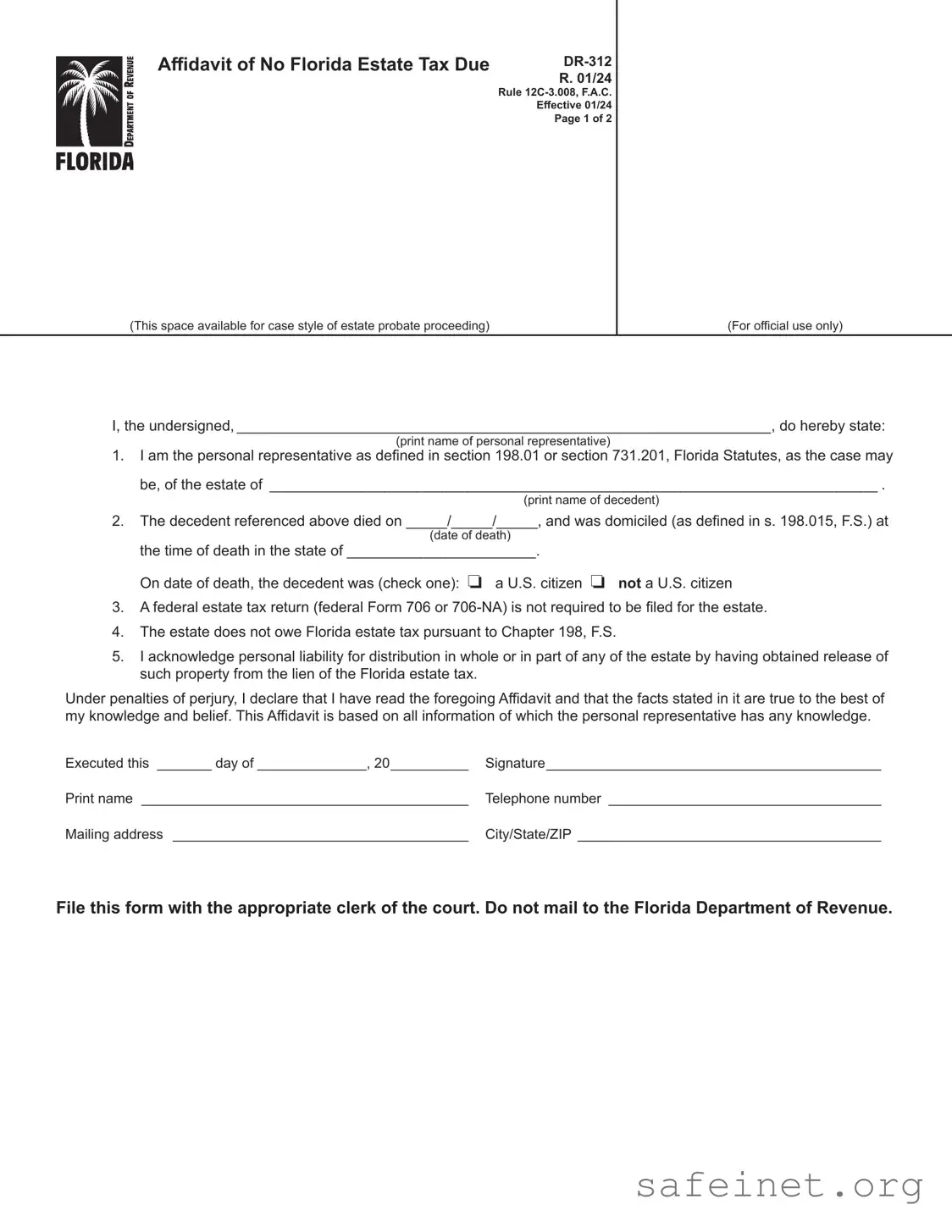
The Florida Form DR-312, also known as the Affidavit of No Florida Estate Tax Due, serves a crucial role in the estate administration process. This form is utilized by personal representatives of estates to affirm that no Florida estate tax is owed and that a federal estate tax return is not required. It is essential for individuals managing the estate of a decedent who was not subject to Florida estate tax under Chapter 198 of the Florida Statutes. The form requires the personal representative to provide specific details, including their name, the name of the decedent, and the decedent's date of death. By completing this affidavit, the personal representative acknowledges their liability for any distribution of the estate's assets and certifies the truthfulness of the information provided. Filing the DR-312 with the appropriate clerk of the court not only removes the Florida Department of Revenue's estate tax lien but also serves as evidence of nonliability for estate taxes. It is important to note that this form should not be submitted to the Florida Department of Revenue, and it is not applicable for estates that are required to file federal Form 706 or 706-NA. Understanding the proper use and filing requirements of the DR-312 is vital for ensuring compliance and facilitating a smoother estate administration process.


| Fact Name | Description |
|---|---|
| Form Title | Affidavit of No Florida Estate Tax Due (Form DR-312) |
| Governing Law | Chapter 198, Florida Statutes and Rule 12C-3.008, Florida Administrative Code |
| Filing Requirement | This form must be filed with the clerk of the circuit court where the decedent owned property. |
| Federal Estate Tax | A federal estate tax return (Form 706 or 706-NA) is not required for estates using this form. |
| Personal Liability | The personal representative acknowledges liability for any distributions made from the estate. |
| Effective Date | This version of the form is effective as of January 2021. |
Filling out the FL DR 312 form is an essential step in managing an estate when no Florida estate tax is due. Completing this form accurately ensures that the personal representative can proceed without the burden of estate tax liabilities. Follow these steps to fill out the form correctly.
After completing the form, it must be filed with the appropriate clerk of the court in the county where the decedent owned property. Remember, do not send this form to the Florida Department of Revenue. Make sure to keep a copy for your records.
What is the purpose of the FL DR 312 form?
The FL DR 312 form, officially known as the Affidavit of No Florida Estate Tax Due, is used to declare that an estate is not subject to Florida estate tax. This form is necessary when a federal estate tax return is not required, and it helps in removing any estate tax lien imposed by the Florida Department of Revenue.
Who is eligible to file the FL DR 312 form?
Only the personal representative of the estate, as defined in Florida Statutes, can file the FL DR 312 form. This includes individuals who are in actual or constructive possession of the decedent’s property. If you are managing the estate of someone who passed away and meet these criteria, you can complete and submit this form.
When should I use the FL DR 312 form?
You should use the FL DR 312 form when the estate does not owe Florida estate tax under Chapter 198 of the Florida Statutes and when a federal estate tax return (Form 706 or 706-NA) is not required. If the estate meets these conditions, this form is appropriate for filing.
Where do I file the FL DR 312 form?
The FL DR 312 form must be filed with the clerk of the circuit court in the county or counties where the decedent owned property. It is important to note that this form should not be sent to the Florida Department of Revenue.
What information do I need to complete the FL DR 312 form?
To complete the FL DR 312 form, you will need to provide the name of the personal representative, the name of the decedent, the date of death, the decedent's domicile at the time of death, and whether the decedent was a U.S. citizen. Additionally, you must affirm that no federal estate tax return is required and that no Florida estate tax is owed.
What happens if I file the FL DR 312 form incorrectly?
If the FL DR 312 form is filed incorrectly, it may lead to delays in the estate administration process. Moreover, if the estate is later found to owe taxes, the personal representative may face personal liability for any distributions made based on the affidavit. It is crucial to ensure all information is accurate before submission.
Can the FL DR 312 form be used for estates that require federal Form 706?
No, the FL DR 312 form cannot be used for estates that are required to file federal Form 706 or 706-NA. If an estate meets the thresholds for filing these federal forms, the FL DR 312 form is not applicable.
What is the significance of filing the FL DR 312 form?
Filing the FL DR 312 form is significant because it serves as evidence that the estate does not owe Florida estate tax. This filing removes any estate tax lien, allowing for the proper distribution of the estate’s assets without tax encumbrances.
How can I get assistance with the FL DR 312 form?
If you need assistance with the FL DR 312 form, you can contact the Florida Department of Revenue's Taxpayer Services at 850-488-6800. They are available Monday through Friday, excluding holidays. Additionally, you can find resources and tutorials on their website for further guidance.
Failing to provide accurate information about the decedent. It's essential to ensure that the name and date of death are correct. Any discrepancies can lead to delays or issues with the filing.
Not checking the appropriate box regarding the decedent's citizenship status. This is a crucial step that can affect the estate's tax obligations.
Neglecting to sign the form. Without a signature, the affidavit is not valid. Make sure to sign and date the form before submission.
Submitting the form to the wrong office. The DR-312 form must be filed with the clerk of the circuit court, not the Florida Department of Revenue. Sending it to the wrong place can cause unnecessary complications.
Overlooking the requirement for a federal estate tax return. If a federal Form 706 or 706-NA is required, the DR-312 cannot be used. Confirm the filing requirements before proceeding.
When navigating the complexities of estate management in Florida, several forms and documents are essential in conjunction with the Affidavit of No Florida Estate Tax Due (Form DR-312). Each of these documents serves a specific purpose, ensuring that the estate is handled according to legal requirements. Below is a brief overview of four key forms that are often utilized alongside the DR-312.
Understanding these documents can help simplify the estate management process. By ensuring that all necessary forms are filed correctly and timely, personal representatives can fulfill their duties with confidence, knowing they are adhering to legal requirements. If you have any questions about these forms or the estate management process, seeking professional guidance can provide clarity and peace of mind.
The Affidavit of No Florida Estate Tax Due, or Form DR-312, shares similarities with the Affidavit of Heirship. This document is often used to establish the heirs of a decedent's estate when no formal probate proceedings are initiated. Like the DR-312, the Affidavit of Heirship requires the personal representative to affirm the truthfulness of the information provided. Both documents serve to clarify the status of the estate and can be used to facilitate the transfer of property without the need for court intervention. They help provide a clear record of the decedent's wishes and the rightful heirs, simplifying the process for all parties involved.
Another document akin to the DR-312 is the Estate Tax Return (Form 706). While the DR-312 is used to affirm that no estate tax is due, Form 706 is required when an estate exceeds certain financial thresholds and is subject to federal estate taxes. Both forms require detailed information about the decedent, including their date of death and financial status. However, while the DR-312 aims to release the estate from tax liability, Form 706 serves to report and calculate the taxes owed. Both documents are crucial in determining the financial responsibilities of an estate, although they address different scenarios.
The Small Estate Affidavit is another document that has a similar purpose to the DR-312. This affidavit is used in situations where the total value of the estate is below a certain threshold, allowing heirs to claim assets without formal probate. Like the DR-312, the Small Estate Affidavit simplifies the transfer process and requires the personal representative to declare the truth of the information provided. Both documents help streamline the administration of estates, particularly when tax liabilities are not a concern, making it easier for heirs to access their inheritance.
Lastly, the Waiver of Process and Consent to Appointment of Personal Representative shares similarities with the DR-312. This document is often used in probate cases when beneficiaries agree to waive formal notice of proceedings and consent to the appointment of a personal representative. Both documents promote efficiency in estate administration by reducing the need for formal court processes. They also require the signatories to acknowledge their understanding of the estate’s status, whether it involves tax liabilities or the appointment of representatives. In this way, both forms facilitate smoother transitions for estate management.
When filling out the FL DR-312 form, it's important to keep a few key things in mind. Below is a list of dos and don'ts to help you navigate the process smoothly.
There are several misconceptions about the Florida Form DR-312, also known as the Affidavit of No Florida Estate Tax Due. Understanding these can help avoid confusion during the estate administration process.
This is not true. Form DR-312 can be used for estates of any size, as long as they do not owe Florida estate tax and do not require a federal estate tax return.
Many people mistakenly believe that the form should be sent to the Florida Department of Revenue. In reality, it must be filed directly with the clerk of the circuit court where the decedent owned property.
Filing Form DR-312 indicates that no Florida estate tax is due. However, it does not exempt the estate from other potential taxes or obligations that may arise.
This is incorrect. Form DR-312 is only applicable when a federal estate tax return is not required. If the estate meets the federal thresholds for filing, this form cannot be used.
Here are some key takeaways about filling out and using the Florida Form DR-312: