Homepage > Blank Fl 300 Template
Article Structure

The FL-300 form is a crucial document used in family law proceedings in California, specifically designed for individuals seeking a court order related to child custody, support, or other family matters. This form allows a petitioner to formally request modifications to existing court orders or to initiate new requests, such as child custody arrangements, visitation schedules, spousal support, or even domestic violence restraining orders. It requires detailed information about the parties involved, including their names, addresses, and the specific orders being requested. Notably, the FL-300 also includes sections for notifying the other party of the hearing date and provides warnings about the consequences of failing to respond. Additionally, it outlines the necessary documentation that must accompany the request, such as income declarations and supporting declarations for attorney fees. By completing this form accurately and submitting it on time, individuals can ensure their voices are heard in court, allowing for fair consideration of their requests regarding family law issues.
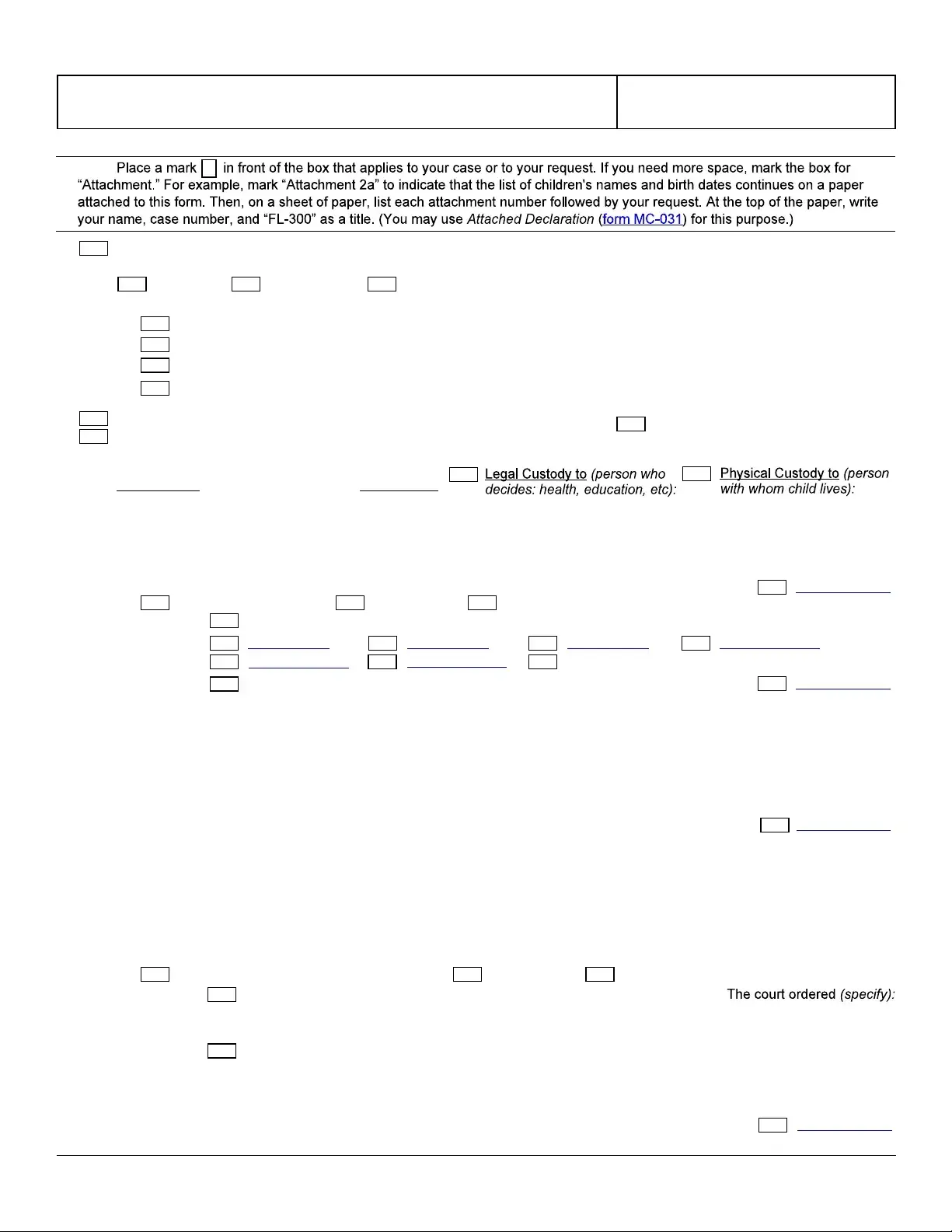
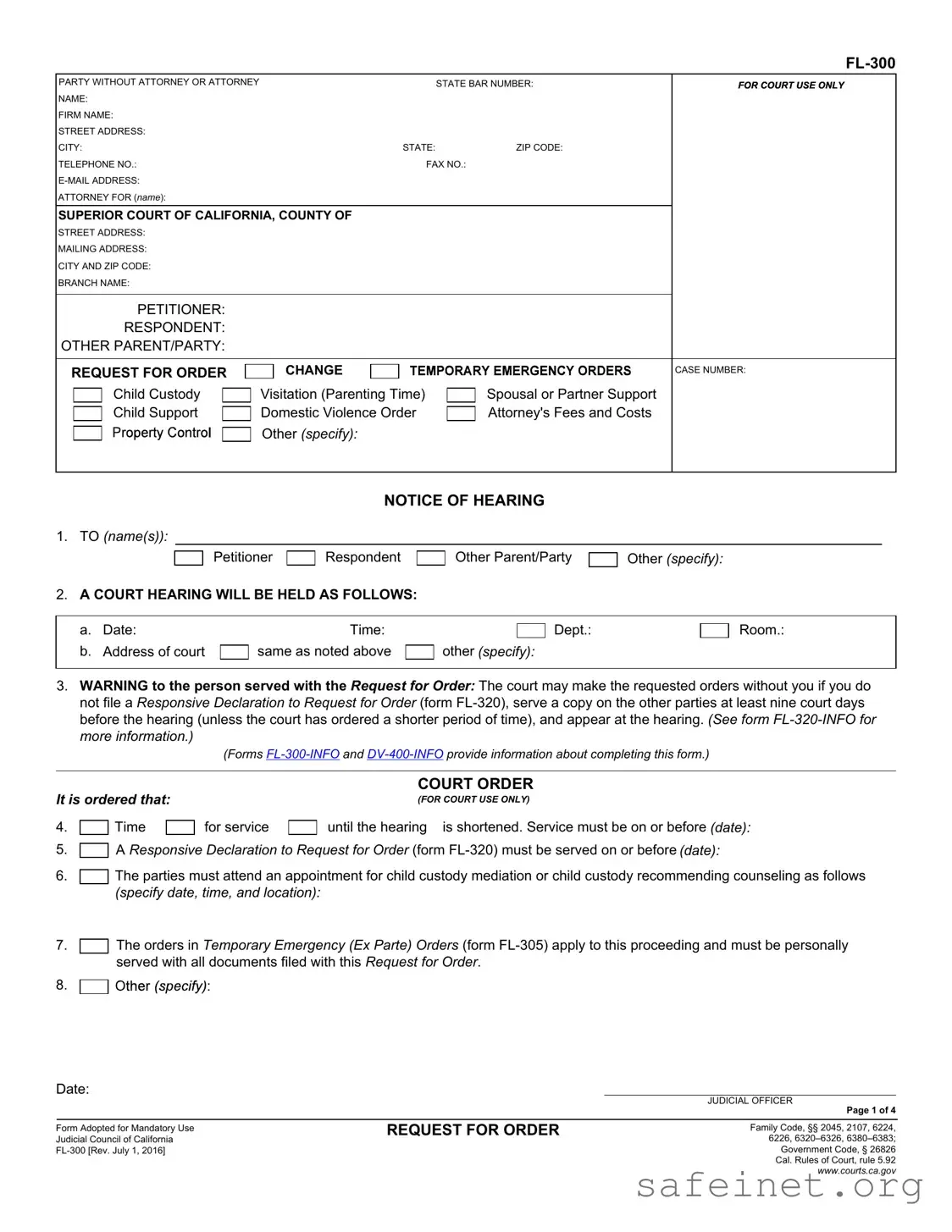
Form Sample

WARNING to the person served with the Request for Order: The court may make the requested orders without you if you do
not file a Responsive Declaration to Request for Order (form FL-320), serve a copy on the other parties at least nine court days
before the hearing (unless the court has ordered a shorter period of time), and appear at the hearing. (See form FL-320-INFO for
more information.)
Form Adopted for Mandatory Use
Judicial Council of California
FL-300 [Rev. July 1, 2016]
7.
JUDICIAL OFFICER
COURT ORDER
(FOR COURT USE ONLY)
6.
A COURT HEARING WILL BE HELD AS FOLLOWS:
Time:Date:
Address of court (specify):
Page 1 of 4
REQUEST FOR ORDER
Family Code, §§ 2045, 2107, 6224,
6226, 6320–6326, 6380–6383;
Government Code, § 26826
Cal. Rules of Court, rule 5.92
www.courts.ca.gov
8.
2.
(date):
(date):
REQUEST FOR ORDER
CHANGE
Domestic Violence OrderChild Support
Child Custody
Attorney's Fees and Costs
Visitation (Parenting Time) Spousal or Partner Support
Other (specify):
FOR COURT USE ONLYFOR COURT USE ONLY
TELEPHONE NO.:
E-MAIL ADDRESS:
ATTORNEY FOR (name):
FAX NO.:
STATE: ZIP CODE:CITY:
STREET ADDRESS:
FIRM NAME:
NAME:
STATE BAR NUMBER:
SUPERIOR COURT OF CALIFORNIA, COUNTY OF
BRANCH NAME:
CITY AND ZIP CODE:
STREET ADDRESS:
MAILING ADDRESS:
PETITIONER:
RESPONDENT:
OTHER PARENT/PARTY:
CASE NUMBER:
FL-300
1.
a.
b. same as noted above
Dept.: Room.:
other
4.
A Responsive Declaration to Request for Order (form FL-320) must be served on or before
Time for service until the hearing is shortened. Service must be on or before
The parties must attend an appointment for child custody mediation or child custody recommending counseling as follows
(specify date, time, and location):
Date:
It is ordered that:
The orders in Temporary Emergency (Ex Parte) Orders (form FL-305) apply to this proceeding and must be personally
served with all documents filed with this Request for Order.
(Forms FL-300-INFO and DV-400-INFO provide information about completing this form.)
NOTICE OF HEARING
3.
5.
Other Parent/PartyRespondentPetitioner
TO (name(s)):
PARTY WITHOUT ATTORNEY OR ATTORNEY
Other (specify):
The visitation (parenting time) order was filed on
The order for legal or physical custody was filed on
(date):
(2)
.
. The court ordered (specify):
(1)
(date):
Attachment 2d.
visitation (parenting time).child custodyThis is a change from the current order for
The orders that I request are in the best interest of the children because (specify):
Attachment 2a.
a.
Form FL-311 Form FL-312
Form FL-341(D)
Form FL-341(C)
Form FL-341(E)
Form FL-305
(specify):
Other
(2)
As follows (specify):
Specified in the attached forms:
(1)
Attachment 2b.
visitation (parenting time) are:child custodyThe orders I request forb.
Child's Name Date of Birth
I request that the court make orders about the following children (specify):
c. Attachment 2c.
d.
REQUEST FOR ORDER
FL-300
Page 2 of 4
FL-300 [Rev. July 1, 2016]
REQUEST FOR ORDER
CASE NUMBER:
PETITIONER:
RESPONDENT:
OTHER PARENT/PARTY:
2.
CHILD CUSTODY
VISITATION (PARENTING TIME)
I request temporary emergency orders
The orders are from the following court or courts (specify county and state):
(specify):
(specify):
(specify):
(specify):
Case No. (if known):
Petitioner
Respondent Other Parent/Party (Attach a copy of the orders if you have one.)
a.
b.
c.
d.
Criminal: County/state
Family: County/state
Juvenile: County/state
Other: County/state
One or more domestic violence restraining/protective orders are now in effect between (specify):
1.
Note:
X
RESTRAINING ORDER INFORMATION
FL-300 [Rev. July 1, 2016]
Page 3 of 4
REQUEST FOR ORDER
4.
a. $
Amount requested (monthly):
The court should should make, change, or end the support orders because (specify):
I have completed and filed a current Income and Expense Declaration (
form FL-150) in support of my request.d.
e.
(date):
end the current support order filed onchangeb.
I want the court to
Attachment 4e.
The court ordered $
c.
This request is to modify (change) spousal or partner support after entry of a judgment.
I have completed and attached Spousal or Partner Support Declaration Attachment (form FL-157) or a declaration
that addresses the same factors covered in form FL-157.
(Note: An Earnings Assignment Order For Spousal or Partner Support (
form FL-435) may be issued.)
per month for support.
I have completed and filed with this Request for Order a current Income and Expense Declaration (
form FL-150) or I filed
a current Financial Statement (Simplified) (form FL-155) because I meet the requirements to file form FL-155.
c.
(date):
b.
d. The court should make or change the support orders because (specify):
Attachment 3d.
The court ordered child support as follows (specify):
Monthly amount ($) requested
(if not by guideline)
Child's name and age
a.
I request support for each child
based on the child support guideline.
Attachment 3a.
I request that the court order child support as follows:
(Note: An earnings assignment may be issued. See Income Withholding for Support (form FL-195)
FL-300
SPOUSAL OR DOMESTIC PARTNER SUPPORT
3.
CHILD SUPPORT
a.
control of the following property that we
The petitioner respondent other parent/party be given exclusive temporary use, possession, and
b.
and liens coming due while the order is in effect:
The petitioner respondent other parent/party be ordered to make the following payments on debts
own or are buying lease or rent (specify):
c. This is a change from the current order for property control filed on (date):
Specify in Attachment 5d the reasons why the court should make or change the property control orders. d.
For:Pay to: Amount: $ Due date:
Pay to: For: Amount: $ Due date:
5. PROPERTY CONTROL
I request temporary emergency orders
CASE NUMBER:
PETITIONER:
RESPONDENT:
OTHER PARENT/PARTY:
I want the court to change or end the orders because (specify):
The Restraining Order After Hearing (form DV-130) was filed on (date):
a.
endchange
I request that the court the personal conduct, stay-away, move-out orders, or other
protective orders made in Restraining Order After Hearing (form DV-130). (If you want to change the orders, complete 7c.)
b.
Attachment 7c.
I request that the court make the following changes to the restraining orders (specify):
c.
Attachment 7d.
d.
10.
I declare under penalty of perjury under the laws of the State of California that the information provided in this form and all attachments
is true and correct.
Page 4 of 4
FL-300 [Rev. July 1, 2016]
REQUEST FOR ORDER
Requests for Accommodations
Assistive listening systems, computer-assisted real-time captioning, or sign language interpreter services are available if
you ask at least five days before the proceeding. Contact the clerk's office or go to www.courts.ca.gov/forms for Request
for Accommodations by Persons With Disabilities and Response (
form MC-410). (Civ. Code, § 54.8.)
FACTS TO SUPPORT the orders I request are listed below. The facts that I write in support and attach to this request
cannot be longer than 10 pages, unless the court gives me permission.
The hearing date and service of the the Request for Order to be sooner.
I need the order because (specify):
b.
(number): court days before the hearing.To serve the Request for Order no less than
a.
c.
Attachment 9c.
Date:
(TYPE OR PRINT NAME)
(SIGNATURE OF APPLICANT)
OTHER ORDERS REQUESTED (specify):
8.
FL-300
7.
DOMESTIC VIOLENCE ORDER
Attachment 8.
6.
A current Income and Expense Declaration (form FL-150).
b.
A Supporting Declaration for Attorney's Fees and Costs Attachment (
form FL-158) or a declaration that addresses the
factors covered in that form.
c.
A Request for Attorney's Fees and Costs Attachment (
form FL-319) or a declaration that addresses the factors covered
in that form.
a.
I request attorney's fees and costs, which total (specify amount): $ . I filed the following to support my request:
ATTORNEY'S FEES AND COSTS
Do not use this form to ask for domestic violence restraining orders! Read form DV-505-INFO, How Do I Ask for a
Temporary Restraining Order, for forms and information you need to ask for domestic violence restraining orders.
Read
form DV-400-INFO, How to Change or End a Domestic Violence Restraining Order for more information.
TIME FOR SERVICE / TIME UNTIL HEARING
9.
I urgently need:
Attachment 10.
CASE NUMBER:
PETITIONER:
RESPONDENT:
OTHER PARENT/PARTY:

Document Specifications

Fact Name Description
Form Purpose The FL-300 form is used to request a court order regarding various family law matters, including child custody, child support, and spousal support.
Governing Laws This form is governed by specific sections of the Family Code, including §§ 2045, 2107, 6224, and others, as well as the California Rules of Court, rule 5.92.
Filing Requirements To successfully file the FL-300, individuals must serve a Responsive Declaration (form FL-320) on other parties at least nine court days before the scheduled hearing.
Hearing Notification The form includes a section for notifying involved parties about the court hearing date, time, and location, ensuring everyone is informed.
Domestic Violence Orders It is important to note that this form should not be used to request domestic violence restraining orders; separate procedures exist for that purpose.
Attachments Required When submitting the FL-300, various attachments may be required, such as the Income and Expense Declaration (form FL-150) or other relevant documentation to support the requests made.

Steps to Filling Out Fl 300

Filling out the FL-300 form is an important step in your legal process. Once you complete this form, it will be submitted to the court, and a hearing will be scheduled. The following steps will guide you through the process of filling out the form accurately and effectively.

  1. Gather Your Information: Collect all necessary information, including your name, address, and details about the other parties involved.
  2. Complete the Header: Fill in the section at the top of the form with your name, address, and contact information. If you have an attorney, include their details as well.
  3. Identify the Court: Write the name and address of the court where you are submitting the form.
  4. Fill in the Case Information: Provide the case number, and specify whether you are the petitioner or respondent.
  5. Request for Order: Clearly indicate what you are requesting (e.g., child custody, support, etc.) by checking the appropriate boxes.
  6. Notice of Hearing: Specify the name(s) of the parties involved and provide the date, time, and location of the court hearing.
  7. Provide Additional Information: If applicable, fill out sections regarding restraining orders, child custody, child support, and any other relevant details.
  8. Attach Supporting Documents: If you are referencing other forms or documents, make sure to attach them as needed.
  9. Sign and Date: At the bottom of the form, sign and date it to certify that the information is true and correct.
  10. Make Copies: Before submitting, make copies of the completed form and any attachments for your records.

After you’ve filled out the FL-300 form, you will need to file it with the court and serve copies to the other parties involved. Be mindful of the deadlines for service and ensure that you follow up with any required documentation or responses as needed.

More About Fl 300

What is the FL-300 form used for?

The FL-300 form, also known as the Request for Order, is a legal document used in California family law cases. It allows a party to request specific court orders regarding child custody, visitation, spousal support, child support, and other related matters. This form is essential for individuals seeking to modify existing orders or establish new ones in family law proceedings.

Who needs to fill out the FL-300 form?

The FL-300 form must be completed by individuals involved in family law cases, such as parents seeking custody or support modifications. It can be filled out by either party in the case, whether they have legal representation or are representing themselves. If you are looking to make a request related to child custody, support, or other family law issues, this form is likely necessary.

How do I submit the FL-300 form?

To submit the FL-300 form, you must first complete it accurately, ensuring that all required information is provided. After filling it out, you will need to file it with the appropriate Superior Court in California. Make sure to check the local court rules for specific filing procedures, including any necessary fees. After filing, you must serve a copy of the form to the other parties involved in the case, typically at least nine court days before the scheduled hearing.

What happens if I do not respond to a FL-300 request?

If you receive a FL-300 request and fail to respond, the court may proceed to make orders without your input. It’s crucial to file a Responsive Declaration (using form FL-320) and serve it on the other parties before the hearing date. This response gives you the opportunity to present your side of the case and contest any requests made by the other party.

Can I request an expedited hearing using the FL-300 form?

Yes, the FL-300 form allows you to request an expedited hearing if you have urgent matters that need immediate attention. In the form, you can specify the reasons for the urgency and request that the hearing date be moved up. However, you must provide sufficient justification for this request, and it is subject to the court's approval.

Common mistakes

  1. Incorrect Case Number: One of the most common mistakes is failing to enter the correct case number. Ensure that you double-check this number, as it helps the court identify your case quickly.

  2. Missing Signatures: Many individuals forget to sign the form. Without a signature, the court may reject the submission. Always remember to sign and date the form before filing.

  3. Incomplete Information: Leaving sections blank can lead to delays. Fill in all required fields, including names, addresses, and contact information. The more complete your form, the smoother the process will be.

  4. Failure to Attach Required Documents: If you are required to submit additional documents, such as income declarations or previous court orders, be sure to include them. Missing attachments can result in your request being delayed or denied.

  5. Incorrect Dates: Entering the wrong dates, especially for the hearing or deadlines, can cause significant issues. Carefully review all date fields to ensure accuracy.

  6. Not Following Service Requirements: It’s crucial to understand and follow the service requirements outlined in the form. Failing to serve the other party correctly can jeopardize your request.

  7. Ignoring the Instructions: Each form comes with specific instructions. Ignoring these can lead to mistakes. Take the time to read the instructions thoroughly before filling out the form.

Documents used along the form

The FL-300 form is a Request for Order used in family law cases in California. It is often accompanied by several other forms and documents that help provide additional information or support for the request being made. Below is a list of commonly used forms that are frequently filed alongside the FL-300.

  • FL-320 - This is the Responsive Declaration to Request for Order. It allows the other party to respond to the requests made in the FL-300. It is essential for ensuring both parties have a chance to present their side before the court hearing.
  • FL-150 - The Income and Expense Declaration provides a detailed account of a party's income, expenses, and financial situation. This form is crucial for matters involving child support or spousal support.
  • FL-155 - The Financial Statement (Simplified) is a shorter version of the Income and Expense Declaration. It is used when a party meets specific criteria and is seeking a more straightforward process.
  • FL-305 - The Temporary Emergency (Ex Parte) Orders form is used to request urgent orders from the court before a full hearing can take place. It addresses immediate needs like child custody or support.
  • FL-319 - This is the Request for Attorney's Fees and Costs Attachment. It supports a request for attorney's fees and outlines the reasons for the request.
  • FL-158 - The Supporting Declaration for Attorney's Fees and Costs Attachment provides additional details to support the request for attorney's fees, addressing specific factors considered by the court.
  • FL-341 - The various attachments (FL-341(C), FL-341(D), FL-341(E)) are used to specify child custody and visitation arrangements, providing detailed information about the proposed orders.
  • DV-130 - The Restraining Order After Hearing form is used if there are existing domestic violence restraining orders. It can be referenced when requesting changes to those orders.
  • MC-410 - This form is for Request for Accommodations by Persons With Disabilities. It ensures that individuals with disabilities can access court services and proceedings.

Each of these forms serves a specific purpose in the family law process. They help ensure that all relevant information is presented to the court, allowing for informed decisions regarding custody, support, and other important matters. If you are preparing to file the FL-300, consider which of these additional documents may be necessary for your case.

Similar forms

The FL-300 form, used in California family law cases, is similar to the FL-320 form, known as the Responsive Declaration to Request for Order. Both documents are essential in family law proceedings, particularly when one party is requesting changes to existing court orders. The FL-320 allows the responding party to present their side of the case, detailing any objections or modifications they wish to propose. Just like the FL-300, the FL-320 requires specific information about the parties involved and the nature of the request, ensuring that both parties have the opportunity to be heard before the court makes a decision.

Another document that shares similarities with the FL-300 is the FL-305 form, which is used for Temporary Emergency (Ex Parte) Orders. This form is crucial when immediate action is needed, such as in cases involving domestic violence or urgent child custody matters. While the FL-300 requests a formal hearing to modify orders, the FL-305 allows a party to seek immediate relief without the standard notice period. Both forms require detailed information about the circumstances necessitating the request, emphasizing the urgency and importance of the situation at hand.

The FL-150, known as the Income and Expense Declaration, is another related document. This form provides a comprehensive overview of an individual's financial situation, which is often necessary for requests involving child support or spousal support. Similar to the FL-300, the FL-150 must be filed with the court and served to the other party. Both forms aim to ensure that the court has all relevant information to make informed decisions regarding financial obligations and changes to existing support orders.

Lastly, the FL-319 form, which is the Request for Attorney's Fees and Costs Attachment, is also comparable to the FL-300. This document is used when a party seeks to recover attorney's fees and costs incurred during the legal process. Like the FL-300, the FL-319 requires the submission of supporting documentation and a clear explanation of the request. Both forms help the court assess the financial implications of the case and ensure that parties are held accountable for their legal expenses while navigating family law matters.

Dos and Don'ts

When filling out the FL-300 form, consider the following guidelines:

  • Ensure all personal information, including names and contact details, is accurate and complete.
  • Clearly specify the type of orders you are requesting, such as child custody or support.
  • Attach all necessary supporting documents, including previous orders and financial declarations.
  • Double-check the deadlines for filing and serving the form to avoid delays in your case.
  • Maintain a professional tone throughout the form, focusing on facts and clarity.

However, avoid these common mistakes:

  • Do not leave any sections blank; incomplete forms may be rejected.
  • Avoid using legal jargon or overly complex language; keep it straightforward.
  • Do not forget to sign and date the form before submission.
  • Refrain from making emotional statements; focus on the facts of the case.
  • Do not ignore the specific instructions for each section of the form.

Misconceptions

Misconceptions about the FL-300 Form

  • Misconception 1: The FL-300 form is only for divorce cases.
  • This form is applicable in various family law matters, including child custody, child support, and spousal support. It is not limited to divorce situations.

  • Misconception 2: You need an attorney to file the FL-300 form.
  • While having legal representation can be beneficial, individuals can file the FL-300 form on their own. The form is designed for use by both parties, whether represented or not.

  • Misconception 3: The FL-300 form guarantees a court hearing.
  • Filing the FL-300 does not automatically secure a hearing. The court must schedule the hearing after reviewing the request.

  • Misconception 4: You can request any type of order on the FL-300 form.
  • The form is specific to certain requests, such as child custody or support. It does not cover all family law issues, like domestic violence restraining orders.

  • Misconception 5: You can submit the FL-300 form without supporting documents.
  • Supporting documents are often required to substantiate your requests. For example, an Income and Expense Declaration may be necessary for support requests.

Key takeaways

When filling out and using the FL-300 form, keep these key takeaways in mind:

  • Complete All Required Sections: Ensure that all sections of the form are filled out accurately. Missing information can delay your request.
  • File on Time: Submit the form and serve it to the other parties at least nine court days before the hearing. This is crucial for the court to consider your request.
  • Attach Necessary Documents: Include any supporting documents, such as the Income and Expense Declaration (form FL-150) or any previous court orders relevant to your case.
  • Understand the Warning: Be aware that if you do not file a Responsive Declaration (form FL-320) and appear at the hearing, the court may grant the requested orders without your input.