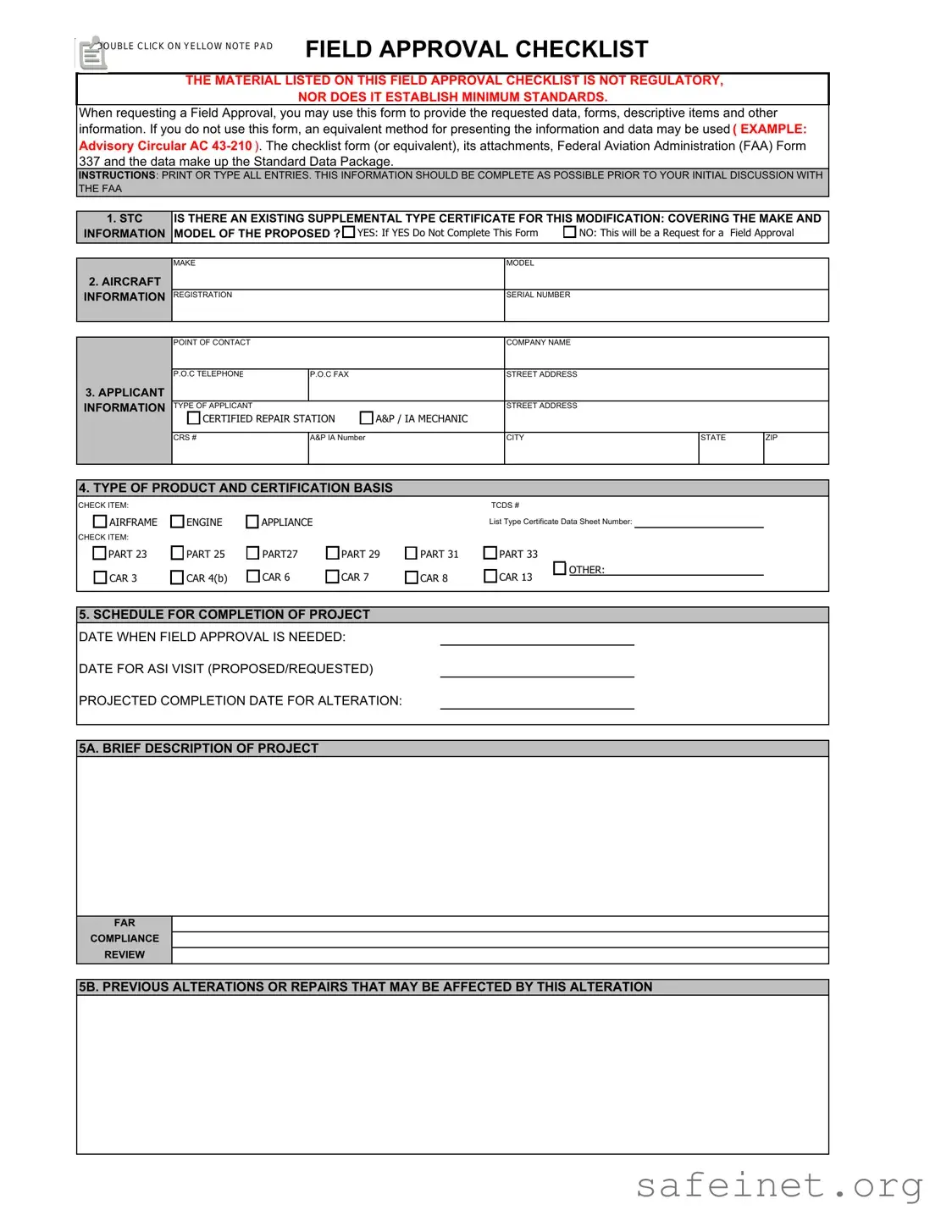
The Field Approval Checklist form serves as a crucial tool for aviation professionals seeking to modify aircraft in compliance with Federal Aviation Administration (FAA) regulations. This form is not merely a bureaucratic requirement; it plays an essential role in ensuring that all necessary information is presented clearly and comprehensively. Users must provide critical data such as the model and serial number of the aircraft, details about existing supplemental type certificates, and the applicant's information, including their contact details. The checklist also prompts users to specify the type of product being modified, the certification basis, and any previous alterations that may impact the proposed changes. Additionally, it includes sections for scheduling project timelines, evaluating the need for an Aircraft Flight Manual Supplement (AFMS), and attaching supporting documentation. By meticulously completing this form, applicants can facilitate a smoother review process with the FAA, ensuring that all alterations meet the necessary safety and compliance standards. Ultimately, the Field Approval Checklist is designed to streamline the approval process while safeguarding the airworthiness of modified aircraft.

| Fact Name | Description |
|---|---|
| Purpose | The Field Approval Checklist form is used to request approval for modifications to aircraft. |
| Regulatory Status | The materials listed on the checklist are not regulatory and do not establish minimum standards. |
| Standard Data Package | The checklist, FAA Form 337, and any attachments form the Standard Data Package. |
| Initial Discussion | Complete the form as much as possible before your first discussion with the FAA. |
| STC Inquiry | Check if there is an existing Supplemental Type Certificate (STC) for the proposed modification. |
| Applicant Information | Provide details about the applicant, including contact information and type of applicant. |
| Project Schedule | Indicate the date when the field approval is needed and the projected completion date for the alteration. |
| AFMS Requirement | Determine if the alteration requires an Aircraft Flight Manual Supplement (AFMS). |
| Data Attachment | Check all applicable data types that are attached, including FAA Form 337 and supporting documents. |
| Damage Tolerance Evaluation | Assess if damage tolerance and fatigue evaluations apply to the proposed alteration or repair. |
Filling out the Field Approval Checklist form is an important step in the process of requesting a field approval. Completing this form accurately will help ensure that your submission is clear and comprehensive. After you fill out the form, you will submit it along with any necessary attachments to the appropriate FAA office for review.
What is the purpose of the Field Approval Checklist form?
The Field Approval Checklist form serves as a tool for individuals and organizations seeking a field approval from the Federal Aviation Administration (FAA). It allows applicants to present necessary data, forms, and other relevant information regarding modifications to aircraft. By using this checklist, you can ensure that all required details are organized and submitted for review, which can facilitate a smoother approval process.
Who should complete the Field Approval Checklist form?
This form should be completed by the applicant or their representative, who may be an A&P mechanic, a certified repair station, or a designated engineering representative. It is essential that the information provided is accurate and comprehensive, as it will be used by the FAA to assess the request for field approval. Proper completion of the form is crucial before engaging in discussions with FAA personnel.
What information is required in the Field Approval Checklist?
The checklist requires various pieces of information, including aircraft details, applicant information, project descriptions, and any previous alterations that may impact the current request. You will also need to provide data about the type of product, certification basis, and any designated representatives involved in the project. Additionally, you must indicate whether an Aircraft Flight Manual Supplement (AFMS) is needed and attach any relevant documents that support your request.
What happens if I do not use the Field Approval Checklist form?
If you choose not to use the Field Approval Checklist form, you may still submit your request for field approval using an equivalent method. An example of an acceptable alternative is Advisory Circular AC 43-210. However, it is important to ensure that all necessary information is still clearly presented to avoid delays in the approval process.
Are there any specific deadlines associated with the Field Approval process?
Yes, the checklist includes a section where you must indicate the date when the field approval is needed, as well as the proposed date for the FAA inspector's visit. It is crucial to provide realistic timelines to ensure that the FAA can accommodate your request. Planning ahead can help avoid last-minute complications and ensure that your project stays on schedule.
What should I do if additional information is required after submitting the checklist?
If the FAA determines that additional information is needed after your submission, they will communicate this to you. It is important to respond promptly and provide any requested documentation or clarification. Maintaining open lines of communication with the FAA will help facilitate the approval process and ensure that your project proceeds smoothly.
Incomplete Information: Failing to provide all required details in the checklist can lead to delays. Ensure that every section is filled out completely before submission.
Incorrect Model or Serial Number: Listing the wrong model or serial number can cause confusion and may result in the rejection of the request. Double-check these entries for accuracy.
Not Indicating Existing STC: If there is an existing Supplemental Type Certificate (STC) for the modification, it is crucial to indicate this. Omitting this information can complicate the approval process.
Missing Contact Information: Applicants often forget to include complete contact details for the point of contact. This can hinder communication with the FAA.
Improperly Documented Previous Alterations: Failing to list previous alterations or repairs that may be affected by the current modification can lead to oversight during the review.
Neglecting the AFMS Requirement: Not indicating whether an Aircraft Flight Manual Supplement (AFMS) is needed can result in additional requests for information later in the process.
Omitting Supporting Data: Not attaching necessary supporting data, such as FAA Form 337 or engineering drawings, can lead to delays. Ensure all required documents are included.
Failure to Review Damage Tolerance: Ignoring the requirement to evaluate damage tolerance and fatigue for the proposed alteration can result in significant issues. Be sure to check this carefully.
The Field Approval Checklist form is a crucial document used in the process of obtaining field approval for modifications to aircraft. However, it is often accompanied by other important forms and documents that help to provide a complete picture of the proposed alterations. Below is a list of five additional forms and documents that are commonly used in conjunction with the Field Approval Checklist.
Using these forms and documents in conjunction with the Field Approval Checklist will help ensure a thorough and compliant submission to the FAA. Each document plays a vital role in the approval process, contributing to the overall safety and airworthiness of the aircraft.
The Field Approval Checklist form shares similarities with the FAA Form 337, which is used to document major repairs and alterations. Both forms require detailed information about the aircraft, the nature of the modification, and the applicant's details. They are crucial for ensuring that any changes made to the aircraft comply with FAA regulations. The checklist serves as a guide to gather the necessary data that will ultimately be submitted on Form 337, making it easier for applicants to present their case for approval.
Another document that is similar to the Field Approval Checklist is the Supplemental Type Certificate (STC). An STC is issued when a modification has been approved by the FAA, confirming that the alteration meets safety and performance standards. Like the checklist, the STC process requires comprehensive documentation about the aircraft and the proposed changes. Both documents aim to ensure that modifications are safe and compliant with aviation regulations.
The Advisory Circular AC 43-210 also parallels the Field Approval Checklist. This circular provides guidance on the process for obtaining field approvals and outlines the necessary data that must be submitted. Just as the checklist outlines what information is needed for a field approval request, AC 43-210 serves as a resource for understanding the steps and requirements involved in the process.
The Type Certificate Data Sheet (TCDS) is another document that shares a connection with the Field Approval Checklist. The TCDS provides essential information about the aircraft's design, including its specifications and limitations. When completing the checklist, applicants may refer to the TCDS to ensure that their proposed modifications align with the aircraft's approved design, thus maintaining safety and compliance.
The Instructions for Continued Airworthiness (ICA) document is also relevant. This document outlines maintenance and operational procedures necessary to keep the aircraft safe after modifications are made. Similar to the checklist, the ICA requires careful consideration of how changes affect the aircraft's airworthiness. Both documents ensure that safety standards are upheld throughout the life of the aircraft.
The FAA Form 8110-3, which is used for approving major repairs and alterations, is another document that aligns with the Field Approval Checklist. This form is often used in conjunction with the checklist to provide the FAA with the necessary data for evaluating the proposed modification. Both documents emphasize the importance of thorough documentation and review to ensure compliance with regulatory standards.
Lastly, the Aircraft Flight Manual Supplement (AFMS) is similar in that it provides critical information about how modifications affect the aircraft's operation. When a modification is made, an AFMS may be required to update the operating procedures and limitations. The checklist prompts applicants to consider whether an AFMS is necessary, ensuring that all aspects of the modification are addressed for safe operation.
When filling out the Field Approval Checklist form, it’s important to keep certain best practices in mind. Here’s a helpful list of what you should and shouldn’t do:
Understanding the Field Approval Checklist form is essential for anyone involved in aircraft modifications. However, several misconceptions can lead to confusion. Here are five common misconceptions:
By clarifying these misconceptions, individuals can better navigate the process of seeking field approvals and ensure compliance with aviation regulations.
When filling out and using the Field Approval Checklist form, keep these key takeaways in mind:
By following these guidelines, you can streamline the process and enhance the chances of a successful Field Approval request.