Homepage > Blank Fee Worksheet Template
Article Structure

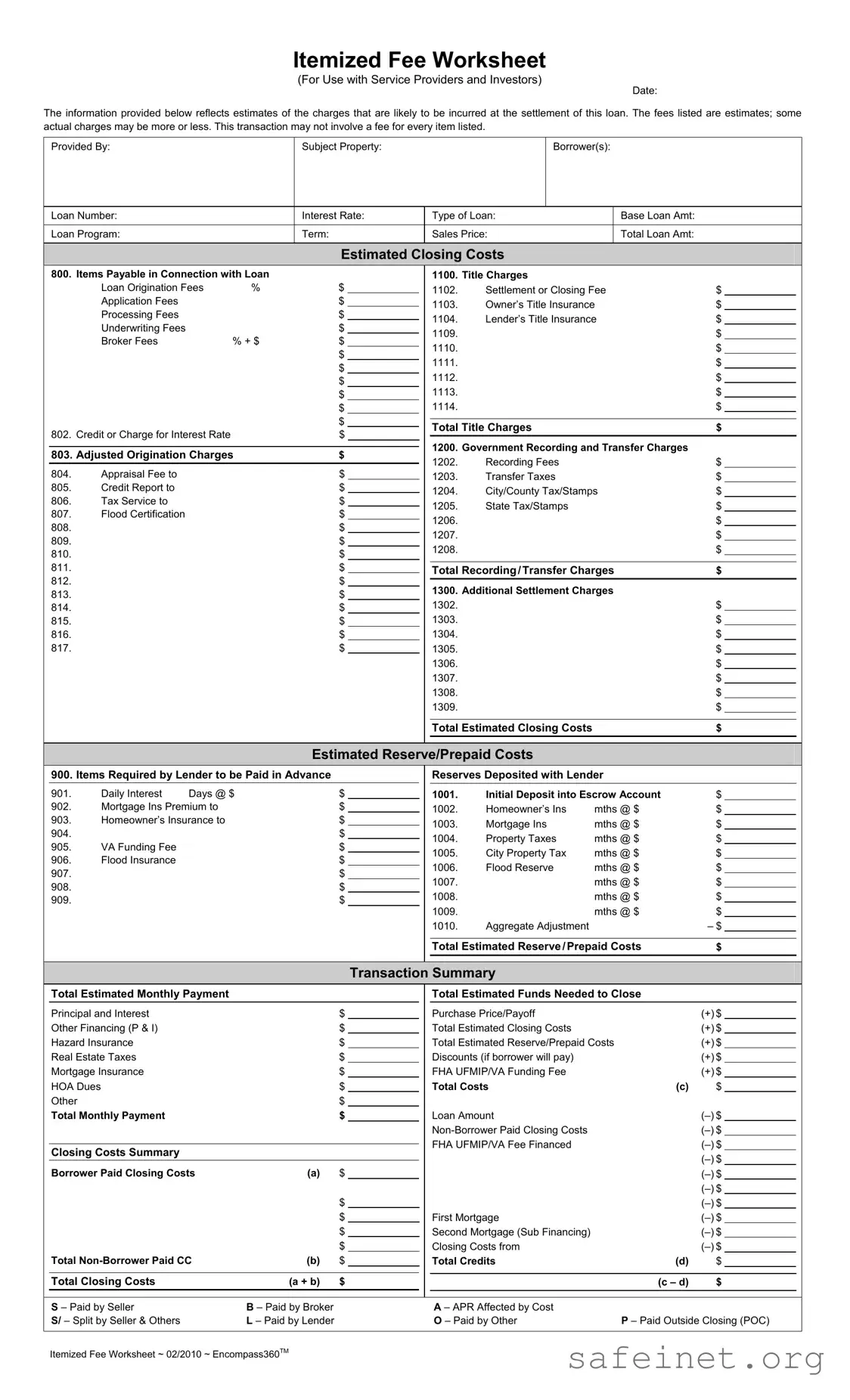
The Fee Worksheet form serves as a crucial tool in the real estate transaction process, providing a detailed breakdown of anticipated costs associated with a loan settlement. This document is designed for use by service providers and investors, allowing them to estimate various charges that may arise during the closing of a loan. It includes sections for essential information such as the date of the transaction, subject property, borrower details, loan number, interest rate, and type of loan. The form categorizes fees into several groups, including title charges, government recording and transfer charges, and additional settlement charges. Each category lists individual fees, such as loan origination fees, title insurance, appraisal fees, and more, providing transparency regarding the costs involved. Moreover, the Fee Worksheet outlines estimated closing costs and reserves required by the lender, which may include prepaid items like homeowner's insurance and property taxes. By summarizing these costs, the form helps borrowers understand their financial obligations, ensuring they are well-informed before proceeding with the transaction.
Form Sample

Itemized Fee Worksheet ~ 02/2010 ~ Encompass360
TM
Itemized Fee Worksheet
(For Use with Service Providers and Investors)
Date:
The information provided below reflects estimates of the charges that are likely to be incurred at the settlement of this loan. The fees listed are estimates; some
actual charges may be more or less. This transaction may not involve a fee for every item listed.
Provided By: Subject Property: Borrower(s):
Loan Number: Interest Rate: Type of Loan: Base Loan Amt:
Loan Program: Term: Sales Price: Total Loan Amt:
Estimated Closing Costs
800. Items Payable in Connection with Loan
Loan Origination Fees % $
Application Fees $
Processing Fees $
Underwriting Fees $
Broker Fees % + $ $
$
$
$
$
$
$
802. Credit or Charge for Interest Rate $
803. Adjusted Origination Charges
$
804. Appraisal Fee to $
805. Credit Report to $
806. Tax Service to $
807. Flood Certification $
808. $
809. $
810. $
811. $
812. $
813. $
814. $
815. $
816. $
817. $
1100. Title Charges
1102. Settlement or Closing Fee $
1103. Owner’s Title Insurance $
1104. Lender’s Title Insurance $
1109. $
1110. $
1111. $
1112. $
1113. $
1114. $
Total Title Charges
$
1200. Government Recording and Transfer Charges
1202. Recording Fees $
1203. Transfer Taxes $
1204. City/County Tax/Stamps $
1205. State Tax/Stamps $
1206. $
1207. $
1208. $
Total Recording / Transfer Charges
$
1300. Additional Settlement Charges
1302. $
1303. $
1304. $
1305. $
1306. $
1307. $
1308. $
1309. $
Total Estimated Closing Costs
$
Estimated Reserve/Prepaid Costs
900. Items Required by Lender to be Paid in Advance
901. Daily Interest Days @ $ $
902. Mortgage Ins Premium to $
903. Homeowner’s Insurance to $
904. $
905. VA Funding Fee $
906. Flood Insurance $
907. $
908. $
909. $
Reserves Deposited with Lender
1001. Initial Deposit into Escrow Account $
1002. Homeowner’s Ins mths @ $ $
1003. Mortgage Ins mths @ $ $
1004. Property Taxes mths @ $ $
1005. City Property Tax mths @ $ $
1006. Flood Reserve mths @ $ $
1007. mths @ $ $
1008. mths @ $ $
1009. mths @ $ $
1010. Aggregate Adjustment $
Total Estimated Reserve / Prepaid Costs
$
Transaction Summary
Total Estimated Monthly Payment
Principal and Interest $
Other Financing (P & I) $
Hazard Insurance $
Real Estate Taxes $
Mortgage Insurance $
HOA Dues $
Other $
Total Monthly Payment $
Closing Costs Summary
Borrower Paid Closing Costs (a) $
$
$
$
$
Total Non-Borrower Paid CC (b) $
Total Closing Costs
(a + b) $
Total Estimated Funds Needed to Close
Purchase Price/Payoff (+) $
Total Estimated Closing Costs (+) $
Total Estimated Reserve/Prepaid Costs (+) $
Discounts (if borrower will pay) (+) $
FHA UFMIP/VA Funding Fee (+) $
Total Costs (c) $
Loan Amount (–) $
Non-Borrower Paid Closing Costs (–) $
FHA UFMIP/VA Fee Financed (–) $
(–) $
(–) $
(–) $
(–) $
First Mortgage (–) $
Second Mortgage (Sub Financing) (–) $
Closing Costs from (–) $
Total Credits (d) $
(c – d) $
S – Paid by Seller
S/ – Split by Seller & Others
B – Paid by Broker
L – Paid by Lender
A – APR Affected by Cost
O – Paid by Other
P – Paid Outside Closing (POC)

Document Specifications

Fact Name Description
Purpose The Fee Worksheet is designed to provide an itemized estimate of charges associated with the settlement of a loan.
Estimates All fees listed on the worksheet are estimates; actual charges may vary at the time of settlement.
Provided By The form includes fields for the service provider's name and the subject property details.
Governing Law In many states, the use of this form is governed by the Real Estate Settlement Procedures Act (RESPA).
Closing Costs The worksheet outlines various categories of closing costs, including title charges and government recording fees.
Reserve Costs It also estimates prepaid costs and reserves required by the lender, such as mortgage insurance and property taxes.
Transaction Summary A transaction summary section calculates total estimated monthly payments and funds needed to close.
Version The current version of the Itemized Fee Worksheet is dated February 2010 and is associated with Encompass360™.

Steps to Filling Out Fee Worksheet

Filling out the Fee Worksheet form is an essential step in preparing for your loan settlement. This form helps you estimate the various charges that may arise during the closing process. By accurately completing it, you can better understand the financial obligations associated with your loan.

  1. Gather Necessary Information: Collect all relevant details, including the date, property information, borrower names, loan number, interest rate, and loan type.
  2. Fill in Basic Details: Enter the date at the top of the form. Then, provide the subject property address, borrower(s) name(s), loan number, interest rate, type of loan, base loan amount, loan program, term, sales price, and total loan amount.
  3. Estimate Closing Costs: Start with the section labeled "Estimated Closing Costs." List the various fees under "Items Payable in Connection with Loan," including loan origination fees, application fees, and broker fees. Be sure to include any additional charges that may apply.
  4. Complete Title Charges: In the "Title Charges" section, input the settlement or closing fee, owner’s title insurance, and lender’s title insurance. Sum these charges to get the total title charges.
  5. Record Government Charges: Move to the "Government Recording and Transfer Charges" section. Fill in the recording fees, transfer taxes, and any other applicable charges. Calculate the total for this section.
  6. List Additional Settlement Charges: In the "Additional Settlement Charges" section, list any extra fees that may apply. Sum these to find the total additional charges.
  7. Estimate Reserve/Prepaid Costs: In the section for "Estimated Reserve/Prepaid Costs," enter items required by the lender to be paid in advance, such as daily interest and insurance premiums. Calculate the total for these costs.
  8. Summarize the Transaction: In the "Transaction Summary" section, provide a total estimated monthly payment and total estimated funds needed to close, including all relevant costs and adjustments.
  9. Review and Double-Check: Go through each section of the form to ensure accuracy. Verify that all calculations are correct and that no fees have been overlooked.

More About Fee Worksheet

What is the purpose of the Fee Worksheet form?

The Fee Worksheet form serves as a detailed estimate of the charges associated with a loan settlement. It helps borrowers understand the various costs they may incur during the closing process. By itemizing fees related to title charges, government recording, and additional settlement charges, the form provides transparency. This allows borrowers to prepare financially for the closing of their loan, ensuring they are aware of both expected and potential costs.

How are the estimated closing costs determined on the Fee Worksheet?

Estimated closing costs on the Fee Worksheet are calculated based on various factors, including the type of loan, interest rate, and specific charges associated with the transaction. Service providers and lenders typically provide these estimates. It’s important to note that while the worksheet lists potential charges, actual costs may vary. Some fees may end up being higher or lower than estimated, and not all items listed may apply to every transaction.

What should I do if my actual closing costs differ from the estimates on the Fee Worksheet?

If your actual closing costs differ from those estimated on the Fee Worksheet, it's advisable to review the final closing statement carefully. Any discrepancies should be discussed with your lender or service provider. They can explain the reasons for the differences and provide clarity on any unexpected charges. Understanding these variations can help you make informed decisions and better prepare for future transactions.

Are there any fees on the Fee Worksheet that I can negotiate?

Yes, certain fees listed on the Fee Worksheet may be negotiable. For example, you can discuss loan origination fees, broker fees, and even some title charges with your lender or service provider. It’s beneficial to shop around and compare offers from different lenders, as this may give you leverage in negotiations. Open communication about your concerns regarding fees can lead to potential savings.

Common mistakes

  1. Missing Information: Many people forget to fill in critical details such as the Date, Borrower(s), or Loan Number. This can lead to confusion and delays in processing.

  2. Incorrect Fee Estimates: Some individuals underestimate or overestimate fees. Ensure that all charges, like Title Charges and Government Recording Fees, are accurately reflected to avoid surprises at closing.

  3. Not Specifying Loan Type: Failing to indicate the Type of Loan can result in miscalculations. Different loans have different fees associated with them.

  4. Omitting Required Charges: Some users overlook mandatory items such as Mortgage Insurance or Property Taxes. These are essential for a complete financial picture.

  5. Confusing Total Costs: When adding up various costs, mistakes can happen. Double-check the Total Estimated Closing Costs and ensure all components are included.

Documents used along the form

The Fee Worksheet form is an essential document used in real estate transactions to estimate the costs associated with a loan. Alongside this form, several other documents are commonly utilized to provide a comprehensive overview of the financial aspects involved in closing a loan. Below is a list of these documents, each serving a specific purpose in the process.

  • Loan Estimate: This document provides a summary of the loan terms, projected payments, and closing costs. It helps borrowers understand their financial obligations before finalizing the loan.
  • Closing Disclosure: This form outlines the final details of the loan, including the costs and terms. It must be provided to the borrower at least three days before closing.
  • Title Report: This report shows the ownership history of the property and any liens or encumbrances. It ensures that the title is clear before the transaction is completed.
  • Appraisal Report: An appraisal assesses the property's value to ensure it is worth the amount being borrowed. This report is crucial for lenders to mitigate their risk.
  • Credit Report: This document provides the lender with the borrower’s credit history and score. It helps assess the borrower's creditworthiness.
  • Homeowners Insurance Policy: Proof of insurance is often required by lenders to protect the property against damages. This document shows that the borrower has coverage in place.
  • Escrow Agreement: This document outlines the terms of the escrow account, where funds are held until the closing process is complete. It ensures that all parties fulfill their obligations.
  • Purchase Agreement: This contract between the buyer and seller details the terms of the sale, including the purchase price and any contingencies that must be met.
  • IRS Form 4506-T: This form allows lenders to request a transcript of the borrower’s tax returns. It helps verify income and financial stability.
  • Power of Attorney: If someone is signing on behalf of the borrower, this document grants them the authority to act in the borrower’s place during the transaction.

Each of these documents plays a vital role in ensuring that the loan process is transparent and that all parties are informed of their rights and responsibilities. Proper documentation helps facilitate a smoother closing experience.

Similar forms

The Loan Estimate form is a document that serves a similar purpose to the Fee Worksheet. It is provided to borrowers within three business days of applying for a mortgage. This form outlines the estimated closing costs, interest rates, and monthly payments associated with the loan. Like the Fee Worksheet, it presents a detailed breakdown of various fees, making it easier for borrowers to understand the financial implications of their loan. Both documents aim to promote transparency and help borrowers make informed decisions about their financing options.

The Closing Disclosure is another document closely related to the Fee Worksheet. It is provided to borrowers three days before closing on a mortgage and includes final details about the loan, including the costs and terms. While the Fee Worksheet provides estimates, the Closing Disclosure contains actual figures that reflect the costs of the transaction. Both documents share the goal of ensuring that borrowers are fully aware of the financial obligations they are undertaking, but the Closing Disclosure finalizes the information presented in the Fee Worksheet.

The Good Faith Estimate (GFE) was a document used in the past to provide borrowers with an estimate of the costs associated with their mortgage loan. Although it has been largely replaced by the Loan Estimate, it shares similarities with the Fee Worksheet in that it aimed to provide a clear overview of expected fees and charges. Both documents were designed to help borrowers compare different loan offers and understand the financial commitments involved in their transactions, fostering informed decision-making.

The HUD-1 Settlement Statement is another document that aligns closely with the Fee Worksheet. This form was used primarily in real estate transactions to itemize all closing costs and fees associated with the settlement. Like the Fee Worksheet, the HUD-1 provided a detailed breakdown of charges, allowing both buyers and sellers to see exactly where their money was going at closing. While the HUD-1 is no longer used for most residential transactions, it shares the same intent of clarity and transparency found in the Fee Worksheet.

The Itemized Statement of Account is yet another document that bears resemblance to the Fee Worksheet. This statement is often provided by lenders to outline the various charges and credits associated with a loan. It includes a detailed list of fees, payments made, and any outstanding balances. Both the Itemized Statement of Account and the Fee Worksheet aim to provide a comprehensive view of the financial aspects of a mortgage, enabling borrowers to track their expenses and understand their financial commitments throughout the loan process.

Dos and Don'ts

When filling out the Fee Worksheet form, attention to detail is crucial. Here are five things to consider doing and avoiding:

  • Do double-check all entries for accuracy. Mistakes can lead to delays or unexpected costs.
  • Do ensure that all required fields are filled out completely. Incomplete information can complicate the process.
  • Do use clear and legible handwriting or type the information. Clarity is key for effective communication.
  • Do consult with a financial advisor if you have questions about specific fees. Understanding these charges can save you money.
  • Do keep a copy of the completed form for your records. Documentation is important for future reference.
  • Don't leave any sections blank unless specified. Each item is important for the overall assessment.
  • Don't estimate fees without proper research. Accurate estimates help prevent surprises at closing.
  • Don't rush through the form. Take your time to ensure all information is correct and comprehensive.
  • Don't ignore any additional documentation requirements. Missing documents can lead to processing delays.
  • Don't forget to review the form before submission. A final check can catch errors you might have missed.

Misconceptions

Misconceptions about the Fee Worksheet form can lead to confusion for borrowers and service providers alike. Here are eight common misunderstandings explained:

  • All fees are mandatory. Many people believe that every fee listed on the Fee Worksheet must be paid. In reality, some fees may not apply to every transaction, and borrowers can negotiate certain charges.
  • The estimated costs are final. Some assume that the estimated closing costs provided are set in stone. However, these figures are only estimates, and actual charges may vary at the time of settlement.
  • All lenders use the same Fee Worksheet. There is a misconception that every lender utilizes the same format for the Fee Worksheet. In fact, different lenders may have variations in their worksheets, which can lead to different fees and charges.
  • The Fee Worksheet is only for borrowers. Many think this form is solely for the benefit of borrowers. However, it also serves service providers, helping them understand the costs involved in the loan process.
  • Fees are always disclosed upfront. Some believe that all fees will be disclosed at the beginning of the loan process. While many fees are outlined in the Fee Worksheet, additional charges may arise later, depending on the specific circumstances of the transaction.
  • The Fee Worksheet guarantees a smooth closing. A common misconception is that having a completed Fee Worksheet ensures a seamless closing process. While it provides a breakdown of costs, other factors can affect the closing, such as missing documentation or unexpected issues with the property.
  • Fees are fixed and cannot be negotiated. Many borrowers think that the fees listed are non-negotiable. In truth, borrowers can often discuss and negotiate fees with their lenders, potentially lowering their overall closing costs.
  • The Fee Worksheet is only relevant at closing. Some people believe that the Fee Worksheet is only important during the closing. However, it can be useful throughout the entire loan process, helping borrowers understand their financial obligations from the start.

Key takeaways

Filling out and using the Fee Worksheet form is a crucial step in the loan settlement process. Here are five key takeaways to consider:

  • Accurate Estimates: The form provides estimates of charges likely to be incurred at settlement. Ensure that all amounts are as accurate as possible to avoid surprises.
  • Itemized Breakdown: Each section of the worksheet categorizes fees, such as title charges and recording fees. This breakdown helps you understand where your money is going.
  • Review Required Items: Pay attention to the items required by the lender to be paid in advance. These can include reserves for taxes and insurance, which are essential for closing.
  • Transaction Summary: The transaction summary section consolidates all costs. Review this carefully to ensure all calculations align with your expectations.
  • Clear Communication: Use the completed worksheet to communicate with your lender or service provider. It can clarify any questions about fees and help facilitate a smoother closing process.