Homepage > Blank Fedex Bill Of Lading Template
Article Structure

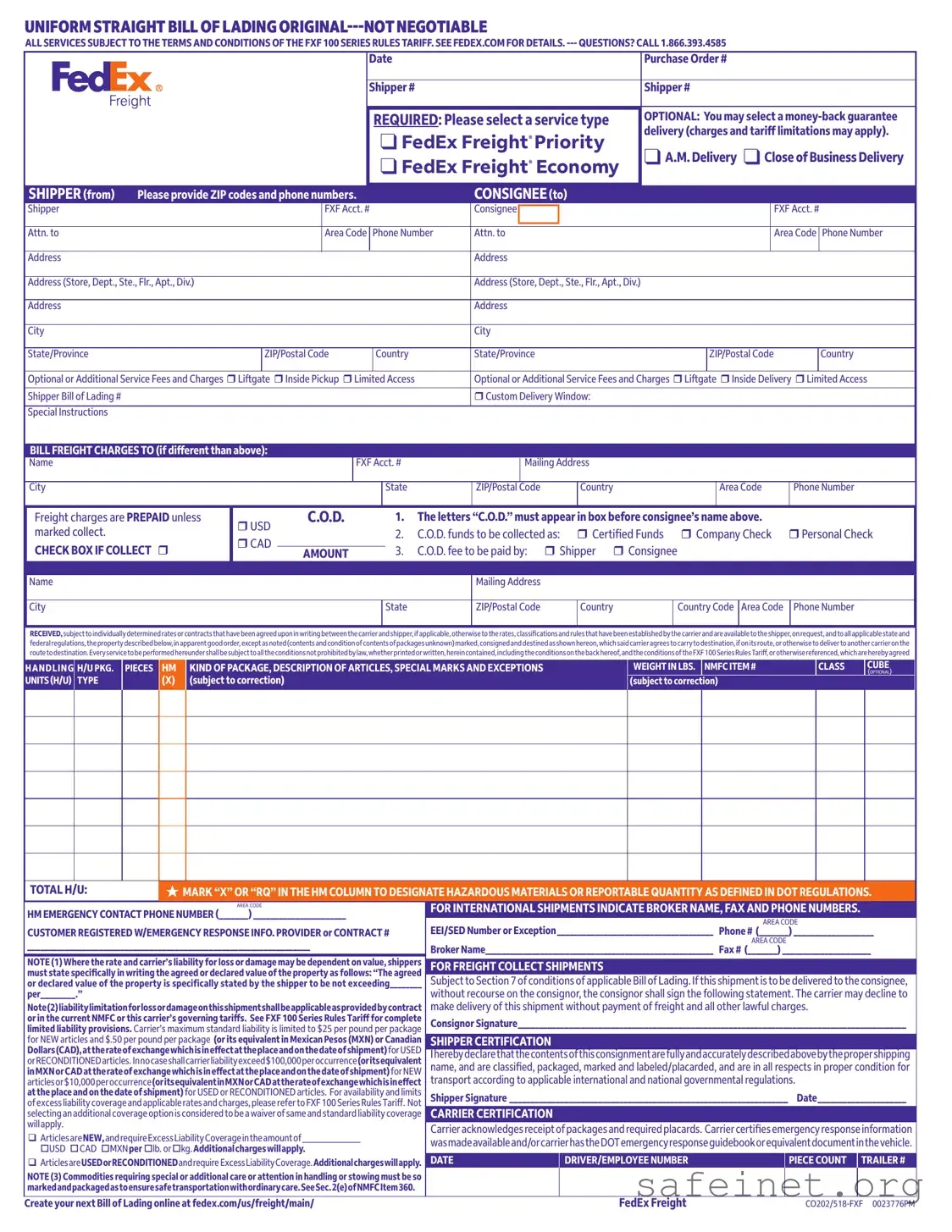
The FedEx Bill of Lading form serves as a crucial document in the shipping process, outlining the responsibilities and agreements between the shipper and the carrier. This form is not just a receipt; it includes essential details such as the shipper and consignee information, service types, and any optional services selected, such as liftgate or inside delivery. The shipper must provide accurate ZIP codes and phone numbers to ensure smooth communication and delivery. Furthermore, the form specifies how freight charges will be billed, whether prepaid or collect, and includes options for cash on delivery (C.O.D.) arrangements. In addition to these fundamental elements, the form addresses the handling of hazardous materials, requiring specific markings and emergency contact information. The Bill of Lading also outlines the liability limitations for loss or damage, which are dependent on the nature of the goods being shipped. Shippers must certify that the contents are accurately described and properly packaged, adhering to national and international regulations. This document, therefore, encapsulates the terms and conditions under which the shipment is carried, reflecting both the legal obligations and the practical considerations of freight transportation.
Form Sample

KIND OF PACKAGE, DESCRIPTION OF ARTICLES, SPECIAL MARKS AND EXCEPTIONS
(subject to correction)
WEIGHT IN LBS.
CLASS
CUBE
RECEIVED, subject to individually determined rates or contracts that have been agreed upon in writing between the carrier and shipper, if applicable, otherwise to the rates, classications and rules that have been established by the carrier and are available to the shipper, on request, and to all applicable state and
federal regulations, the property described below, in apparent good order, except as noted (contents and condition of contents of packages unknown) marked, consigned and destined as shown hereon, which said carrier agrees to carry to destination, if on its route, or otherwise to deliver to another carrier on the
route to destination. Every service to be performed hereunder shall be subject to all the conditions not prohibited by law, whether printed or written, herein contained, including the conditions on the back hereof, and the conditions of the FXF 100 Series Rules Tari, or otherwise referenced, which are hereby agreed
HANDLING

Name FXF Acct. # Mailing Address
City State ZIP/Postal Code Country Area Code Phone Number
Freight charges are PREPAID unless
marked collect.
CHECK BOX IF COLLECT
1. The letters “C.O.D.” must appear in box before consignee’s name above.
2.
C.
O.D. funds to be collected as: Certied Funds Company Check Personal Check
3.
C.
O.D. fee to be paid by: Shipper Consignee
NMFC ITEM #
(subject to correction)
SHIPPER CERTIFICATION
I hereby declare that the contents of this consignment are fully and accurately described above by the proper shipping
name, and are classied, packaged, marked and labeled/placarded, and are in all respects in proper condition for
transport according to applicable international and national governmental regulations.
Shipper Signature __________________________________________________________________ Date _____________________
HM
(X)
SHIPPERfrom Please provide ZIP codes and phone numbers. CONSIGNEEto
CARRIER CERTIFICATION
(optional)
Carrier acknowledges receipt of packages and required placards. Carrier certies emergency response information
was made available and/or carrier has the DOT emergency response guidebook or equivalent document in the vehicle.

TYPE
PIECES

BILL FREIGHT CHARGES TO
REMIT C.O.D. TO 
Name Mailing Address
City State ZIP/Postal Code Country Country Code Area Code Phone Number
NOTE (1) Where the rate and carrier’s liability for loss or damage may be dependent on value, shippers

or declared value of the property is specifically stated by the shipper to be not exceeding________
per_________.”
Note (2) liability limitation for loss or damage on this shipment shall be applicable as provided by contract

limited liability provisions. Carrier’s maximum standard liability is limited to $25 per pound per package
for NEW articles and $.50 per pound per package (or its equivalent in Mexican Pesos (MXN) or Canadian
 for USED
or RECONDITIONED articles. In no case shall carrier liability exceed $100,000 per occurrence (or its equivalent
 for NEW
articles or $10,000 per occurrence 
at the place and on the date of shipment) for USED or RECONDITIONED articles. For availability and limits
of excess liability coverage and applicable rates and charges, please refer to FXF 100 Series Rules Tari. Not
selecting an additional coverage option is considered to be a waiver of same and standard liability coverage
will apply.
Articles are NEW, and require Excess Liability Coverage in the amount of _______________
o
USD o CAD oMXN per olb. or okg. 

Articles are USED or RECONDITIONED and require Excess Liability Coverage. 



or CONTRACT #
___________________________________________________________________
area code
CO202/518-FXF 0023776PM
Consignee FXF Acct. #
Attn. to
Ar
ea Code
Phone Number
A
ddress
Address (Store, Dept., Ste., Flr., Apt., Div.)
Address
City
State/Province
ZIP/
Postal Code
C
ountry
Optional or Additional Service Fees and Charges Ligate Inside Delivery Limited Access
Custom Delivery Window:
AREA CODE
Phone # (_______) ___________________
AREA CODE
EEI/SED Number or Exception _____________________________________
H MARK “X” OR “RQ” IN THE HM COLUMN TO DESIGNATE HAZARDOUS MATERIALS OR REPORTABLE QUANTITY AS DEFINED IN DOT REGULATIONS.
   
FedEx Freight
Create your next Bill of Lading online at fedex.com/us/freight/main/
Date Purchase Order #
Shipper # Shipper #


q A.M. Delivery q Close of Business Delivery
REQUIRED
UNIFORM STRAIGHT BILL OF LADING ORIGINAL---NOT NEGOTIABLE

FOR FREIGHT COLLECT SHIPMENTS
Subject to Section 7 of conditions of applicable Bill of Lading. If this shipment is to be delivered to the consignee,
without recourse on the consignor, the consignor shall sign the following statement. The carrier may decline to
make delivery of this shipment without payment of freight and all other lawful charges.
Consignor Signature ____________________________________________________________________________________________
Fax # (_______) _____________________
Broker Name______________________________________________________
USD
CAD
C.O.D.
AMOUNT
q
FedEx Freight
®
Priority
q
FedEx Freight
®
Economy
FOR INTERNATIONAL SHIPMENTS INDICATE BROKER NAME, FAX AND PHONE NUMBERS.
Shipper FXF Acct. #
Attn. to
Ar
ea Code
Phone Number
A
ddress
Address (Store, Dept., Ste., Flr., Apt., Div.)
Address
City
State/Province
ZIP/
Postal Code
C
ountry
Optional or Additional Service Fees and Charges Ligate Inside Pickup Limited Access
Shipper Bill of Lading #
Special Instructions

Document Specifications

Fact Name Details
Type of Document The FedEx Bill of Lading is a Uniform Straight Bill of Lading, which means it is not negotiable.
Governing Rules All services are subject to the terms and conditions outlined in the FXF 100 Series Rules Tariff.
Service Options Shippers can select from various service types, including FedEx Freight Priority and FedEx Freight Economy.
Freight Charges Freight charges are generally prepaid unless marked as collect. Special instructions must be clearly stated.
Hazardous Materials Shippers must mark hazardous materials or reportable quantities as defined in DOT regulations.
Liability Limits The carrier's liability is limited to $25 per pound for new articles and $0.50 per pound for used articles.
Contact Information Shippers must provide complete contact information for both the shipper and consignee, including phone numbers.

Steps to Filling Out Fedex Bill Of Lading

Filling out the FedEx Bill of Lading form is an essential step for shipping goods. This document serves as a receipt and contract between the shipper and the carrier. Ensuring accuracy in this form helps facilitate smooth transportation and delivery of your items. Here’s how to complete it step-by-step:

  1. Begin by entering the Date and Purchase Order # at the top of the form.
  2. Choose a Service Type from the options provided, such as FedEx Freight® Priority or Economy.
  3. Fill out the Shipper section, including your name, address, ZIP code, and phone number.
  4. Complete the Consignee section with the recipient's information, including their name, address, and contact details.
  5. If applicable, indicate any Optional or Additional Service Fees and charges, such as Liftgate or Inside Delivery.
  6. In the Bill Freight Charges To section, provide the name and address of the individual or entity responsible for freight charges, if different from the shipper.
  7. Specify if the freight charges are PREPAID or C.O.D. (Collect on Delivery), and fill in the necessary details if C.O.D. is selected.
  8. For hazardous materials, mark the appropriate boxes and provide the Emergency Contact information.
  9. List the details of the items being shipped, including kind of package, description, weight, and any special instructions.
  10. If required, declare the value of the property being shipped, following the specified format.
  11. Sign the form as the Shipper and include the date.
  12. Lastly, the carrier will complete their section, confirming receipt of the packages.

Once you have filled out the form, review it carefully to ensure all information is accurate. This attention to detail can help prevent delays or issues during shipping. After confirming that everything is correct, you can submit the form along with your shipment.

More About Fedex Bill Of Lading

What is a FedEx Bill of Lading?

The FedEx Bill of Lading is a crucial shipping document that serves as a contract between the shipper and the carrier. It outlines the details of the shipment, including the sender's and recipient's information, the type of service requested, and any special handling instructions. This document is non-negotiable and is essential for tracking and managing freight shipments.

What information do I need to fill out on the Bill of Lading?

When completing the FedEx Bill of Lading, you will need to provide several key pieces of information. This includes the shipper's and consignee's names, addresses, and contact numbers. You must also indicate the service type you are selecting, any optional services, and details about the shipment itself, such as the weight and description of the items being shipped.

What are the different service types available?

FedEx offers various service types for freight shipments. These include FedEx Freight Priority, which provides expedited delivery, and FedEx Freight Economy, which is a more cost-effective option. Additionally, you can choose specific delivery times, such as A.M. Delivery or Close of Business Delivery, depending on your needs.

What is a C.O.D. shipment?

A C.O.D. (Cash on Delivery) shipment allows the shipper to collect payment from the consignee at the time of delivery. To utilize this option, you must mark "C.O.D." on the Bill of Lading and specify the amount to be collected. You can also indicate the type of payment that will be accepted, such as a certified check or personal check.

What should I do if my shipment contains hazardous materials?

If your shipment includes hazardous materials, you must mark the appropriate box on the Bill of Lading to indicate this. It is essential to comply with all regulations regarding the transport of hazardous materials. Ensure that the items are properly packaged, labeled, and documented to facilitate safe transportation.

What happens if my shipment is lost or damaged?

In the event of loss or damage, the liability of the carrier is limited. For new articles, the maximum liability is typically $25 per pound per package. For used or reconditioned articles, it is limited to $0.50 per pound. If you wish to declare a higher value for your shipment, you must specify this in writing on the Bill of Lading.

Can I request additional services for my shipment?

Yes, the FedEx Bill of Lading allows for optional services such as liftgate delivery, inside pickup, and limited access services. You can select these options based on your specific needs. Keep in mind that additional charges may apply for these services.

How do I ensure my shipment is compliant with regulations?

To ensure compliance, you should accurately describe the contents of your shipment on the Bill of Lading. Additionally, verify that the items are classified, packaged, and labeled according to applicable national and international regulations. This is crucial for safe and legal transport.

Where can I find more information about FedEx's terms and conditions?

For detailed information about FedEx's terms and conditions, including the FXF 100 Series Rules Tariff, you can visit FedEx's official website at fedex.com. This resource provides comprehensive guidelines and regulations that govern your shipment.

Common mistakes

  1. Incomplete Address Information: Ensure that both the shipper and consignee addresses are fully filled out. Missing ZIP codes or phone numbers can lead to delivery delays.

  2. Incorrect Service Type Selection: Choose the correct service type based on your delivery needs. Selecting the wrong option can result in unexpected charges or delays.

  3. Failure to Specify C.O.D. Details: If you intend to use Cash on Delivery, clearly mark “C.O.D.” in the designated box and specify the amount. Omitting this information can lead to complications during delivery.

  4. Neglecting Hazardous Materials Designation: If your shipment includes hazardous materials, mark the appropriate columns. Not doing so can result in legal issues and safety hazards.

  5. Missing Signature: Both the shipper and carrier must sign the Bill of Lading. A missing signature can invalidate the shipment and create liability issues.

  6. Ignoring Special Handling Instructions: If your shipment requires special care, clearly state this on the form. Failing to do so can lead to damage or loss during transit.

Documents used along the form

The FedEx Bill of Lading is a crucial document in the shipping process, serving as a receipt and contract between the shipper and carrier. However, several other forms and documents often accompany it to ensure compliance and facilitate smooth transactions. Below is a list of these essential documents, each playing a unique role in the shipping process.

  • Commercial Invoice: This document outlines the transaction between the buyer and seller, detailing the goods being shipped, their value, and payment terms. It is essential for customs clearance.
  • Packing List: This list itemizes the contents of the shipment, including quantities and descriptions. It helps both the shipper and receiver verify that the correct items have been sent and received.
  • Certificate of Origin: This document certifies the country where the goods were produced. It is often required for international shipments to determine tariffs and trade agreements.
  • Export Declaration: Required for shipments leaving the U.S., this document provides details about the goods, their value, and destination. It helps U.S. Customs track exports.
  • Import License: Some goods require an import license to enter a foreign country. This document ensures compliance with that country’s regulations.
  • Hazardous Materials Declaration: If shipping hazardous materials, this declaration is necessary. It provides information about the nature of the materials and ensures safe handling during transport.
  • Insurance Certificate: This document provides proof of insurance coverage for the shipment. It protects against potential loss or damage during transit.
  • Freight Bill: This is a bill issued by the carrier, detailing the charges for transportation. It serves as a request for payment from the shipper.
  • Delivery Receipt: Upon delivery, the consignee signs this document to confirm receipt of the goods in good condition. It serves as proof of delivery.
  • Customs Bond: This document guarantees that the duties and taxes owed to customs will be paid. It is often required for larger shipments or those with a high value.

Each of these documents plays a vital role in ensuring compliance, facilitating communication, and protecting the interests of all parties involved in the shipping process. Properly preparing and managing these forms can significantly reduce the risk of delays and complications during transit.

Similar forms

The Uniform Commercial Code (UCC) Bill of Lading is a widely recognized document in the shipping and transportation industry. Like the FedEx Bill of Lading, it serves as a contract between the shipper and the carrier, outlining the terms of transport. The UCC Bill of Lading also provides evidence of the receipt of goods, detailing the type and quantity of items being shipped. Both documents ensure that all parties understand their responsibilities and liabilities during transit, making them essential for smooth shipping operations.

The Air Waybill (AWB) is another important document similar to the FedEx Bill of Lading. Primarily used for air shipments, the AWB acts as a receipt for the cargo and a contract of carriage between the shipper and the airline. Like the FedEx Bill of Lading, it contains crucial details such as shipper and consignee information, description of goods, and payment terms. The AWB simplifies the process of air freight by providing clear guidelines and obligations for all parties involved, ensuring that shipments are handled efficiently.

The Ocean Bill of Lading is a document used in maritime shipping that shares similarities with the FedEx Bill of Lading. This document serves as both a receipt for the goods and a contract between the shipper and the shipping line. It includes essential details such as the description of the cargo, shipping terms, and destination. Both documents protect the interests of the shipper and the carrier, providing a clear framework for the transportation of goods across different modes of transport.

The Consignment Note is another document that parallels the FedEx Bill of Lading. Typically used in road transport, it serves as a receipt for the goods and outlines the terms of the delivery. The Consignment Note includes information about the sender, recipient, and the nature of the goods, similar to the FedEx Bill of Lading. This document ensures that all parties are aware of their responsibilities and the conditions under which the goods are being transported, helping to prevent misunderstandings and disputes.

Lastly, the Shipper's Letter of Instruction (SLI) is a document that complements the FedEx Bill of Lading in the shipping process. While the SLI provides specific instructions to the carrier regarding the shipment, the FedEx Bill of Lading serves as the formal contract for transportation. The SLI may include details such as handling instructions, special requirements, and billing information. Both documents work together to ensure that shipments are executed according to the shipper's specifications, thus facilitating a smoother transportation process.

Dos and Don'ts

When filling out the FedEx Bill of Lading form, attention to detail is essential. Here are five important dos and don’ts to keep in mind:

  • Do provide accurate and complete information for both the shipper and consignee. This includes names, addresses, and contact numbers.
  • Do select the appropriate service type that fits your shipping needs. Consider options like FedEx Freight Priority or Economy.
  • Do indicate if any special services are required, such as liftgate or inside delivery. This ensures that the carrier is prepared for your shipment's needs.
  • Do check for hazardous materials and mark them clearly. This is crucial for compliance with safety regulations.
  • Do sign and date the form to validate the information provided and confirm your agreement to the terms.
  • Don't leave any required fields blank. Missing information can delay your shipment.
  • Don't forget to include the C.O.D. instructions if applicable. Ensure that the correct payment method is selected.
  • Don't underestimate the importance of the declared value. Accurately state the value of the shipment to avoid issues with liability.
  • Don't ignore the terms and conditions outlined in the FXF 100 Series Rules Tariff. Familiarize yourself with these to understand your rights and responsibilities.
  • Don't submit the form without reviewing it for errors. A simple mistake can lead to complications in shipping.

Misconceptions

Here are eight common misconceptions about the FedEx Bill of Lading form, along with explanations to clarify these misunderstandings:

  • The Bill of Lading is only for freight shipments. Many people believe that the Bill of Lading is exclusively for freight. However, it can also be used for other types of shipments, including parcels and packages.
  • Once the Bill of Lading is signed, the shipper has no control over the shipment. In reality, the shipper can still make changes or cancel the shipment, as long as they contact FedEx before the shipment is picked up.
  • The Bill of Lading guarantees delivery by a certain date. While it provides service options, it does not guarantee delivery by a specific date unless a money-back guarantee is selected.
  • All shipments are automatically insured. This is not true. The standard liability coverage is limited, and shippers need to select additional coverage if they want higher protection for valuable items.
  • The Bill of Lading is only needed for domestic shipments. This is a misconception. The Bill of Lading is also essential for international shipments, ensuring compliance with customs regulations.
  • Shippers cannot track their shipments without a tracking number. While a tracking number is necessary for real-time tracking, shippers can still inquire about their shipments using the Bill of Lading number.
  • Only the shipper is responsible for the accuracy of the Bill of Lading. In fact, both the shipper and the carrier share responsibility for ensuring the information is accurate to prevent issues during transit.
  • Once a shipment is in transit, changes cannot be made. This is not accurate. Changes can be made, such as rerouting or updating delivery information, but they may incur additional fees and require prompt communication with FedEx.

Key takeaways

When filling out the FedEx Bill of Lading form, there are several important points to keep in mind. Here are the key takeaways:

  • Service Type: Choose the appropriate service type for your shipment. Options include FedEx Freight Priority, A.M. Delivery, and FedEx Freight Economy.
  • Accurate Information: Ensure that the shipper and consignee details are complete, including ZIP codes and phone numbers.
  • Optional Services: Consider any additional services you may need, such as liftgate service or inside pickup/delivery.
  • C.O.D. Options: If you select Cash on Delivery (C.O.D.), make sure to specify how the funds will be collected and who will pay the C.O.D. fee.
  • Hazardous Materials: If you are shipping hazardous materials, mark the appropriate box and provide emergency contact information.
  • Liability Limits: Be aware of the carrier's liability limits. Standard liability may not cover the full value of your shipment.
  • Certification: Sign the shipper certification to confirm that the contents are accurately described and properly packaged for transport.

Following these guidelines will help ensure that your shipment is processed smoothly and efficiently.