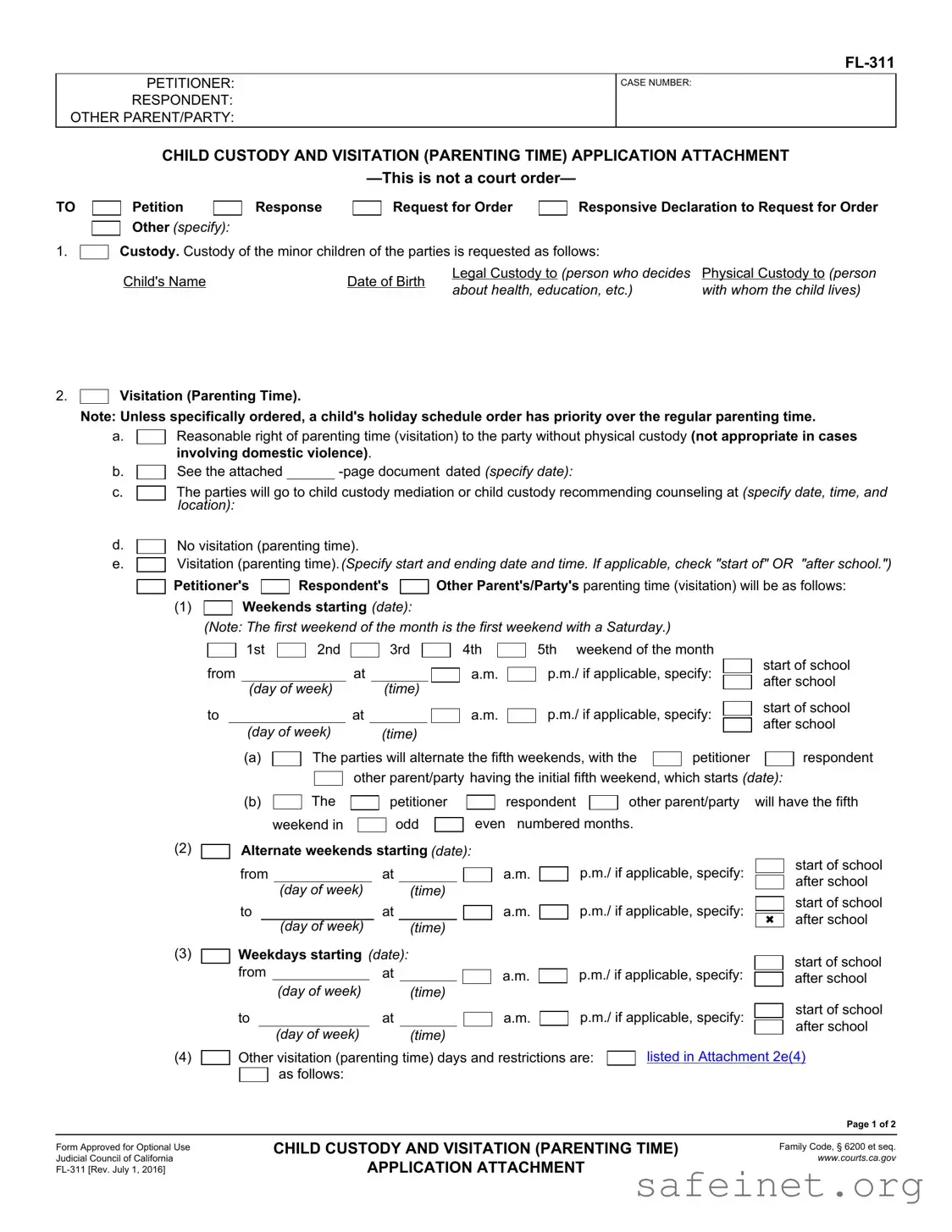
The Family Law FL 311 form is a crucial document for parents navigating the complexities of child custody and visitation arrangements. This form serves as an attachment for applications related to child custody and visitation, outlining the specific requests of the parties involved. It includes essential details such as the names of the petitioner, respondent, and any other involved parties, along with the case number. The form addresses various aspects of custody, including legal and physical custody, visitation schedules, and any necessary provisions for supervised visitation. It also emphasizes the importance of mediation and counseling in resolving custody disputes. Additionally, the FL 311 form allows parents to specify holiday schedules and transportation arrangements for visitation, ensuring that the best interests of the children are prioritized. Understanding how to properly fill out and submit this form can significantly impact the outcome of custody arrangements, making it a vital tool for parents seeking clarity and structure in their parenting plans.


| Fact Name | Details |
|---|---|
| Purpose | The FL-311 form is used to request child custody and visitation arrangements in California family law cases. |
| Governing Law | This form is governed by California Family Code, § 6200 et seq. |
| Parties Involved | The form requires information about the petitioner, respondent, and any other parent or party involved in the custody case. |
| Custody Requests | It allows parties to specify legal and physical custody arrangements for minor children, including details such as the child's name and date of birth. |
| Visitation Schedule | The form outlines visitation (parenting time) rights, including specific days and times for visitation and any conditions that apply. |
| Supervised Visitation | In cases involving domestic violence, the form can request supervised visitation, requiring a declaration to support this request. |
Completing the Family Law FL-311 form is an essential step in addressing child custody and visitation arrangements. This process involves providing detailed information about the children involved, the parties' requests for custody and visitation, and any specific circumstances that may affect these arrangements.
Once the form is completed, it is advisable to review all entries for accuracy before submission. Ensure that any necessary attachments are included, as this will support your requests during the legal process.
What is the purpose of the FL-311 form?
The FL-311 form serves as an attachment for child custody and visitation applications in family law cases. It allows parents to outline their requests regarding legal and physical custody, visitation schedules, and any necessary supervision during visitation. This form is crucial for establishing clear guidelines for parenting time and ensuring the best interests of the children are prioritized.
Who should fill out the FL-311 form?
The FL-311 form should be filled out by a parent or legal guardian involved in a custody dispute. This individual is referred to as the petitioner. The respondent, or the other parent, may also need to respond to the requests made in this form. Both parties are encouraged to provide accurate and honest information to facilitate a fair resolution.
What information is required on the FL-311 form?
The FL-311 form requires details such as the names and birth dates of the children, the type of custody being requested, and the proposed visitation schedule. Additionally, it may ask for information about any necessary supervision during visits, transportation arrangements, and holiday schedules. The form aims to create a comprehensive overview of the custody and visitation arrangements being sought.
What is the difference between legal custody and physical custody?
Legal custody refers to the right to make important decisions about a child's life, including education, health care, and religious upbringing. Physical custody, on the other hand, pertains to where the child lives and who is responsible for their daily care. It is possible for one parent to have legal custody while the other has physical custody, or both parents can share both types of custody.
Can visitation be supervised, and under what circumstances?
Yes, visitation can be supervised if there are concerns about the child's safety. This may be necessary in cases involving domestic violence or substance abuse. If one parent believes that unsupervised visitation would be harmful to the child, they must provide a declaration explaining their concerns. The court will then consider these allegations when making its decision.
What should I do if I need to travel with my children?
If you plan to travel with your children outside of California or to specific counties, you must obtain written permission from the other parent or a court order. This requirement helps prevent potential child abduction and ensures both parents are aware of travel plans. It is essential to adhere to these guidelines to avoid legal complications.
How are transportation arrangements for visitation determined?
Transportation arrangements for visitation should be clearly outlined in the FL-311 form. This includes specifying who will provide transportation to and from visits, ensuring that only licensed and insured drivers are responsible for the children. The form also addresses safety measures, such as the use of child restraint devices during transport.
What happens if there is a risk of child abduction?
If there is a concern that one parent may attempt to take the children out of California without consent, the FL-311 form allows for specific orders to be requested. This may include measures to prevent abduction, such as notifying law enforcement or requiring permission for travel. It is crucial to address these concerns proactively to protect the children.
How can I request additional custody provisions?
To request additional custody provisions, you can specify your needs in the designated section of the FL-311 form. This may include unique arrangements that do not fit the standard visitation schedule or specific conditions that you believe are necessary for the child's well-being. Clearly articulating your requests will assist the court in understanding your concerns.
What should I do if I have further questions about the FL-311 form?
If you have additional questions regarding the FL-311 form or the child custody process, it is advisable to seek guidance from a family law attorney or a legal aid organization. They can provide personalized assistance and help you navigate the complexities of family law to ensure that your rights and the best interests of your children are protected.
Missing Information: Many people forget to fill in important sections, like the names and birthdates of the children. Each child's details are crucial for clarity.
Inconsistent Terminology: Using different terms for custody and visitation can create confusion. Stick to the terms used in the form to avoid misunderstandings.
Not Specifying Visitation Details: Failing to clearly outline visitation schedules can lead to disputes later. Be specific about dates, times, and locations.
Overlooking Supervised Visitation Requirements: If supervised visitation is needed, it's essential to attach the required declaration. This helps the judge understand the situation better.
Ignoring Additional Attachments: Many forget to include necessary attachments like forms FL-312 or FL-341(C). These documents can provide crucial context for your case.
The Family Law FL-311 form is often accompanied by several other documents that provide additional context and details regarding child custody and visitation arrangements. Each of these documents plays a specific role in the overall process of family law proceedings.
These documents collectively contribute to a clearer understanding of custody and visitation arrangements, ensuring that the best interests of the children are prioritized throughout the legal process.
The FL-300 form, known as the "Request for Order," is similar to the FL-311 in that both documents are used in family law cases to request specific orders from the court. While FL-311 focuses on child custody and visitation, FL-300 can cover a broader range of issues, including spousal support, property division, and restraining orders. Both forms require detailed information about the parties involved and the specific requests being made, ensuring the court has the necessary context to make informed decisions.
The FL-320 form, or "Responsive Declaration to Request for Order," serves as a counterpart to the FL-300. It allows a responding party to provide their perspective on the requests made in the FL-300. Like the FL-311, it requires specific details about the respondent's position on custody and visitation matters, ensuring that all voices are heard in the decision-making process. This form is crucial in fostering communication between parties and the court.
The FL-341(C) form, titled "Children's Holiday Schedule," is directly related to the FL-311 as it outlines specific visitation arrangements during holidays. While the FL-311 provides a general framework for custody and visitation, the FL-341(C) focuses on special occasions, ensuring that both parents can plan for important family events. This document is essential for parents who want to avoid conflicts during holiday seasons.
The FL-324 form, "Declaration of Supervised Visitation Provider," is necessary when supervised visitation is requested, as mentioned in the FL-311. This form outlines the qualifications of the individual who will supervise visitation, ensuring that the child’s safety and well-being are prioritized. Both forms emphasize the importance of creating a safe environment for children during visitation.
The FL-312 form, or "Child Abduction Prevention Order," addresses concerns about the potential for one parent to take the children out of the state without permission. This form complements the FL-311 by providing additional protective measures for custody arrangements. It highlights the seriousness of child abduction risks and ensures that the court can implement necessary safeguards.
The FL-341(E) form, which pertains to "Joint Legal Custody Provisions," is relevant when parents seek to share decision-making responsibilities for their children. While the FL-311 lays out the custody and visitation framework, the FL-341(E) focuses specifically on how parents will collaborate on important issues like education and healthcare. This document promotes cooperation and communication between parents.
The FL-310 form, or "Petition for Custody and Support of Minor Children," serves a similar purpose to the FL-311 but is primarily used to initiate custody and support requests. Both forms require detailed information about the children and the parents' desired arrangements. The FL-310 is often the starting point for custody cases, while the FL-311 may be used later to refine or specify visitation details.
The FL-200 form, known as the "Petition for Dissolution of Marriage," may also have similarities with the FL-311 in cases where child custody is a component of divorce proceedings. While FL-200 addresses the dissolution of the marriage itself, it often includes requests for custody arrangements, making it essential for parents navigating divorce to understand both forms and how they interact.
Lastly, the FL-300 form can also be compared to the FL-311 in terms of addressing temporary orders. Both forms can be used to request immediate decisions from the court regarding custody and visitation, ensuring that children’s needs are met promptly. This is particularly important in urgent situations where stability for the child is paramount.
When filling out the Family Law FL 311 form, it is important to be thorough and accurate. Here are five things to keep in mind:
Misconceptions about the Family Law FL 311 form can lead to confusion and misunderstandings. Here are four common misconceptions:
Here are key takeaways for filling out and using the Family Law FL 311 form: