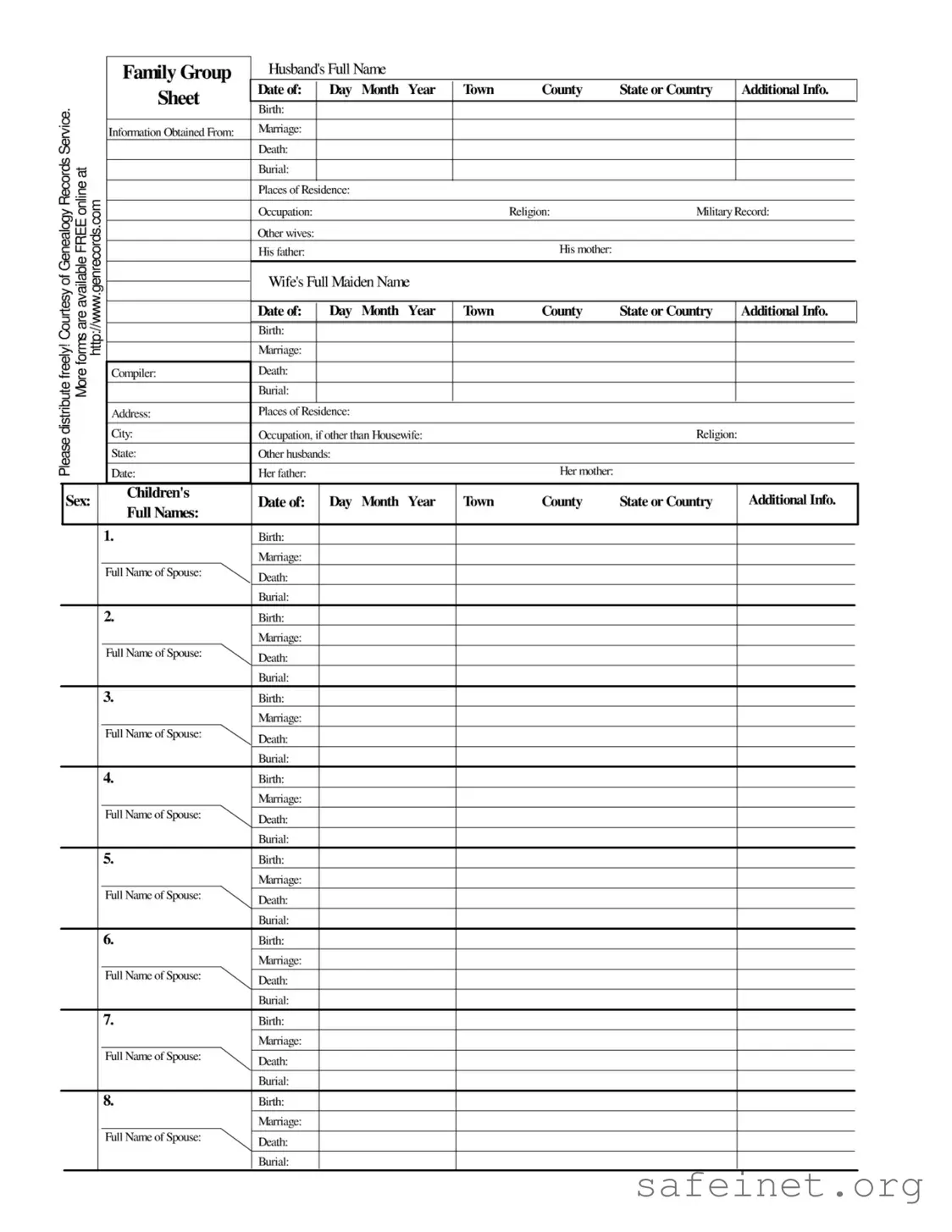
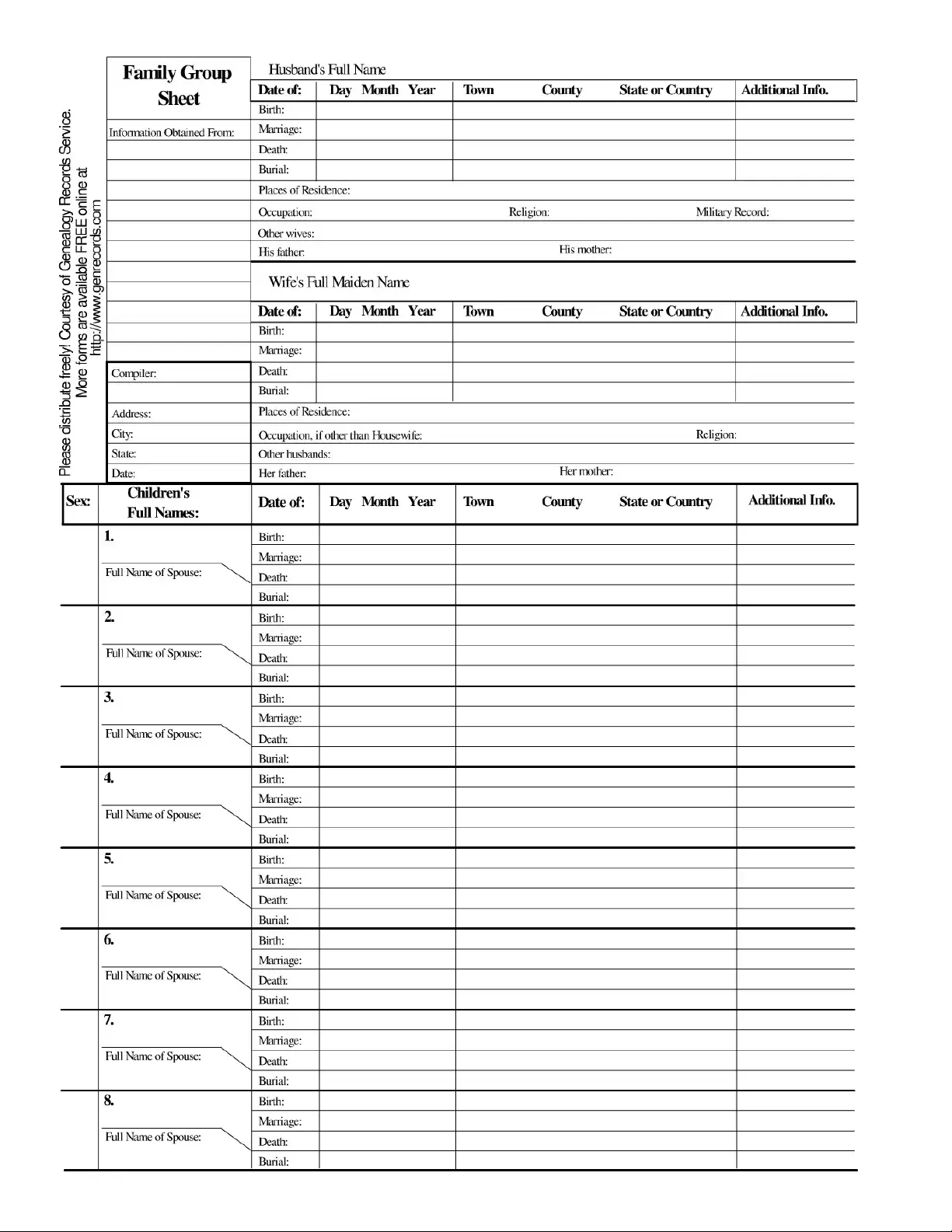
The Family Group Sheet is an invaluable tool for anyone delving into the intricate tapestry of family history. This comprehensive form captures essential details about family members, providing a structured format that simplifies the documentation of relationships and vital events. It includes sections for the husband and wife, detailing their full names, birth dates, and places of residence, as well as information about their parents and any previous spouses. The form also encourages the inclusion of children's names, birth dates, and marriages, ensuring a holistic view of family dynamics. Each entry allows for additional notes, which can be crucial for recording unique family stories or significant events. By organizing this information clearly, the Family Group Sheet not only aids in genealogical research but also helps preserve family legacies for future generations.
| Fact Name | Details |
|---|---|
| Purpose | The Family Group Sheet is used to document the family relationships of individuals, including vital statistics like birth, marriage, and death dates. |
| Content | This form collects information about the husband, wife, children, and additional sources, ensuring a comprehensive family history. |
| State-Specific Forms | Many states have their own versions of the Family Group Sheet, governed by local laws regarding vital records and genealogy research. |
| Usage | Genealogists and family historians commonly use this form to organize and present family data systematically. |
| Importance | Accurate completion of this form is crucial for preserving family history and may assist in legal matters such as inheritance claims. |
After gathering the necessary information, you can begin filling out the Family Group Sheet form. This form requires details about the husband, wife, and children in the family. Make sure to have all relevant information ready, as this will help you complete the form accurately.
What is a Family Group Sheet?
A Family Group Sheet is a document used to organize and record family history information. It includes details about family members, such as their names, birth dates, marriage dates, and other significant life events. This form helps individuals and researchers keep track of relationships and lineage in a structured manner.
What information is required on the Family Group Sheet?
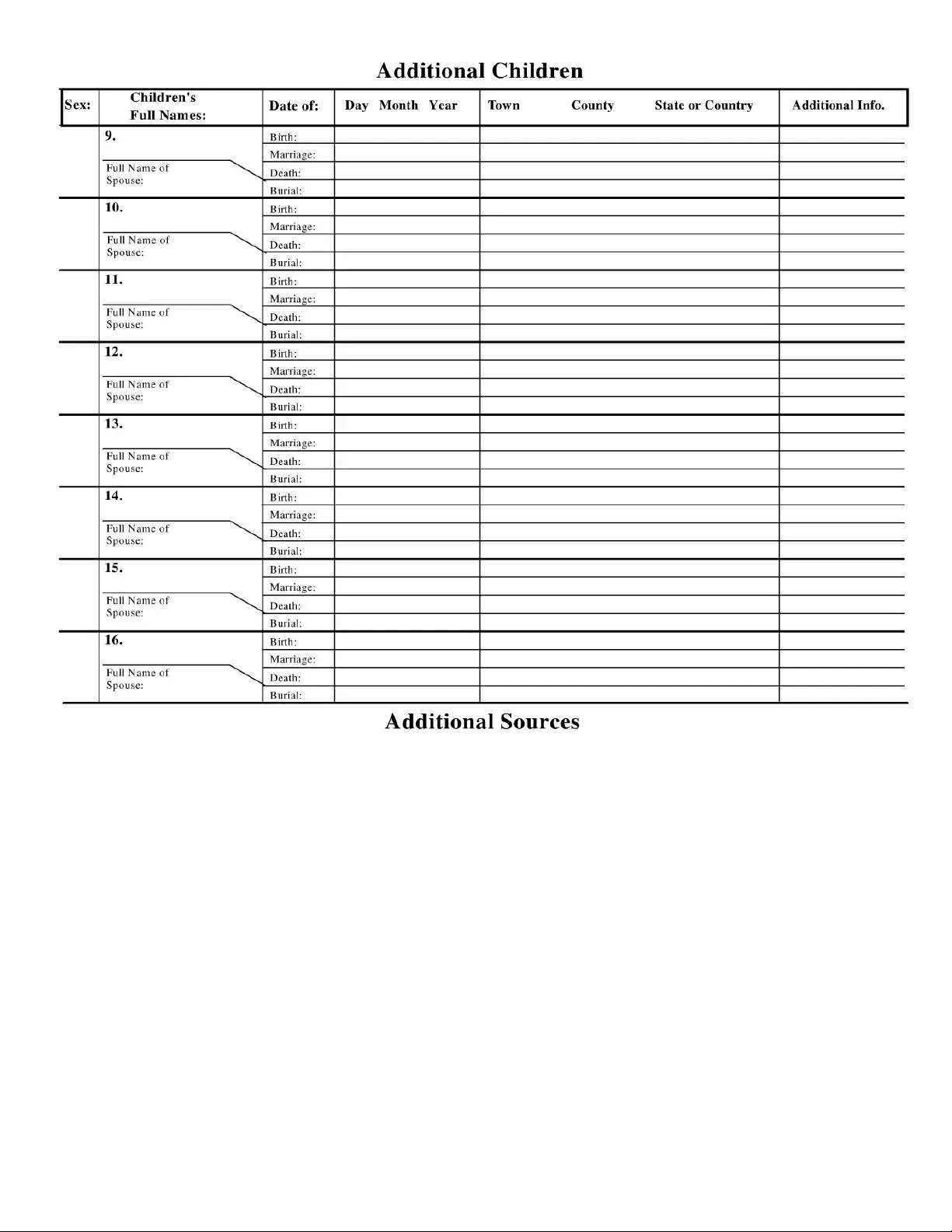
The Family Group Sheet requires various details for each family member. For the husband and wife, you will need their full names, birth dates, marriage dates, and death dates if applicable. Additionally, you should include information about their parents, occupation, religion, and military records. For children, you will need their names, birth dates, and marriage information, along with any additional children.
How do I fill out the Family Group Sheet?
To fill out the Family Group Sheet, start with the husband's information at the top. Enter his full name, birth date, and other relevant details. Next, fill in the wife's information in the designated area. Continue by listing each child, ensuring you include their full names and significant dates. Use clear handwriting or type the information to maintain legibility.
Why is the Family Group Sheet important?
The Family Group Sheet is important for several reasons. It serves as a central repository for family information, making it easier to trace lineage and understand family connections. This form can be particularly helpful for genealogical research, allowing individuals to document their heritage accurately. Additionally, it can assist in preserving family history for future generations.
Can I use the Family Group Sheet for multiple generations?
The Family Group Sheet primarily focuses on one family unit, typically the parents and their children. However, you can create multiple sheets for different generations. Each sheet can document a family unit, allowing you to build a comprehensive family tree over time. This method helps keep information organized and accessible.
Where can I obtain a Family Group Sheet?
You can find Family Group Sheets online through genealogical websites or local historical societies. Many organizations offer free downloadable templates. Additionally, you can create your own sheet using a word processor or spreadsheet software by following the standard format. Ensure that the layout allows for clear and organized entry of information.
Failing to provide complete names for all individuals listed. This includes not only the husband and wife but also children and parents.
Omitting important dates, such as birth, marriage, and death. Each date is crucial for accurate record-keeping.
Not specifying the correct locations for events. Town, county, state, or country must be included to provide context.
Using abbreviations instead of full names or terms. Clarity is key, so avoid short forms that might confuse readers.
Neglecting to include additional information that may be relevant, such as occupation or military record.
Forgetting to list all spouses for each individual, especially in cases of remarriage. This is vital for a comprehensive family history.
Failing to indicate the sex of children, which is necessary for proper identification in family trees.
Not double-checking for spelling errors or inaccuracies. Mistakes can lead to confusion and misinterpretation of the family history.
The Family Group Sheet form is a vital document for recording family history. It serves as a foundational tool for genealogists and family historians. Alongside this form, several other documents can enhance your understanding of family lineage and relationships. Below are five common forms that are often used in conjunction with the Family Group Sheet.
Using these documents alongside the Family Group Sheet can create a more comprehensive view of family history. Each form contributes unique information that can help piece together a family's story, ensuring that no detail is overlooked.
The Family Group Sheet form is similar to a Pedigree Chart. Both documents are used to record family relationships and lineage. A Pedigree Chart typically focuses on a single individual and traces their ancestry, showing parents, grandparents, and so forth. In contrast, the Family Group Sheet provides a broader view, detailing not only the parents and their children but also additional information like marriages, births, and deaths. This makes the Family Group Sheet more comprehensive for documenting an entire family unit.
Ancestry Charts share similarities with the Family Group Sheet as well. Like the Family Group Sheet, Ancestry Charts help visualize family connections over generations. However, Ancestry Charts usually emphasize lineage and blood relationships, often starting from an ancestor and moving downward. The Family Group Sheet, on the other hand, captures a family group’s information at a specific point in time, including spouses and children, making it more practical for immediate family documentation.
The Vital Records form is also comparable to the Family Group Sheet. Vital Records are official documents that provide information about life events such as births, marriages, and deaths. While the Family Group Sheet organizes this information within a family context, Vital Records serve as legal proof of these events. Both documents are essential for genealogical research, but the Family Group Sheet offers a more familial perspective.
Another related document is the Genealogical Record. This record serves to compile detailed information about a family’s history and lineage, much like the Family Group Sheet. However, the Genealogical Record often includes more extensive narratives and research notes. In contrast, the Family Group Sheet focuses on presenting concise data about family members, making it easier to see relationships at a glance.
The Family Tree is a visual representation of family relationships, similar to the Family Group Sheet. While the Family Group Sheet is text-based and emphasizes detailed information about each family member, the Family Tree provides a graphical layout of connections. Both documents serve the purpose of illustrating family ties, but the Family Tree is often used for a quick visual reference, whereas the Family Group Sheet allows for more in-depth details.
The Marriage License Application can also be likened to the Family Group Sheet. Both documents collect vital information about individuals, including names, dates, and places. However, the Marriage License Application specifically focuses on the couple intending to marry, whereas the Family Group Sheet encompasses a broader family context, including children and extended family members.
The Census Record is another document that shares similarities with the Family Group Sheet. Census Records capture household information at specific intervals, listing names, ages, and relationships among family members. While both documents provide insights into family structures, the Family Group Sheet is more focused on individual life events and relationships, whereas Census Records are snapshots of households at a given time.
Lastly, the Personal History Form is comparable to the Family Group Sheet. This form typically collects biographical information about an individual, including life events and family background. While the Personal History Form emphasizes one person's experiences, the Family Group Sheet compiles information about an entire family unit, making it a more collaborative document for genealogical purposes.
When filling out the Family Group Sheet form, it is essential to approach the task with care and attention to detail. Here are some guidelines to help ensure accuracy and completeness.
By following these guidelines, you can create a comprehensive and accurate Family Group Sheet that will serve as a valuable resource for future generations.
Understanding the Family Group Sheet form can be challenging. Here are some common misconceptions that might cause confusion:
By addressing these misconceptions, you can approach the Family Group Sheet with clarity and confidence. It’s a useful resource for anyone looking to keep their family history organized.
Filling out and utilizing the Family Group Sheet form can significantly enhance your understanding of family history. Here are six key takeaways to consider: