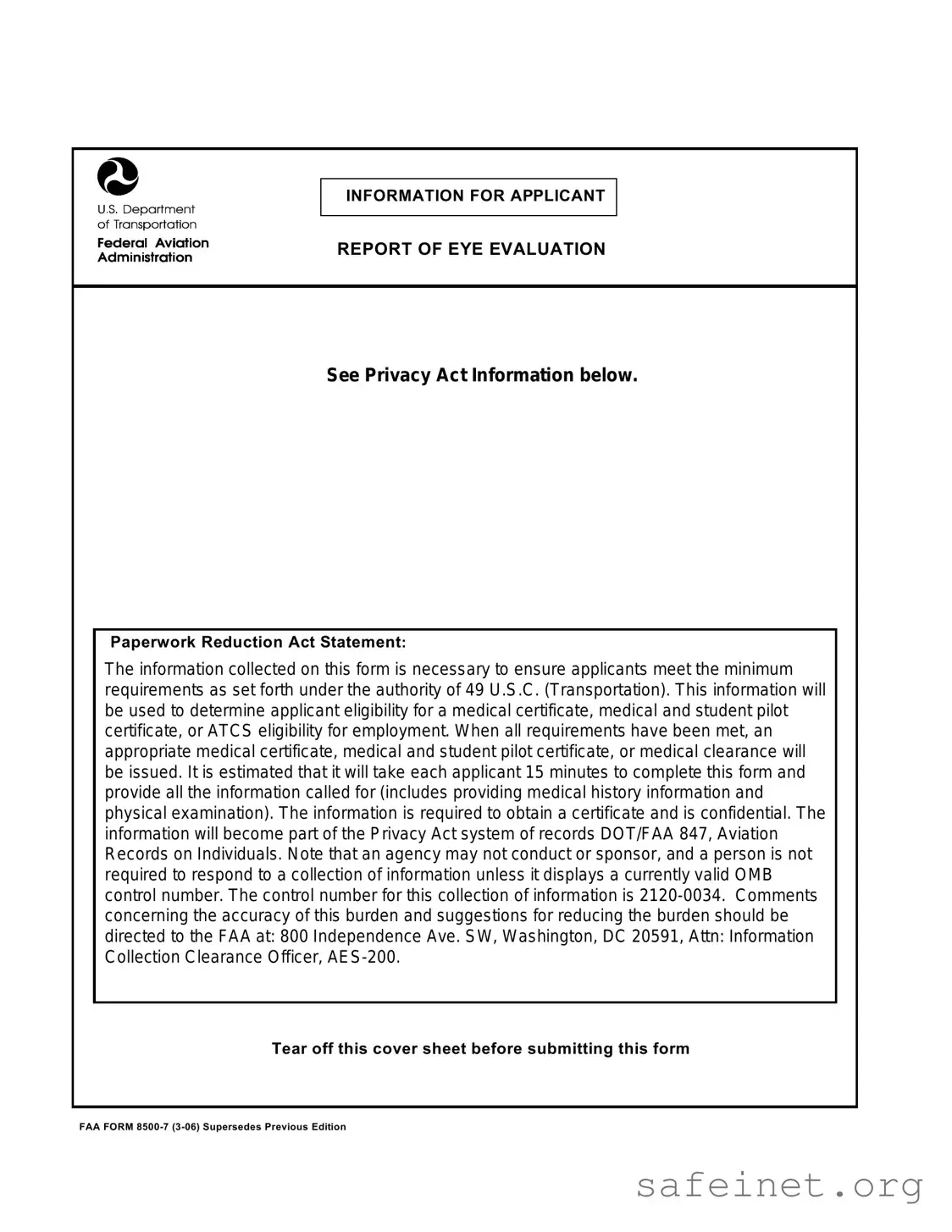
The FAA Form 8500-7 is an essential document for individuals seeking to obtain a medical certificate, medical and student pilot certificate, or employment as an air traffic controller. This form focuses on the applicant's eye health and vision, which are critical for ensuring safety in aviation. Completing the form requires providing personal medical history and undergoing a physical examination, with an estimated completion time of about 15 minutes. The information collected is confidential and becomes part of a system of records that complies with the Privacy Act. It is mandatory to submit most of the information requested, while providing a Social Security Number is optional. Failure to provide the required details may prevent the issuance of the desired certification. The form also includes a Privacy Act statement, explaining how the information will be used and shared, ensuring transparency and protection for applicants. Understanding the requirements and implications of the FAA Form 8500-7 is crucial for anyone pursuing a career in aviation or seeking to maintain their flying privileges.


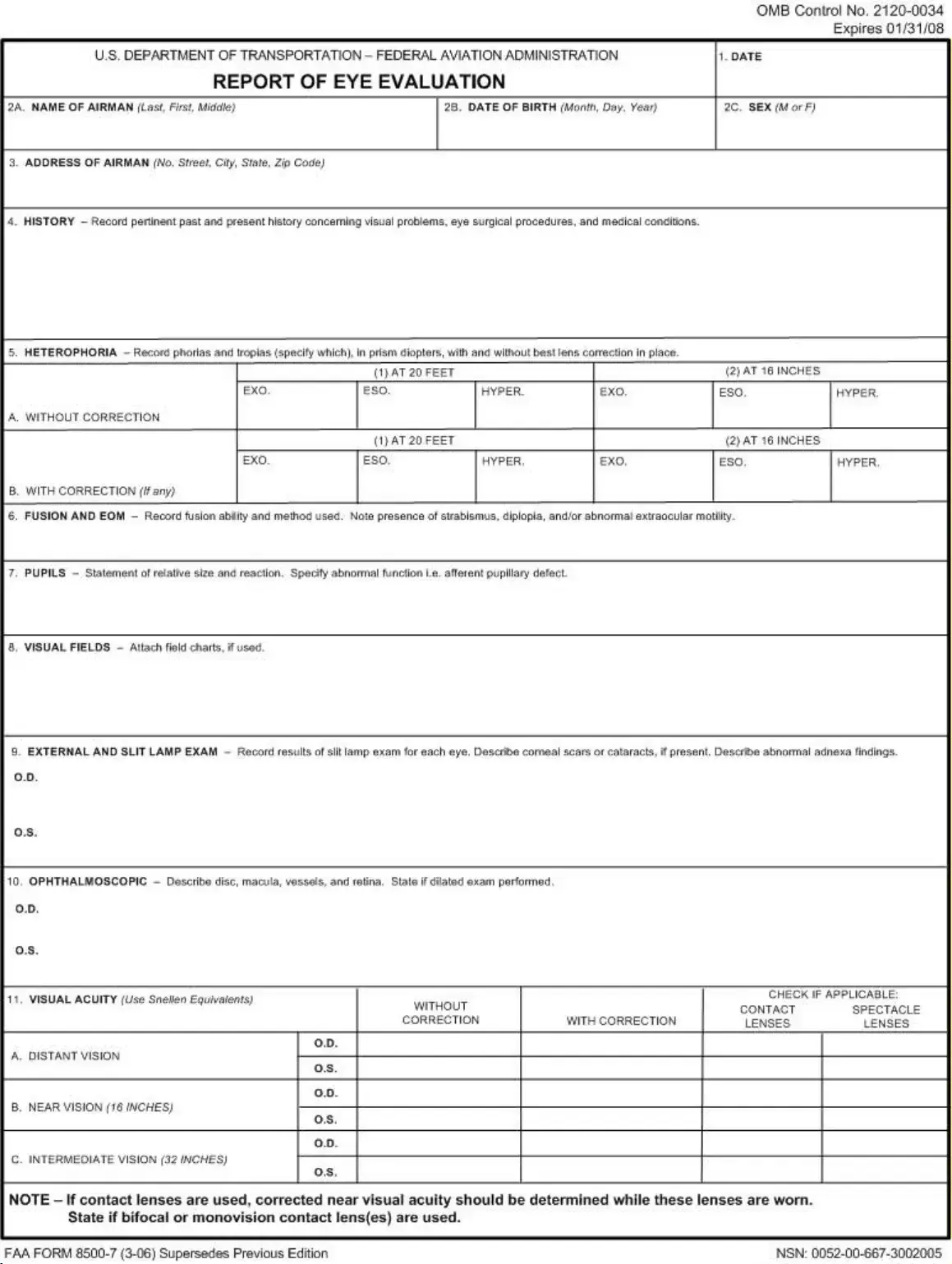
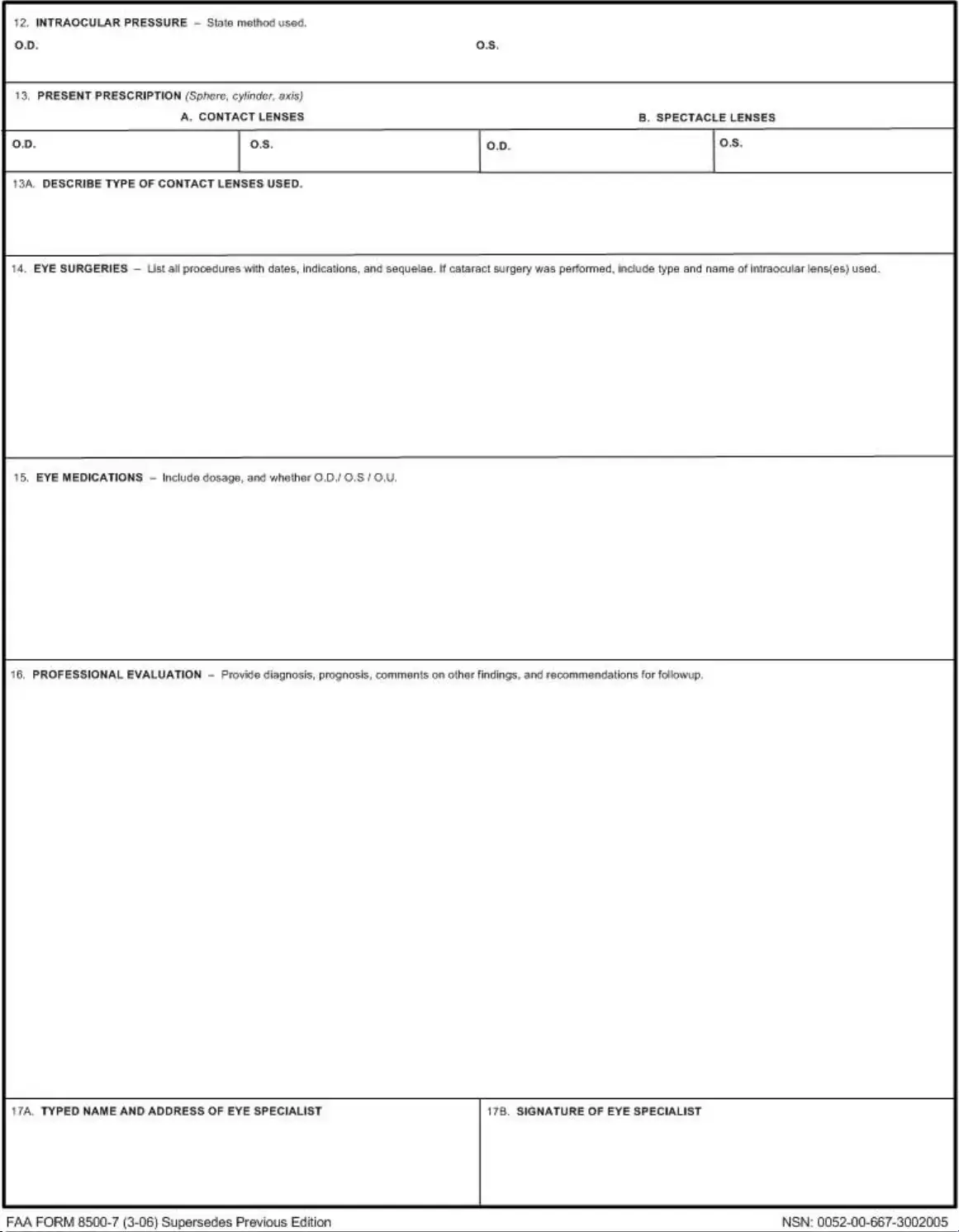
| Fact Name | Fact Description |
|---|---|
| Purpose | The FAA Form 8500-7 is used to evaluate an applicant's eye health as part of the medical certification process for pilots and air traffic controllers. |
| Authority | This form is governed by 49 U.S.C. §§ 40113, 44702, 44703, 44709 and 14 C.F.R. Part 67. |
| Confidentiality | Information collected on this form is confidential and becomes part of the Privacy Act system of records DOT/FAA 847. |
| Time to Complete | Applicants are estimated to take about 15 minutes to complete this form, which includes providing medical history and undergoing a physical examination. |
| Submission Requirement | Submission of data is mandatory, except for the Social Security Number, which is voluntary. |
| OMB Control Number | The current OMB control number for this collection of information is 2120-0034. |
After completing the FAA Form 8500-7, you will submit it to the appropriate authority for processing. Ensure that all sections are filled out accurately to avoid delays in your application for a medical certificate or related qualifications.
What is the purpose of the FAA Form 8500-7?
The FAA Form 8500-7 is used to report eye evaluations for individuals seeking medical certification, medical and student pilot certificates, or eligibility for air traffic control specialist employment. This form collects necessary information to determine if applicants meet the minimum medical standards set by the FAA.
Who is required to complete the FAA Form 8500-7?
Individuals applying for a medical certificate, medical and student pilot certificates, or air traffic control specialist positions are required to complete this form. It is essential for ensuring that the applicants meet the medical requirements outlined by the FAA.
How long does it take to complete the FAA Form 8500-7?
It is estimated that it will take each applicant approximately 15 minutes to complete the form. This time includes providing medical history information and undergoing a physical examination.
Is the information provided on the FAA Form 8500-7 confidential?
Yes, the information collected on this form is confidential. It becomes part of the Privacy Act system of records known as DOT/FAA 847, which is designed to protect individuals' personal information.
What happens if required information is not provided on the FAA Form 8500-7?
If an applicant fails to provide all required information, the FAA will be unable to issue a medical certificate or rating. It is crucial to complete the form accurately and thoroughly to avoid delays in the certification process.
What is the Privacy Act Statement associated with the FAA Form 8500-7?
The Privacy Act Statement informs applicants about the authority under which the information is collected, its intended use, and the mandatory nature of the submission. It also clarifies that while providing a Social Security Number is voluntary, all other information is mandatory.
What kind of information is collected on the FAA Form 8500-7?
The form collects information related to the applicant's eye health and vision. This includes medical history and results from the physical examination, which are necessary for assessing the individual's eligibility for medical certification.
Where can I send comments regarding the FAA Form 8500-7?
Comments concerning the accuracy of the information collection or suggestions for reducing the burden can be directed to the FAA at 800 Independence Ave. SW, Washington, DC 20591, Attention: Information Collection Clearance Officer, AES-200.
What is the OMB control number for the FAA Form 8500-7?
The OMB control number for this collection of information is 2120-0034. This number indicates that the form has been approved for use and is required for compliance with federal regulations.
Not providing complete medical history. Ensure all relevant medical conditions are disclosed.
Failing to sign and date the form. An unsigned form will be considered incomplete.
Incorrectly filling out the personal information section. Double-check your name, address, and contact details for accuracy.
Omitting the Social Security Number. While it’s voluntary, providing it can help with identification.
Not including the name and contact information of the examining physician. This information is crucial for verification.
Misunderstanding the requirements for eye evaluations. Make sure you have the necessary evaluations completed by an appropriate specialist.
Failing to tear off the cover sheet before submission. This can lead to confusion about your application.
Ignoring instructions regarding the submission process. Follow the guidelines carefully to avoid delays.
Not keeping a copy of the completed form. Retaining a copy can help if questions arise later.
Submitting the form without reviewing it for errors. Take a moment to proofread your answers before sending it in.
The FAA Form 8500-7 is an essential document for individuals seeking medical certification in aviation. It specifically addresses eye evaluations and is part of the broader application process for various aviation-related certificates. Alongside this form, there are several other documents that applicants may need to complete or submit. Below is a list of these documents, each with a brief description.
Each of these documents plays a critical role in the certification process. Ensure that all forms are completed accurately and submitted in a timely manner to avoid delays in obtaining your medical certification.
The FAA Form 8500-7 is similar to the FAA Form 8500-8, which is the Report of Medical History. Both forms serve to evaluate the medical qualifications of individuals seeking aviation-related certifications. The 8500-8 focuses on the applicant's medical history, including past illnesses and treatments, while the 8500-7 specifically addresses eye evaluations. Together, they ensure that applicants meet the necessary health standards required for safe operation in aviation.
Another comparable document is the FAA Form 8500-9, the Application for Airman Medical Certificate. This form is integral to the certification process and collects comprehensive medical information from the applicant. Like the 8500-7, it is mandatory for those seeking a medical certificate. The 8500-9 includes sections for reporting various health conditions, ensuring that all medical evaluations are considered in the decision-making process.
The FAA Form 8060-5, known as the Notice of Disapproval, is also relevant. This document is issued when an applicant does not meet the necessary medical standards. Similar to the 8500-7, it communicates essential information regarding the applicant's eligibility. Both documents are part of the regulatory framework that governs aviation safety and medical certification.
The FAA Form 8500-2, the Application for Student Pilot Certificate, is another related form. While the 8500-7 focuses on eye health, the 8500-2 is aimed at those pursuing a student pilot certificate. It requires applicants to provide personal and medical information, ensuring that they meet the basic requirements for flight training. Both forms emphasize the importance of health in aviation qualifications.
The FAA Form 8500-3, the Medical Certificate Application, shares similarities with the 8500-7 as it is also used to assess an applicant's fitness for flying. This form collects information about the applicant's physical and mental health. Both forms are crucial in determining whether an individual can safely operate an aircraft, reinforcing the FAA's commitment to aviation safety.
The FAA Form 8500-6, the Medical Certificate Action, is another document in this category. It outlines the actions taken regarding an applicant's medical certificate status. Similar to the 8500-7, it plays a role in the overall assessment of an applicant's medical qualifications. Both forms are part of the process that ensures only qualified individuals receive medical certification.
The FAA Form 8500-4, which is a Medical Examination Report, is closely related to the 8500-7. This form is completed by aviation medical examiners and provides a detailed report of the examination findings. The 8500-7 relies on the information provided in the 8500-4 to evaluate an applicant's eye health, making both forms essential in the medical certification process.
The FAA Form 8710-1, the Airman Certificate Application, is also similar in purpose. It is used by applicants for various airman certificates, including pilot and flight instructor certificates. Like the 8500-7, it requires detailed personal and medical information. Both forms ensure that the FAA can assess the qualifications and health of individuals seeking to operate aircraft.
The FAA Form 8100-1, the Application for Repairman Certificate, is relevant as it pertains to the certification of individuals in maintenance roles. While the focus is different, both forms require applicants to demonstrate their qualifications and health status. The FAA uses these forms to maintain safety standards across all areas of aviation.
Lastly, the FAA Form 4050-1, the Application for Air Traffic Control Specialist Certificate, shares similarities with the 8500-7. This form evaluates the qualifications of individuals seeking to work in air traffic control. Like the eye evaluation form, it assesses the applicant's fitness for a critical role in aviation safety, underscoring the importance of health and qualifications in aviation careers.
When filling out the FAA 8500-7 form, it is essential to ensure accuracy and completeness. Here are some important dos and don'ts to keep in mind:
This form is mandatory for anyone seeking a medical certificate or pilot certification. Failing to submit it can result in the inability to obtain the necessary credentials.
All information collected is confidential and protected under the Privacy Act. It becomes part of a system of records that safeguards personal data.
This form is required for various applicants, including air traffic controller candidates and individuals seeking student pilot certificates.
The FAA 8500-7 form gathers detailed medical history and evaluation data to assess eligibility for medical certification.
While the form is necessary for consideration, it does not guarantee that a medical certificate will be issued. Eligibility is determined based on the information provided and medical standards.
Completing the form may take approximately 15 minutes, but applicants should prepare by gathering their medical history and understanding the required information.
The FAA may use the information for various purposes, including statistical analysis, safety monitoring, and reporting to law enforcement agencies when necessary.
Here are key takeaways for filling out and using the FAA 8500-7 form: