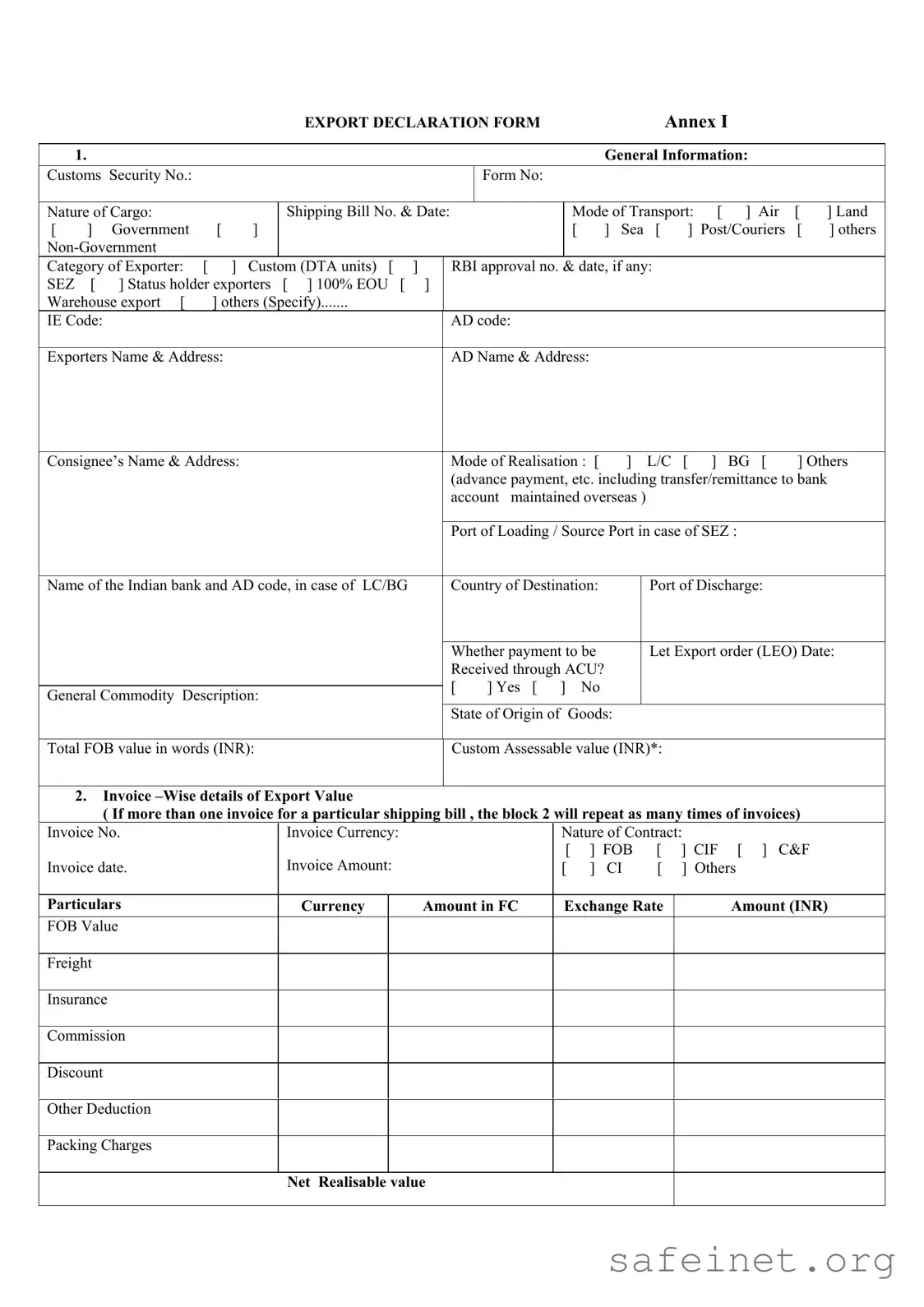
The Export Declaration Form serves as a crucial document in the international trade process, ensuring that all necessary information about exported goods is accurately captured and reported. This form includes several key sections that collectively provide a comprehensive overview of the export transaction. General information such as the Customs Security Number, Form Number, and details about the nature of the cargo are foundational elements. Additionally, it captures the shipping bill number and date, as well as the mode of transport, which can range from air to sea or land. The form also categorizes the exporter, allowing for distinctions between different types of exporters, such as those operating under the Special Economic Zone (SEZ) or those with 100% Export Oriented Units (EOU). Importantly, it requires the Exporter’s and Consignee’s names and addresses, alongside the mode of payment realization, which may include options like Letters of Credit or advance payments. The form further outlines details about the country of destination and port of discharge, which are essential for customs clearance. In addition to these specifics, the form includes a declaration section where the exporter affirms the accuracy of the provided information and commits to complying with foreign exchange regulations. This ensures that all parties involved in the export process are aligned and that the transaction adheres to legal and financial standards. Understanding the intricacies of the Export Declaration Form is vital for exporters, as it not only facilitates the smooth movement of goods across borders but also ensures compliance with regulatory requirements.

| Fact Name | Description |
|---|---|
| Purpose of the Form | The Export Declaration Form is used to declare the details of goods being exported from the country. It helps in customs clearance and ensures compliance with regulations. |
| Governing Laws | This form is governed by the Foreign Exchange Management Act (FEMA) of 1999 and customs regulations. Specific state laws may also apply based on the export location. |
| Required Information | Exporters must provide details such as the nature of cargo, shipping bill number, mode of transport, and the value of goods. Accurate information is crucial for smooth processing. |
| Categories of Exporters | Exporters can be categorized as Custom, SEZ, status holder exporters, 100% EOU, or warehouse exporters. Each category may have different requirements. |
| Invoice Details | If there are multiple invoices for a single shipping bill, the form must repeat the invoice details for each one. This ensures clarity in financial transactions. |
| Declaration Requirement | Exporters must declare that they are the sellers of the goods and that the information provided is accurate. This declaration is essential for legal compliance. |
| Signature of Authorized Dealer | The form requires the stamp and signature of an authorized dealer, confirming that all details are verified and in accordance with regulations. |
Completing the Export Declaration form is essential for ensuring that your export transaction is properly documented. Following these steps will help you fill out the form accurately and efficiently.
After completing the form, review all entries for accuracy. Ensure that all required signatures are in place before submission to the relevant authorities. This step is crucial for compliance with export regulations.
What is the purpose of the Export Declaration Form?
The Export Declaration Form is a crucial document required for exporting goods from the United States. It serves multiple purposes, including providing customs authorities with essential information about the cargo, ensuring compliance with export regulations, and facilitating the collection of export duties and taxes. This form helps in tracking the movement of goods and ensures that exporters adhere to the laws governing international trade.
What information is required to complete the Export Declaration Form?
To complete the Export Declaration Form, several key pieces of information are necessary. This includes the Customs Security Number, the nature of cargo, shipping bill number and date, mode of transport, and details about the exporter and consignee. Additionally, you will need to provide the invoice details, including invoice number, currency, and total FOB value. Accurate and complete information is vital to avoid delays in the export process.
How do I determine the mode of transport for my export?
The mode of transport refers to how the goods will be shipped to the destination country. You can choose from several options, including air, land, sea, or post/couriers. Consider the nature of your cargo, the urgency of delivery, and cost factors when selecting the mode of transport. Each option has its own advantages and disadvantages, so it’s important to assess which method best suits your needs.
What is the significance of the Let Export Order (LEO) date?
The Let Export Order (LEO) date is a critical component of the export process. It indicates when customs authorities have officially allowed the export of goods. This date is essential for compliance with regulations, as it marks the beginning of the timeline for the realization of payment. Ensuring that the LEO date is accurately recorded can help prevent issues with customs and facilitate smoother transactions.
What should I do if I make an error on the Export Declaration Form?
If an error is discovered on the Export Declaration Form, it is important to address it promptly. Depending on the nature of the mistake, you may need to amend the form and resubmit it to customs authorities. In some cases, a simple correction may be sufficient, while other situations might require a more formal amendment process. Always keep a record of any changes made for your documentation.
Incorrect or Missing Customs Security Number: Failing to provide the correct Customs Security Number can lead to delays. This number is crucial for tracking and processing your export.
Inaccurate Nature of Cargo: Misstating the type of cargo can result in compliance issues. Ensure that you accurately describe the goods being exported.
Omitting Exporter and Consignee Details: Leaving out the names and addresses of both the exporter and consignee can cause confusion. Complete and accurate information is essential.
Incorrect Invoice Details: If you have multiple invoices, it’s easy to mix them up. Each invoice should be clearly listed with the correct corresponding details.
Failure to Specify Mode of Realisation: Not indicating how payment will be received can complicate the transaction. Be sure to select the appropriate option, such as L/C or BG.
Neglecting to Include Total FOB Value: Forgetting to write the total Free on Board (FOB) value in words can lead to misunderstandings. Always include this information to avoid confusion.
Incorrect Port of Loading: Listing the wrong port can delay shipments. Double-check that the port of loading is accurate and matches shipping documents.
Not Signing the Declaration: Failing to sign the declaration can render the form invalid. Ensure that the exporter’s signature is included to confirm the information is correct.
Ignoring the Caution List: If you are on the Reserve Bank of India’s Caution List, it’s important to disclose this. Not doing so can lead to severe penalties.
Not Keeping Copies of the Form: Failing to retain a copy of the completed form can be a mistake. Always keep records for your own reference and for compliance purposes.
The Export Declaration form is a crucial document in international trade, ensuring compliance with customs regulations. However, it is often accompanied by several other forms and documents that facilitate the export process. Below are four commonly used documents that work in conjunction with the Export Declaration form.
Understanding these documents is essential for smooth export operations. They work together to ensure compliance with legal requirements and facilitate the successful movement of goods across borders.
The Export Declaration Form shares similarities with the Commercial Invoice, which serves as a critical document in international trade. Like the Export Declaration Form, the Commercial Invoice details the nature of the goods being shipped, their value, and the parties involved in the transaction. It also includes information about payment terms, which is essential for customs clearance. This document not only facilitates the export process but also acts as a legal record for both the buyer and seller, ensuring that all parties are aware of the terms of the sale.
Another document akin to the Export Declaration Form is the Bill of Lading. This document is issued by a carrier and serves as a receipt for the goods being transported. It outlines the details of the shipment, including the type of cargo, destination, and consignee information, much like the Export Declaration Form. The Bill of Lading also provides proof of ownership and can be used to claim the goods upon arrival at the destination port, making it a vital component of the shipping process.
The Air Waybill (AWB) is similar to the Export Declaration Form but specifically used for air freight. It serves as a contract between the shipper and the airline, detailing the shipment's contents, weight, and destination. Like the Export Declaration Form, the AWB contains essential information that facilitates customs clearance and ensures that the goods are delivered to the correct party. It also acts as a receipt, confirming that the airline has received the goods for transport.
The Certificate of Origin is another important document that shares characteristics with the Export Declaration Form. This document certifies the country in which the goods were manufactured and is often required by customs authorities to determine tariffs and duties. Both documents provide crucial information that helps streamline the export process and ensure compliance with international trade regulations.
Similar to the Export Declaration Form is the Packing List, which details the contents of each package being shipped. This document outlines the quantity, description, and weight of the items, providing a clear overview of what is being exported. Like the Export Declaration Form, the Packing List is essential for customs clearance and helps prevent disputes between the exporter and importer regarding the shipment's contents.
The Proforma Invoice also bears resemblance to the Export Declaration Form. This preliminary invoice is issued before the actual sale takes place and provides potential buyers with an estimate of the costs involved. It includes details such as product descriptions, quantities, and pricing, which are similar to the information found in the Export Declaration Form. While it is not a legal document like the Commercial Invoice, it serves as a useful tool for exporters to communicate pricing and terms to prospective buyers.
Finally, the Import Declaration Form is a counterpart to the Export Declaration Form, used by importers to declare goods coming into a country. It contains similar information, including the nature of the goods, their value, and the parties involved. Both forms are crucial for customs authorities to assess duties and ensure compliance with regulations. By providing detailed information about the shipment, these forms help facilitate smooth trade operations across borders.
When filling out the Export Declaration form, it’s essential to be accurate and thorough. Here’s a list of things to do and avoid during the process:
By following these guidelines, you can help ensure a smoother export process and avoid potential issues with customs authorities.
Misconceptions about the Export Declaration form can lead to confusion and mistakes in the export process. Here are four common misconceptions explained:
Filling out the Export Declaration form is a crucial step in the export process. Here are some key takeaways to keep in mind:
By keeping these points in mind, you can navigate the export declaration process with confidence and ease.