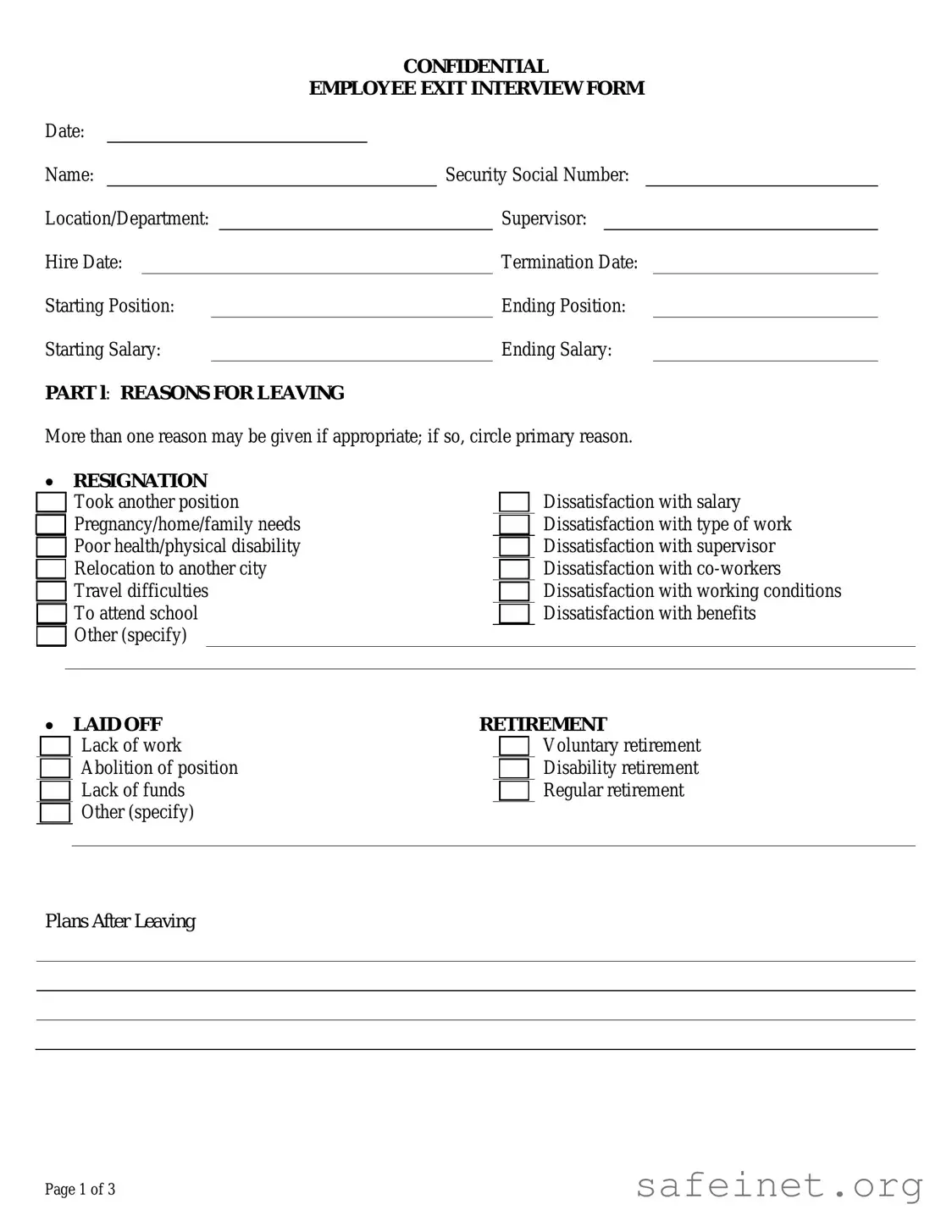
When an employee decides to leave a company, the exit interview form plays a crucial role in capturing valuable insights that can benefit both the organization and future employees. This form typically includes sections that allow departing employees to share their reasons for leaving, which can range from personal circumstances to workplace culture issues. Additionally, it often prompts feedback on management practices, job satisfaction, and opportunities for growth within the company. By addressing these areas, the exit interview form not only helps employers identify potential areas for improvement but also provides a platform for employees to voice their experiences. Ultimately, the information gathered can lead to better retention strategies and a more positive work environment for current and future staff members.


| Fact Name | Description |
|---|---|
| Purpose | The Exit Interview form is used to gather feedback from employees who are leaving the organization. |
| Confidentiality | Responses are typically kept confidential to encourage honest feedback. |
| Format | Forms can be provided in paper or digital format, depending on company preference. |
| Timing | It is usually completed on the employee's last day or during their notice period. |
| Content | Questions often cover job satisfaction, reasons for leaving, and suggestions for improvement. |
| State-Specific Forms | Some states may have specific guidelines for exit interviews, such as California's Labor Code Section 970. |
| Legal Compliance | Employers must ensure that the form complies with relevant labor laws and regulations. |
| Impact on Future Employment | Feedback provided may influence company policies and practices, affecting future employee experiences. |
| Follow-Up | Employers may choose to follow up on feedback received to implement changes or address concerns. |
After completing the Exit Interview form, your responses will be reviewed by the HR department. They will use this information to understand your experiences and improve the workplace for current and future employees.
What is the purpose of the Exit Interview form?
The Exit Interview form serves as a tool for organizations to gather valuable feedback from employees who are leaving the company. This feedback can provide insights into the workplace environment, management practices, and overall employee satisfaction. By understanding the reasons behind an employee's departure, organizations can identify areas for improvement, enhance retention strategies, and foster a more positive workplace culture. The information collected is often used to inform future hiring practices and employee engagement initiatives.
Who should complete the Exit Interview form?
Typically, the Exit Interview form is completed by employees who are resigning or being terminated from their positions. It is important for the departing employee to provide honest and constructive feedback to ensure that the organization can learn from their experiences. While it is primarily the responsibility of the departing employee to fill out the form, management or HR personnel may also facilitate the process by guiding the discussion or providing additional context when necessary.
How is the information from the Exit Interview form used?
The information collected from the Exit Interview form is analyzed by human resources and management teams to identify trends and patterns in employee departures. This analysis can lead to actionable insights that help improve workplace policies, enhance employee satisfaction, and address any underlying issues that may contribute to turnover. The feedback is typically aggregated and anonymized to protect individual privacy, ensuring that the focus remains on organizational improvement rather than on personal grievances.
Is participation in the Exit Interview process mandatory?
Participation in the Exit Interview process is generally encouraged but not mandatory. Employees have the right to choose whether or not to complete the Exit Interview form. However, engaging in this process can be beneficial for both the employee and the organization. It provides an opportunity for the departing employee to share their thoughts and experiences, while also allowing the organization to gain insights that could lead to positive changes. Employees should feel empowered to express their opinions, but they should also be aware that their feedback can contribute to the overall improvement of the workplace for future employees.
Failing to provide accurate contact information. This can lead to missed opportunities for follow-up or clarification.
Not being honest about reasons for leaving. Providing vague or misleading information can hinder the organization's ability to improve.
Leaving sections blank. Omitting responses can result in an incomplete picture of the employee's experience.
Using inappropriate language or tone. Maintaining professionalism is crucial, even when expressing dissatisfaction.
Neglecting to provide constructive feedback. Comments that are solely negative without suggestions for improvement are less helpful.
Not reviewing the form before submission. Errors or unclear statements can be avoided by taking the time to proofread.
Forgetting to mention positive experiences. Highlighting what worked well can provide a balanced perspective for the organization.
When an employee leaves a company, several documents often accompany the Exit Interview form. These forms help ensure a smooth transition and provide valuable insights for both the employee and the employer. Below are some commonly used documents.
These documents play a crucial role in the exit process. They help clarify expectations, protect interests, and ensure that both the employee and employer are on the same page as the transition occurs.
The Exit Interview form shares similarities with the Employee Satisfaction Survey. Both documents aim to gather feedback from employees about their experiences within the organization. While the Exit Interview focuses on reasons for departure, the Employee Satisfaction Survey seeks to understand ongoing job satisfaction and areas for improvement. Both forms typically include questions about management, workplace culture, and job responsibilities, allowing organizations to identify patterns and make informed changes to enhance employee retention.
Another document akin to the Exit Interview form is the Stay Interview. This tool is designed to engage current employees in discussions about their job satisfaction and reasons for staying with the company. Like the Exit Interview, the Stay Interview seeks to uncover insights about the work environment, management practices, and employee needs. However, while the Exit Interview looks backward at reasons for leaving, the Stay Interview focuses on the present and future, aiming to strengthen employee engagement and retention strategies.
The Performance Review also bears resemblance to the Exit Interview form. Both documents involve a structured format for providing feedback, though their purposes differ. The Performance Review assesses an employee’s work performance and contributions, while the Exit Interview seeks to understand an employee's motivations for leaving. Despite these differences, both forms include open-ended questions that allow for detailed responses, enabling organizations to gain insights into employee experiences and areas for improvement.
Similar to the Exit Interview is the Onboarding Survey, which is conducted with new hires to assess their initial experiences within the organization. While the Exit Interview examines the reasons behind an employee’s departure, the Onboarding Survey focuses on the factors that contribute to a positive start. Both documents gather feedback on aspects such as training, support, and company culture, helping organizations to enhance their processes for both incoming and outgoing employees.
The Grievance Form also shares characteristics with the Exit Interview. Both documents provide a platform for employees to express concerns and experiences related to their employment. The Exit Interview often reveals underlying issues that may have contributed to an employee’s decision to leave, while the Grievance Form allows current employees to formally report problems. Both forms encourage open communication and can lead to organizational improvements when properly analyzed.
Finally, the Employee Engagement Survey resembles the Exit Interview form in its goal of understanding employee sentiments. While the Exit Interview focuses on those who are leaving, the Employee Engagement Survey targets the broader workforce to gauge overall morale and satisfaction. Both documents use similar question formats to explore themes like job fulfillment, management effectiveness, and workplace culture, providing valuable insights that can inform retention strategies and enhance the employee experience.
When filling out an Exit Interview form, it's important to approach the process thoughtfully. Here are six things you should and shouldn't do:
By following these guidelines, you can ensure that your Exit Interview feedback is both valuable and constructive.
Exit interviews are an important part of the employee departure process, yet several misconceptions can cloud their purpose and effectiveness. Below are some common misunderstandings about exit interview forms:
Understanding these misconceptions can help create a more effective exit interview process, benefiting both the organization and its departing employees.
Filling out and using the Exit Interview form is an important process that can provide valuable insights for both the departing employee and the organization. Here are some key takeaways to keep in mind:
By keeping these points in mind, the Exit Interview process can become a meaningful exchange that benefits everyone involved.