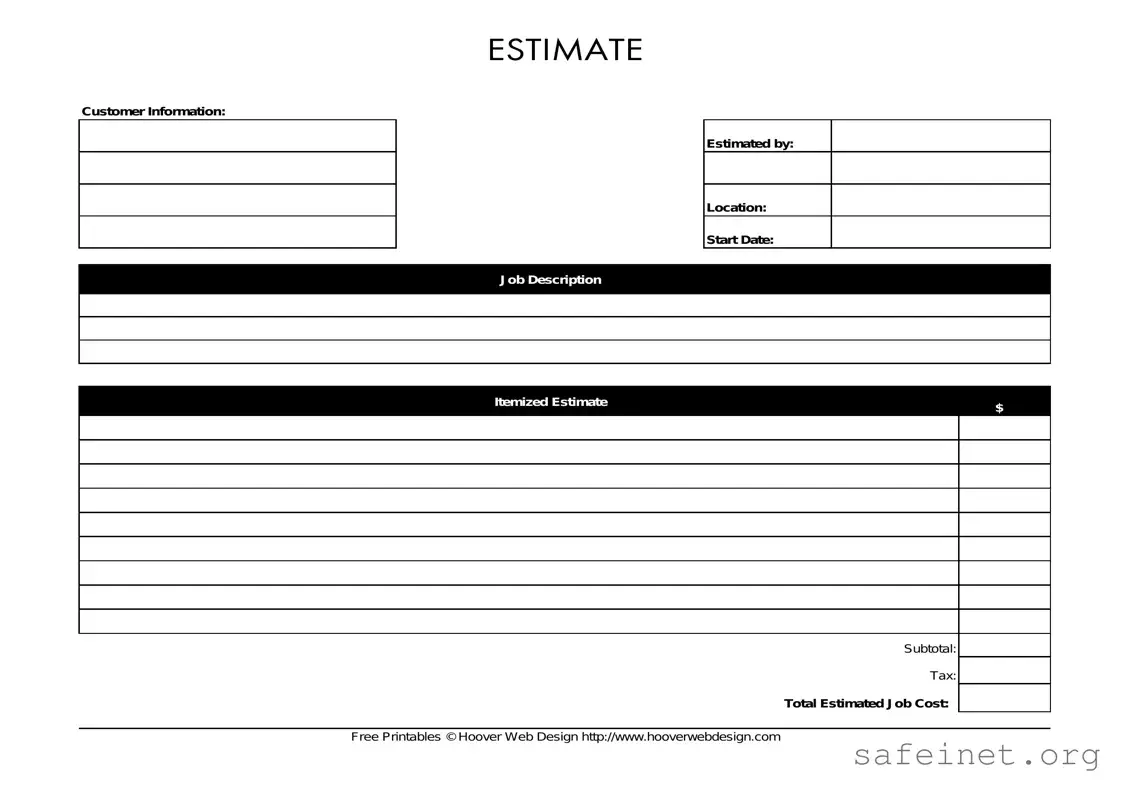
The Estimate form plays a crucial role in various industries, serving as a foundational tool for both service providers and clients. It outlines the projected costs associated with a project or service, ensuring transparency and clarity from the outset. By detailing the scope of work, materials needed, and labor costs, this form helps prevent misunderstandings and disputes down the line. Additionally, it can include terms and conditions, payment schedules, and expiration dates, making it a comprehensive document for all parties involved. Whether you are a contractor bidding on a job or a customer seeking a clear understanding of expenses, the Estimate form is essential for facilitating smooth transactions and fostering trust between clients and service providers.
| Fact Name | Description | Governing Law |
|---|---|---|
| Purpose | The Estimate form is used to provide a detailed projection of costs for services or projects. | Varies by state |
| Required Information | It typically requires information such as project scope, itemized costs, and timelines. | Varies by state |
| Signature Requirement | Many states require a signature from the client to acknowledge the estimate. | Varies by state |
| Validity Period | Estimates often have a validity period, after which they may need to be updated. | Varies by state |
| Legal Implications | Estimates can serve as a basis for contracts, but may not be legally binding unless specified. | Varies by state |
After gathering all necessary information, you are ready to fill out the Estimate form. Completing this form accurately will help ensure that your request is processed smoothly and efficiently. Follow the steps below to provide the required details.
What is the purpose of the Estimate form?
The Estimate form is designed to provide individuals and businesses with an approximate cost for services or products. By filling out this form, you can receive a tailored estimate based on your specific needs and requirements. This helps in budgeting and planning for future expenses.
How do I fill out the Estimate form?
To fill out the Estimate form, begin by providing your contact information, including your name, email address, and phone number. Next, detail the services or products you are interested in. Be as specific as possible to ensure an accurate estimate. Finally, submit the form, and you will receive a response within a specified timeframe.
Is there a fee for using the Estimate form?
No, there is no fee associated with submitting the Estimate form. It is a complimentary service intended to assist you in understanding potential costs. This allows you to make informed decisions without any financial commitment upfront.
How long does it take to receive an estimate?
The time it takes to receive an estimate can vary depending on the complexity of your request and the volume of submissions. Typically, you can expect a response within a few business days. If your request is urgent, consider indicating that in the form.
Can I make changes to my request after submitting the form?
Yes, if you need to make changes to your request after submitting the Estimate form, you can contact the provided support email or phone number. It is advisable to provide your original submission details to ensure clarity and efficiency in processing your updates.
What should I do if I do not receive a response?
If you do not receive a response within the expected timeframe, please check your spam or junk email folder. If you still cannot find a response, reach out to customer support for assistance. Providing your contact details and the date of submission will help them address your inquiry more effectively.
Is my information kept confidential?
Yes, your information is treated with the utmost confidentiality. The details you provide in the Estimate form will only be used for the purpose of generating your estimate. Your personal information will not be shared with third parties without your consent.
When filling out an Estimate form, individuals may encounter various challenges. Below is a list of common mistakes that can lead to inaccuracies or delays in processing.
Many people fail to provide all required details. Missing information can hinder the evaluation process.
Providing outdated or incorrect contact details can result in communication issues. Ensure that all phone numbers and email addresses are current.
Some individuals overlook the guidelines for filling out the form. This can lead to errors in the information provided.
Failing to double-check the completed form can result in overlooked mistakes. A thorough review helps catch errors before submission.
Some people forget to include required documents or supporting materials. This can delay the processing of the estimate.
By being aware of these common mistakes, individuals can improve their chances of successfully completing the Estimate form. Taking the time to review and ensure accuracy can lead to a smoother process.
The Estimate form is a crucial document in various transactions, particularly in construction, repairs, and service agreements. It provides a detailed projection of costs associated with a project or service. Along with the Estimate form, several other documents may be required to ensure clarity and legality in the process. Below is a list of commonly used forms and documents that complement the Estimate form.
Each of these documents plays a vital role in the overall process, ensuring that both parties have a clear understanding of their rights and responsibilities. Having these forms organized and readily available can facilitate smoother transactions and minimize disputes.
The Estimate form is similar to a Proposal document in that both serve to outline the scope of work and the associated costs for a project. Proposals typically go a step further by providing a detailed explanation of the services offered, timelines, and sometimes even qualifications of the service provider. While an Estimate focuses primarily on cost, a Proposal aims to persuade the client to choose a particular service provider by showcasing their expertise and the value they bring to the project.
An Invoice is another document that shares similarities with the Estimate form. Both documents include financial information, but they serve different purposes. An Estimate provides a cost prediction before work begins, while an Invoice is issued after services have been rendered, requesting payment for the completed work. The Invoice will reflect the actual costs incurred, which may differ from the initial Estimate due to changes in scope or unforeseen expenses.
A Contract shares similarities with the Estimate form in that both outline the terms of a project. However, a Contract is a legally binding document that includes detailed obligations and rights of both parties, while an Estimate serves as a preliminary cost assessment. The Estimate can be incorporated into the Contract as a schedule or attachment, establishing a clear understanding of the financial expectations before formalizing the agreement.
The Purchase Order (PO) is another document that resembles the Estimate form. Both are used to initiate a transaction, but a Purchase Order is typically issued by a buyer to confirm the purchase of goods or services at specified prices. While an Estimate provides a cost prediction, a Purchase Order serves as a formal agreement to purchase those services, often following the acceptance of the Estimate. This ensures that both parties are aligned on the financial terms before the work commences.
Finally, a Quotation is closely related to the Estimate form. Both documents provide an anticipated cost for services, but a Quotation is often more formal and may include specific terms and conditions. Quotations are usually valid for a limited time, encouraging the client to make a decision quickly. Like an Estimate, a Quotation aims to give clients a clear idea of what to expect financially, but it may carry more weight in terms of commitment if accepted by the client.
When filling out the Estimate form, attention to detail is crucial. Here are some guidelines to help ensure your submission is accurate and effective.
Following these dos and don'ts can help streamline the process and ensure a smoother experience with your Estimate form submission.
Understanding the Estimate form is crucial for accurate project planning and budgeting. However, several misconceptions can lead to confusion. Here are six common misunderstandings:
This is not true. Estimate forms can be beneficial for projects of any size. They help ensure that all costs are accounted for, regardless of the project's scale.
Estimates are not set in stone. They are based on available information at the time and can be adjusted as project details become clearer or as circumstances change.
While it may seem simple, filling out an Estimate form requires a good understanding of the project. It is best completed by someone familiar with the specifics of the work involved.
Different industries may have unique requirements for their Estimate forms. It is important to use a form that is tailored to the specific industry and project type.
Estimates should include all costs, not just materials. Labor, overhead, and any other expenses should also be factored into the estimate for accuracy.
This is a misconception. An Estimate form provides a projection of costs but does not create a binding agreement. A contract must be established separately to confirm terms and obligations.
When it comes to filling out and using the Estimate form, there are several important points to keep in mind. Here are five key takeaways:
These takeaways will help you navigate the Estimate form with confidence and clarity.