The Employment Verification form plays a crucial role in the hiring process, serving as a key document that employers use to confirm a candidate's work history and qualifications. This form typically requests essential information such as the employee's previous job titles, dates of employment, and the nature of their duties. Additionally, it may include sections for the employer to provide insights into the employee's performance and conduct while employed. By filling out this form, previous employers help prospective employers assess the reliability and suitability of candidates for a new position. The process not only safeguards the hiring organization but also ensures that candidates are accurately represented in their job applications. Understanding the components and significance of the Employment Verification form can help both job seekers and employers navigate this essential aspect of the employment landscape more effectively.
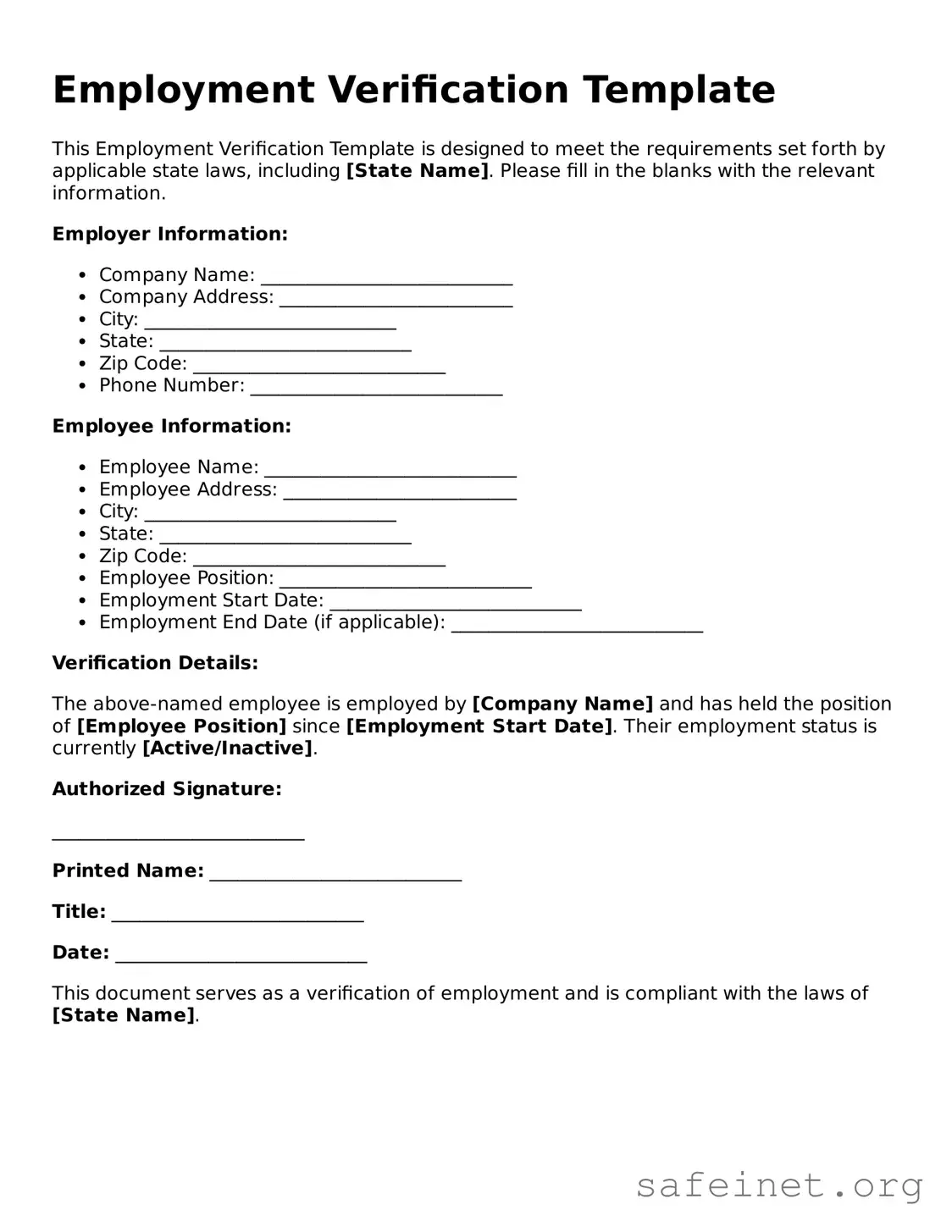
Employment Verification Template
This Employment Verification Template is designed to meet the requirements set forth by applicable state laws, including [State Name]. Please fill in the blanks with the relevant information.
Employer Information:
Employee Information:
Verification Details:
The above-named employee is employed by [Company Name] and has held the position of [Employee Position] since [Employment Start Date]. Their employment status is currently [Active/Inactive].
Authorized Signature:
___________________________
Printed Name: ___________________________
Title: ___________________________
Date: ___________________________
This document serves as a verification of employment and is compliant with the laws of [State Name].
| Fact Name | Description |
|---|---|
| Purpose | The Employment Verification form is used to confirm an employee's work history and status. |
| Common Use | Employers often request this form during background checks or loan applications. |
| Information Required | Typically includes employee's name, job title, dates of employment, and salary information. |
| Employee Consent | Employees must usually provide consent before their information can be verified. |
| State-Specific Forms | Some states have specific forms or requirements for employment verification. |
| Governing Law (California) | In California, the Fair Employment and Housing Act governs the use of employment verification. |
| Governing Law (Texas) | Texas law requires employers to comply with the Texas Workforce Commission regulations. |
| Confidentiality | Employers must handle the information in accordance with privacy laws to protect employee data. |
| Verification Process | Employers may contact previous employers directly or use third-party services for verification. |
Completing the Employment Verification form is a straightforward process. Once filled out, this form will help facilitate the verification of employment details, which may be necessary for various purposes such as loan applications or background checks. Follow these steps carefully to ensure accuracy and completeness.
After completing these steps, review the form for any errors or missing information. Ensure that all details are accurate before submitting it to the relevant party for processing.
What is an Employment Verification form?
An Employment Verification form is a document used to confirm an individual's employment status, job title, and the duration of their employment with a particular company. Employers often use this form when a current or former employee is applying for a loan, renting an apartment, or seeking new employment. The form provides third parties with reliable information about the employee's work history.
Who typically completes the Employment Verification form?
Why is an Employment Verification form important?
This form plays a crucial role in the hiring process and other financial transactions. It helps potential employers or lenders verify that the information provided by the employee is accurate. By confirming employment details, it reduces the risk of fraud and ensures that the applicant meets the necessary qualifications for the job or loan they are seeking.
How can I request an Employment Verification form?
To request an Employment Verification form, employees should reach out to their employer's human resources department. It is often helpful to provide a brief explanation of why the form is needed and any deadlines that must be met. Some employers may have a standard process for handling these requests, so it’s important to follow their guidelines.
What should I do if my Employment Verification form contains errors?
If you notice any inaccuracies on your Employment Verification form, it is important to address them promptly. Contact your employer's human resources department as soon as possible to discuss the discrepancies. They can review the information and make any necessary corrections. Accurate employment records are essential for your professional reputation and future opportunities.
Inaccurate Job Titles: One common mistake is providing an incorrect job title. Job titles should match those used by the employer. If there is a discrepancy, it can lead to confusion and delays in the verification process.
Missing Employment Dates: Failing to include the exact dates of employment is another frequent error. It is essential to specify both the start and end dates clearly. Omitting this information can raise questions about the applicant's work history.
Neglecting to Include Contact Information: Some individuals forget to provide the necessary contact information for the employer. This includes the name, phone number, and email address of the HR representative or supervisor. Without this, the verification process may stall.
Inconsistent Information: Providing information that conflicts with what the employer has on record can create significant issues. Ensure that all details, such as salary and job responsibilities, align with the employer’s records to avoid complications.
When applying for a job, you may encounter various forms and documents that help verify your employment history and qualifications. Understanding these documents can make the process smoother and more efficient.
Being familiar with these documents can enhance your job application experience. Each plays a crucial role in demonstrating your qualifications and readiness for employment.
The I-9 Form is a document used by employers to verify the identity and employment authorization of individuals hired for employment in the United States. Like the Employment Verification form, it requires information about the employee's identity and legal eligibility to work. Both forms aim to prevent unauthorized employment and ensure compliance with federal regulations.
The W-2 Form is another important document that provides information about an employee's annual wages and the taxes withheld from their paycheck. While the Employment Verification form focuses on confirming current employment status, the W-2 reflects the financial relationship between the employer and employee over a specific period. Both documents are essential for tax purposes and employment records.
The Pay Stub serves as a summary of an employee's earnings for a specific pay period. It details gross pay, deductions, and net pay. Similar to the Employment Verification form, it provides evidence of employment and income. Employers often use pay stubs to verify employment when individuals apply for loans or rental agreements.
The Offer Letter outlines the terms of employment, including job title, salary, and start date. This document is similar to the Employment Verification form in that it confirms the individual's employment status. Both documents establish a formal relationship between the employer and the employee, detailing expectations and responsibilities.
The Employment Contract is a legally binding agreement between an employer and employee. It typically includes job responsibilities, compensation, and termination conditions. Like the Employment Verification form, it serves as proof of employment and clarifies the terms under which the employee works. Both documents are crucial for maintaining clear communication between the parties involved.
The Reference Letter, often provided by a previous employer or supervisor, attests to an individual's work history and character. While the Employment Verification form confirms current employment, a reference letter provides insight into past performance and reliability. Both documents are used to validate an individual's professional background during job applications.
The Social Security Administration (SSA) Verification is a process where employers confirm an employee's Social Security number with the SSA. This verification is similar to the Employment Verification form in that it helps ensure that the employee is legally authorized to work. Both processes help prevent identity fraud and maintain accurate employment records.
The Background Check Report is a document that provides information about an individual's criminal history, credit history, and employment history. Employers often use this report to assess potential hires. Like the Employment Verification form, it plays a role in confirming the legitimacy of an individual's work history and suitability for a position.
When filling out the Employment Verification form, attention to detail is crucial. Here are some guidelines to help you navigate the process effectively.
Following these guidelines will help ensure that your Employment Verification form is completed accurately and efficiently.
Employment verification is a common process in the hiring and employment management sector. However, several misconceptions exist regarding the Employment Verification form. Understanding these misconceptions can help clarify the process and alleviate concerns.
This is not true. Employment verification can also be conducted for current employees, especially when they apply for loans, promotions, or new positions within different organizations.
In reality, employment verification can apply to part-time, temporary, and contract workers as well. Any employment relationship may necessitate verification.
Employers are typically limited to sharing factual information such as job title, dates of employment, and salary. Sharing personal opinions or unverified details is generally not permitted.
While it can take some time, many employers have streamlined their processes. Verification can often be completed quickly, especially when using automated systems.
In many cases, employees provide blanket consent when they start their employment. However, specific situations may require additional consent.
Each employer may have their own version of the form, tailored to their specific needs and policies. Variations can exist based on industry standards or company practices.
Filling out and using the Employment Verification form can be straightforward if you keep a few key points in mind. Here are some important takeaways to consider:
By keeping these points in mind, you can effectively navigate the Employment Verification process.