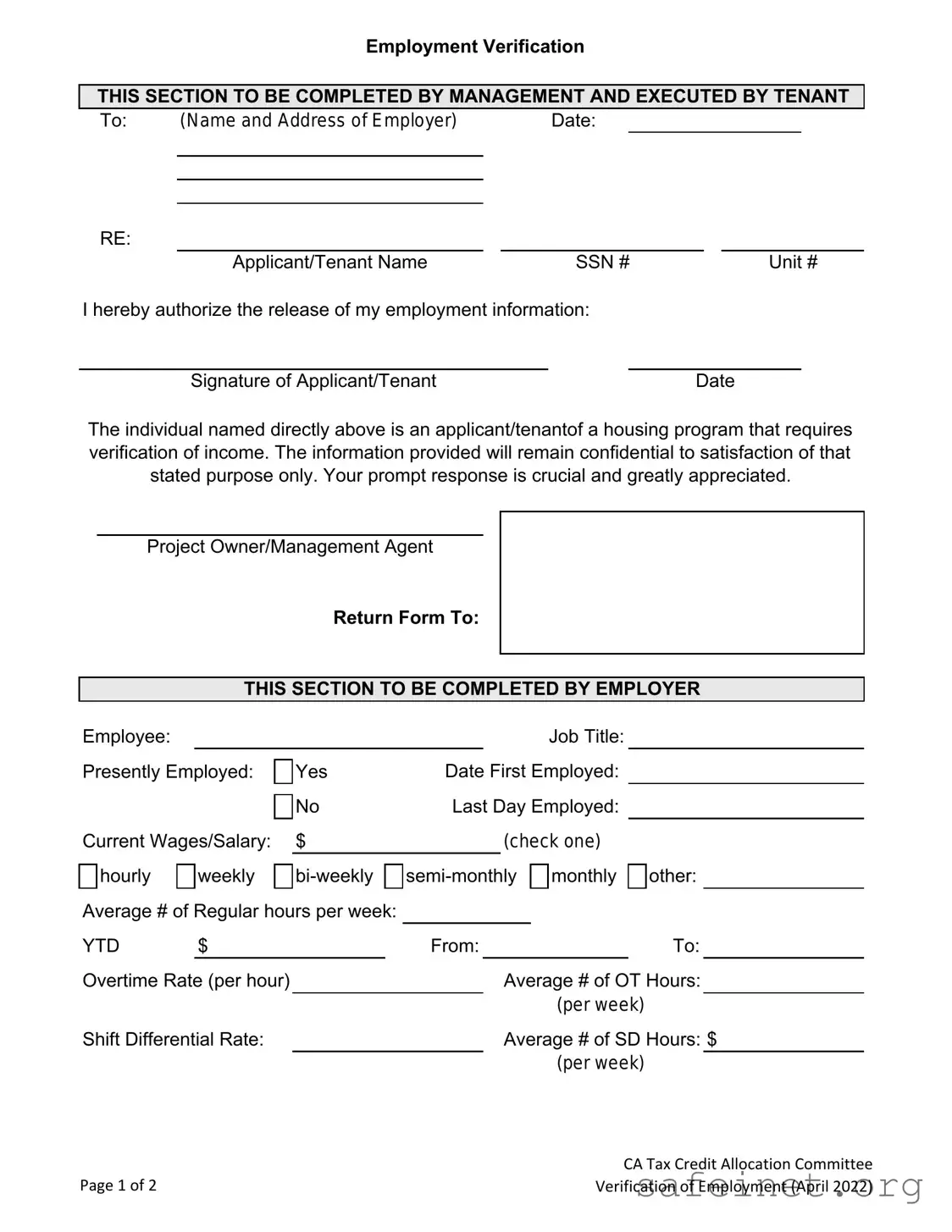
When navigating the complexities of the job market, both employers and employees often encounter the Employment Verification Form, a crucial tool in the hiring process. This form serves multiple purposes, primarily ensuring that a candidate's work history is accurately represented and verified. It typically includes essential information such as the applicant's previous job titles, dates of employment, and the nature of their duties. Employers use this form to confirm that the details provided by a candidate align with their actual work experience, which helps in making informed hiring decisions. Additionally, the form may require the signature of a previous employer or supervisor, granting permission to release information about the candidate's performance and conduct. By streamlining the verification process, this form not only protects employers from potential misrepresentation but also fosters transparency and trust in the employment relationship. In an era where background checks are increasingly common, understanding the Employment Verification Form is vital for both job seekers and hiring managers alike.
| Fact Name | Description |
|---|---|
| Purpose | The Employment Verification Form is used to confirm an individual's employment status and history. |
| Common Uses | Employers often require this form for background checks, loan applications, or rental agreements. |
| Information Required | The form typically requests the employee's name, position, dates of employment, and salary information. |
| Confidentiality | Employers must handle the information with care, ensuring it is only shared with authorized parties. |
| State-Specific Forms | Some states have their own versions of the form, which may include additional requirements based on local laws. |
| Governing Laws | For example, California's employment verification is governed by the California Labor Code. |
| Signature Requirement | Most forms require the employee's signature to authorize the release of their employment information. |
| Retention Period | Employers are generally advised to retain completed forms for a specific period, often three to five years. |
Once you have the Employment Verification Form in front of you, it’s time to fill it out carefully. This form is essential for confirming your employment status, and completing it accurately will help streamline the verification process. Here’s how to proceed.
What is an employment verification form?
An employment verification form is a document used to confirm an individual's employment status, job title, and duration of employment. Employers, landlords, or financial institutions often request this information to assess a person's reliability and stability.
Why do I need to fill out an employment verification form?
You may need to fill out this form to provide proof of your employment when applying for a loan, renting an apartment, or undergoing a background check. It helps third parties verify your income and employment history, which can be crucial for their decision-making process.
Who typically requests an employment verification form?
What information do I need to provide on the form?
How is my information protected when I submit this form?
Can I refuse to fill out an employment verification form?
How long does it take to process an employment verification form?
What should I do if there is an error on my employment verification form?
Failing to provide accurate information: It's crucial to ensure that all details, such as job title, dates of employment, and salary, are correct. Inaccuracies can lead to delays or complications in the verification process.
Not including necessary documentation: Many people overlook the importance of attaching relevant documents, such as pay stubs or tax forms. These documents can substantiate the information provided and help streamline the verification process.
Ignoring instructions: Each employment verification form may have specific instructions. Neglecting these can result in incomplete submissions. Always read the guidelines carefully before filling out the form.
Providing outdated contact information: If the contact details for a previous employer are incorrect or outdated, it can hinder the verification process. Always double-check that the information is current.
Rushing through the form: Taking time to fill out the form thoughtfully can prevent errors. Hasty submissions often lead to mistakes that could have been easily avoided.
Neglecting to sign and date the form: A signature and date are often required for the form to be valid. Omitting these can result in the form being rejected or delayed.
When applying for a job or verifying employment, various forms and documents may be required alongside the Employment Verification Form. Each of these documents serves a specific purpose and helps establish an applicant's qualifications and work history. Below is a list of commonly used forms and documents that may accompany the Employment Verification Form.
Having these documents ready can streamline the employment verification process and enhance the applicant's chances of securing a job. Each document plays a crucial role in presenting a complete picture of the applicant's qualifications and work history.
The W-2 form is similar to the Employment Verification Form in that it provides proof of employment and income. Employers issue W-2 forms to report wages paid to employees and the taxes withheld. This document is often required when applying for loans or renting property, just like the Employment Verification Form, which confirms an individual’s employment status and salary.
The Pay Stub serves as another comparable document. It details an employee's earnings for a specific pay period, including deductions for taxes and benefits. While the Employment Verification Form focuses on confirming employment status, the Pay Stub provides a snapshot of financial compensation, both serving as critical tools for verifying employment and income.
The Job Offer Letter is closely related to the Employment Verification Form. This document outlines the terms of employment, including position, salary, and benefits. When seeking to verify employment, a Job Offer Letter can serve as proof of an individual's job status and compensation, similar to the Employment Verification Form's purpose.
The Reference Letter can also be viewed as a similar document. Often provided by a previous employer or colleague, it confirms an individual's work experience and character. While it does not directly verify employment like the Employment Verification Form, it supports an applicant's claims about their work history and professional capabilities.
The I-9 form is essential for employment verification in the United States. It is used to confirm an employee's identity and eligibility to work. Like the Employment Verification Form, the I-9 helps ensure that employers are compliant with federal regulations regarding employment eligibility.
The Tax Return can serve as a verification document as well. Individuals often submit their tax returns to prove income when applying for loans or other financial services. While it does not specifically confirm employment, it provides a comprehensive view of an individual’s earnings over a year, similar to what the Employment Verification Form aims to establish.
The Offer Acceptance Letter complements the Job Offer Letter. It confirms that the candidate has accepted the position and outlines the agreed-upon terms. This document can be used alongside the Employment Verification Form to substantiate an individual's employment history and job details.
The Employment Contract is another document that shares similarities. It outlines the specific terms of employment, including duties, salary, and duration of employment. This contract can serve as a formal verification of employment status and conditions, akin to the Employment Verification Form.
The Background Check Report can also be relevant. Employers often conduct background checks to verify an applicant's work history and qualifications. This report provides insights into an individual's past employment, reinforcing the information provided in the Employment Verification Form.
Lastly, the Social Security Earnings Statement is a useful document for verifying employment history. It details an individual's earnings as reported to the Social Security Administration over their working years. While it does not confirm current employment, it provides a record of past earnings, which can be beneficial when assessing an applicant's overall work history.
When completing an Employment Verification Form, it is essential to follow certain guidelines to ensure accuracy and efficiency. Below is a list of things you should and shouldn't do:
By adhering to these guidelines, individuals can facilitate a smoother verification process and avoid potential issues.
Employment verification forms are essential tools for both employers and employees. However, several misconceptions surround their use. Let’s clarify these misunderstandings.
Many believe these forms are solely for confirming the employment of new employees. In reality, they can also be used for current employees seeking loans, renting apartments, or applying for government benefits. They serve a broader purpose than just initial hiring.
While many employers do provide this information, they are not legally obligated to complete every request. Employers can choose to decline if they have concerns about privacy or if the request lacks proper authorization.
Different industries and companies may have varying requirements for these forms. Some may request specific details, such as job title or salary, while others might only confirm dates of employment. It's crucial to understand that there is no one-size-fits-all approach.
While it can take time in some cases, many employers have streamlined their processes. With digital tools and resources, verification can often be completed quickly. Factors such as the responsiveness of the previous employer and the complexity of the request can influence the timeline.
When filling out and using the Employment Verification Form, there are several important points to keep in mind. These takeaways can help ensure that the process goes smoothly and that all necessary information is accurately provided.