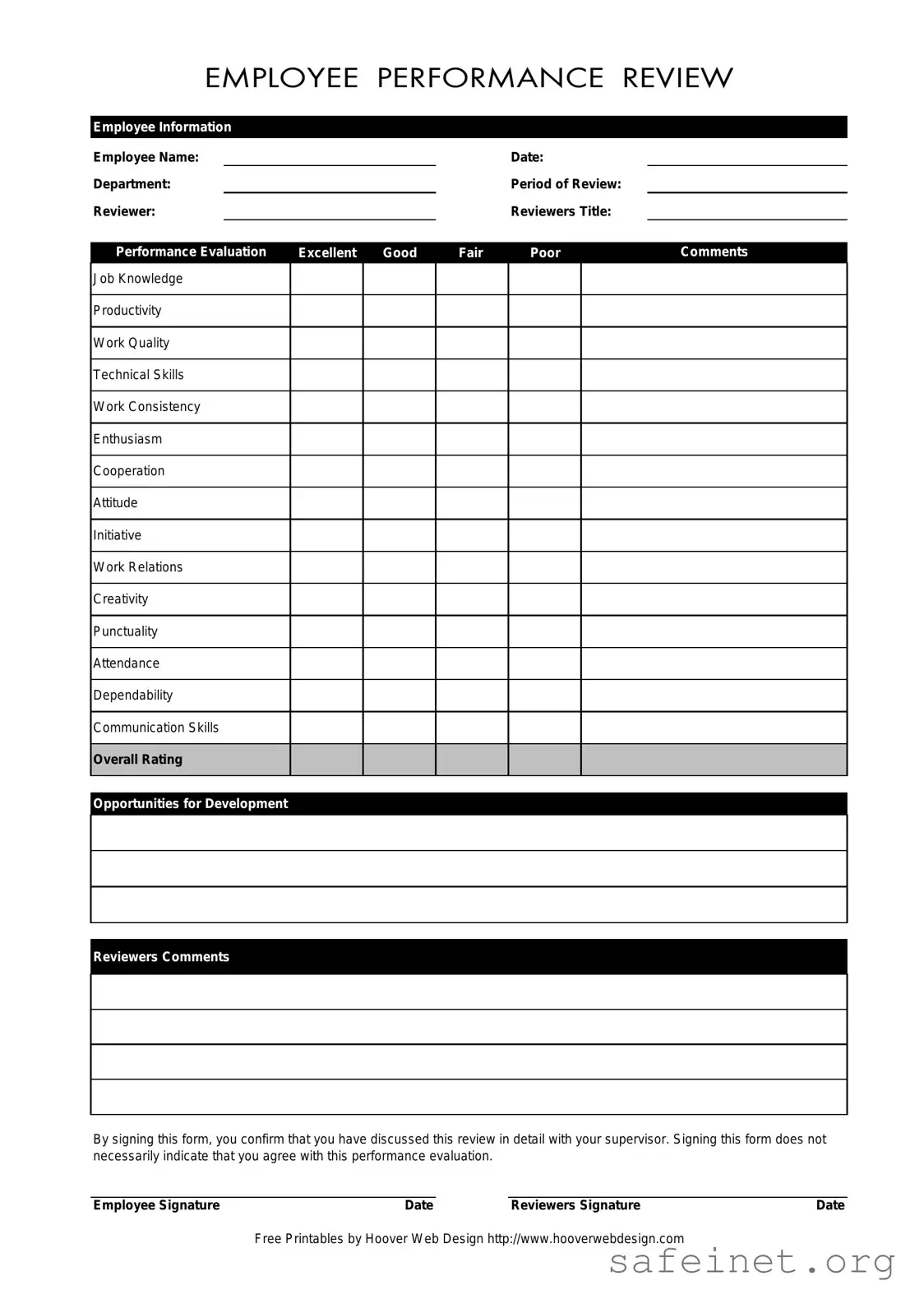
The Employee form serves as a crucial tool in the performance evaluation process, allowing both employees and reviewers to engage in meaningful discussions about job performance. It captures essential information such as the employee's name, department, and the period under review, providing a clear context for the evaluation. This form includes a section for the reviewer’s title and a performance evaluation scale, which ranges from excellent to poor, allowing for a nuanced assessment of various competencies. Key areas such as job knowledge, productivity, work quality, and communication skills are evaluated, ensuring a comprehensive overview of the employee’s strengths and areas for improvement. Additionally, the form invites comments on enthusiasm, cooperation, and creativity, which are vital for fostering a positive workplace culture. The opportunity for development section encourages constructive feedback, while the signature lines affirm that the review has been discussed in detail, though they do not imply agreement with the evaluation. This collaborative approach not only enhances transparency but also promotes professional growth.
| Fact Name | Description |
|---|---|
| Employee Information | This section captures essential details about the employee, including their name, department, and review period. |
| Performance Evaluation Criteria | The evaluation includes various criteria such as job knowledge, productivity, and work quality, allowing for a comprehensive assessment. |
| Rating Scale | Performance is rated on a scale of excellent, good, fair, and poor, providing clarity on the employee's performance level. |
| Opportunities for Development | Reviewers are encouraged to identify areas for improvement, fostering professional growth for the employee. |
| Reviewers Comments | This section allows the reviewer to provide additional feedback, which can be crucial for the employee's understanding of their performance. |
| Signatures | Both the employee and reviewer must sign the form, indicating that the review has been discussed, though not necessarily agreed upon. |
| State-Specific Forms | Some states may require specific employee evaluation forms governed by local labor laws; it is important to check state regulations. |
| Governing Laws | In states like California, the Fair Employment and Housing Act (FEHA) may influence the evaluation process and employee rights. |
| Free Printables | The form is available for download and printing from Hoover Web Design, providing easy access for employers. |
Completing the Employee form is an important step in the performance evaluation process. This form gathers essential information about an employee's performance and provides a structured way for both the employee and the reviewer to share their perspectives. Following the steps below will ensure that the form is filled out accurately and comprehensively.
What information is required on the Employee form?
The Employee form requires several key pieces of information to ensure a comprehensive evaluation. First, the employee's name must be filled out, along with the date of the review. Additionally, the department in which the employee works and the period of review are essential. The reviewer’s name and title should also be included. This information helps to provide context for the performance evaluation and ensures that all parties involved are clearly identified.
How is performance evaluated on the Employee form?
Performance is evaluated using a rating system that includes categories such as job knowledge, productivity, work quality, and technical skills, among others. Each category is rated as excellent, good, fair, or poor. Reviewers are encouraged to provide comments for each area to give more context to the ratings. This qualitative feedback is crucial as it helps employees understand their strengths and areas for improvement, making the evaluation more meaningful.
What does signing the Employee form signify?
By signing the Employee form, the employee confirms that they have discussed the performance review in detail with their supervisor. It is important to note that signing does not necessarily indicate agreement with the evaluation. Instead, it serves as an acknowledgment that the review process has taken place and that the employee has had the opportunity to engage in a dialogue about their performance.
What opportunities for development are mentioned in the Employee form?
The Employee form includes a section for opportunities for development, where reviewers can outline specific areas where the employee can improve or grow. This may include recommendations for training, mentoring, or other resources that can aid in the employee's professional development. By identifying these opportunities, the form aims to foster a constructive approach to performance management, encouraging employees to enhance their skills and advance their careers.
When filling out an Employee form, it’s easy to overlook details. Here are ten common mistakes that people often make:
Being mindful of these common errors can lead to a more accurate and effective performance evaluation process. Taking the time to carefully complete the form benefits both the employee and the reviewer, fostering clearer communication and understanding.
When managing employee records, several forms and documents complement the Employee form. Each of these documents serves a specific purpose in the evaluation and management process. Here’s a brief overview of some commonly used forms.
These documents play a crucial role in the employment lifecycle, ensuring clarity and compliance. By using them effectively, both employers and employees can foster a positive and productive work environment.
The Performance Appraisal form serves a similar purpose to the Employee form by evaluating an employee's performance over a specific period. It typically includes sections for employee information, performance ratings, and comments from both the reviewer and the employee. Like the Employee form, it emphasizes the importance of feedback and dialogue between the employee and supervisor, ensuring that both parties have a clear understanding of performance expectations and areas for improvement.
The Self-Assessment form allows employees to evaluate their own performance, mirroring the Employee form's focus on individual contributions. This document encourages reflection and self-awareness, enabling employees to identify strengths and weaknesses. Just as the Employee form requires signatures, the Self-Assessment often includes a section for the employee to acknowledge their review with their supervisor, fostering open communication about performance and career development.
The Development Plan is another document that aligns closely with the Employee form. It outlines specific goals and objectives for an employee's growth, often informed by the performance evaluation. This plan typically includes timelines and resources needed for development, similar to how the Employee form highlights opportunities for development. Both documents aim to enhance the employee's skills and contributions to the organization.
The Job Description document provides a foundation for the Employee form by outlining the responsibilities and expectations for a specific role. It serves as a reference point during performance evaluations, ensuring that employees are assessed based on their actual job duties. The clarity provided by the Job Description helps both the reviewer and the employee understand the criteria against which performance is being measured.
The Feedback Form is another related document that captures ongoing performance insights throughout the review period. Unlike the structured evaluation of the Employee form, the Feedback Form allows for more informal and frequent comments from peers and supervisors. Both documents contribute to a comprehensive view of an employee’s performance, but the Feedback Form emphasizes continuous improvement and real-time communication.
Finally, the Exit Interview form can be compared to the Employee form in terms of gathering insights about an employee's experience within the organization. While the Employee form focuses on performance during employment, the Exit Interview seeks to understand the reasons behind an employee's departure. Both documents aim to enhance organizational practices, but they do so from different perspectives—one from within and one from the outside looking in.
When filling out the Employee form, it is essential to approach the task with care and attention to detail. Below is a list of recommendations that can help ensure the process is smooth and effective.
By following these guidelines, you can enhance the quality of your performance evaluation and foster a constructive dialogue with your supervisor.
Many people have misunderstandings about the Employee form used for performance evaluations. Here are five common misconceptions:
Understanding these misconceptions can help employees and reviewers approach performance evaluations with a clearer perspective.
When filling out and utilizing the Employee form, it is essential to keep several key points in mind to ensure clarity and effectiveness. Here are some important takeaways:
By adhering to these takeaways, both employees and reviewers can make the most out of the Employee form, leading to meaningful discussions and improved performance outcomes.